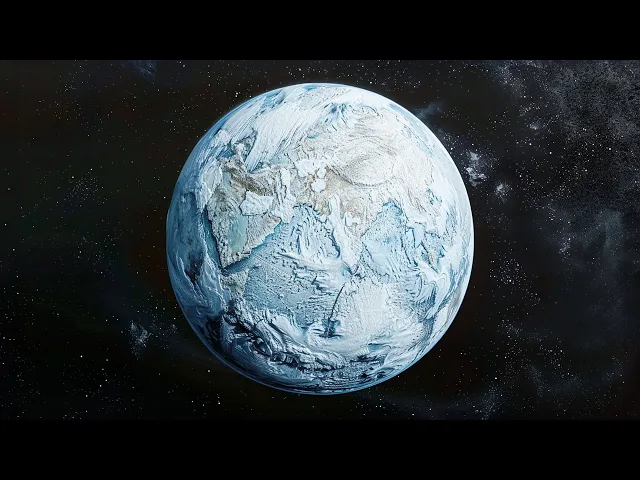
humans animals in fact all life on Earth are only here by chance 99% of all the species that ever lived have been wiped out in a series of catastrophes disasters that changed the course of evolution 650 million years ago the earth froze it pushed life to the verge of Extinction but if this disaster hadn't happened then life today would be little more than microscopic slime this is the story of snowball [Applause] Earth it's almost impossible to comprehend the immense time scale of our planet's lifetime so imagine the whole of Earth's history compressed into a single day at midnight on our clock 4 and 1/2 billion years ago the planet was born minutes later the protoplanet Thea smashed into the infant Earth and our moon was formed at 4:00 a. m. the first primitive life appeared by 8:00 a.
m. the continents were surrounded by shallow Seas full of simple bacteria over the next three billion years bacteria colonized the oceans then at 8:27 p. m.
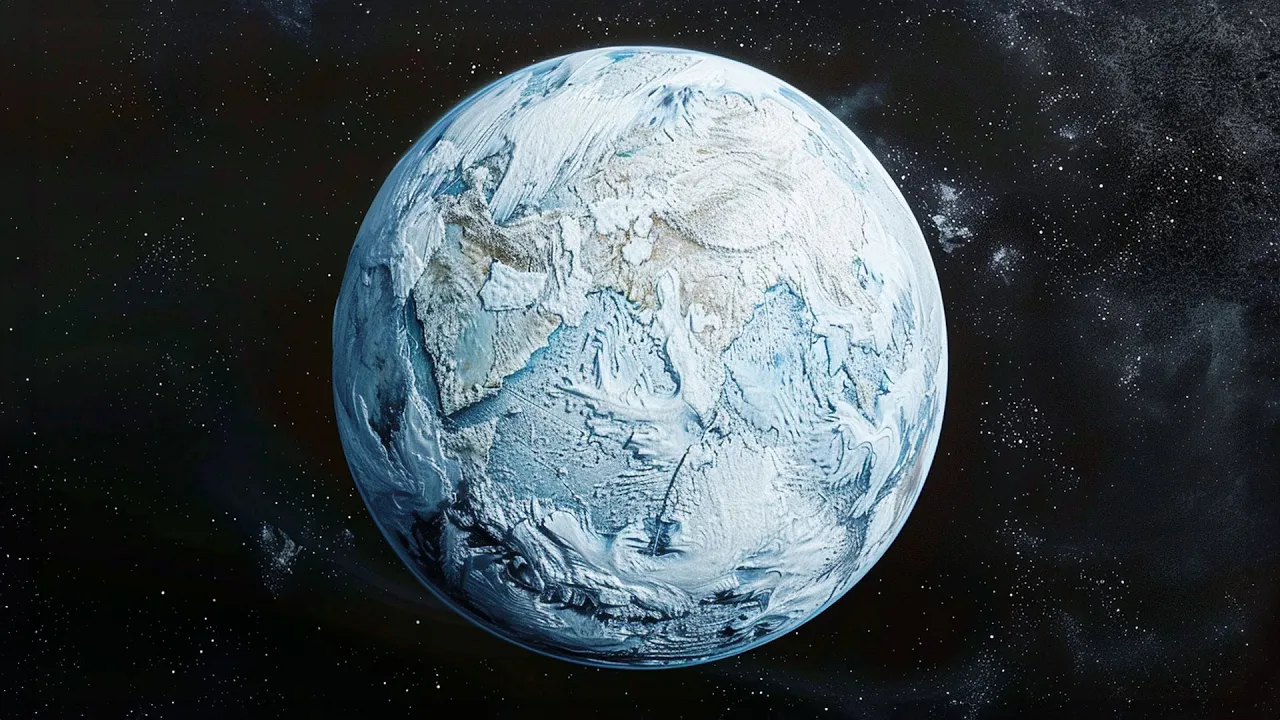
650 million years ago disaster [Music] struck the planet froze temperatures plummeted many degrees below freezing ice spread down from the poles and crept towards the equator eventually the entire planet was locked in a straight jacket of ice a snowball Earth life had only just got started now it seemed doomed Earth remained icebound for 25 million years before it finally thawed some microorganisms did survive and made the biggest evolutionary Leap Forward in the history of the planet the catastrophe almost wiped out life on Earth but instead kickstarted Evolution creating Life as we know it including us how did all of this happened and how on Earth did scientists figure it out there are no traces of the ancient ice sheets left they're long gone but there are still clues that can tell us about this dramatic ancient ice age the evidence is hidden away in some of the world's most remote places these are the fenders ranges in the Australian Outback today it's one of the hottest and driest places on Earth so it's ironic that this is where geologist Jim giling is searching for evidence of the coldest period in [Music] history the area is so vast the best way to investigate is from the air there's a disaster story written in these layers of rock you just have to know how to read it it's really like looking at a a book made of rock every single layer has a secret on it we look at these rocks as though they're a history book The Spot has located an unusual rock formation in a dried up creek [Music] bed it's the evidence giling has been looking for a 650 milliony old rock called A dropstone a dropstone is a an exotic piece of rock they shouldn't be mixed in with mud and sand they should be together in Boulder beds or gravel beds but there they sit the rock may look insignificant but it's a major clue to the powerful forces that created the Frozen world of snowball Earth this rock shouldn't be here it's sitting in a rock composed of mud silt sand and gravel and normally that's impossible the dropstone has been transported here from thousands of miles away there's only one Forest that can carry rocks like this around the globe and that is [Music] [Applause] ice there's not a lot of ice in Australia today so to investigate how ice could have moved rocks around the world in the ancient past glaciologist Shad O'Neal scales the sheer walls of the Matanuska Glacier in Alaska it's the closest we can get to our distant icy past it's much smaller than the ancient glaciers but it still operates in the same way we're taking a look at the rocks that are being transported down the valley by the glacier and to do that we need to go down there Glaciers are nature's bulldozers They smash everything in their path they gouge stones and rocks from high up in the mountains and carry them down the valley rocks as big as buses can be transported for miles across the landscape by by a glacier and the longest Glaciers are hundreds if not thousands of kilometers long so you can move move rocks over long distances when the ice melts it deposits debris at the base of the glacier this Glacier is only a few hundred ft thick but it can still carry thousands of tons of rock the glacier brought all this stuff down from the the mountains and when the glacier melts away it ends up looking like a building site that's been bulldozed it's exactly the same process that transported dropstones to the flenders ranges but there's one important distinction the Matanuska Glacier transports rocks over 24 miles the glaciers of 650 million years ago carried them for many thousands of miles here's a great example of a rock that was picked up by the glacier carried down down Valley and then deposited very similar to what you'd find in in Australia where glaciers used to be in the past the flenders Rangers drop ston show that Australia was once covered in ice but they don't prove that the whole world was frozen over because the continents were not always where they are today the earth's surface is in constant very slow motion and it pushes the continents around the planet so where were they 650 million years ago and where was Australia perhaps it was closer to the South Pole and the dropstones came from Antarctic glaciers the answer to that question comes from another brutal [Music] desert Death Valley in the American southwest geologist Joe kersin coined the term snowball Earth he's been Gathering evidence to prove it actually happened for the past two decades Death Valley has a series of rocks that are extremely important for understanding Earth history it's a treasure [Music] chest like the flenders ranges it's not the kind of place you'd expect to find evidence of ice yet scattered among the sediments of an ancient seabed are more glacial drop Stones every time I come here I see new things there are those big boulders and I see one at the bottom they're all dropstones you can see that they're coming in from the top this is one of the best places in the world to see this type of geology the dropstones kersen has discovered here date back to the same period as those found in the outback 650 million years ago two of the hottest places on the planet today death Valley and the Australian Outback were covered in ice and what's more kersin can tell where these two deserts were at the time of the big freeze the answer is in the Rocks themselves every Rock has a unique magnetic signature that enables scientists to zero in on their point of origin with great accuracy to study this signal kersen drills cores from the Rocks containing the drops stones and measures their magnetic field the Earth's magnetic field is formed by electric currents flowing in the middle of the planet uh the pattern of that field allows us to measure the latitude that a rock forms at once they know the latitude at which a rock formed scientists can figure out where on the planet it came from when a glacier dumped these drops Stones here Death Valley was inside the tropics Rock cores from dropstones in the Australian Outback had an even more stunning tale to tell a group started studying the magnetism in the funders ranges and they thought they had a very stable magnetization that I said well wait a minute something might be relevant there The Rock's magnetic signal revealed that 650 million years ago Australia had been in a completely different place than it is today when the planet was in the grip of the big freeze Australia was near the equator here was the proof the scientists were looking for it it was wonderful it was the first time anywhere that we had proven that the glaciers were on the [Music] equator ice sheets along the Equator Earth's warmest climate zone could mean only one thing if you have ice at the equator then the whole of the globe must have been covered by ice and so you have to envisage a completely white Planet a giant snowball the planet was locked in a deep freeze by the greatest Ice Age in the history of the Earth the entire Earth would have looked like Antarctica looks today even areas as desolate like this in Death Valley with nothing on it would be under several hundred meters of ice what was to become of the single celled organisms trapped beneath the thick crust of snow and ice their future was not a bright one this was the greatest Ice Age that this planet has ever known you have to imagine a planet whose oceans were not only C by ice near the poles but that ice had grown across the entire planet and all but shut down its living systems 650 million years ago the planet was shutting down life on Earth seemed destined for total Extinction somehow something had plunged the the whole planet into a catastrophic deep freeze the question was what 8:27 p. m. on our 24-hour clock representing the history of the earth 650 million years ago the planet faced climate catastrophe a global deep freeze but what made it happen snowball Earth wasn't the first time the planet was frozen and it wouldn't be the last our planet is struck by an Ice Age roughly every 100,000 years ice sheets and Glaciers expand reshaping the landscape but normally stop before reaching the equator 650 million years ago that rule was broken most ice ages are triggered by changes in the planet's orbit around the sun the further the Earth moves away from its star the colder it gets but factors like orbit and rotation aren't enough to explain ice stretching right down to the equator that would have taken something far more dramatic The Smoking Gun turned out to be our atmosphere specifically greenhouse gases like carbon dioxide too much greenhouse gas causes global warming but normal levels of CO2 provide the Earth with a moderate climate a greenhouse gas is any kind of gas which has the capacity to convert the sun's Rays into heat these gases are amazingly effective making this planet the warm planet that it is today but it's a delicate Balancing Act if levels of CO2 grow too high or too low the climate will spiral into [Music] chaos too much and the planet warms too little and it cools carbon dioxide is a very important gas it's both our dilemma and our solution when it's there in too great a proportion that overheats the Earth which of course we worried about today however in the time leading up to snowall Earth we had the opposite problem there wasn't enough carbon dioxide and the Earth began to cool to a point where there was a runaway Refrigeration that locked this Earth up in an icy crust giling believes that a drop in carbon dioxide levels caused the snowball Earth disaster something was removing the CO2 on a huge scale scale and there's only one process capable of doing that weathering it occurs when carbon dioxide mixes with water vapor to form acid rain when acid rain falls on rocks it reacts with minerals locking the CO2 in the water that runs off it then washes down to the Sea where it helps form solid Limestone carbon diox oxide that was once in the atmosphere is now locked in rock on the seaf Flor when weathering occurs at a great rate you strip away rocks with acid rain and that takes carbon dioxide out of the atmosphere and makes sure that it's locked away in the ocean weathering happens more quickly in hot and humid [Music] locations normally at least some of Earth's land masses are too far north or south for weathering to be a major factor but 650 million years ago all the earth's land masses from Death Valley to Australia were clumped together into one big supercontinent at the equator a hot humid Zone with the greatest rainfall on Earth the weathering process went into overdrive CO2 levels crashed and so did the Earth's temperature you have carbon dioxide being taken out and not replaced and as a result the Earth inevitably has to cool normally the Earth's plants and animals balance the levels of carbon dioxide in the atmosphere ensuring it's neither too hot nor too cold but 650 million years ago life on land was yet to evolve in the oceans life was still emerging as simple single celled bacteria in fact the bacteria were actually making the situation worse 650 million years ago this is a world of CA bacteria bacteria that formed a slime layer on the seaf FL C bacteria are tiny organisms that have been around on this planet for 3 billion years before snow Earth but at this time they were particularly important these cyanobacteria sucked even more carbon dioxide from the oceans and locked it into limestone reefs called stromatolites some of this ancient carbon dioxide is still locked up in fossilized reefs like these in Southern Australia when Jim giling pours a weak acid onto them the ancient carbon dioxide that has been locked away for hundreds of millions of years is released what you'll see is an effervescence those white bubbles of carbon dioxide that had been locked up in these trates being released back into the atmosphere rather than stabilizing the carbon dioxide levels the cyan bacteria were depleting them further in combination with weathering they sucked the carbon dioxide out of the atmosphere and temperatures dropped even then the planet might have avoided a total freeze until a catastrophic Chain Reaction pushed it to the point of no return 8:27 and 302s in the evening on our clock of Earth history snowball Earth 650 million years ago and Counting ice was advancing from the poles it happens during all ice ages normally it stops but not this time instead it just kept on marching towards the equator as it did it triggered a chain reaction that pushed the primit of life in the oceans to the edge of [Music] Extinction the earth's surface is made up of land open ocean and Ice these surfaces all reflect sunlight differently and that's the key to what happened [Music] next here in the Arctic geophysicist Don perovich heads for the boundary where the sea ice meets open water it's a point sign SST called the lead Edge and one of the best places to study how the Earth tipped over into the catastrophic deep freeze this is the place where the ice that's frozen to the shore meets the open Arctic Ocean but it's more than that the lead is where there's water the leads where there's light and so the leads where they life we see whales going by and seals and birds flying above it's an incredibly productive area here perovich can compare the reflectivity or albo of two very different surfaces the sea ice and open ocean his sensor measures the amount of sunlight hitting the snow and the amount it reflects back sea ice is the most reflective surface on the planet it reflects 85% of the sunlight that hits it if we were to just go out there just 100 yards away to the lead the alido would be less than 10% and what's interesting about this is this snow covered ice has the largest albo of any naturally occurring surface on earth and the open ocean has the smallest so right here we have a contrast between the best natural reflector and the worst natural reflector Open Sea reflects very little light back into space it absorbs the energy in the sunlight keeping the planet warm scientists believe that 650 million years ago the opposite happened Earth's Best reflector sea ice was replacing its worst reflector sea water when enough ice had formed the in Ocean couldn't absorb enough heat so the Earth cooled so more sea ice built up that reflected more sunlight the Earth got colder and that made still more ice it was the point of no return let's say we grow a little bit more ice so we're replacing the worst reflector with the best reflector we'll cool things off we'll get more ice and we'll cool off more more and it builds upon itself a runaway freezing effect capable of turning the whole planet into an ice ball it's an idea no one even considered until a few decades ago scientists only discovered it was possible when they were studying another kind of disaster [Music] altogether a nuclear war during the Cold War researchers predicted that a nuclear war could push enough smoke and dust into the atmosphere to block out the Sun and initiate a global freeze Russian climate modeler miky Bodo was investigating this scenario when he made a chilling Discovery he calculated that if the ice sheet spread Beyond 30° latitude as far south as New Orleans they would reflect so much of the sun's energy that the Earth would reach an irreversible Tipping Point so when we have a a system like the Earth with these feedbacks one of the things that's talked about a lot is tipping points you can think of it as you're in a boat rocking back and forth not much changes until you go too far and then you're in a new state and but deco's work said that if we move the ice down far enough we' reach a Tipping Point and cover the whole earth with it budo calculated that if the ice ever reached this Tipping Point the planet would no longer absorb enough heat to keep the ice in check the planet would be inomed in ice from pole to pole the theory is that 650 million years ago this was exactly what happened instead of the world we have today would have something that looked like this a vast expanse of white a blocks of ice tilted Every Which Way covered by snow the sheer totality of the snowball Earth disaster is hard to imagine eventually the ice sheets collided clamping their icy jaw shut at the equator it seemed that nothing could survive in this this Frozen Wasteland and yet life managed not only to survive this disaster but Thrive and triggered the greatest evolutionary leap in our history 650 million years ago 828 p.
m. on our clock representing the Earth's history deep beneath the the ice sheets single celled organisms the only life on the planet faced a tough choice adapt or die bacteria that had evolved over 3 billion years now faced Extinction but what would happen to life if snowball Earth repeated itself today could we survive the same conditions as ice sheets spread down from the poles supplies of fresh water would freeze crops and livestock would perish worldwide industry would grind to a halt you could not run a nuclear power plant long enough to get through the snowball many experts believe that Humanity could find ways to live through a short-term Ice Age but the odds of surviving a snowball Earth are next to nothing if humans ever experience a snowball Earth we will quite bluntly be out of control there was no way we could stop it it would be easier to live on the surface of Mars probably than on the surface of Earth during a snowball the thick layer of ice covering the planet would become Humanity Tombstone 650 million years ago the only life facing extinction was single cell bacteria even their survival seemed improbable but here we are life clearly did survive the question is how the quest to learn how ancient organisms kept Evolution alive has brought this lone microbiologist to White out glacier in southern Alaska here Hazel Barton studies how life could survive a global deep freeze her mission is to find Signs of Life in some very dead looking Frozen caves people used to think that caves were devoid of life that there was nothing in there but it turns out they're actually teaming with microorganisms Barton searches for modern-day microbes living in this ice cave to learn how their ancient ancestors survived the mother of all climate disasters millions of years ago if you look on the edge of the cave you can see all the particle dust that's got lodged in the ice and it it creates a surface that the microbes can actually live on this cave runs underneath the glacier inside it's 4° below freezing organism Ms that live in conditions this harsh are rightly called extremophiles Barton takes samples of the microbes buried and freezing Rock sediments at the base of the [Music] glacier I'm looking for some sediments that might contain microbes and have never been exposed to the heat so the thing we remember about these these bugs is that they love the cult and they've actually evolved to live in those cold conditions and because of that if I was to take them outside right now into the heat of the sunlight they die it would be like taking us into the middle of the desert and dropping us off there Barton believes this cave Can Shed light on how microbes adapted to conditions during snowball [Music] Earth the majority of surfaces Exposed on Earth would probably have looked something like this so we're looking at the kind of conditions that organisms that survived that period would have been living on they're not just living on the ice they're living in it too sunlight penetrates a few feet into the ice and that's enough for the microbes to [Music] flourish we're still pretty close to the entrance right here so I think there's definitely a lot of sunlight energy and enough for cob bacteria to grow on and they're probably in the ey ice they're living in the ice right [Music] now the deeper Barton goes into the cave the darker and colder it gets but even here life hangs on this is a community looks like CYO bacteria they're incredibly resistant to all um all kinds of stress that you would put them under they can survive it during snowball Earth the ice was thousands of feet thick Barton finds similar conditions hundreds of feet deeper into the cave here there is hardly any light at all but even in this dim icy World Barton finds microbes thriving so we walk we're looking at are microorganisms that have to adapt and generate energy when there is no sunlight so what they do is they pull energy from the rock itself they're actually chew into the Rock to get that energy outside Barton trains her field microscope on the sample she's collected she believes the ancient microbes had similar structures to the cyan bacteria and were consumate [Music] survivors we're seeing cyanobacteria it's a whole community living in that ice cyanobacteria really are these amazing organisms they're very very adaptive they're one of the most ancient forms of life on our planet they can survive some really extreme conditions cyan bacteria have evolved amazing survival mechanisms if our cells freeze they burst their walls if they dry out they die but cyan bacteria have evolved a cell structure that prevents rupturing in some of the most extreme conditions on Earth they've changed the structure of their DNA so it doesn't get damaged if you were to take us and dry us then you know our DNA would be irreparable you do that to a CYO bacteria and you just have to add water a 100 years later and within a few hours it's starting to carry out photosynthesis again just as some could cope with dry conditions others could cope with ice as the ice rolled over them most microbes died but the heartiest survived over time strains evolved that thrived in the cold and dark to become the ancestors of every living thing on Earth today every body thinks about these Global catastrophes like it's going to wipe out all life and it's like no these microorganisms have been going through similar things for billions of years and they're adaptive and and and they change and then they they feel the niche that's left behind Barton's research proves that even in the most extreme conditions in the ice in the dark life finds a way short of an object the size of Mars hid in the Planet you know Life Will Go On on Earth and events that we may think are you know catastrophic just simply turn over New Leaf and and we start seeing a different form of life on Earth the only reason we are here today is because life adapted and survived but for life to move on and evolve the Earth had to melt but what force could have broken through the 25 million year IC see hell the answer was hidden deep within the Earth itself but it was about to burst through to the surface 8:35 p. m.
on our clock of Earth's history the planet surface has been locked in ice for almost 25 million years but then at 8:37 p. m.