If you're emotional about investments, you're not going to do well. I mean, facts are facts and reason is reason. In investing, there are no call strikes.
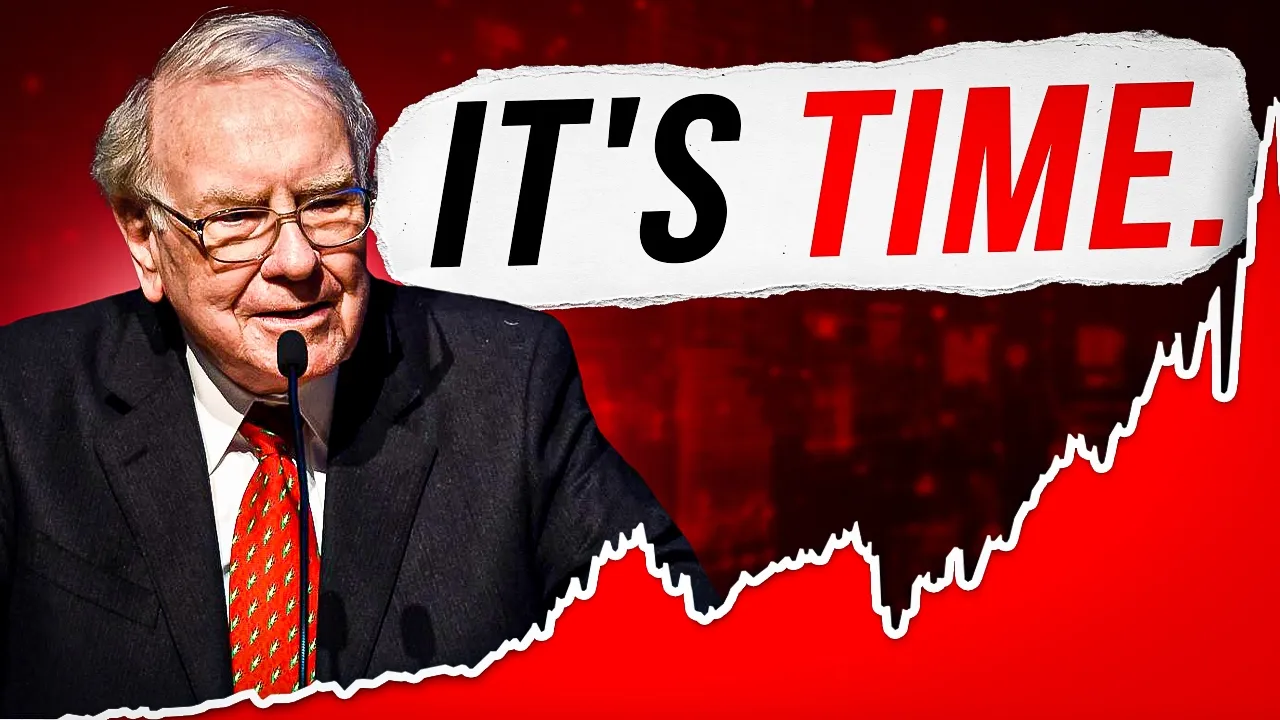
I can look at a thousand different companies. And I don't have to be right on every one of them or even 50 of them or even 25 of them. >> That's Warren Buffett, arguably the world's greatest investor.
Since taking control of Berkshire Hathway in 1965 until now, the stock has averaged 20% returns per year. That's double the return of the S&P 500 each year, which over time has added up to a 5. 5 million% return for Buffett versus 39,000% for the S&P 500.
So, in this video, we're going to hear some of Warren Buffett's advice specifically for this investing market at the end of 2025 and going into 2026. So, what is that? Well, we're seeing AI stocks hit record valuations with Nvidia alone, now worth more than all the major banks in the US and Canada combined.
US debt, both private and governmental, is rising exponentially with some investors now worrying about the future of the US dollar, especially in the face of new competition from China and BRICS countries. And throw in the potential of a full-on market correction. With the S&P 500 now more concentrated than ever in just a few stocks, it makes sense investors are feeling kind of stressed about the future.
So, let's walk through the four indicators the US market might be overvalued today, as well as Warren Buffett's four pieces of advice for us as rational long-term investors in a market that's been behaving erratically to say the least. So, the first worrying sign that investors are seeing in the market is an increasing amount of stocks being bought using debt. This chart shows how stocks bought using borrowed money has been outpacing the growth of the broader market over the past 30 years.
Meaning more and more of the market's current value is just built on debt that people are borrowing. So, I covered this and how it could lead to what Buffett calls a potential loss decade in stocks in a previous video. But in addition to leveraging themselves to buy stocks, we're also seeing an economy where more and more debt is being taken on to fund lifestyles as well due to high inflation and rising costs that just makes it harder to afford living.
And that whole situation is rightly concerning to Buffett because he's actually warned about using debt to buy stocks in the past. >> Anything can happen in markets. I mean, anything can happen to markets.
That's why they don't ever borrow money against securities. So the big concern here is that more debt is being used to artificially inflate prices in the market. There's more money in there than there should be and that could contribute to stocks hitting unsustainable valuations and to the increase in volatility that we've seen in the market.
Basically how much the market has been bouncing up and down. This is the VIX index and it tracks the expected volatility of the S&P 500 and it has spiked by over 30% in the past month, showing signs that people don't expect the market to calm down anytime soon. So, in addition to debt, we'll see three more warning signs about the market's current valuations.
But first, let's look at Buffett's first rule and how it applies to this market. >> I look to the business to determine whether I made a good investment. It's the business I look at.
When you're just looking at the price of something, you're not investing. >> So that's Buffett's first rule of investing. Focus on buying a business rather than a stock.
Whenever we see markets run up to an unreasonable price, it always follows the same pattern. It's investors looking to buy a stock and then flip it at a higher price. They don't really care what the fundamental company underneath that stock is worth.
They're just looking to make a quick profit. Because if you haven't studied the fundamental business, it's very hard to tell if a stock is overvalued or not. So, what can we take away from this advice?
Well, if the market is overvalued and we do see a pullback in stocks, there are certain types of businesses that will tend to perform well no matter what the overall economy is doing. Companies selling necessities like medicine, groceries, utilities, your phone. These are called defensive stocks.
And as a group, they tend to outperform when the rest of the market is down because they're businesses that operate in areas that people don't tend to cut back on. So that's at an industry level, but specific stocks can still rise or fall based on their business. And so Buffett also has some advice here, and he uses a really good analogy that he actually borrowed from his longtime mentor Benjamin Graham.
And it's a way to make it easier to think about stocks like a business. Imagine you have a business partner named Mr Market in a business where you own a small share for $1,000. Mr Market is very obliging.
He's also a little manic depressive. So every other day he tells you what he thinks your little business is worth and offers to either buy you out or sell you more of the business. Sometimes his offer seems reasonable based on what the business is doing.
And sometimes Mr Market lets his enthusiasm or fear run away with him and he offers you some silly prices. Mr Market is like the stock market and we're like the business owner. We get to decide if we think Mr market is charging too much or if he's offering stocks at a discount.
And we get to pick and choose the specific businesses that are at a price that we think is reasonable. But how do we determine if it's a reasonable price? Well, let's look at the second warning sign in the market.
And then we'll get to Buffett's second rule of investing that answers that question. But that leads us to a much more immediate warning sign in the market. One that Buffett has been issuing increasingly strong warnings about.
And to show you this visually and in fact throughout this entire video, I've been using Story Blocks, who has been kind enough to sponsor this video. So, check this out. If I type China map, for one set price, you can get access to all of these assets.
I think there's over a million assets on Story Blocks, and you can download as many as you want. I like to just download tons of these for my videos, and then later decide what looks best in the video. So, the stuff I use gets put in, the stuff I don't doesn't, and I don't pay any extra for that.
But more than footage, my editor and I actually use templates like all the time in these videos, like transitions, this animated text. So, I'm not an animator, but I can use these cool, useful graphics to make the video feel way more premium without designing all the graphics from scratch. So, I've been using Story Blocks since early 2024, basically as long as I've been trying to make these videos look good.
So, way before they reached out about sponsoring a video, because it's just the best option for high-quality assets at a pretty cheap price. It's just one price either monthly or annually. No extra fees, no licensing, and it makes the videos so much better and so much faster.
It's like one of the best ROI tools that I've paid for on this channel. So, there's a link in the description, storyblocks. com/fintech.
And if you click on that, you help support the channel, but you also get 2 months extra free when you sign up for an annual plan. Go to storyblocks. com/fintech to take advantage of this limited time offer.
Thank you, Storyblocks. And now let's see the second warning sign in the market and how Buffett's second rule of investing can help us follow the long-term rational path. So on top of the high leverage in the market, we're also seeing a second risk that could be contributing to overvaluation, concentration risk.
So here's the official definition of concentration risk. When your portfolio is too focused on one type of investment, it can make you lose a bunch of money if that investment goes down. It's like those group projects in school where just one or two people do all the work.
Ask me how I know. And if just those few people stop working, well, the entire project can fall apart. That's kind of like what's happening in the S&P 500 right now.
A huge chunk of the S&P's recent growth has been driven by just a few huge tech companies. Apple, Amazon, Nvidia. According to Goldman Sachs, the top 10 companies in the S&P 500 now make up a third of the index's value.
that's even more concentrated than during the dotcom bubble in 2000. So now if those few companies run into trouble, that can drag down the entire S&P 500, even if the other 490 companies are doing fine. And this is also why the S&P 500's PE ratio, which measures the average stock's price versus the average profits US companies are making.
That PE ratio is now sitting at over 30. The last time it was this high was before the 2021 market correction and before that was 2008. Historically, the S&P 500 trades at a PE ratio between 16 and 20.
So today, it would take a 50% drop to reach those same prices. And a lot of that recent rise in price is driven by AI and tech companies. Now look, I'm not saying that AI or technology is not creating value.
It clearly is. I'm personally very invested in a lot of tech stocks, but I think Buffett's second rule of investing really shows the difference here. So, let me share an analogy from Buffett that I think about anytime a new technology starts to gain traction in the market.
>> I given talks in the past where I carry with me a 70page tightly printed list and it shows 2,000 auto companies. Now, if at the start of the 20th century, you had seen what the auto was going to do to this country, the impact it would have, but if those 2,000 companies, three basically survive, so how do you pick three winners out of 20,000? I mean, it's not so easy to do it.
>> Buffett here makes the analogy that any new technology is like the car in 1905. And he gave this talk around the time of the dot bubble, by the way. So you might realize that a technology is going to change the world like the car did.
But you need another level of experience to understand which company is going to win out in that new technology. And Buffett's fix for this is fairly simple. Defining your circle of competence is the most important aspect of investing.
You don't have to be an expert on everything, but knowing where the perimeter of that circle of what you know and what you don't know is and staying inside of it is all important. investing only within your circle of competence, the area of the market that you know best and that you have experience in. It's like if you ask me to fix a boat.
I don't know anything about boats. I grew up in the mountains. I can help you fix your cloud computing.
And if you ask a boat mechanic the opposite, well, he can run circles around me with engines, but he probably can't fix networking. And it's the same in investing. You don't have to be an expert in everything, and you don't have to invest in every trend.
So before buying a stock, you can ask yourself, am I really an expert in this area? Do I know how AI works, how companies are using it, and how it's creating value? If yes, then you can probably spot deals in stocks in the market.
But if not, it's easy to just get swept up with the crowd that is just buying whatever the hot new thing is. And that is a really important lesson that I've had to learn time and time again. But okay, even if you stick to industries in your circle of competence and you look at the company as a business, you can still get hurt by an overall falling market.
So, let's now look at the third warning sign in the market. And this one is very Buffett specific. And then we'll look at the third rule that comes from Buffett's partner, Charlie Munger, and it's one that I find using myself probably the most in my life.
And sorry about my voice. There's a cold that's been going around kind of hitting everybody. And I really wanted to film this video this month.
and let me know what you think of the style of this video as well, ignoring my almost gone voice. So, number three, well, back in 1998, Buffett issued a famous warning that the US was headed for a lost decade in stocks, where the market wouldn't have any meaningful return for the first 10 years of the early 2000s. And that prediction ended up being right.
The market went on to have an annualized return of only 2% from 2000 through 2012, which is less than inflation. And that happened because the. com bubble burst and it took years for the market to recover.
In the years that followed, it kind of seemed miraculous that Buffett had called this prediction when the rest of the market got it so wrong. But then in 2001, he revealed an indicator, basically a single number that investors could look at to determine if the market was overvalued or not. He called the indicator probably the best single measure of where valuations stand at any given moment.
Though he did walk that quote back a little bit later, it still became known as the Buffett indicator, which looks like this and can act as one data point for how expensive the market currently is. It may look a little bit mathy, but the core idea is really simple. Take the total value of all US stocks and divide that by the total production of the United States, GDP.
That's it. It's a way to see how much people are paying for companies compared to how much they actually produce, which makes it a very tangible indicator, not just based on numbers on a spreadsheet. And while this isn't the be all end all of indicators that will tell us exactly when a market will crash, it's still a useful data point that can give us a temperature on the situation.
And this indicator is flashing a warning light. This is a chart in the trend of the Buffett indicator over time. This historical trend line is sort of the average growth that we've seen historically.
In 2020, the market passed one standard deviation above that line, and today we're sitting more than two standard deviations above it. Meaning, it's now 69% higher than we would expect from historical data. And considering we've never sustained that level of deviation for more than 6 months without seeing a market correction, it's a useful data point to understand how expensive the market currently is.
So, how do we deal with this? We can't just focus on finding great companies because in a market downturn, the indexes tend to group everything together and pull it down all at once. So, even a really good company can drop.
And this is where Buffett's third rule of investing comes in. And it's one that you can really apply in a lot of different areas of life. But let's hear it in Buffett's words.
>> Obviously, if you understood a business perfectly, future of a business, you would need very little in the way of a margin of safety. The more volatile the business is or possibility is, the larger the margin of safety. >> A margin of safety, basically some buffer between the value of something and the price we pay.
And Buffett gives a good analogy for how we should scale this margin of safety depending on what we're investing in. >> If you're driving a truck across a bridge, it says it holds 10,000 lb and you've got a 9,800 lb vehicle. You know, if the bridge is about 6 in above the crevice that it covers, you may feel okay.
But if it if it's, you know, over the Grand Canyon, you may feel you want a little larger margin of safety. >> So, it's the same with buying stocks in this market. If you're buying a defensive stock like a utility, you might need a smaller margin of safety than if you're buying a highly risky stock like maybe a high-flying AI player.
A utility stock is like driving a truck over a low bridge, while certain AI stocks might be like driving a truck over a bridge over the Grand Canyon. The consequences of failure are just much higher. But I think this advice also applies to today's market in general because if we do see a market crash, there's very little chance that we can time it, meaning selling out before the dip and then buying back in later.
It sounds easy, but in practice, it just doesn't work consistently. Here are three separate studies which I'll share in the description. All of which show that holding through a market dip outperforms trying to trade in and out.
So, if we need to plan to hold through a market dip, then we need to build in a margin of safety into our portfolios so that we can ride through the many temporary downturns that someone like Buffett has seen over the course of his career so that we can survive as long-term investors and get that compounding growth of the market over time. So, let's look at the fourth warning sign in the market as well as Buffett's fourth rule. But, I've always appreciated how plain spoken Buffett is about everything.
He doesn't try to make things sound complicated to sell you some story. And that's an example that I try to follow on this channel. We're on a quest right now to pass the mly fool in YouTube subscribers and try to change the way people talk about stocks.
Just show the data, keep it simple, and stick to time- tested wisdom. That's what I'm trying to do on this channel. So, if you want to help out, thank you.
I appreciate every single one of you who subscribes. And now, let's take a look at the fourth warning sign and Buffett's fourth rule of investing. So, this next warning sign is actually way more specific to retail investors, which is basically Wall Street's name for normal investors buying stocks.
Basically, me and you investing in the market. Well, this chart shows retail investors interest in the riskier forms of trading, day trading, options, swing trading. We've seen a big spike recently, and this has corresponded with an equally large rise in the amount of cash that is sitting on the sidelines of the market.
basically disposable income that people could throw into stocks. And historically, we see this type of activity before a market correction because it's an indicator that people are playing the market as a short-term game rather than holding as long-term investors. Now, I'm not here to tell anyone they shouldn't use advanced tools like options if they know what they're doing.
And even though 90% of traders lose money, there are some who do okay. But Buffett takes a different approach in his fourth rule. And as he likes to do, he explains this one in an analogy.
This clip comes from an old DVD from like 2004, so the footage is a little bit grainy, but the wisdom Buffett shares is still timeless. >> If you have five good ideas in your lifetime to get very rich. I tell students sometime they'd be better off if they had a punch card when they got out of school with only 20 punches on it because then instead of listening to somebody at a cocktail party and then going out the next morning and buying some shares, they'd really think about every punch.
20 punches is plenty. >> The idea goes that if you could only buy 20 stocks in your entire life and once you've used those up, that's it. You can't buy anymore.
Well, we would be so much more careful about which stocks that we buy. And that rule to minimize activity is a lesson that applies just as well today as it did then. As Buffett wrote in his 1983 letter to shareholders, a hyperactive stock market is the pickpocket of enterprise.
There's this famous story about a study at Fidelity. It's apocryphal as far as I can tell, but the lesson is still really useful. So, the story goes that Fidelity set out to figure out what is the type of investor that performs the best in the stock market.
So they looked at all their investor accounts across the entire company and found that the second best performing investors were people who forgot that they had accounts at Fidelity. But the best type of investor were dead. So sometimes it's not about doing more.
It's about making a good investing decision and then just forgetting about it for a very very long time. And if this was valuable to you, I also made a video on Berkshire Hathway's latest trades and what they tell us about how Buffett views today's stock market.