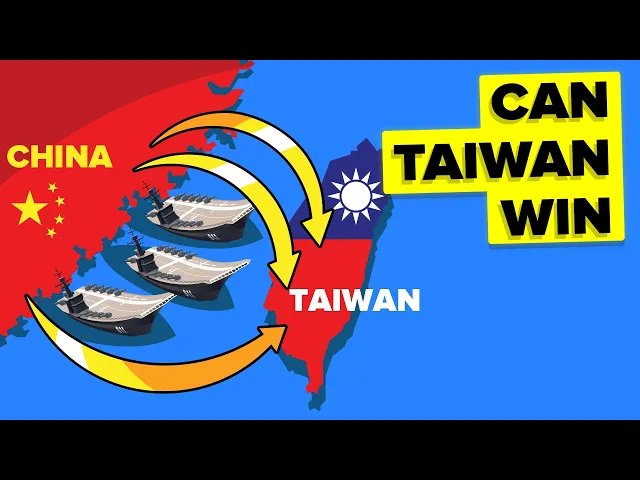
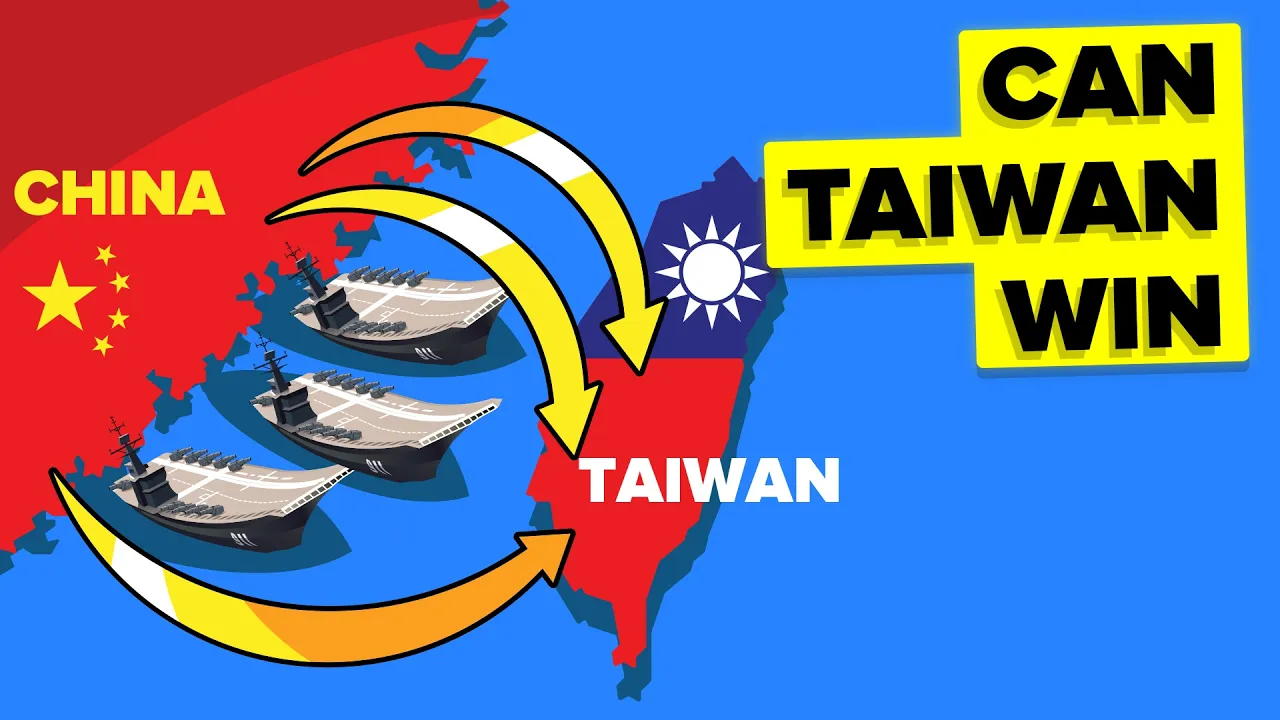
“The Ambitious Drgon. ” These are words that have been used to describe Chinese President Xi Jinping and his ambition is to modernize the People’s Liberation Army, or PLA, to the point it could invade Taiwan by 2027. So how does a small island nation like Taiwan stand up to the military might of China?
Prepare to be surprised. So let’s look at how they really compare and what would actually happen if war broke out in today’s episode of The Infographics Show, “Taiwan vs China - Military Comparison”. Let’s start with money.
Recognizing the clear threat being presented by China, Taiwan upped its defense budget toward the end of 2023, meaning its baseline for 2024 is $13. 8 billion, a 7. 7% increase over the amount spent in 2023.
This is the seventh consecutive year in which Taiwan has spent more on defense than it did in the previous year. Add a handful of supplemental defense budgets into the equation, and the real number may end up being closer to $19. 1 billion for 2024, meaning Taiwan is likely to spend 2.
5% of its gross domestic product, or GDP, on its military. But even with those increases, China still massively outspends Taiwan every year, with 2024 being no different. According to the Texas National Security Review, or TNSR, China will spend a staggering $232 billion on its military by the end of 2024.
However, that figure isn’t all that it appears. Several studies show that China’s actual spending has typically been between 27% and 33% higher than it claims in its official budgets over recent years, which means China’s actual spending may reach between $295 billion and $309 billion by the end of 2024. And it gets worse for Taiwan.
China also spends billions on “off-budget” items that aren’t included in either its official military budget or unofficial spending. Adding these off-budget items into the equation would knock China’s military spending up to $471 billion in 2024 – over 24. 5 times more than Taiwan’s spending.
And, like Taiwan, China’s defense spending has been increasing over the last few years. The base $232 billion figure it has announced represents a 7. 2% increase on the amount Beijing spent last year.
So, China has a clear advantage when it comes to the amount of money it can throw around. But what about manpower? On the surface, China appears to have a clear advantage here, with a population of over 1.
4 billion compared to Taiwan’s 23. 5 million. But how many of those are actually able to fight?
In Taiwan, around 1 million people are fit for service – though estimates put their total available manpower at as high as 12 million – with an additional 300,000 people reaching military age every year. China destroys those numbers though. It has a staggering 626 million people who are fit for service out of available manpower of 763 million, with another nearly 20 million people reaching military age annually.
That’s just four million less than Taiwan’s entire population! However, the numbers start to even up a little when you hone in on each country’s military. China has an estimated 3.
2 million military personnel, around 2 million of whom are actively serving in the PLA. Add to that 510,000 reserve personnel, meaning people who have military training but are no longer actively serving, and 625,000 paramilitary forces. These paramilitary fighters are interesting – they’re not officially part of China’s military, but instead organized groups that tend to align with the country’s goals.
Think mercenaries in the vein of Wagner’s relationship to the Russian military and you have the idea. Taiwan still falls behind these numbers, though not by as much as you might think, with around 2. 6 million military personnel, 215,000 of whom are actively serving in Taiwan’s military.
The island has a further 55,000 paramilitary fighters, with the rest of its military personnel consisting of 2. 3 million reservists. That places Taiwan third in the entire world for pure numbers of reserve troops, with this number being a result of Taiwan having something that China doesn’t – compulsory military service.
As of 2024, Taiwan has a one-year mandatory service program that only affects young men. Women can enter Taiwan’s active military, too, though their service isn’t compulsory. So, Taiwan is in a position where it has far fewer people than China, but it also has millions of reservists it can call upon to supplement its active military if the two ever come to blows.
Still, China’s combination of a larger active military and a much larger population gives it an advantage on the manpower front. But what about land forces? Taiwan has about 1,000 tanks, though only around 800 of them are combat-ready with the rest being mothballed in storage.
It also has about 20,000 other military vehicles, with nearly 16,000 of those being combat-ready, and around 300 self-propelled artillery units. Add a little over 200 rocket artillery units and an impressive 1,120 towed artillery units and you get an impressive collection of land forces. But bear in mind that this isn’t an invasion force – Taiwan is an island, so everything it has built in this department would be dedicated to defending it in the case of an invasion.
And defend is what it’ll have to do, because China is way ahead in terms of pure land forces. It has 5,000 tanks, 4,000 of which are combat-ready, giving it a tank force four times the size of Taiwan’s. It also has just under 140,000 combat-ready vehicles – around nine times what Taiwan has – and 3,850 self-propelled artillery units.
Throw in 3,180 rocket artillery units and almost 1,450 towed units and China is far more impressive in a land-based war. Seems like China is the clear winner right? Wrong.
China has a big problem here, since most of this equipment would prove useless against the island nation of Taiwan. That means China faces the logistical hurdles of getting its tanks, artillery, and vehicles onto Taiwan before it can leverage them. So, despite the numbers, Taiwan may actually have an advantage on land because all of its assets are already located on the island.
Perhaps that means we can score one for Taiwan. But the air is one thing. What about the sky?
The entire Taiwanese air force only has access to 750 aircraft, of which GFP says 600 are in a combat-ready state. Of that 750, 286 are fighter jets, with the F-16V being the most impressive. In February 2024, Taiwan also announced that it was working on building 66 new F-16Vs, with April 2023 also bringing with it the news that it had signed a $420 million maintenance deal with the U.
S. , most of which will be dedicated to purchasing parts to keep its fighter jets in the skies. Beyond fighters, Taiwan has 19 fixed-wing transports and 18 aircraft it can dedicate to special missions.
It has no aerial tankers – which are planes used to refuel other planes while in the air – but it likely wouldn’t need them. Any fight with China would take place over Taiwan and the Taiwan Strait. The rest of Taiwan’s aerial assets are helicopters, with 236 standard choppers and 91 attack helicopters as part of its arsenal.
The country is also investing heavily in drones, inspired in no small part by how Ukraine has made effective use of Unmanned Aerial Vehicles, or UAVs, in its war against Russia. In July 2023, there was a report noting that Taiwan was far behind China when it came to UAV stocks. At the time, Taiwan only had four types of drones, with its total fleet size being in the hundreds.
It’s actively looking to change that though, and in June 2024 Taiwan inked a $360 million deal with the U. S. to purchase around 1,000 new drones.
These include 720 Switchblades – which have been used as kamikaze drones against Russian troops and equipment in the Ukraine war – and 291 Altius 600M loitering munitions drones, which have explosive capabilities. For China, numbers are a little harder to come by for drones, but what we do know is that China accounts for the vast majority of the consumer drone sector, with just one company – DJI – making 90% of the drones. Not only does that mean China has in-country manufacturers capable of building military drones, but commercial drones also have uses in war, like in Ukraine where large numbers of commercial drones are being modified to carry explosives.
China has also established itself as the world’s leading exporter of military UAVs, delivering 282 combat drones to 17 countries between 2013 and 2023. So it's likely safe to say that China at least matches Taiwan on the drone front, and more likely far exceeds it in terms of pure numbers. And that pattern holds true when you compare the PLAAF’s aerial asset numbers to Taiwan’s.
China has around 3,300 total aircraft, of which nearly 2,500 are combat-ready. That’s over four times the number of aerial assets available to Taiwan, and it gets worse for Taiwan as we dig into specific types of aircraft. China has around 1,200 fighters, of which about 900 are combat-ready, meaning it has the second-largest fleet of fighter jets in the world.
It also has 370 attack-type aircraft – which typically fly close to the ground for strafing and bombing runs – compared to the big zero Taiwan has in its aerial fleet. When it comes to transports, China has 289 of those, and they would prove essential in transporting troops into Taiwan if it’s able to establish a safe route. It also has 112 special mission aircraft and a small fleet of 10 tankers which would enable its fighters and attack types to conduct operations within Taiwanese airspace for longer.
Add over 900 standard helicopters and 281 attack choppers to this impressive aerial fleet and you once again have China dominating in terms of sheer numbers. And given that any conflict with Taiwan would involve a hefty aerial component, those higher numbers would add up to a distinct advantage. Next we dive into the water.
Any war between China and Taiwan would predominantly take place in the Taiwan Strait, at least in the early stages. So, both countries need to have powerful navies – a big problem for Taiwan. China’s fleet is the largest in the world in terms of pure number of vessels – with 730 ships.
These include 49 destroyers to Taiwan’s four, along with 42 frigates and 72 corvettes. China also has a far stronger submarine fleet with 61 versus the four Taiwan can muster. Even more worrying for Taiwan is that all of its submarines are diesel-fueled, which makes them detectable.
China’s fleet is predominantly diesel-fueled, too, but it also has 16 nuclear-powered submarines that are far more effective in stealth operations. China also has 150 patrol vessels – though these ships are unlikely to take an active role in a war with Taiwan – and a small fleet of 36 mine warfare ships. Then, there’s the real difference maker – China has two aircraft carriers, The Liaoning entered service in 2012, followed by the Shandong in 2019.
The former displaces about 60,000 metric tons of water and is capable of reaching a top speed of 20 knots. More worrying for Taiwan is the number of planes it can hold – 24 Shenyang J-15 multirole fighter jets. The Shandong is even larger.
It’s able to carry up to 36 aircraft, including 24 J-15s, eight Changhe Z-18s, and four Harbin Z-9s, creating a combined total of 60 aircraft that China could position in the Taiwan Strait – or just outside it – to launch aerial attacks against Taiwanese ships and the island’s mainland. Taiwan on the other hand, ranks 40th in the world in terms of naval assets, with 93 in its fleet. It has no aircraft or helicopter carriers, though it likely wouldn’t need either if it’s defending itself against China.
More problematic is that Taiwan only has four destroyer warships, 22 frigates, and two corvettes. The rest of its fleet is made up of a small number of submarines – just four – with 14 mine warfare vessels and a small fleet of 43 patrol ships rounding the numbers out. China has the clear advantage on the naval front.
It has far more ships, including a much larger number of warships, that it could use to pack the Taiwan Strait for a combined naval and aerial assault. But speaking of aerial assaults, there’s another very important category to consider: Missiles. Any Chinese attack on Taiwan would heavily rely on missiles to devastate the mainland and the smaller surrounding islands that Taiwan has fortified.
It was estimated in 2021 that China likely has between 2,300 and 2,400 ballistic missiles in its arsenal, with 90 of those being intercontinental ballistic missiles, and 320 of them having nuclear warheads attached to them. About half of this stock are short-range weapons with ranges varying between less than 620 miles (998 km) and up to 1,864 miles (3,000 km), giving Beijing the ability to launch missiles from the Chinese mainland to strike Taiwan. Taiwan’s missile numbers are a little less impressive, since most of its stock is comprised of short-range ballistic missiles and defensive missiles, such as those designed to strike ships and defend against aerial attacks.
However, Taiwan does have one advantage in that it’s a major missile producer, and it doubled its missile output to 500 per year back in 2022. Finally, we come to the weapon that can end a war in a heartbeat – nukes. Taiwan has no nuclear weapons, whereas China is believed to have up to 500 right now and is on course to build up to 1,000 by 2030 if it continues its current manufacturing pace.
Ultimately, China is the clear victor in terms of numbers, having more of everything compared to Taiwan. But will that be enough to help President Xi annex the island? Tell us your thoughts in the comments.
Now go watch INDIA vs CHINA - 2024 Military/Army Comparison or check out this other video instead!