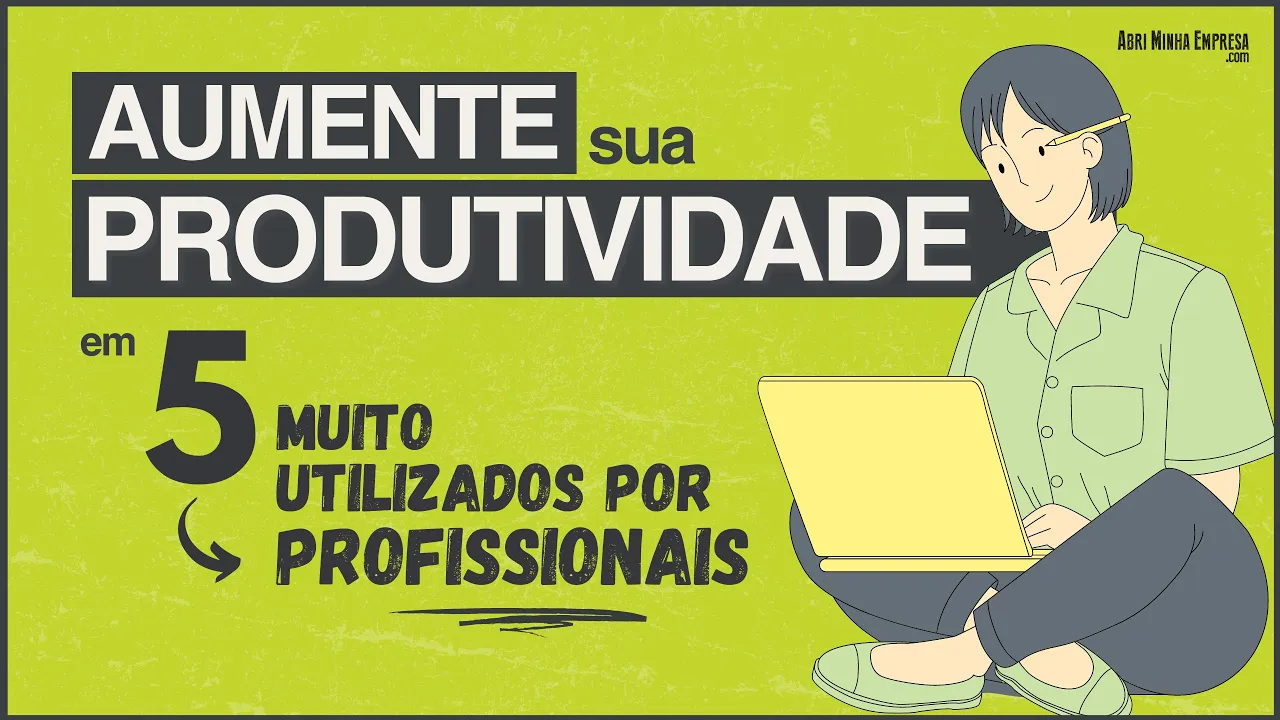
Types of productivity methods. The best professional productivity methods vary from person to person. Because each individual has their own preferences, work styles and areas of focus.
However, some methods have been widely adopted and praised for being extremely effective and very functional. This is precisely why we are now going to show you 5 of the best professional and personal productivity methods that will greatly increase your organization and planning to produce more. And so, always achieve your goals and results.
Can believe! You want to receive tips and information to set up your own business. So subscribe to this channel and stay up to date with everything you need to know to open your own company.
Productivity is not a single , uniform entity. It manifests itself in many ways, each with its own nuances and benefits. Therefore, understanding the different types of productivity can make all the difference in optimizing performance and achieving goals effectively.
Therefore, here we are going to show you the 5 incredible productivity methods that are widely used and bring great results. Both for work, studies and personal life. So, let's go!
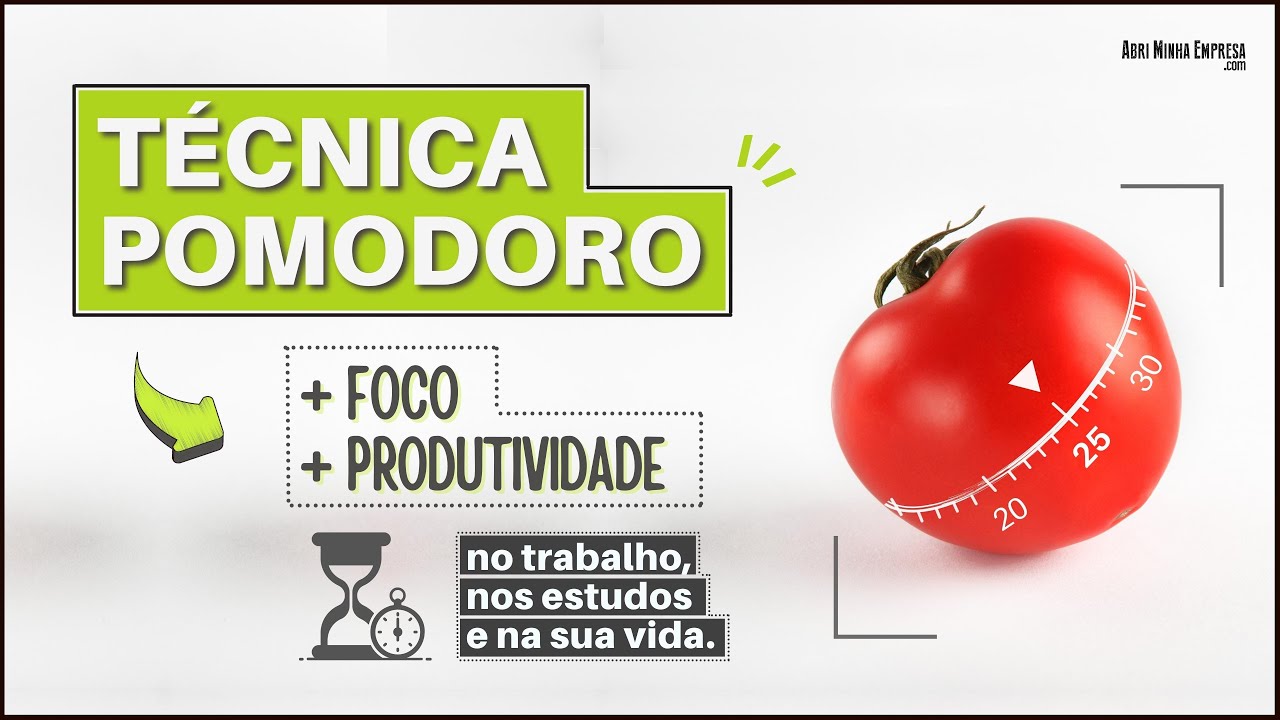
1. POMODORO TECHNIQUE In short, it is a time management method. In it, each activity is worked on exclusively, in pre-determined blocks of minutes.
No interruptions and total focus on her. Furthermore, it can be applied to various tasks. Like work, studies, personal tasks, whatever.
In practically everything. HOW IT WORKS? Above all, the pomodoro technique works in 25-minute blocks.
Above all, interspersed with blocks of 5 minutes of rest (and then a longer rest of 15 to 30 minutes). In practice, it would be like this: Start by defining the activity that needs to be carried out. Then, divide the task into 25-minute blocks, interspersed with 5-minute rests.
And after 4 cycles, consider a rest or longer break of 15 to 30 minutes. Thus, we would have the following scenario: MOMENT 1: 25 minutes of focus on the task to be performed + 5 minutes of rest. In other words, set your timer to 25 minutes and start counting the time.
After finishing, set the timer for 5 minutes of rest breaks or breaks. Then, after this, repeat the process for the next Pomodoro steps, which would be: MOMENT 2: 25 minutes of focus on the task to be performed + 5 minutes of rest MOMENT 3: 25 minutes of focus on the task to be performed + 5 minutes rest MOMENT 4: 25 minutes of focus on the task to be performed + 5 minutes of rest AT THE END. .
. Schedule a rest or break of 15 to 30 minutes. After this period, restart the Pomodoro method again, if necessary.
So, if you want to understand how this method works in practice, watch the full video by clicking here or on the link we leave in the description. 2. EISENHOWER MATRIX Also known as Time Management Matrix.
In short, the Eisenhower Matrix is a tool used to prioritize tasks. Likewise, guide decision-making processes. Whether in companies or even in your personal life.
In other words, it serves to prioritize tasks that are, in fact, very important. So, focus on where it really matters. HOW IT WORKS?
Basically, 4 quadrants make up this matrix. In addition to this, there are two criteria: urgency and importance. In which pending tasks/activities or those that need to be carried out are distributed.
And these quadrants are: • important and urgent; • important and not urgent; • not important and urgent; • not important and not urgent. By filling in these quadrants, it will be possible to define a priority order for the tasks/activities in question. Firstly, it is necessary to clarify the difference between what is important and what is urgent.
Important tasks are those whose results directly affect the goals and objectives that need to be achieved. Urgent tasks are those that have a specific deadline. Therefore, if they do not receive due attention and focus as soon as possible, they can bring undesirable, negative or even irreversible results.
With this in mind, now we will show how the Eisenhower Matrix is composed. In practical terms, it is formed by two axes: importance and urgency. Considering this, we have the four quadrants.
Which are: Important and urgent In other words, the tasks/activities listed in this quadrant are those that need to be done immediately. They are the priorities. In other words, it's do or do.
Important but not urgent Here are the ones that are important. However, it is not as urgent. They can be carried out in the medium or long term.
Therefore, you can schedule time to focus on them. However, as they are not priorities at first, they can be done after the activities in the previous quadrant. Which we just showed.
Urgent, but not important This quadrant includes tasks that are urgent. In other words, they need to be carried out as soon as possible as their respective deadlines are coming to an end. However, they are not of paramount importance.
They can often be delegated to other people to do. While the biggest focus is on the “Important and Urgent” quadrant, for example. Not urgent and not important Finally, this includes tasks that are on the list, but can wait and be carried out over time.
Or until they are eliminated. So, if you want to understand how this method works in practice, watch the full video by clicking above or on the link we leave in the description. 3.
GTD METHOD Formed by the acronyms of the English words Getting Things Done, which basically means The Art of Making It Happen, the GTD method works as a personal productivity tool. However, it is more than productivity or task organizer. He seeks a balance between his professional career and personal life, prioritizing people's mental health.
In other words, the GTD method makes us delete all the tasks we have in our head and record them somewhere else, which they call “external memory”. For example: on paper, a notebook or on a computer or cell phone, for example. This way, our mind will be free, as we won't need to memorize these things and focus on where it really matters.
How to execute projects, have new ideas or make decisions, for example. HOW IT WORKS? Basically, this method works on 5 pillars: 1.
COLLECT Which is collecting everything that catches our attention at the moment. List everything that appears. Be it ideas, concerns, thoughts, pending issues, whatever.
2. CLARIFY Which is to analyze the list created in the previous step and clarify what needs to be done for each item. Here, there will be items that cannot be resolved with actions and those that can be executed.
3. ORGANIZE In other words, classify the actions that need to be done, organizing everything within its current context. 4.
REFLECT Which is analyzing your list and reviewing it periodically. Whether it’s once a week, a month or even every day. Finally, review whenever possible.
5. DO Literally, put your tasks or actions into practice. In other words, carry out the tasks that need to be done or engage people who have been delegated some tasks to be done as well.
So, if you want to understand how this method works in practice, watch the full video by clicking above or on the link we leave in the description. 4. PARETO PRINCIPLE Basically, it is a theory that is based on which 80% of the effects occur as a result of 20% of the causes.
In other words, this principle shows that 20% of your efforts dedicated to work are responsible for 80% of your performance. Or that 20% of the products/services that your company sells are responsible for 80% of your revenue. These are just a few examples, but you can apply this theory to any subject you want to analyze.
– And also, 20% of your employees guarantee 80% of the business results. – 20% of your investments are responsible for 80% of your results – 20% of your customers represent 80% of your company’s revenue And this can be applied to your personal life too, for example: – 80% of the use of your cell phone comes from 20% of your applications – Or that 20% of your tasks are responsible for 80% of your results Anyway… The Pareto Principle aims to understand the relationship between action and benefit. In other words, being able to prioritize actions that will bring better results.
So, if you want to understand how this method works in practice, watch the full video by clicking above or on the link we leave in the description. 5. KANBAN The term “Kanban” is of Japanese origin and means “signaling” or “card”.
He proposes the use of cards (post-its) to indicate and monitor the progress of production within a business or project. Kanban is a visual system for managing work or production flow in companies and projects. He uses colored cards (or post-its).
And that is precisely why it is also known as visual management, due to the use of card colors as flags. In other words, it is a way of recording tasks and actions through visual symbols. The focus of Kanban is to prioritize productivity and organization of deliveries.
The objective is to provide more transparent and targeted work. In general, the concept of Kanban can be defined by three points: VISUAL SYSTEM: A process, defined in a board divided by columns to organize work into segments or statuses. And in each space, a post-it is placed in the appropriate place to indicate where each item is in the overall workflow.
COLOR CARDS (OR POST-IT): They describe the real work that is in the given process. WORK IN PROGRESS: Allows you to assign limits on how many items can be in progress in each segment or state of the workflow. In this way, Kanban can work in a workflow that seeks to indicate (and limit) the work in progress.
And this helps to make the work more tangible and realistic. So, if you want to understand how this method works, watch the full video by clicking here or on the link we leave in the description. These are the most commonly used productivity methods.
Both in companies , studies and personal issues as well. However, they are not the only ones. There are many other methods that are quite effective as well.
So, if you know any others, write in the comments and share with us! Furthermore, if you want to take a leap in your productivity, we highly recommend identifying your type of productivity. This will help you a lot to understand your style and method that will help you the most.
So, if you want to find out which type is yours, watch the video that shows the 4 main types of productivity. If you want to watch it, just click on this button above or on the link we leave in the description. And just to recap what we talked about here: 1.
POMODORO TECHNIQUE 2. EISENHOWER MATRIX 3. GTD METHOD 4.
PARETO PRINCIPLE 5. KANBAN We hope you enjoyed it! And if you want to know more about how to set up and manage your own business, visit our YouTube channel where we have several videos on this subject, okay?
And if you liked it, share this video with your friends and family to help them too! If you want to prepare even more, download our free e-book now with 11 key questions to find out if you are ready to open your own business or not. Let's leave the download link here in the description of this video, okay?
And be sure to subscribe to this channel and stay up to date with all our news on how to set up and manage your own business. And if you can, leave your like to help this channel. A hug and see you next!