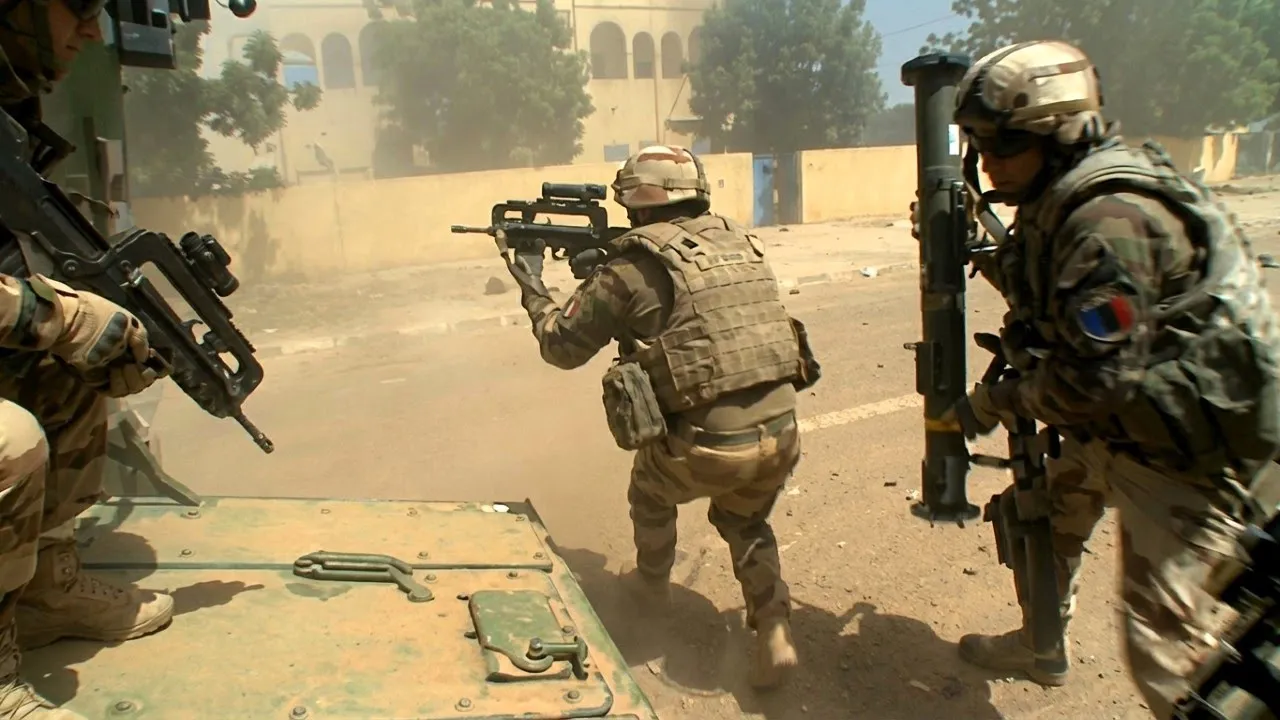
These images are the first that the public retained from Operation Serval. A jubilant crowd welcomes the French soldiers as liberators. January 11, 2013, France intervenes to stop the rush of jihadists towards the south of the country.
Al-Qaeda in the Islamic Maghreb and two other Islamist groups overwhelmed a routed Malian army. After three weeks of a lightning operation, The main cities held by these jihadists for a year have been recaptured. But images of combat, almost not at all to the point that we could speak of a war without images.
The images do exist, however. and many have never been revealed. Man, 16 We were shot at.
Chief, Where did they come from this time? Frankly, from here to there. We're going to pull back.
All the images you are about to see. . .
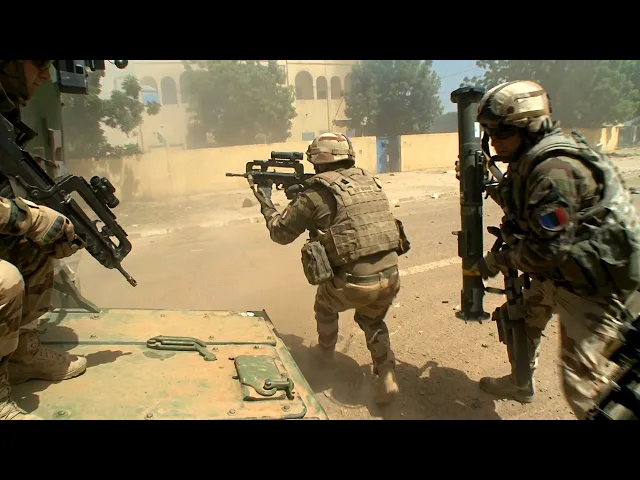
were not taken by journalists. but by the military. They were filmed primarily by army cameramen and photographers as close as possible to the action.
"It whistles. " We can hear you clearly. We can clearly hear these.
. . » Military, They go to the front line and can find themselves under fire.
"Okay, then," We're going to set up the system. The army general staff allowed us to use this raw material on the condition that we do not show any images of soldiers or enemies killed in combat. For the army, Serval is not just another operation in Africa.
With 4,500 men deployed, This intervention is the largest carried out outside the coalition since the Algerian War. You know about shooting, You see where the enemy is. This is Operation Serval from the inside.
as you've never seen it before. Bomb dropped! She's coming!
Radiance for 45 seconds! 45 seconds, attention. It is early February 2013 in Thessaly, three weeks after the start of Operation Serval.
The French, along with their Malian and Chadian allies, drove the jihadists out of the city. But intelligence indicates that they have entrenched themselves in the south. in the heart of the Adrar des Iforas desert massif.
On February 19th, The French are struggling to reach the western entrance of their sanctuary. A legionnaire, Staff Sergeant Harold Vormezel, finds death. First warning.
Three days later, Chadian forces are encountering similar resistance in the East. 26 dead, 62 injured. This is also part of the war.
How are you, boss? We're going to try to move you a little to the side. All night long, The injured are being evacuated by helicopter to the Tessalit airbase.
where a field hospital has been set up. Seated position, cleaning, Drssing three sides if you can. Lieutenant, How's it going ?
This will be Serval's darkest day. Never before had these military doctors had to treat so many wounded at once. All available personnel on the base have been mobilized.
This evacuation made a deep impression on all the soldiers present. They will go into battle with these images in their minds. We're going to inject the products into your vein.
It will do you good. You're in pain, Afterwards you won't feel any more pain. All right ?
The warning is clear. The jihadists are very determined. The military will have to go and get them one by one on their own territory.
This manhunt has a code name, Panther. From February 18 to March 25, 2013, 8 Panther missions will depart from Tessalit. 1400 French soldiers and several hundred Chadians are participating.
A staff officer from 2nd REP points to the threat. The enemy is present. The enemy is present.
The enemy situation, It was not done lightly. He is present. We must be proactive in order to react to the enemy's actions.
And you have to be curious to bring back the information you need. right now, on the ground, on the caches, etc. Operation Panther 3 will focus on the Ametetai Valley, the heart of the jihadist operation in the Iforas mountains.
These men from the 2nd RIMA are heading towards the western entrance of the valley, the same one where the French legionnaire was killed a week earlier. The advance of this unit towards the jihadist stronghold was followed by the camera of Sergeant Major Philippe. We know we're going to stumble upon it.
We know they are there. that they are not far away, that they might be able to observe us. We are vulnerable because we are on the move.
They can be in combat positions. They can be hidden, protected. So the task has been brought up again.
The soldiers were vigilant. And until the moment when, truly, We were ready to leave. Then we retaliated.
Attention ! Attention ! Offensive!
Come on, You're making me sing. Attention, in front of you There's a pebble in front of you. Yes, I.
. . It's good, visual !
The objective of the section chief, The goal is to identify the origin of the shots. F-E-E-E-E-E-E-E-E-E-E-E-E-E-E-E-E-E-E-E-E-E-E-E-E-E-E-E-E-E-E-E-E-E-E-E-E-E-E-E-E-E-E-E-E-E E-E-E-E-E-E-E-E-E-E-E-E-E-E-E-E-E-E-E-E-E-E-E-E-E-E-E-E-E-E-E-E-E-E-E-E-E-E-E-E-E-E-E-E-E-E-E Leave your heads, Keep your heads down, children! The unit that has just been attacked belongs to the 3rd Combined Arms Tactical Group.
He heads towards the western entrance of this valley, which is about thirty kilometers long. The Chadian forces, they, by blocking the eastern end. At the same time, French paratroopers are arriving from the north.
across the terrain, to surprise the enemy. The approach from the north is on foot. in a lunar landscape.
Not a single shadow. An open-air oven It gets up to 60 degrees. With his film crew, Lieutenant Charles followed the progress of the paratroopers.
We weigh almost 60 kilos. The equipment on one's person. We have the ballistic equipment, the protective measures, the bulletproof vest, weaponry, So, chargers, the rifles, the FAMAS, grenades.
We have the bag with the food. Each time, we count 48 hours' worth of food supplies. with daily deliveries.
We counted approximately 6-7 bottles of water, 1. 5 liters each time. So indeed, We are in charge.
But we have to move forward with that. During at night, The temperature dropped to 14 degrees. The men slept as best they could.
taking turns standing guard, carving out a little corner for himself between the stones. Upon waking, They realize they were not alone. They shared their campsite with a horned viper.
At 8 a. m. , The column starts working again.
Suddenly, at the top of a ridge, The leading men are coming under fire. The entire unit of paratrooper legionnaires comes to a standstill. In concrete terms, The enemy is in the middle of your deployment.
correct ? Negative. The enemy is 50 meters away.
It moves in front of my device and is sheltered behind the pebbles. So don't hesitate, You have an airplane at your disposal. shoot for you in a little while.
The soldiers' worst nightmare, to be taken by surprise. Passing through a jihadist hideout without detecting it and exposing oneself to their fire once past. They received clear orders.
All enemy positions must be taken. The solution will come from the sky. Shells fired from a helicopter will destroy the jihadist outpost.
The clash resulted in one injury on the French side. A miracle survivor, This young legionnaire narrowly escaped death by mere centimeters. A bullet ricocheted off the scope of his rifle before hitting his helmet.
He is bruised. but unharmed. The result of each strike, of each confrontation.
. . is systematically verified by the French.
The soldiers are searching all the located caches. or what remains of it, after the strikes. They spend hours climbing, searching every nook and cranny.
All information gathered is immediately sent back to the command. The caches, their locations, their contents, the jihadists killed, the identity papers they were carrying. their mobile phone.
I drew one. The fabric bag probably contained chargers. All the ammunition found is gathered together and placed under a rock.
The French troops, always in motion cannot be burdened with these RPG-7 cartridges and rockets. It is also impossible to leave them there. for fear that the jihadists would recapture them.
The engineers will get rid of it. in their own way. Verons, you announce.
We take advantage of the chest. The bomb disposal engineers are priming the explosive. The soldiers take cover.
The engineering sergeant will ascertain the result of the explosion. Nothing remains of the ammunition. The paratrooper commandos are also advancing on foot from the north.
In five days of walking, These soldiers have already destroyed several enemy outposts. But this rocky outcrop blocks their progress just as they are about to reach the valley. There is a shooter on the left, That's for sure!
Granite, The genius was partly taken by one individual there. to the east. Send, Send!
Send everything you can quickly, guys. Go on, Go on ! Women in decision-making positions, Send it up!
I said send it! We need to bring him in. But you have to be seated!
We need to intensify the fire! The fire is intensifying! The jihadists are completely entrenched.
They are about ten against 130 soldiers. The exchange of fire will last several hours. Despite this deluge of fire, The jihadists continue to retaliate.
We will ask for some more detailed information on these positions. knowing that they are viciously upwards. A Tiger helicopter comes to support the paratroopers with its cannons.
But that still won't be enough. If thunder, You can take a shot. missile, hop, as soon as possible.
They're firing! Air strikes aren't everything. While these soldiers are providing cover, Others moved closer to the hilltop to dislodge the enemy.
There will be several assaults. During one of them, Corporal Cédric Charenton was fatally wounded. In concrete terms, I'm coming, I see one of my colleagues literally collapse, who cries about it.
And then, We understand that something is not happening normally. We quickly made the connection with the injured person we had. At that moment, It's a really complicated situation.
It needs to be swallowed quite quickly. It needs to be digested. because the mission continues behind the scenes.
And there you have it. Effectively, It's not obvious. On the same day, at the bottom of the valley, The legionnaires of the 2nd REP have achieved one of their objectives.
The village of Ametetai. In the abandoned school, The engineers discover everything needed to manufacture IEDs. homemade bombs.
The jihadists will not have had time to use them. I'm still using Bravo 2. A huge amount of equipment.
From the estimate, for the end of the excavation, 30 minutes. Motorized troops have also arrived in the heart of the wadi. After five days of progress, The operation ends with a link-up with Chadian forces coming from the East.
We did it. Did it go well for you, General? Yes, as per usual, That's our job.
Good mission? Good mission. It's all over, isn't it?
We're all finished. We're all finished. What's impressive is the mass effect.
There are a great many of them. They actually have a cavalry effect. That is to say, they accelerate the whole vehicle at full speed and then you see 15 Chadian soldiers on a pickup truck and that's it, It's really.
. . They have a very significant deterrent effect.
During this operation, Nearly 200 fighters belonging to Al-Qaeda in the Islamic Maghreb were killed. A stronghold has fallen, But there are others. Between each mission in the Iforas forest.
. . The soldiers return to the Tessalit camp.
In these improvised installations, Men have a minimum of 24 hours to rest. The military calls this reconditioning. Equipment becoming stuck in sand, maintenance of weapons and bodies.
The conditions are spartan. Of course, No running water. The well provides water for washing and doing laundry.
The film crews are also making do with what they have. A very luxurious bed, It can be cobbled together using parachute fabric and cardboard salvaged from airdrop pallets. Because here, Part of the supply arrives by air.
These paratrooper commandos direct the drops from the ground. The plane, a C-130 Hercules comes from the capital, Bamako, 1700 km away. The entire supply chain is under extreme strain.
In just a few minutes, Three pallets weighing several tons will be brought down to earth. or rather, Drmedaries. During the Panther operations, the French need it every day 20 tons of water and 1400 combat rations.
Everything is first transported by means of trucks or helicopters which get as close as possible to the bivouacs. The soldiers then come to collect their supplies. Up to an hour's walk added to their day's progress on foot.
In the Adrard of the Iforas, Everything is a test of endurance. After the Métaille valley, The military is attacking the one in Terz. further south.
After three days of walking, The paratroopers of the second rep descend into the valley. Essential, the control of water points in this desert region. The information is accurate.
The jihadists were indeed there. But they fled. The first camp was destroyed.
Bivouac for about fifteen staff members on sleeping mats. on the cover. So we assume that if there is ammunition, It would be on the south side of the Oued.
So I have a group traveling there to do an initial check. A little further along the wadi, The search begins. Rock after rock, cavity after cavity, cave after cave.
Until the military made a discovery. You take stock of the entire boat. you say to.
. . I'm going to see you to give you the doses.
if nothing more is needed. A series of caches that the military will take several hours to empty. In the middle of nowhere, computer equipment, hard drives, electronic components.
Oh, There's a shell there. anyway. And also a whole arsenal of high-caliber weapons.
Twin-barreled cannons, 14. 5mm machine guns, heavy weapons that can be mounted on pickup trucks. You can find all this equipment and that's a real joy for the.
. . It's almost a gift.
almost a reward for all these legionnaires, For all these paratroopers who have been advancing for three days, and for the guys who are tired, they find. . .
Suddenly, everyone gets their hands on the gouache paint because all the weapons need to be brought out. And suddenly, There was a great deal of excitement surrounding these discoveries. I found about ten passports with about ten identity cards.
Egypt, Tunisia and even Canada. These passports, valuable sources of information prove that the international jihadist network was being formed here. a heavily armed rear base.
All these documents, and especially the GPS devices that were found. have made it possible to trace a highway of jihadism for foreign fighters. The Drr des Iforas massif will take months to reveal all its secrets.
In July, The French returned to the same Terz valley to continue their search. Mission complete. back to basics.
This hunt for jihadists, That is Serval's primary objective. And from that, The media were able to report. But on the first day of the operation, The war had a completely different face.
Serval initially took place with eight nails. It is the evening of January 11, 2013. First day of Operation Serval.
French forces pre-positioned in Chad as part of Operation Epervier are taking action. These 250kg bombs will be the first dropped over Mali. 1500 km to the east.
The crews of the Mirage 2000D are tasked with undermining enemy rear areas. Mali has been divided in two for several months. The south.
. . was weakened by a coup d'état.
The North eludes him. Tuareg rebels initially seized control of it. quickly supplanted by armed Islamist groups, some of which are linked to Al-Qaeda.
January 9, 2013, The jihadists are resuming their offensive. French intelligence services estimate their number at 2000. They seize the city of Kona, are advancing towards Mopti and Diabali, locks in the south of the country.
France therefore intervenes urgently, at the request of the Malian authorities, and with the agreement of the UN. These aerial images, Jihadist pickup trucks are advancing along a track. The aircraft are targeting them.
Their advance will be stopped in its tracks. Aviation will play a crucial role throughout the operation with these bombs. It is hitting logistics centers.
supply, command and this, far to the north, where the jihadists thought they were safe. Because in the vastness of Mali, The enemy is being watched from the sky. Five Atlantique 2 aircraft like this one, packed with detection equipment, are increasing their missions over Mali.
About ten radio operators, radars, acoustics. Watch and listen to the enemy, guides the troops on the ground. The eyes of the army, It is also this aiming device.
Mounted under the planes, at an altitude of several thousand meters, It allows you to distinguish enemy vehicles. The army is also deploying its observation drones, pilotless aircraft controlled from the ground. Following the hostage-taking at the Inamenas oil site, in southern Algeria, The Americans will agree to add theirs.
The attack heading, You have it there. Hop, It remains close to the west. Exactly a few minutes.
But also on the ground. France intervened very quickly. The war in Mali is first and foremost a war of special forces.
These elite soldiers intervened from the very beginning of the engagement. They had been present in the region for years already. ready to intervene in the event of a crisis.
particularly to free French hostages held in the Sahel. You will never see the faces of these highly trained men equipped with the most advanced equipment and weapons. These belong to elite units, 1st PIMA, Marine Commando and Air Commando.
They are recruited based on their physical and mental abilities. They must demonstrate unwavering composure. Their cohesion must be total.
Their gestures, They repeated them a thousand times. Their specialties, struck quickly, by surprise. For that, These forces are largely autonomous.
with their own helicopters, their own transport squadrons. From the very first days, The exchanges of fire with the jihadists were intense. These images were taken at night by a Tiger helicopter of the special forces.
He supports a commando unit that is deploying on the ground. ready to fire, towards a jihadist encampment. The same fight scene, Aerial view.
This black line that starts from the ground, It's an RPG-7 rocket that narrowly misses the helicopter providing cover. These men on the run belong to the group that fired the rocket. Before letting them fire again, The helicopter will intervene.
The same men, seen from above. The Tiger's 30mm cannon leaves them no chance. Despite the apparent imbalance of power, The risks are real.
The images that follow are exceptional. They will show you for the first time the very first minutes of the French intervention. It is the afternoon of January 11, 2013.
A special forces gazelle helicopter is preparing to destroy a jihadist pickup truck spotted by aircraft. The aircraft is under fire from the ground. He fires at his target.
Hit several times, He will have to make an emergency landing. The crew will get out of this one wing. During this mission, The pilot of a second helicopter involved was fatally injured.
First French casualty of Operation Serval. the lieutenant Damien Boiteux. This short video also shows how the jihadists are progressing.
No column of pickup trucks that would be easy prey for aircraft. but small groups, scattered, camouflaging themselves in the vegetation and gathering at the last moment to launch the assault. Key cities, Gao, Kidal, Tessalit, It was the special forces who first entered them.
alone. In Gao, from January 25th, in the middle of the night, Their helicopters and air commandos are securing the airport runway. The way is clear for the large transport aircraft of the Poitou squadron, an assault landing, in military terms.
We can see that the track has been blocked by jihadists with two armored vehicle carcasses. The plane only has 900 meters left to land. A few meters from the obstacle, He turns around.
Abès has a rear ramp and the 4x4s of the special forces get out without stopping its engines. They take off again immediately. The whole thing lasted less than 3 minutes.
When the bulk of the ground troops arrive, The enemy fled before the special forces. Is that all right, Colonel? Yeah.
The city is yours. Everyone is with me. Alright, let's go!
Are you following us? No ? They're following us!
Recovered from the soul! Open the flight! Malian soldiers can enter Gao.
History is repeating itself in other strategic cities in the North. In Kidal, The special forces hand over to the Chadians. In Tessalit, The airport's main runway is unusable.
Special forces drop at night, at an altitude of 4000 meters, three dozen paratrooper commandos. Some. .
. they will test a small side track made of sand and pebbles. The assault landing will take place there.
with almost zero visibility due to the dust. Behind the special forces, The bulk of the troops land to hold the ground. Convoys of hundreds of vehicles that sometimes stretch for ten kilometers in length.
Desert caravans, way 21st century, with a mobile petrol station. Serval put French logistics to a severe test. Early February 2013, The Niger loop is secure.
The reconquest of the cities is complete. The hunt for jihadists begins. In the Adra, but also in the Gao region, where part of the French and African forces will concentrate.
At the airport, The French are safe from the But not tornadoes. This camp will house up to a thousand men. Among the first to arrive, The four members of an army film crew set up their drool camp there.
This is the table. This is where we eat. We work here.
not far from the stove. We can eat with this. we drink, We're making coffee.
That's for coffee in the morning. That's planned. We can put the handle on.
It's perfect. Now here is the work plan. rustic Unbreakable French, so here you are at the video control room.
filming methods plus production to the archive also archive operator in top form and now the rooms quickly done well and one last subtlety here, the well water As you can see, It's not spring water. And we wash with it. For now, We don't have a button.
But it will come. However, It's hot. Look at that, this pretty fishing port.
That's not good. The desert? On February 21st, about fifty men from The 92nd Infantry Regiment leaves the airport for an emergency intervention.
The city is under Malian control. but not entirely secure. The fighters of the movement for unity and jihad in West Africa, the Mujah, They hastily left the city upon the arrival of special forces.
less than a month ago. Infiltrated into the population, They are back today. Leave the heads alone for now.
As soon as you see an armed man who is not from the Malian army or from our country, you send. For the past hour, about twenty fighters from the Moudjao are holed up in the courthouse. In the VBCI, the armored fighting vehicle, Lieutenant Michael's film crew will be following the operation.
The interior of a VBCI, We need to see clearly, It's narrow. There are 8 of us in the back. armies, equipped.
We know from the outset that we are starting in a conflict situation and that the risks are there. But the work has to be done. We are not aware of what is happening outside, apart from what is said by the radios and by those famous periscopes.
So obviously, a certain apprehension mixed with excitement. So we trust the guy we're with. to the group leader, We're following along anyway.
So we glue it. THE Malian soldiers have been fighting on the front lines for several hours. But they don't have the firepower of the French.
Rocket and then missile fire will overcome the resistance. The troops can now approach the courthouse and the market destroyed by the fighting. Okay, guys, bags to be displayed second pylon, You support the photographer who is going to take the picture.
OK? Ahead. The alley, the entire alley, All.
However, action, action, action, We don't have time. This is what makes the military so cautious, It is the corpse of a Mujahideen jihadist. I see that the ear of corn actually is.
Killed by the Malian army, He lies on the ground behind the motorcycle. A suicide bomber who was ready to commit a suicide attack. Oh, He still has his belt there.
The engineering soldiers arrive to neutralize the belt. Enough to cause maximum damage. Melted military explosives and steel balls.
There were victims within a 25-meter radius of the suicide bomber. I think we'll go back there and then we'll do that. Oh yes, How's it going.
It's good ? Yes. I'm putting support there at the level of the broken gate.
Danger is everywhere. The bomb disposal experts were the first to enter the courthouse. They are going there to retrieve a missile warhead that did not explode.
And to ensure that the building is not booby-trapped. This moment, which is actually very short, but it is extremely long when you experience it. where screams can be heard inside, We only hear one of the staff members.
We can't hear the other person. So right away we say to ourselves, Good, One of them has died. Something very serious has happened.
When we see them come out again, We are obviously reassured. And there's that split second where you really think, What happened? I have an injured person whom I classify as Bravo.
one that I classify as Charlie. The bomb disposal experts will only be slightly injured. What are the risks still present in Gao today?
The risks, This represents a very significant mobility of armed Jainist groups. So it's difficult to know exactly where they start from and what their endpoints are. their areas of operation.
So we really maintain a 360-degree security system because we can't be sure of anything. Events will prove him right. One month later, March 24, 2013, New Mujaho infiltration new emergency intervention.
During the night, Gunfire was heard in Gao. The morning, The Malian army swept through several neighborhoods and pushed back the jihadists to the northeastern edge of the city. This time, The French army will not intervene.
The Malians are finishing their hunt for the terrorists on their own, using Kalashnikovs and heavy-caliber machine guns. The population wants to show its support for its army and participate in this manhunt. It's chaos.
Civilians are recklessly mingling with the military. Two of them will die, as well as a soldier. The fighting lasted half an hour.
As soon as the shooting stopped, The population is currently in operation. But the civilians must be pushed back quickly. Of the four Islamist fighters killed, three were wearing explosive belts which they did not have time to detonate.
Faced with these repeated clashes, The French and Malian armies are leaving Gao to hunt down Mujaho fighters who are well established among the population of the region. It is March 17, 2013. in Tortely, 200 km northeast of Gao, with Tuareg units of the Malian army and the 92nd Infantry Regiment.
So the Tuareg announced that there was possible access. a vehicle, until they entered Tortely. X-ray, here.
A helicopter struck a jihadist camp. The troops will verify the results of the firing on the ground. The fire was lit by the Moudjao's men to cover their escape.
The troop is approaching the area where a pickup truck was destroyed by the helicopter strike. Okay, Okay, can I? There's a pickup truck there.
There are other barrels over there. Okay, We're going to go all the way back up. When you walk through thorny forests, in the wadis, We are being cautious.
In all cases, We remain cautious. People remain professional. We are careful to progress while maintaining a connection.
eye contact. Never be alone. lost in the middle of that area.
The enemy can arrive at any moment. It's not like you're leaving, guys! Guys, stay on the ground!
Lie down on the ground up there! Guys, don't stay standing! No visibility.
The section leader takes some of his men to safety before launching a reconnaissance mission. The soldiers are actually just a few meters from a hiding place. The jihadists escaped the airstrike and managed to flee.
Only a portion of their weapons. . .
was found by the Malians. During these operations, codenamed d'Oro, 200 Mujawont fighters were killed. In this area, The soldiers were constantly spied on by the enemy.
This man who has just been arrested is what we call a doorbell. a lookout who reports all troop movements. He had a weapon on him.
A satellite phone and a pair of binoculars. For us, These are elements of observation. Mujaho who provide information about our activities.
One person captured, a procedure to follow. The suspect is first identified before being presented to a French doctor who examines his state of health. This finding will allow the International Committee of the Red Cross to verify subsequently who me There was no mistreatment.
Because the rule during Operation Serval, This is because the French forces do not hold prisoners. They systematically hand them over to the Malian authorities. In total, 430 prisoners were taken during the military operations.
including at least two French jihadists. The hunt for Mujaho fighters around Gao will continue for weeks. From April 7, 2013, A new large-scale operation will mobilize a thousand soldiers.
almost a quarter of the French workforce. As in the Adrard of the Iforas, The goal is to destroy the jihadist logistics. And for one week, The discoveries keep coming.
From the generator hidden in the sand, in the stained pickup truck, standing upright so as not to be spotted by drones or planes. In areas identified by intelligence services, aerial or human, The desert is transformed into a vast excavation site. a treasure hunt.
Ammunition, including transmission equipment, Enough to equip an entire army. Everything is meticulously recorded. all serial numbers were recorded to verify their origin.
The men of The 31st Engineer Regiment is using all means to ensure nothing gets through. Metal detectors and dogs trained to detect explosives. The most surprising discovery that day, It's the exhumation of aerial bombs in their original protective casing.
5 bombs of 90 kg and 11 others of 155 kg were extracted from the sand. That's not common, is it? Especially since they don't have any air assets.
They are asking themselves questions. Loaded into a truck for a suicide attack, These bombs could have pulverized a building. The desert continues to spew forth from its depths all that the jihadists have hidden there.
Mountains of small arms ammunition, shells, warheads, primarily of Russian manufacture. Most of this ammunition comes from looting Malian army stockpiles in the north. The French will return to the Malians what can be returned and destroy the rest.
For aerial bombs, The engineers built what they called a furnace, a deep cavity filled with sand to absorb the shock wave. 3, 2, 1. .
. 230 tons of weapons and ammunition were thus discovered. Of the 2,000 jihadists involved in the fighting, a third were killed.
400 taken prisoner. The remainder either blended into the population or fled the country. April 25, 2013 The Gao market was destroyed during the assault on the René-de-Sessandre courthouse in the city.
He is named Damien Boiteux, named after the first French casualty of Serval. Life is returning to a semblance of normality. and on French bases, The disengagement began in favor of African forces.
In September 2013, There were still 3200 French soldiers left in Mali. The jihadists have been weakened, but they are still present in the region. Intelligence services have located some of them in southern Libya.
Operation Serval is undoubtedly just one step in the fight against terrorism in Africa.