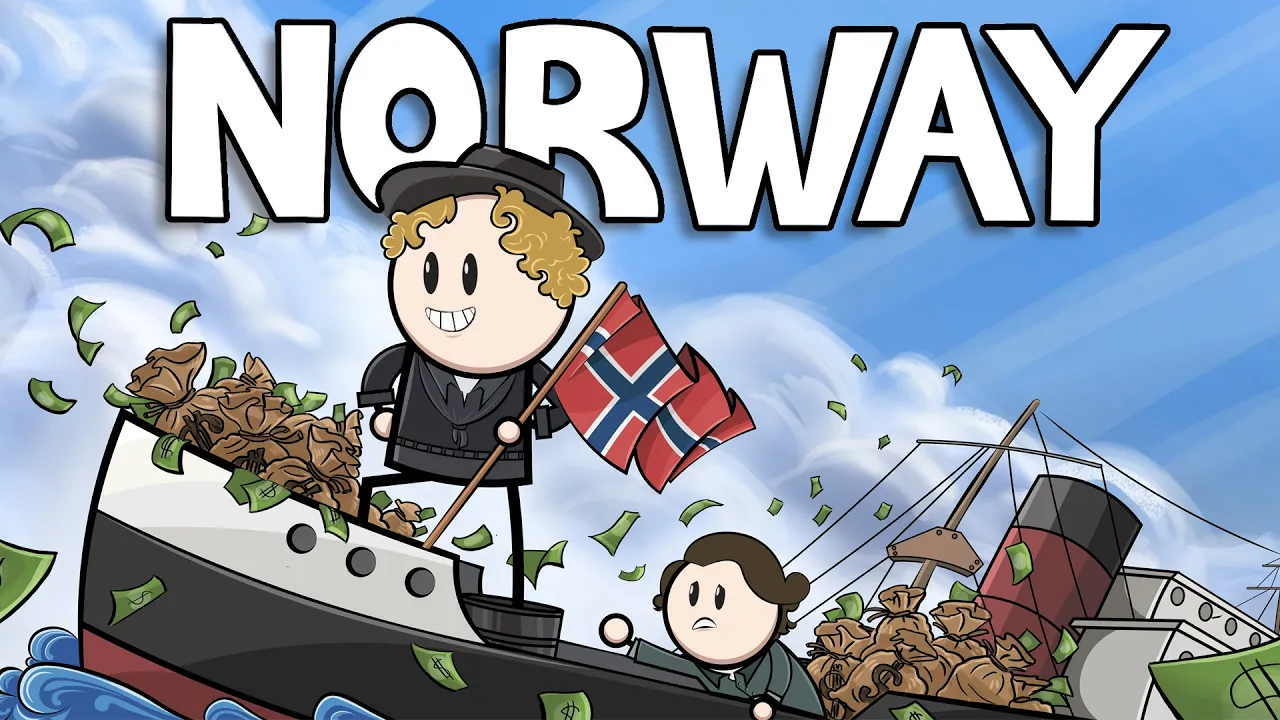
Norway, a country that seems too good to be true. Known for being one of the wealthiest countries in the world with a high GDP per capita, high standard of living, and rich in natural resources, Norway appears on the surface to have everything going for it. Today, it ranks among the top countries on many social and economic factors.
But how exactly did it achieve this success in the past 100 years? This is the story of how Norway defied the odds to become one of the richest countries in the world. Let's rewind in time to the year 1814.
Following the Napoleonic Wars, Denmark was forced to seed its 434-year control of Norway to Sweden. However, Norway had already created its own constitution and wanted independence. Following a short war with Sweden, Norway would be allowed to keep its constitution while still being part of a union with Sweden.
In the early 1800s, Norway had a population of 900,000 people with 90% living on farms in rural areas. Renowned English economist Thomas Mouthus had toured Norway in 1799 and wrote that it had a standard of living that looked high when compared to continental Europe, although historians note he sometimes overstated and may have missed internal variations. Despite its cold, rugged, mountainous terrain, Norway benefited from its abundance of fish, timber, and fresh water.
Being close to Great Britain and having the longest coastline in Europe also gave it a step up. In the early 1800s, Norway's open economy exported predominantly wooden goods, fish, glass, and iron product. I've brought back some timber and dried fish.
Great. Here's some British machinery and textiles. And the grain ship from Denmark should be arriving soon as well.
Perfect. Nice doing business with you. The United Kingdom acted as a key trading partner and a vital import source of machinery and technical skills into Norway.
Norway's economy was closely tied to the UK, benefiting from strong British demand, but also vulnerable during downturns in the UK. Since only 3% of Norway's land was arable for agriculture, it was heavily reliant on food imports. Out of this necessity, Norway had historically maintained one of the largest merchant fleets relative to its population size.
From the 1840s to 1870s, Norway's currency experienced relative stability after restoring a silver standard, and its economy experienced high growth largely driven by an increase in merchant ship building, foreign trade, and improved agriculture productivity. Over time, Norway's merchant fleet would turn into a strength, making transportation cheaper for sending Norway's exports abroad and employing many people who weren't in agriculture. During the 19th century, Norway's population grew at a rapid rate, and the country eventually had a hard time keeping up.
With the development of the steamship in the 1860s, Norway lacked the technical knowledge and was slow to transition from sail to steam ships. In the 1870s, with an international economic slowdown from the long depression, Norway faced economic stagnation and issues with overpopulation. The development of steam ships had also made the journey to North America safer.
Roughly 800,000 Norwegians left the country from the 1830s until the early 1900s, heading mainly to the American Midwest in search of better opportunities. Norway had the second highest immigration rate in Europe at the time, only behind Ireland. Many Norwegians experienced hardships, and it makes us realize how fortunate we are to have access now to so many modern services to support our well-being, including therapy.
Before we continue, it's time for a quick word from today's paid partner, Better Help. While often times it may be easier to focus more on our financial or physical health, mental health is also extremely important. Without it, it can be hard to sleep, be productive, and feel our best.
That's why one of my New Year's resolutions is to better support my well-being. I have found when I allocate time for this, I'm more present and able to do better work. In the rush of day-to-day work, having someone to talk to can really make a difference in our mental health.
BetterHelp is an online platform that helps match you to the right therapist based on your own needs. You can message, video chat, or communicate in whichever way works best for you. Go to their site, betterhelp.
com, to get started. And once you're there, simply answer a few questions to get matched. BetterHelp will match you with a therapist based on your preferences, their own clinical experience, and over a decade of matching expertise.
Click the link in the description or go to betterhelp. com/casualeconomics and enjoy a special 10% discount off your first month of therapy. And with that, back to the video.
Alongside having the longest coastline, Noi's unique geography of mountains rising from the sea with plateaus provided fields as well as lakes, waterfalls, and rivers, giving the country an almost perfect opportunity for creating lowcost hydroele electricity. Moving into the 1890s, hydroelect electricity played a vital role in powering Norway. Hydroelect electricity allowed Norway to develop out chemical, fertilizer, and aluminium industries that needed high energy inputs.
With the growth in hydroele electricity, Norway saw rapid industrialization in the early 1900s with abundant cheap electricity. Norway officially gained full independence as a country in 1905 after a peaceful dissolution from Sweden. The new country experienced economic expansion using its hydroelect electricity base to industrialize.
As the country continued to industrialize, it led to improved social reforms, including protections for women and children, accident insurance for seammen, health insurance, and the introduction of a 10-hour workday. At the start of World War I in 1914, Norway had the fourth largest merchant navy in the world. Although by declaring neutrality, since the Allied countries controlled much of Norway's foreign trade, it was forced to cut off its exports of fish, iron, and copper to Germany, which were vital commodities to the German war effort.
Germany would attack neutral ships delivering goods to Allied countries, and also declared war on non-friendly vessels. As a result, about half of Norwegian merchant ships were lost from the war at sea. Following the war and 1920s, just like other countries around the world, Norway suffered from the Great Depression with a peak unemployment rate of 33.
4% in 1933. Being an open economy that relied on exports and foreign trade, it was hit hard by the decline in global trade. Going into World War II in 1939, Norway again declared itself neutral.
However, the country was invaded by the Germans in April 1940. Its economy dipped as it turned into a war-based economy for Germany. It supplied aluminium for aircraft manufacturing, iron ore, nickel, and even fish for the German war effort.
This was devastating for Norway's economy, and people faced severe rationing and food shortages. As a result, many in Norway resisted with general strikes and sabotage, even in the face of imprisonment or executions. Norway would not regain its sovereignty until the end of World War II in 1945, 5 years after the initial invasion.
After the war ended, Norway faced economic challenges with damaged infrastructure and shipping losses. The US's Marshall aid program gave Norway $400 million to help rebuild the country. Norway also began to pursue a social democratic mixed economic system, which evolved to the Nordic model.
It focused on full employment, income equality, and social security. The aim of it is to balance economic growth with social equity by having a high progressive taxation to fund and support universal social services. To achieve this, there was a growing public sector and state planning and expanding hydropower and energyintensive industries, including aluminium and chemicals.
Even though Norway's economic growth lagged other Western countries in this period, it still saw respectable economic growth and rising living standards in the 1950s and60s. And then in the late 1960s, Norway was about to make a discovery that would change everything. But what could it be?
Well, if you said oil and gas, you're right. In the summer of 1969, Philips Petroleum discovered Norway's first oil field, Ecoisk, in the North Sea. It was one of the largest fields discovered at the time.
Over the next few years, more oil reserves were discovered and Norway played a significant role in Europe's oil and gas industry. This discovery supercharged Norway's wealth and led the country to experience higher growth rates than most other Western countries. In 1972, Norway established Stat Oil as a state oil company to ensure the country's oil wealth stayed inside Norway and didn't flow out of the country.
The oil and gas boom helped raise government revenues and accelerated funding for Norway's welfare state, including healthcare improvements, child care, and parental leave. With the discovery of large amounts of natural gas and petroleum along Norway's claim of the North Sea, the country would progress into one of the world's richest countries in the world over the coming decades. In 2023, the oil industry would grow to account for 24% of national GDP, 32% of the state's revenue, and 52% of Norway's exports.
Unlike many other resourcerich countries, Norway has largely been successful in avoiding the resource curse. Strong democratic institutions, low corruption, and an educated workforce helped ensure that oil wealth strengthened rather than undermined the economy. Through public ownership and Norway's petroleum taxation system, the government was able to maximize revenue capture from the oil and gas industry.
While a boom in oil and gas seems like a windfall for a country, it can also lead to a host of problems. Dutch disease occurs when a country discovers valuable natural resources like oil, causing its currency to rise, which makes other industries like manufacturing or farming less competitive abroad. Resource wealth can end up hurting other domestic industries by inflating the local currency, making it harder for them to compete globally.
To try to avoid Dutch disease, Norway decided to always invest its oil profits outside Norway. In 1990, Norway passed a law to establish a government petroleum fund, or otherwise known as the oil fund. The goal of the fund was to help the government create a long-term management with the spike in oil and gas revenue.
The fund initially only bought bonds, but eventually began buying equities in foreign companies, not in the fossil fuel industry. This fund offered the country a way to diversify away from oil and gas and ensure the wealth was sustained for future generations. Today, Norway's sovereign wealth fund has ballooned into being the largest fund in the world, worth $1.
9 trillion and holding approximately 1. 5% of the value of all listed companies in the world. This amount equates to over $340,000 per Norwegian citizen, a staggering amount.
Another interesting rule about the fund is that the Norwegian government is not allowed to cash out and spend more than 3% of the fund annually unless there is severe economic downturn or exception. This ensures the fund continues to grow long-term and helps to cover a fair percentage of the government spending each year. Despite all this, Norway still lost some of its competitiveness with the high growth and profitability of the oil and gas sector.
With consistently high oil prices from 1973 to 1985, this pushed labor costs up given the high wages in the oil and gas sector. Even with this lower competitiveness in other industries, Norway still experienced high economic growth from 1970 until 2000. Although driven by oil, the country still faces ongoing challenges with developing out non-oil competitive industries.
Even with large oil and gas production, Norway domestically uses hydro power for 96% of its electricity, and over 90% of new car sales are now EVs, making Norway a leader among the shift away from fossil fuels. The country also continues to make investments in hydropower and renewable energy. In recent years, with the Russia invasion, there has been EU sanctions against Russian gas, resulting in Norway becoming Europe's largest provider of natural gas.
Norway's importance as an oil and gas producing country in Europe has only continued to intensify and has come into focus in recent years. Overall, Norway has done exceptionally well in terms of its aim to balance economic growth with universal social programs. The country has used its rich natural resources, skilled labor force, and efficient institutions to thrive as a country while also investing its oil wealth away from fossil fuels into the world's largest sovereign wealth fund.
And there you have it, the economic history of Norway, one of the world's wealthiest countries. Comment your thoughts down below on what stood out to you. And if you want to learn about the economic rise and subsequent lost decades in Japan, click the video on screen and we will see you there.