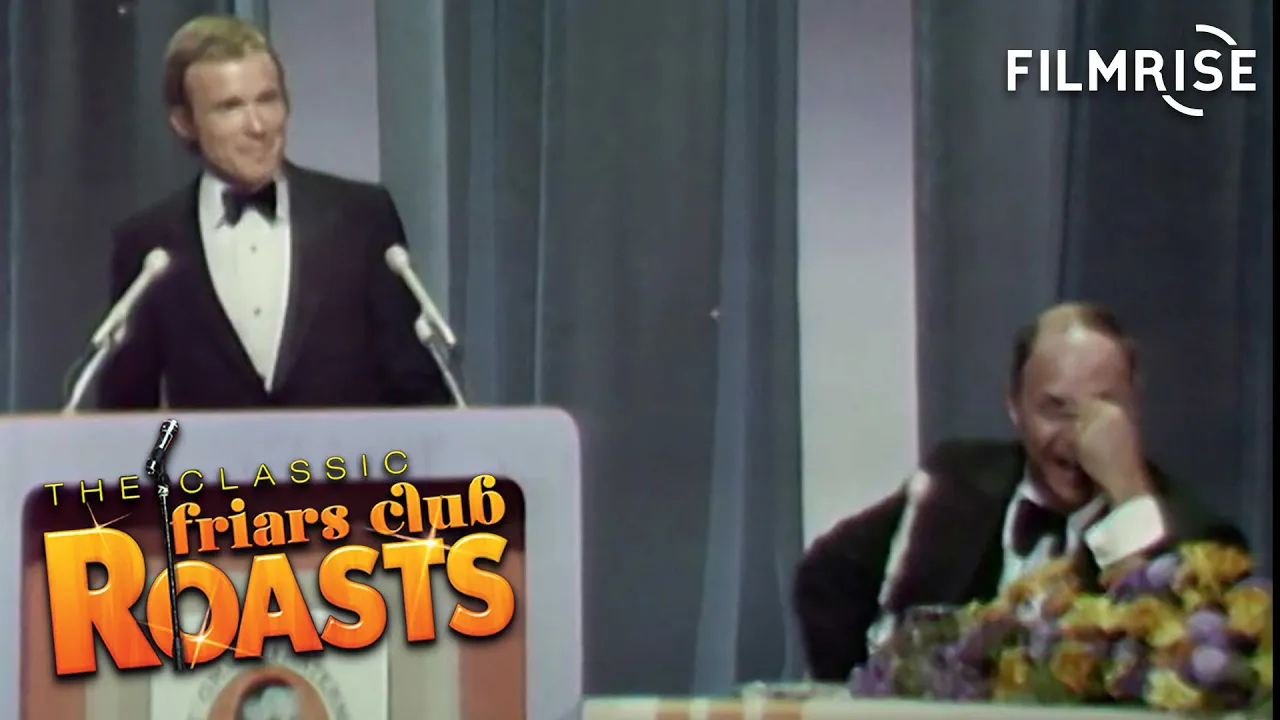
[AUDIO LOGO] ANNOUNCER: Friars Don Rickles. [APPLAUSE] Starring Milton Berle. Dick Cavett.
Chet Huntley. Alan King. George C.
Scott. Henny Youngman. Roast master Johnny Carson.
And our guest of honor, Don Rickles. All brought to you by Kraft. Kraft for good food and good food ideas.
And now, ladies and gentlemen, your roast master for tonight, here's Johnny. [APPLAUSE] Sit down, Donny. Thank you.
Thank you, ladies and gentlemen, and I bid you a very warm welcome to "The Friars Roast Don Rickles". For those of you who are joining us for the first time but have never attended one of these Kraft roasts, I might tell you a brief word about the Friars. We're a fraternal organization established, I understand, Milton told me, in 1914, and based on the concept of mutual interests, friendship, and most importantly of all, that you get your dues up on time every year.
Now, in the past, the Friars-- I could be watching jackpot bowling and I have to be here. In the past, the Friars Club has honored such great luminaries as Al Jolson, George M. Cohan, Irving Berlin, and tonight, Don Rickles.
Which should give you some indication of the deterioration of this club. During-- you're going to be easy tonight, are you? During this roast tonight, the gentlemen on our dais will come up here to this podium and they will pay tribute to our guest of honor.
Now, for those of you who have been with us before, I hope you realize that all of these remarks are made in the spirit of good fun, mutual admiration, and affection. We're suspending these conditions tonight because of the nature of our guest. Before you meet the first speaker, I have a few personal observations to make.
[LAUGHTER] You want to sit out here? Rickles got his early start in show business as a heckler at telethons. I don't know whether you know this or not, but Don didn't get married until late in life because he felt that marriage would jeopardize his career working gay bars.
I, I have a warm spart in my-- spot in my heart, or spart. I have several things in my heart. Spart has to be one of them.
Say the-- say the second word. I'm going to die. Oh, you'll be dynamite at the end.
This is an indication of your humor tonight, is it? No, I remember with fond memories the many quiet evenings that we've spent together. I only wish they hadn't been on my show.
And then it was just, just a year and a half ago that ABC scored the programming coup of the year, the Don Rickles television show. His manager, one of the most perceptive managers in our business, Mr Joe Scandore, said it couldn't miss. Mr Scandore, you might remember was also a lookout at Pearl Harbor.
It was a-- actually, it wasn't Don's fault that the show went off the air. The competition was brutal. Channel 13 at that time was running a documentary called "The Phillips Screwdriver: A Tool for Our Time".
But, Don, some of your friends are here tonight. Don Adams could not be here, and I can say this, I think, and Don might back me up on this, that Don Adams and I are probably the two closest friends that Rickles has, and neither of us can stand him. So I welcome you, I thank you for joining us, and you will meet our first speaker in just a moment.
[APPLAUSE] Thank you, ladies and gentlemen. In 15 years, the words "good night, Chet" and "good night, David" have become household words, particularly in the household they set up together in Georgetown. Little known, well-kept secret.
But it's a pleasure tonight to introduce the newsman's newsman and Vice President Agnew's favorite entertainer, Mr Chet Huntley. [APPLAUSE] Being invited to this affair tonight is a refreshing change for me. For one thing, I never knew anything happened after 7 o'clock.
I'm sure many of you are wondering why I, of all people, I who have ruined more jokes in my life than any other person I know of-- You're proving it. Why I was, was chosen. Why I was chosen to be a guest at this testimonial for Don Rickles.
Well, I guess it was because I've had such long experience communicating bad news. [APPLAUSE] This guy is rolling. And here, if you please, is a bulletin that just came in, was just handed to me as I walked into the studio.
The films, and this is all in quotes, the films of all the old Don Rickles television show, which was canceled two years ago, have been encased in cement and the Army is taking them on a train to a sea port from where they'll be dumped into the ocean. A great tide of protest has arisen from the towns through which this train will be passing. Who would figure this guy would go over?
Outraged townspeople are afraid of possible leakage. Well, as a result-- Get him out of here. As a result of all of these bulletins and others like them, David Brinkley and I became intrigued last year with the possibilities of a Sunday series to be entitled "The Nation's Wastebasket".
The idea was to star little known people of very little interest. Naturally, we thought of Don Rickles first. We wanted to bring Don into the studio for the opening show, but we had to discard that idea because of a local health ordinance.
So we went to his home. Unfortunately, Don wasn't there, but his mother was, and we interviewed her and it turned out to be a remarkable classic, a document. Brinkley opened the program by asking Mr.
Rickles if she could explain her son's chronic hostility. Mr. Rickles replied that all she knew was that Don had been like that all his life.
She said, even before he was born, he was known in medical circles as the furious fetus. [LAUGHTER] Somebody explain it to Don. And she was also inordinately proud of the fact that shortly after he was born, he became the poster boy for birth control.
[LAUGHTER] Suck it to him, Chet. One of the-- one of the highlights of that show was her disclosure that the family doctor yelled for hot water after Don's birth because he thought he had delivered a lobster. However, as we learned-- You're starting to get on my nerves, Chet.
We learned later he was wrong. He hadn't delivered a lobster, just a nasty little shrimp. But now-- Good night, Chet.
Before I turn-- before I-- before I turn the proceedings back to Johnny Carson-- Why? I should like to close by saying something I have wanted to say and have had a passion indeed to say for many years. Good night, Walter.
[APPLAUSE] I really have to say it was nice you got us off to a flying stop. Chet has all the comedy timing of the Cuban invasion. And now I would like you to meet-- Why don't you get off?
You gave me my start, but I'm fed up with the idea. I've resented that all my life too. I'd like you to meet Alan King, the historian of the Friars Club, a job similar in importance to being a dance director at Forest Lawn.
Would you welcome Alan King. [APPLAUSE] Thank you, Irving. Please forgive me for having to wear these.
I only use them for reading and to keep me from bumping into walls, but they actually are bad fitting contact lenses. Ladies and gentlemen, members of the dais, guest of honor. There isn't enough money in the world that can make me say that with feeling and conviction.
As a member in good standing and historian of the Friars for 24 years, I have participated in many Friars functions, roasts. We never maligned, attacked, ridiculed a man we didn't genuinely care for. Until, of course, tonight.
Now, Don Rickles was admitted to this world on May 8th, 1926, which only meant that his family faced the Great Depression three years earlier. He grew up with the disadvantages of a child of the ghetto. For economic reasons his family moved a great deal, and for some reason they would never tell Don where.
He was run over twice by a welcome wagon, once when his mother was driving and once when his father was driving. Don showed a great talent at a very early age for writing. A lot of you don't know that he helped punch up "Mein Kampf".
Don Rickles' career took an upward turn when in the early '50s he was booked into the club Elegante in Brooklyn, and that's where the legend of insultant to the stars was really born. One evening, in walked Frank Sinatra, and Don, in his usual charming manner, endeared himself to Mr Sinatra with such lines of, "Remember the good old days, Frank, when you had a voice? Saw you in 'The Pride and the Passion'.
The cannon was great. " Sinatra roared with laughter. In fact, after the show, he rushed backstage to Don's dressing room, put his arms around him, and held him while Jilly punched him in the mouth.
If I may digress from his professional life to his personal life, it says in 1965 he was a confirmed bachelor. Until 1965 he was a confirmed bachelor, a gay bon vivant man about town, and you know that most gay men about town are bachelors. No, I'm just reading it, Don.
That's all I'm doing. Don, of course, is now happily married to his lovely Barbara and has two beautiful children, Mindy Beth and Lawrence Corey. Don, you're not at the top of the heap.
Heap of what I don't know, but I don't know anybody that belongs there more than you. Your star keeps rising, your fans keep multiplying, and the royalties from "Mein Kampf" keep rolling in, rolling along. But I never thought that I would ever have this opportunity, in front of a vast audience, to tell you what I really think of you.
No, I'm serious, Don. You know I'm serious. Every time you open your mouth you should be arrested for littering.
And I mean this, Don. You are absolutely, unquestionably the baldest, sweetest pussycat I have ever known in my life, and I love you. [APPLAUSE] Thank you.
Go ahead, Bones. Our next speaker, Henny Youngman, is known as the king of the one liners, mainly because Youngman can't remember two lines in succession. If I had to compare Youngman to one man in the whole world, I suppose it would be Will Rogers, because they've both passed on.
Ladies and gentlemen, take Henny, please. [APPLAUSE] Good evening, ladies and gentlemen. I want to say that I'm so happy to be part of this tribute to gentle Ben.
And speaking of Don Rickles, two guys meet in the gymnasium. [LAUGHTER] Two guys meet in a gym. One's putting a girdle on.
His friend said, since when do you wear a girdle? Since my wife found it in the glove compartment of my car. [LAUGHTER] Cut it out.
Beggar walks up to a lady's house, says, can I have something to eat? I'm hungry. She says, would you eat yesterday's soup?
He says, yeah. She says, come back tomorrow. As everyone knows, Don Rickles has a large family, but what about my family?
Nothing to do with it. Henny, Henny-- I've got a-- Henny, will you-- will you back off just a little bit? Please, back off just a little.
A little further. A little further. - How far do you want me to go?
You got a car? Berle, I need you like he needs a hairnet. I've got a brother-in-law karate expert.
What's that got to do with anything? Who cars? I reminded him when I grabbed him.
I've got a brother-in-law karate expert. Joined the Army. First time he saluted, he killed himself.
Who is this guy? I take my wife everywhere, but she finds her way home. You're rolling, you're rolling.
There's two astronauts up in the air. One of them-- over here, Don Rickles. There's two-- Berle, why do you keep walking?
There's two-- there's two astronauts up in the air. One decides to take a walk in space. He comes back five minutes later, knocks on the other guy's window.
He says, who's there? Don Rickles and I come from the same neighborhood. What am I getting for this guy?
There's a little jeweller who stutters, has a little shop. So a guy, guy walks into the store, he opens it up, he says, here, fix this watch. Put a new band on it, put a new hand on it, clean it up.
I'll be back in a half hour. Walks out, slams the door, and the jeweller looks up and goes, c-c-c-c-come in. Getting back to our guest of honor, Don Rickles-- We never even met.
Let's keep it that way. I think he's crazy, but everybody's crazy these days. A man walks into a psychiatrist's office.
These are your jokes! From now on. [APPLAUSE] A man walks into a psychiatrist's office.
He says, what do you do for a living? He says, I'm an auto mechanic. He says, get under the couch.
I could go on talking about Don Rickles all night, folks. But frankly, he's not worth it. [APPLAUSE] Thank you, Henny.
We enjoyed that trip down memory lane with Joe Franklin. I'm, I'm delighted this next guest is here. Even though his show is opposite mine at 11:30, we, we remain very good friends.
Dick was one of my old monologue writers on "The Tonight Show", and whenever I want to see one of those old monologues, I tune into his show. But I'm glad Dick is here for a much more personal reason. If you'll permit me this, please, because you alone Dick can give, give the lie to the rumors that, that I'm aloof.
Articles have said that I isolate myself and I don't have a warm relationship with the people that work with me. So, ladies and gentlemen, would you welcome my close friend of two years, Dick Carter. [APPLAUSE] Thank you.
Thank you, Johnny. You never should have dropped Treacher. That was a real mistake.
Seriously, if I may digress to the subject of Don Rickles, Don and I go way back. Many people don't know this, but he-- I first saw him in a little club he was working in years ago in New Haven, a little undergraduate club. It was called the Greasy Thesis.
And Don was not the draw actually there. He was not the reason I went. I was interested in legitimate theater in those days and there was rumor that Brian Hearn was going to drop in.
And I went, and first time into a club like this, and there in the spotlight was the headliner. It was not Don, actually. I might point that out.
The headliner was an elderly Korean gentleman who made repulsive hand shadows on his wife's back. Strange club. And Don was there doing his warmup.
Actually, Don was standing in for the regular warmup man who had taken a better job as a derelict, but that was my first evening in a cabaret scene done like that, and it was a new world to me. I had no idea that there was such a thing as a fleeing ovation. The only one who worked harder than Don during his act was the hat check girl.
But the thing was, it was embarrassing. The entire audience walked out, but I stayed. Something held me there.
I don't know if it was a combination of suspense and excitement and Don's mother, a brawny woman, impeccably clad in Naugahyde knickers and a wooden hat. I remember thinking at the time how-- You just blew the will. I remember thinking how lucky Don was that how many mothers would take time off from a vegetable truck to come over and have-- but any way you look at it, when you look back over the years, Don, you really have come a long way since those old days as a paper hanger in Munich.
Actually, you know, it's jokes like that to contribute to the image people have of Don. Friends of his know that he's worked tirelessly behind the scenes for countless charities. He's done benefits that he never brags about publicly.
He worked around the clock night after night helping bang out the charter for gay liberation, and-- It's funny, when you think about it, how fate works. He's a-- he's a strong personality, Don, with a lot of charisma, and if he'd born, born in a different time and a different place and a different period of history, who knows, he might have become a comedian. You're a wonderful human being, Dick.
In closing, I would simply like to say that it is for all these wonderful reasons that Don is, is receiving tonight the reward that he so richly deserved and has so worked for for so many years, public humiliation by a cheese company. [LAUGHTER] [APPLAUSE] Thank you. Thank you.
George C. Scott is on our dais tonight and I haven't the slightest idea why. I don't know how to figure this man.
He refuses to attend the Oscar ceremonies but he will come to a dinner for a two bit comic. He's a-- he's a superb, superb actor. I don't think anybody can forget the magnificent portrayal of the power mad general in "Dr Strangelove", that he went to that to the great portrayal in "The Hustler", and the most brilliant characterization, seriously, I think in film history, the motion picture "Patton".
It is my pleasure to introduce George C. Scott, who will come up here and do absolutely nothing. [APPLAUSE] Ladies and gentlemen, Friars, and honored guest, I think I should confess I feel a little out of place up here with all these marvelous comedians, but I must say that everyone here has done what they could to make me feel comfortable.
A little while ago one of the very funny men here on the dais approached me and said, listen, Georgie baby, know you're not a comic or an entertainer. Don't get uptight. You need any help, if you need somebody to throw you some ad libs, just look at me and wink.
I appreciate this. I really do. However, I think I'm going to try to go it alone tonight, but thanks anyway, Chet.
[LAUGHTER] [APPLAUSE] I think you should all know that I did not come here tonight to make fun of Don Rickles. Neither did I come here to trade barbs with Don Rickles, because it would take a comedian to do the first and a true wit to do the second. Instead, I've come here tonight to say something nice about Don Rickles, and for that you have to have an actor.
My friendship with Don goes back over 20 years. When we met, we were both studying acting at the American Academy of Drmatic Arts here in New York. I was studying there under the GI Bill and Don was there on a sort of scholarship.
He had received a gift certificate from Mussolini. Back in the days when Don was at the Academy of Drmatic Arts, he was a man to be reckoned with. He was a man of ambition and determination, not this poor slob we're honoring here tonight.
Then he was a man of fire, he was a man with drive, he was a man we all depended on, and he never once let us down. I mean, when you sent him out for a prune Danish, by golly you'd get it. I never forgot his many kindnesses and I also never forgot that more than anything else, Don wanted to be an actor.
And when they asked me to do the movie "Patton", I immediately suggested Don for one of the parts. I even helped him with his screen test, and he was superb. It was one of the most poignant scenes in the film and Don played it brilliantly.
The director, Franklin Schaffner, I remember he said he had only one comment. He said, Don, please, when, when Patton slaps you, please don't slap him back. I really wanted Don in the movie because years ago he tried to help me.
He offered me a part in a picture he was making. At the time, however, I was appearing here in New York in Eugene O'Neill's classic "Desire Under the Elms". Don tried to talk me into leaving the play and coming out to Hollywood to do the picture, and I remember his very words, he said, George, it's not much of a part and it doesn't pay much money, but before you turn it down, remember this.
It is a chance to work with Annette Funicello. Don, we have been friends for a long time and you've provided me with many happy moments, and I'd like to say something now that may embarrass you, but I mean it sincerely. On the surface, Don may seem to be brash and crude and insensitive, but believe me, if they ever cut this man open, they would find a heart of pure gold.
And if they didn't, it would be worth cutting him open anyway. Good night, Don. We love you.
[APPLAUSE] Thank you, George, really. It's nice to see you continuing in the dramatic vein. Milton Berle-- Good night, all.
--has been the model for countless comedians, and I'm proud to admit that I was not one of them. Actually, I can think of no one more appropriate for this occasion, no two people in show business who probably have more in common, than Berle and Rickles, and they should both resent that comparison. But the comparison really is kind of unavoidable.
The same brashness, the same highly developed insensitivity. They're really so much alike Berle could actually be Rickles' father. No, he's old enough.
He's also careless enough. Would you welcome please Mr Television, Milton Berle. [APPLAUSE] I want to thank you very much, Johnny.
That was a very wonderful introduction. I needed that introduction like a Hermione Gingold needs the pill. Seeing this tonight, I don't know if it's a testimonial for Rickles or a mercy booking for Youngman.
Henny, when you get home tonight, how are you going to explain to your wife that Chet Huntley got bigger laughs than you did? I'm only kidding. I'm only kidding, Henny.
Someday you're going to find yourself, but it's not worth looking for. Ladies and gentlemen, I must say, I, I enjoyed Dick Cavett and I heard that he used to write jokes for Johnny. Now Dick has his own show, and believe me, Johnny, he's doing you more good where he is now.
I'm only kidding. I'm kidding. I'm kidding.
We understand. When you're number three, you try harder. Am I allowed to ad lib with you?
Yeah, you can, sir. I'll check my brains. We'll start even.
Where-- MILTON BERLE: What? Where would you find a small enough check room? Oh, yeah?
And George C. Scott, you were very, very funny. Did you ever think of teaming up with Moms Mabley?
But, ladies and gentlemen, enough about-- enough about these stars. I didn't come here to talk a lot about these talented people. I came here to talk about Rickles.
This young man, this illegitimate son of Heinrich Himmler. Why are we giving this White Panther a dinner? Why is he sitting up here with all of us biggies?
[LAUGHTER] You can use it. He's the only man that Gentle Ben ever bit. This is the only man the Gentle Ben ever bit.
This is the only man that Gentle Ben ever bit. [APPLAUSE] This is the only man that Bentle Gen ever bit. But I will say, ladies and gentlemen, that recently Don has had some very good luck in the movies.
He found a wallet under his seat. But I saw the picture "Kelly's Heroes" that you made in Czechoslovakia. Oh, it was Yugo.
Yugo, Yugo. That was his first in Yugoslavakia. And that picture was part of our cultural exchange, the picture he made.
We sent them Rickles and they sent us a stag movie of Oscar Homolka. I think, though, I think that I have put him down enough tonight. Let's, let's be fair.
You never heard about the nice things that Don does because Don doesn't do nice things. So in conclusion, Don, may I say about our guest of honor, ladies and gentlemen, you show me one person who doesn't like Don Rickles and I'll show you your average American. [APPLAUSE] Ladies and gentlemen, it's now time to hear from the guest of honor.
Oh. And although we've been kidding him for the past 50, 55 minutes, very good naturedly, he has-- he's been called a great humanitarian. That is if you take the words of the Krupp family.
I would like you to meet our guest of honor, and tonight Kraft does salute Don Rickles, and it's only fitting that a cheese company would sponsor a dinner for a rat. Ladies and gentlemen, I present most affectionately Mr Don Rickles. [APPLAUSE] There have been, ladies and gentlemen, many exciting nights in my career.
Tonight I will not count. I would like to say good evening. They have-- good evening was rolling.
Kraft Music Hall has been kind enough to honor me tonight. I've asked for a dais and unfortunately I got guys that happened to be in the neighborhood. There were three winos hanging out in the highway going-- [MUMBLES] They washed them up and put them here.
But I kid. First of all, we'll go from left to right. Dick Cavett, I say this honestly.
I was on ABC and I'm fed up with them as I'm fed up with you. You have a wonderful nighttime show opposite Merv Griffin and my dear friend Johnny Carson, and they plan to beat you up. And why, Dick?
Because you're catching on. Here's an old guy eight years on the air, this man Johnny Carson sitting to my right. He said to me, beat him up.
I say to you, Dick, really, you wrote for Johnny Carson and today you have your own show on another network opposite this man and you're hurting him. Now that to some people doesn't sound like humor, and I can tell by the reaction-- Sure doesn't to me. Sure doesn't to you.
Seven years ago you were hanging around ABC with a little game show going, err, err! Hit the buzzer and win a trip. And you were a contestant.
And I was a contestant. No, he was the buzzer. Look at this, how the whole dais turned on me.
And it's true. What's true? Oh, shut it!
Henny, once in a while move your lip. How many big stars do I know wear the clip on bow tie with the little rust on the shirt? But I say tonight, my dear friends, and I quote the words of a great man, a great prophet, Eliezer, who said, "If thy love thyself, thy be honored at thy dinner.
Thy dinner be thee. Thith I know thyself. " I've got to get this thing fixed.
And to you, George C. Scott-- I skipped you, Milton, because you are my idol. I say from my heart, George C.
Scott, as Patton you made a fool of yourself. George C. Scott stood on the screen in the great emotional picture starring George C.
Scott and Karl Malden, who you objected to. You remember when you called me and said, why is he on the screen? I could play his part and do it great.
Mm-hm-hm. And he stood there. That's right, Alan.
Laugh your way to stardom. Your wife is leaving you. And I said-- hey, George!
I'm talking! And I kid him about "Patton" and I predict he will win an Academy Award. I'll step out on a limb.
[APPLAUSE] Now, now, now. What is this, a luncheon? George C.
Scott who said in that great scene, I'll never forget it, "When all the men--" listen! You can learn, George! Sitting here tonight like you're Moses.
You're so great, make the crowd disappear. I don't know who you are, kid in the front, but you're getting on my nerves. You're a surly little kid with a drip dry shirt but no stay in the collar.
What's your name, kid? Take your time. What's your name?
Wrong! What's your last name, Jim? You better answer me or the general will wipe you out!
What's your last name, Jim? Take your time. Look on your underwear.
Maybe it's stenciled. What's your last name, Jim? What?
Jim Mulholland? I'm in the business 20 years, I don't have a joke for a dumbbell that's named Mulholland. What are you, a road?
Hope you make a left and go right into yourself. Play it. Play it.
Play it. But to you, George C. Scott, I say from my heart, don't wave the flag of surrender.
You are a big star. Be secure. Tell these people what you told me before the show went on.
You don't need this. You are a big man and you're a great artist. I quote the words of John Barrymore, the late great John Barrymore, who said, "Let the light leave the spot to thyself!
Let thyself be thy spot! " You know what worries me? George C.
Scott's going, yeah, that's true. And to you, Henny Youngman, I say from my heart, you're old. You've got to be put in a home.
You're going to hurt somebody. Can't sit in the room in rockaway with the Farina spoon going, wah! And then there is a man named Alan King, and Alan King is a great valedictorian.
Is that the word? I ask you like you know. Alan King, who said to me in his beautiful country estate, notice how the hunting dogs bite your wife.
He's the type that hangs around the health club and wants to pull off your towel. Is this too fast for you, Mulholland? Why do they put one dumbbell right in the front?
I'm rolling and this kid's going, pull off the towel? Engine room, one third ahead. You're laughing, huh, John?
And Chet Huntley just took your wallet. I didn't forget you, Milton. Don't be depressed.
Milton's sitting there going, he forgot me. I never forget the king. You're the greatest living comedian of our time.
Did he buy that? Anyway, look at the police officer from New York City watching the show. When you get a chance, check the city.
The policeman standing there going, I'm, I'm, I'm a cop. And the woman-- where's my purse? The cop's in the show.
Check with him. I kid you, Officer. My luck, this will be the dummy that stops me outside.
All right, let's hear it again, fella. Let's hear that joke about the cop watching the show. My dear friends, we come to Chet Huntley.
Good night, David. Good night, Chet. You're boring.
Chet, what is your heritage, Irish? - Scotch. - Scotch.
You're cheap. Tell me one thing. You're a Scotchman and be proud of it.
When you march, what's under the kilt? I quote the words of a great Scotchman, Harry Ermin. Look at this, George C.
Scott went, Harry Herman? He said, (SCOTTISH ACCENT) I do not care where you come from, but if the Highland come from the cryke, the cryke come from the Highland. True.
It's true? I made it up. You haven't even heard of it.
Chet, seriously, good luck in your retirement. You've been a great asset to the news, really you have, and you're the only one I will be serious about because you've done great things. You've brought the public honesty, which we need in America today, and I thank you for that on behalf of all.
[APPLAUSE] Last but not least, Johnny Carson. Oh. Before I speak of Milton.
Johnny Carson said to me, make me last. Make a big fuss over me. Who cares what happens to Milton?
And, Milton, he's right. Who cares? But Johnny Carson gave me my start in television on "The Late Night Shot", and I'm very grateful to you.
Johnny, I say this from my heart. I've been proud of you and I've enjoyed working with you, and I say this very honestly, don't ever hang around me. Don.
I'll be with you-- I didn't forget you, Milton. And last but not least, one of the great troopers, a man that was around with all the greats. Sophie Tucker, rest her soul, Al Jolson, Eddie Cantor, and just recently worked with the great Harry Lyman.
This wonderful man, Milton Berle, came up to me and said, I'm Milton Berle, a great star, a great performer. I said, I know, and he tapped for me. Tap danced about an hour and a half.
I said, go away, old man. Milton, you're a great star. I spoke to the Will Rogers home and we have your room.
But I kid about Milton Berle, really. There are many great artists. We all know this.
Not to be maudlin. Is that the word? Good.
I'll go by that. Not to be maudlin or hepentious-- That's hepatitis. Oh, who cares?
I say to you, Milton. What do I say to him? But I say to-- good night, Milton.
But what I say to you, Milton, there are many great performers. I thank you, Milton, for starting me and making me feel important, because that is so beautiful, and you're a great artist and a great showman. I mean that.
[APPLAUSE] Now, to all of you and to Kraft Music Hall, to Mr Johnny Carson, and to the wonderful guests on the dais, to you people in the world of television, thank you for making me feel a little bit important. But I promise you, I will not let it go to my head and forget my values. Thank you.