I will also tell you that for the second year in a row my audio failed when I was recording in lecture one um and my audio was gonna be terrible today but my replacement microphone is getting delivered by Amazon this afternoon so it will be better in the future if you are listening to this after the fact I'm sorry it sounds bad okay so our goal today is to start thinking about how we make sense of this whole interconnected network of things that are part of the immunity system if you think about other physiologic systems
say the nervous system there is kind of this one Spotlight organ the brain also with other important parts you think of the cardiovascular system the heart right away um when you think of the immune system it gets harder to think of what is the organ and as you'll see today we can sort of talk about why that is and what some of the ideas are but we have this it really interconnected system with a lot of different parts and so in order to make sense of it we like to use different sort of classification schemes
to divide up the immune system and to help us describe different aspects of the system one of the ways that we divide up the immune system is into a set of layers um so we often talk about the immune system as having three different layers one the barrier defenses one the innate immune system layer and one the Adaptive immune system layer and so as we talk about different aspects of the immune system we can classify them into one of these different layers um sometimes people also talk about something called the intrinsic um immune layer I'm
not going to say a ton about that and the real reason is because these three layers are a little bit artificial in US deciding we're going to call this part barrier this part in this part adaptive um the things that some people call intrinsic I feel are sort of straddling the line in some different parts and so I cover them in a different in a different way not as something separate um if you have previously learned about the acquired immune system that is actually what I am referencing here as the Adaptive music uh the acquired
immune system term um really stopped being used by immunologists around 2000 but sometimes people in other parts of biology still put it when they're describing their immune system in their textbooks so you will not hear the word acquired from me the word acquired immunity kind of makes me a little Twitchy um one time Dunaway said it in something and it was funny um but uh so so we're gonna think about this in terms of barrier innate and adaptive I'm going to tell you a little bit about barrier defenses today I'm going to tell you a
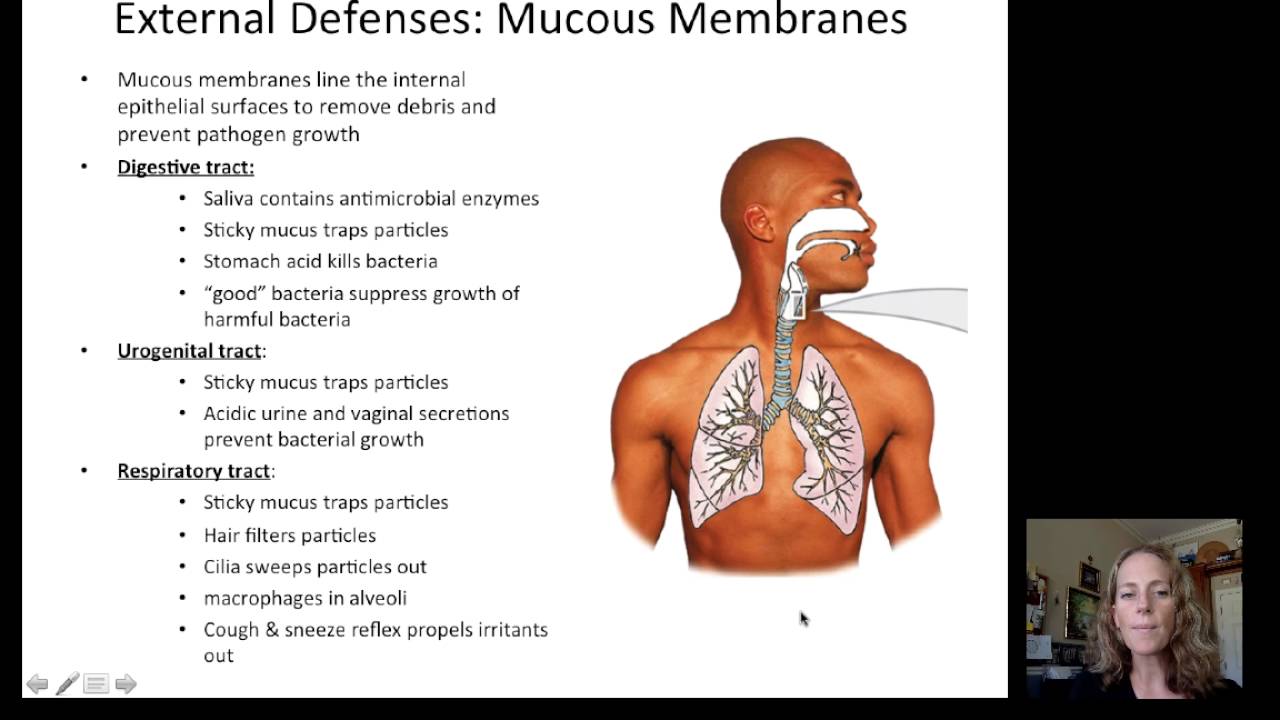
little bit about them another uh day coming up um but immunologists often don't really think about this layer of barrier defenses and people often forget about the barrier defenses as part of the immune system um yet they are incredibly important defenses um one of the things that is becoming kind of new and hot in the field is thinking about barrier immunity and in some ways it's like yeah guys we probably should have been doing that but that's okay um the biggest organ of the barrier defenses is the skin basically you have this nice layer that
protects you in this case in many cases protects you from infection it keeps the microbes out so they can't infect you in the first place to start disease there are some other parts of your body that have to be in contact with microbes um because they have to be in contact with the outside world like the respiratory tract the GI tract and many of them have special adaptations to help reduce infection and be a barrier to infection so there are things like the acidity of the stomach or the Cilia in your lungs that are sweeping
uh microbes out or things like that and so all of these things are kind of broadly things that are part of the barrier defenses again you know people often don't really think about this as being a part of the immune system however if you see people who have compromised barrier defenses the most common way that you might see that is uh thinking about burn victims who have compromises In Their Skin the problem that they have is recurrent infection because they don't have a barrier to microbial colonization so the barrier is important but by and large
when we think about the immune system we tend to spend most of our time as immunologists thinking about either innate or adaptive immunity and so we're I'm going to give you kind of broad Strokes definitions of innate in adaptive immunity um so that we can then apply other stuff to those broad definitions though we will then be spending much of the semester speaking about a neighbor's adaptive immunity um there are some common defining characteristics of the innate versus the Adaptive immune response they are shown from your textbook here um one of the big differences that
we see between the in adaptive immunity is the timing of their response following microbial exposure the innate immune system is responding within hours of that microbe coming into the body usually I think of the innate immune response as being the response that's happening within say the first 96 hours alternatively the Adaptive immune response is going to be much slower it is a response that often is not going to really be appreciable or measurable for about a week it might be Max at 10 days or two weeks so it is slow the immune response is fast
what I hope that you might realize in looking at that is that's actually a pretty important thing if you recall what I told you about growth rates on Monday if you had to wait 10 days before responding to any microbe that microbe would win every time because of how quickly microbes reproduce so having something that's responding in the first 96 hours is pretty important however when I was in graduate school when I took Immunology as an undergraduate actually when I was in graduate school um as Tas we each had to write up things about certain
sections of the course and um the innate immunity stuff was kind of a running joke among us as Tas the thing with the Short Straw like no one wanted to deal with that no one wanted to think about that was the lame thing the Adaptive universe um and there are a lot of reasons why people think about the Adaptive immune responses being really important ly important I went through our class schedule and circled is this more related to Adaptive or innate immunity you would see the majority of what we're going to talk about this semester
is going to be adaptive um because of all of these other properties of adaptive immunity I hope you also can see here that with the time issue if innate immunity didn't exist even though we as grad students back in the day were all like oh that's the lame one um you would not exist so we should not underestimate it um and I'll even show you another uh piece of information about that I'll actually switch the order of some things up and show you that right now um also um if people didn't notice the slides are
posted though I'm going in about things in a slightly different order um so this is um an example of kind of a general idea of what might happen with an infection in an individual so first we can look at the yellow line where we're seeing the amount of take your favorite pathogen um over time and this is kind of what it should look like after infection the microbe should start out at zero because you weren't infected with it then you get infected and the micro starts to grow in you and reproduce eventually it kind of
gets to some peak level and gets stuffed in its tracks no more increase and then finally we decrease and we reduce that number of microbes there are patients who have been described there are some very famous patients in the uh Immunology literature who have genetic mutations that me that mean that they actually have no adaptive immune response at all so there are some mutations that give you zero adaptive immune response and those patients um particularly in the past really did have a lot of issues I would say most of them did not make it past
age 20. um and they had a lot of issues with infections we now have some pretty good treatments so now they can be pretty healthy but what you can see is that in those individuals who are in the green line microbes are able to reproduce and they sort of exponentially in Forever indefinitely they do eventually get stopped in terms of their increase [Music] in those individuals those individuals might have those microbes reproducing in their body forever instead of actually having the immune system get rid of them without the innate immune system we can hypothesize that
we would see what is shown here in the red line which is that the microbes increase exponentially in fact they increase even faster than they normally do because normally the immune system was doing something here to slow them down a little bit they just increase out of control exponentially really quickly and this is only a hypothesis because we have never found a person who does not have who has a complete lack of enemy immune response in fact we really haven't found an organism that has a complete lack of an in the immune response having a
complete lack of an innate immune response is incompatible with life as far as we can understand so as much as we are going to think a lot about adaptive immunity and people adaptive immunity is the big flashy one that many immunologists think about um you can't be alive without the innate immune system so even though I'm going to tell you here about some cool properties of adaptive immunity don't undersell the unique immune system um so the next big difference between these two responses um it sort of hinted at in both of these um next two
boxes it's always really weird to describe to people who don't yet know immunology and so that's why they people always describe these things in the weirdest terms so I'm just going to try to tell you what is going on with me um so the idea with um the third one down with innate immunity um we have a relatively small number of things that can be recognized a small number of receptors most of those receptors recognize things kind of broadly so we do recognize a ton of pathogens sometimes I like to make up a guess this
is a totally made up number that maybe we have say a hundred in the immune receptors and I totally made that number up alternatively with the Adaptive immune response we have about um a quadrillion different receptors um so it's this massive number of receptors allowing us to have really really good specificity if you looked at the news earlier today argument for a later time but there was discussion of in fact the FDA approved overcon specific boosters today the way that those would change the immune response would be in changing this nice selective adaptive response the
innate response is exactly the same the Adaptive response is so specific that's where we're seeing the difference between this year's flu and last year's flu and Omicron and Delta of whatever have you well the innate response is going to be much more limited it might respond to virus um for some reason I mean I'll just love the phrase the Exquisite specificity of the Adaptive immune system because we have such great specificity it's really really specific and there's a huge number of uh potential receptors with the innate so this one is the one that's always real
tricky to to phrase until you know what you're talking about later on you're going to come back to this and be like oh yeah of course right now that's Gobbledy with the with the innate immune Universe you have some limitations in how much variation you can have and The receptors that we have our normal old receptors in the Adaptive immune system there are some unique genetic processes that allow us to get more variability in The receptors so sometimes people will talk about this in a bunch of different ways sometimes people talk about germline receptors versus
variable receptors until you know what the heck germline receptor versus variable means that doesn't help you any more than this the moral of the story is normal receptors versus fun genetics um the other big difference is that when you are making an innate immune response that response is constant while your adaptive response will improve or change over the course of the response so to give you a general idea of this again this is something that can be we can talk about in much more detail later on what might happen when you are exposed to a
particular microbe the lighter blue color shows you the magnitude so this is the general size of the innate immune response over time the darker blue is the Adaptive immune response over time so you can see the innate immune response has this Pro of making a response pretty early where the Adaptive response is a little bit later but then when the Adaptive response finally does decide to show up you have this pretty nice um response that's going to help you out a lot however later on if you get infected again with this same thing your innate
immune response is going to look exactly the same as it did before while your adaptive immune response will look different it will have in fact adapted how we got the name um and so you'll see both it's actually a change both in quantity and quality of the response with adaptive immunity and in fact even if you were to look at the response throughout this time even though you're getting both the change in quantity and quality as well so that response is improving over time the innate immune response is basically always um the same and one
sort of key reason why this can happen again this is this slide is going to look like sort of not that important and why is she telling us this and if you come back and review these slides say right before exam one or right before exam two you're going to look at this one and be like oh yes this is so important because it's actually like a key principle of the whole field it's just now you don't totally know what the importance do you have a question yeah [Music] um but I don't understand why is
it getting so great question um one of the reasons is actually this so perfect question um so a general way that the Adaptive immune response works is that we make a huge diversity of adaptive immune cells here they're shown as different because of different colors they also have different shape receptors so when you start out a response you have one Yellow Sub when the yellow cell binds to its particular microbe we basically are saying to it you're good you did a good job we need more of you you're important and so that self divides a
lot and expands so we have selection of a clone the colonial selection Theory so now instead of having one you have many of those cells and that's a big way that we get that Improvement is that we go from having one cell that has the knowledge to fight the microbe to having many cells that have the knowledge of vitamins does that help to address your question um and so the this idea of clonal selection is a key part of how the Adaptive immune response works um there are other ways that as immunologists we can divide
up the immune system one of the early ways that some immunologists try to divide up the immune system um is one that you might see referenced in books or things I actually kind of despise this distinction but um because and the reason why I despise it is because it confused me so much as a student now I'm like okay I get what you mean but at the time the student I was like but no um so I don't love it that's okay but sometimes we think about cells that do stuff important and we often call
that cellular immunity because the cell is doing a thing other immunologists care a lot more about the liquid of the blood which really contains proteins and so they think about the humors the Greeks talk about the humors and they call it humoral immunity because it's it's the liquid blood stuff I used to get super confused about that because guess what those proteins in the humerus came from cells so I was like this is dumb they're all it's all cells what are you doing um but often we can talk about whether the cell has the key
role or the protein has a key role I mentioned this because um starting on Friday we're going to go into more detail about the innate immune system on Friday we're going to talk about innate immune you need immune response in terms of humoral responses or proteins the next week we'll do innate immunity in terms of cells or cellular responses so there are times when this distinction can be useful um don't get too hung up on it but what I also want you to see is that this is kind of you can see we're sort of
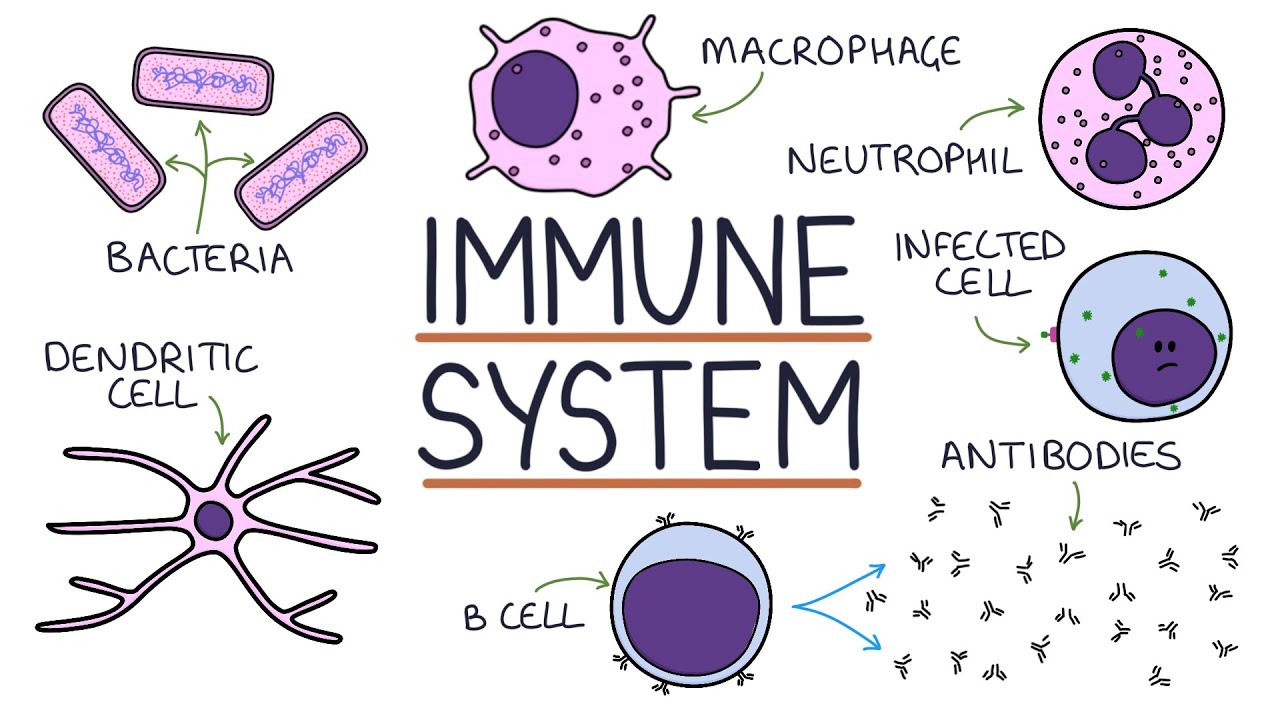
starting to take that mass of all those different things that are part of the immune response and divide it up to try to help us make sense of it the other big thing that we can do is we can look at the different kinds of cells of the immune system and try to divide them up and so um for the next while of this class today we're going to talk about the types of blood cells and sort of divide them up what we would find in terms of cells in the blood um if you actually
look at blood under a microscope this is the list of cells that you might potentially see tomorrow in lab you are going to look at blood under a microscope and this is exactly what you are going to see um so you can see that blood contains red blood cells or erythrocytes as well as white blood cells and some platelets immunologists are generally focused on the white blood cells and another word for white blood cell is leukocyte we can divide up the leukocytes into different types I want to point out that one kind of leukocyte is
called a lymphocyte I'm going to be going through each of these types as we go today but I'm just to start out leukocyte is all the white blood cells one kind is lymphocyte sometimes students want to switch those two terms or use those two terms interchangeably and they're not interchangeable terms leukocyte is all white blood cells lymphocyte is a specific kind of white blood cell um if we think about these cells they differ from one another in many ways so one way they differ from one another is in how long those cells can live so
you can see that we've got sort of a short number of days up to years there are some specific types of lymphocytes that I have seen in papers that have been thought to live up to 75 years versus we've got you know some cells here that are six hours five days so we've got big ranges in how long these cells are going to live um just zooming in on this table we also have big differences in how many cells you have per milliliter of blood of these different types so notice with the red blood cells
this number is times 10 to the sixth when we actually get into all of these white blood cells which are starting here you see we're at 10 to the third or ten to the two so there's a big difference in how many of them we see in the blood kind of makes sense blood is red not white um you might say well you told us earlier that um there wasn't really a organ for the immune system um and you might say well but I think it might be the blood okay cool just realize that I
mean I'll just pretty rarely think about red blood cells so um we're if we just think of the white blood cells it's about like 0.1 percent it was kind of hard to say this is our organ except we only care about point one percent of it so um you can see that there's a bunch of variation I have this slide and this slide here they may help you in lab tomorrow if you want to look at them for reference both of those are going to be pieces of information that are going to be useful all
of the cell types shown here the red blood cells the platelets all of the other cells of the blood have in common that they are known as hematophonic cells what that means is that they come from this process called hematopolesis um they all come from the same original stem cell so there's this one kind of original stem cell the hematopoietic stem cell that can develop along different paths to eventually make every other cell in the blood those hematopoietic stem cells are found in your bone marrow traditionally it's part of a bone marrow transplant so one
of the reasons why even though we are going to talk about red blood cells in this class technically they do come from the hematopoid stem cell they are related to all of our other cell types even if we're not going to think about sort of this piece very much umatically this um the has two green groups that it comes from um hema blood it's not a shotgun Oasis is actually Greek to make and it is the same root word for poetry um I see that because immunologists first of all love to call things something cohesive
so you make lymphocytes it's lymphopolysis if you make mildly cells that's myelopolises and they also really like to write papers about the Poetry of blood cells and like the first time I heard that pun it was funny but now I'm like yeah yeah yeah but you're you're good we're good um this is from a earlier version of your textbook your current version of your textbook looks at this slightly differently um because what the current version of your textbook does is it highlights the fact that there are these two major branches that can be made from
the hematopoietic stem cell you can see one of those branches here so there's that same stem cell it's still Brown it could do a branch that is not shown here or the branch that is shown here and this particular branch leads to the red blood cells that we're not going to think much about and some of our white blood cells those white blood cells are in fact known as the myeloid cells you can see they come from the myeloid progenitor and the thing that is important about the myeloid cells is that myeloid cells all are
part of the innate immune system the cells that are going to develop along this other Branch are going to be part of the Adaptive so this is one place where our divisions meet up well if we look among the myeloid cells there are these two particularly big branches that are shown here one of those types of cells are known as the granulocytes on this slide and all of the rest of the slides I show you today that have some of these cells of the immune system you will see cells with this type of staining from
microscopy images on the slide that is a very classic staining that is called a right stain that is used to identify blood cells um it's so common that people do things like make necklaces of characteristic white blood cells or earrings um and is what we're going to be looking at tomorrow um and these cells were named granulocytes because when you look at them with the right stain they have granules that one it's hard the granules aren't always as obvious in this one um but um by eye but through some other methods there are definitely a
lot of granules there so one type of cell that we're going to see here are these innate Indian cells with granules there are three kinds of granulocytes neutrophils eosinophils and basophils neutrophils are the earrings today part of lab tomorrow is going to be identifying these so while this may seem like oh my gosh all these words tomorrow by the end of the lab tomorrow you're going to be totally good with this um they're different colors based on different components of the granules which we'll talk about when we think about our granulocytes our neutrophils our eosinophils
and our basophils one place where they will vary a lot is in how frequent they are in the blood so if we look at all of the white blood cells you can see that the vast majority of them are neutrophils um then there are a pretty small number of eosinophils and a very small number of basophils this also actually impacts how much we know about these cells and their functions basophils are really hard to work with because they're so few um tomorrow when you are looking for cells you may have trouble finding a basophil you
know find a basophil and I will probably say that's good because that means your donor got to keep their one big instead of you know putting it on a slide so it's okay so you can see there are big differences and most of the time when people are thinking granulocytes they mean neutrophils just because there are so many your house if you have gone to your doctor to have a complete blood count or CDC done um to you they will be looking at the numbers of your white blood cells and they will be basically trying
to see how many like blood cells you have and how they compare to these percentages you might have heard of having an elevated white count who's like you're sick um that actually just means you have too many neutrophils um in the blood because neutrophils like to hang out in other places like the bone marrow and get released when you're sick um so changes in some of these numbers might be an indication of things being awry if you look at these cells and this is something we'll see a lot of tomorrow um you'll see that they're
all pretty round that's actually important if they were not round and they tried to flow through the blood they would get torn in half um some of these cells have relatives that live in tissues outside the blood and so you're probably not going to see them in lab tomorrow because we're looking at blood but there are some other related cells and the big cell type that is related to a granulocyte that is not generally found in the blood is a mast cell so here you can see a mast cell they are closely related to other
granulocytes they are granular as you can see here but they are generally not in the blood they're mostly in the tissues where you can see a really cool electron micrograph of a mast cell before it gets triggered and you can see that Mast Cell after it gets triggered where basically it shoots its granules at things like little bombs um and you can also see this has some you know delicate stuff on the outside that wouldn't make it well in the blood um if we think about our major types of myeloid cells we can get to
another Branch as well so we just saw the granulocytes they are one of these branches of the myeloid cells they're all pretty closely related to each other this puts a muscle over there um but then there's this other Branch here um that is also myeloid salt there are also cells of the innate immune system and these cells are known as monocytes um so you can see a monocyte here monocytes can become cells called macrophages the macrophages often are in tissues I am largely this semester going to say monocytes and macrophages are the same thing officially
they're not but for our purposes they're going to be and so you can see them here as well um they're very characteristic under a scope necklaces monocyte a clean necklace is a macrophage and this is what I work on in my lap um and you can see that those monocytes are kind of a smaller percentage of the total leukocytes so they are less frequent than the total leukocytes the specific functions of neutrophils and monocytes are things that we are going to focus on on next week I don't know which day um eosinophils and basophils you
can see um sort of do some things with response to parasites we'll get to them much later in the semester also there's like four of them so there it's harder to talk a lot about what they're work what they're doing um just like with our granulocytes when we think about the monocyte macrophage group there are some related cells that are not found in the blood and that are instead found in tissues so you probably will not see them tomorrow one of them is known as the dendritic cell that is a terrible image of a dendritic
cell but I have a poster that I put in the front of the room during tomorrow's lab that has some really pretty dendritic cells so if you want to see a pretty one you can look at the poster instead of this ugly one um these cells have little projections like dendrites and they tend to be found in tissues they're 100 myeloid cells they are 100 part of the innate immune system but their job is actually to turn on the Adaptive immune system so they kind of sit on the border a little bit between the two
although they are innate immune cells 100 alternatively we can also think about this other branch of white blood cells that can develop which are the lymphoid cells um the lymphoid cells are the cells of the Adaptive immune system as opposed to the myeloid cells these ones that came from this other branch that were the cells of the innate immune system when you are looking at cells under a Mite the microscope tomorrow all of the lymphoid cells are really going to be clumped together not like physically clumped together but you're going to call them all just
lymphocytes you're not you're not going to call them different kinds of cells you even though there actually are a bunch of different types so you're basically going to say it's lymphoid you're not going to be able to tell me which of all these different types um so we have a bunch of cells we're just going to call lymphocytes at the moment um the big thing about the lymphocyte is this nice big circular nucleus with a little bit of cytoplasm around it it can look a little bit different from time to time but they are largely
going to kind of look like this tomorrow um and usually when we think about lymphoid cells we think about lymphocytes we are talking about cells of the Adaptive immune system much later in the semester we're going to talk a little bit about a specific type of cell called a natural killer cell and natural killer cells are annoying because they don't like they don't understand textbooks and they have to pick a chapter and they have to pick if they are innate or adaptive because in some ways they got a little bit of both so that's why
I have stars up here limp all the rest of the lymphocytes particularly T cells and T cells and B cells they're adaptive immune cells and K cells do not behave and the more we learn the more we actually have realized there's a whole class of new cells that sort of don't behave behave and so we'll talk about them a little bit more later when I say lymphocyte or when I say lymphoid cell I mean adaptive immune cells but for full transparency and honesty there are some obnoxious cells that don't like to be paved like this
they do not want to be contained to one chapter um when we look at lymphocytes you can see their sort of uh second most common in the blood after neutrophils what you should also notice looking at this is that the ranges that are listed for most of these cell types are pretty huge um you know you can imagine if I want to look at your blood and I want to say are you healthy or not are you healthier with 41 versus 74. neutrophils maybe for you 41 is health and for somebody else 74 is health
um this is a place where immunologists sort of have some work to do in some definitions I point this out because some students are going to get um you know worried tomorrow when they look at their blood smears that they have different percentages than somebody else there's a broad range that is an okay percentage for all of these things don't get stressed about that yes um like a like a doctor takes to look at your white blood cells from there it tries to determine if a patient is sick or not um is it so would
they be sick if they have to relax or way more so usually the thing that we're look that they're looking for when they do that is too many um with the idea that neutrophils have come out of the bone marrow so you have extras but to be honest different changes could be indicative of different diseases um but if you if you go to the doctor for a CBC to have your white blood cell count checked the first thing they're really looking at is do you have too many because that would be might be indicative of
ongoing infection but as you will see tomorrow in fact we're going to look at some disease states there are other disease states that you can also detect by using this all right so here we've seen the cells The Who's Who but we also need to think a little bit about the Wares for the immune system so we need to think about specific organs um the organs of the immune system is another place where um eyes and immunologists can take credit for pretty much every organ um if I want an organ I can make it an
immune organ honestly if I want to sell I can make you any consultant um but we've got a bunch of different organs that we can think about as organs of the immune system and again we can sort of divide them up in a few different ways so we we have some classification systems here just like we did for the cells um so you've got a bunch of organs shown here um and labeled you also can notice that they are shown in different colors two of them are shown in red and those two are the primary
lymphoid organs you have two primary lymphoid organs they are the thymus and the bone marrow and you can see some details of the thymus and the bone marrow here primary lymphoid organs are pretty easy in terms of defining what they do primary lymphoid organs are where leukocytes develop um so in some ways you can think about them as the sites of hematopolesis but officially they're defined as word leukocytes develop there's only two choices in adults um in fetuses it's slightly different again problem for another time in adults thymus bone marrow um you are doing leukocyte
you are generating new leukocytes all day every day throughout your life you currently are making new leukocytes in your primary lymphoid organs you will hear many times throughout the semester I will mention things that you are currently doing right now in terms of immune responses and I love them because my poor mother my sister and I both have peaches and Immunology they're both immunologist and she'll be like what are you doing you're sitting on the couch doing nothing and I'd be like Mom I'm doing come out of before mother has to put up with the
two of us um so you are in your primary lymphoid organs you are making my blood cells all the time um we also have secondary lymphoid organs the secondary lymphoid organs are shown in this slide in yellow and these include things like the spleen as well as the lymph nodes which are kind of the Stars um those two spleen and lymph nodes are stars of secondary lymphoid organs you can also see that there are a number of others and to fully explain um secondary lymphoid organs and kind of what's going on with these secondary lymphoid
organs I have to tell you a couple of things about some other aspects of anatomy and physiology with the circulatory system so I'm going to give you the immunologist view of the circulatory system Whoever has taken anatomy and physiology I apologize in advance for some of my oversimplifications there are just a couple points you gotta get so this is kind of all we really need to know about the circulatory system as far as I mean all this are concerned sometimes I draw a little heart here um and what I want you to think about with
the circulatory system is that we have the heart a very large very strong pump that pushes liquid that is going to push liquid through this series of vessels start with these big it's a big tube and then you can see we go into arteries and arterials and then into capillaries and you can see that we're getting into smaller and smaller diameter vessels or tubes diameter can you tell us about area um but you can also think about this in terms of pressures and you actually you just don't know that you understand us so I want
you to imagine that you have liquid flowing at a high rate maybe it's coming out of a fire extinguisher maybe it's coming out of the hose in your backyard whatever kind of fast flowing liquid with a tube you want to think of Imagine right now that now what happens if you take the fire hose the hose whatever and you squeeze it and decrease the diameter what will actually happen if I if I had a whole bunch of water someday I'm going to do this where I have a whole bunch of water and straws I'm looking
to do a live demo but if I if I squeeze the straw squeeze the hose squeeze whatever let's go what happened yeah pressure builds up pressure builds up so that block okay and then everything gets backed up and it gets all and so you can like expands so maybe everything gets backed up maybe everything expands anything else that could happen yeah could burst it could blow up right based on what I'm showing you here this shouldn't work you should actually be getting such increases in pressure as we get smaller and smaller vessels you should explode
exist around you'll notice nowhere so clearly there's something else going on here to deal with this pressure issue and that is in fact true when we think the arteries and the arterials their walls are permeable to liquid and so liquid can actually be forced out of the arteries and arterioles to reduce the pressure some people may have heard of interstitial fluid this is interstitial fluid really so basically we push the liquid out to decrease pressure when I was originally taught about capillaries and high school bio we always learned they're so small one solid a time
if you go through part of it's because we already pushed all the water out so there only is the one cell at a time to go through um to get rid of that pressure so basically we take the water of the blood and we push it out to maintain pressure balance that's cool but it gives us another problem if again if it just worked like this like I've explained we have another issue work like that you are Jabba the Hutt you are just a Big Blob of liquid that has seeped out of your uh vessels
and so we have this stuff this interstitial fluid and we have to collect it back so we don't just become a Big Blob and evolution has been very clever about this there are a bunch of different vessels throughout the body that are open-ended vessels to collect that liquid or that water so that it doesn't build up anywhere those are known as the lymphatic vessels they're just these open-ended vessels for collecting that water there is no pump on this system but there are valves throughout these vessels so liquid can only flow in One Direction the way
that you actually Force liquid to go into any of these open vessels and start the process then once it's in it can only go One Direction because the vessels or the valves will be Let It Go One Direction but the way you force the liquid in is by body movement um and evolution has been clever because at different places throughout this system we've evolved little organs to do surveillance because basically we're picking up all the material from all over the body that could be in this liquid in this water that we pushed out we basically
bathe the cells in this liquid it's pretty good for nutrients as well and if there were microbes around they're gonna end up in this liquid too and then when we collect it back and try to bring it back into the circulatory system we check it to see if there are microbes and so at different places along these lymphatics we have lymph nodes which are really just these immune surveillance organs that are trying to check things and so what you can see here from your textbook are these open-ended lymphatic vessels in different parts of the body
here that we're looking at I guess I think this is supposed to be skin um maybe there are some bacteria that get into a particular wound and those will get picked up along with the fluid as you're moving around and will flow into the lymph node where we can actually start to do surveillance that's really what um is going on with the secondary lymphoid organs you have lymph nodes throughout your entire body this slide is from a textbook that is a little bit out of date and it shows the lymph nodes actually stopping up here
we actually now know there are lymph nodes going throughout if any of you guys have taken cell molecular neuro with Professor Knowles he does you guys do a dissection of the brain and get rid of the trash the meninges the meninges is full of themselves um and so you have these little lymph nodes or surveillance systems throughout the body each of them will drain a particular area and sort of be providing surveillance for that area so for example the lymph node behind the knee is doing surveillance for the bottom half of your leg the lymph
node and the groin is doing surveillance for the top half of your leg the lymph nodes here are doing surveillance for your sinuses and on and on and so we have our blood coming from the heart as well as our white blood cells um and eventually everything's going to end up in the lymph node the lymph that that liquid that water is going to be in the lymph node and we're going to carry it back to the heart dump it into the heart um and keep that water so that we aren't job of the Hut
and so you can see um the blood is going to flow but we're going to pick up all that liquid back into the lymph and dump it back into the heart um and any particular microbes in a in a area will be drained into the local lymphatic and we can start that response there so these lymphatics these secondary lymphoid organs are the places where we are getting the draining and where we're actually doing that surveillance of microbes and in a lot of ways we think about those secondary lymphoid organs as being the places where immune
cells meet microbes for the first time they're the places where the party happens um and so they are kind of particularly important um immune organs but you can see they're kind of spread everywhere it's not like there's the one organ um so um this also makes uh for a lot of efficiency in the immune system imagine that I told you I already can tell you um we have these lymphocytes that are super super specific because they're part of the Adaptive immune system they respond to you know this lymphocyte responds to um the Omicron variant of
stars Kobe 2. up that lymphocyte you got one that lymphocyte to have to go through your body to go to the first cell do you have Sarasota here and that's the cell up here and go through every cell of your whole body from the top of your head to the bottom of your toe that would take a really long time and you can imagine the virus could do it off a lot back there while I'm checking my things out up here right so the cells don't try to check out every single cell individually they just
hit the lymph nodes in this quadrant is there something in this quadrant is there something this quadrants or something in this quadrant is there something it picks you up a lot of efficiency as well to set up a system this way specifically as I've kind of been alluding to our lymph nodes are our main secondary lymphoid organs um in lab two I'm actually going to be showing you some immune organs in a mouse and we're going to I'm actually dissect them out of the mouse and get cells I will show you the lymph node the
lymph nodes are really tiny and hard to actually isolate um but I'll show you them um in cross section they do have a lot of specific structures a lot of specific subparts within them um the other really important secondary lymphoid organ is the spleen um which you can see uh here um I will definitely show you the spleen of a mouse spleens are pretty big I kind of think of a spleen as a really big lymph node um it has a lot of the same Parts um as a lymph node as well as additional aspect
called the red pulp which has to do with red blood cells and filtering red blood cells but it's a really big really easy to obtain source of like blood cells it's a really great secondary lymphoid organ in my mind in a lot of ways I put the spleen and the lymph nodes as being pretty similar somewhat interchangeable there are also secondary lymphoid organs in other parts of the body um so if we look carefully at other parts of the body we can find other patches of secondary lymphoid tissue so this is showing you some secondary
lymphoid tissue um in the gut this is kind of a cartoon version and here you can see some of that organized lymphoid tissue inside of the gut Lumen so here are some of the crypts and then right under the Crips we've got a little bit of secondary A specialized lymphoid tissue um so these are often found in some of those areas of the body that might be in contact with the outside world the barrier organs we have little special surveillance systems particularly we see something called pyre's patches on the GI tract these are show you
those have two as well and sometimes we refer to this the things that are shown here as the gold which stands for gastrointestinal yeah because it's all gastrointestinal tract you can find similar types of organized lymphoid tissue in other places as well not just the GI tract so you can find some of it in the nose you can find some in terms of the adenoids you can find some in terms of the tonsils and different people will refer to this as the malt um which could which is usually the mucosal lymphoid tissue the bolt the
bronchialveolar tissue or the note the nasal lymphoid tissue they're all basically some specialized mucosal site where we have little um pockets of specialized lymphoid tissue to act as these types of surveillance systems finally we have one additional type of organ and these organs are known as the tertiary lymphoid organs um I'm going to give you an example of a tertiary lymphoid organ sorry I'm going to give you a definition and then I'm going to ask you to name tertiary lymphoid organs based on my definition so be ready I have like like a minute and a
half left and this is the last one the place where you are making an immune response a place where you are responding to an infection so what organs are examples of tertiary lymphoid organs can you name a tertiary lymphoid organ Michael the skin skin okay anything else yeah it could just be any organ the answer is it's all of the organs um you could have an infection you could make an immune response anywhere and so anything can be a tertiary lymphoid tissue if on a particular day you have a cut and you have an infection
in your skin that day the tertiary lymphoid organ is the skin if on another day you have a kidney infection the tertiary lymphoid organ is a kid find another day you have a respiratory infection the tertiary lymphoid organ is the law and so the tertiary lymphoid organ basically is whatever organ can be anything it's wherever that infection is and wherever that immune response needs to happen um so I will see you guys tomorrow in lab where we are going to work on thinking about these cells and on Friday we're going to start thinking in more
detail about innate immune responses tomorrow