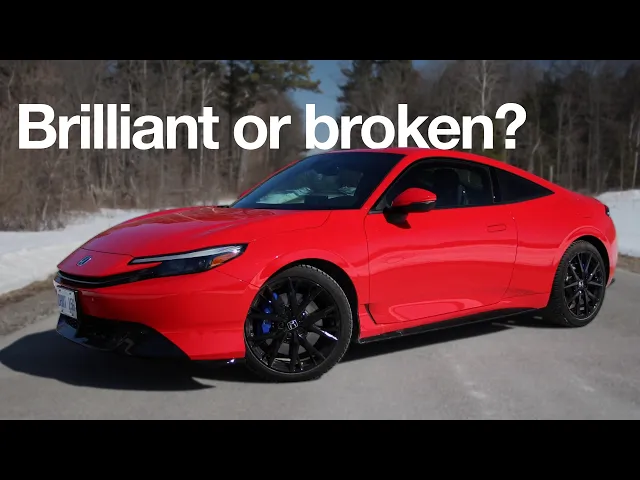
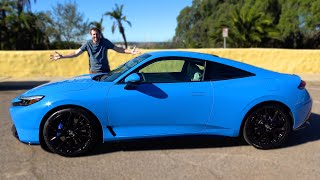
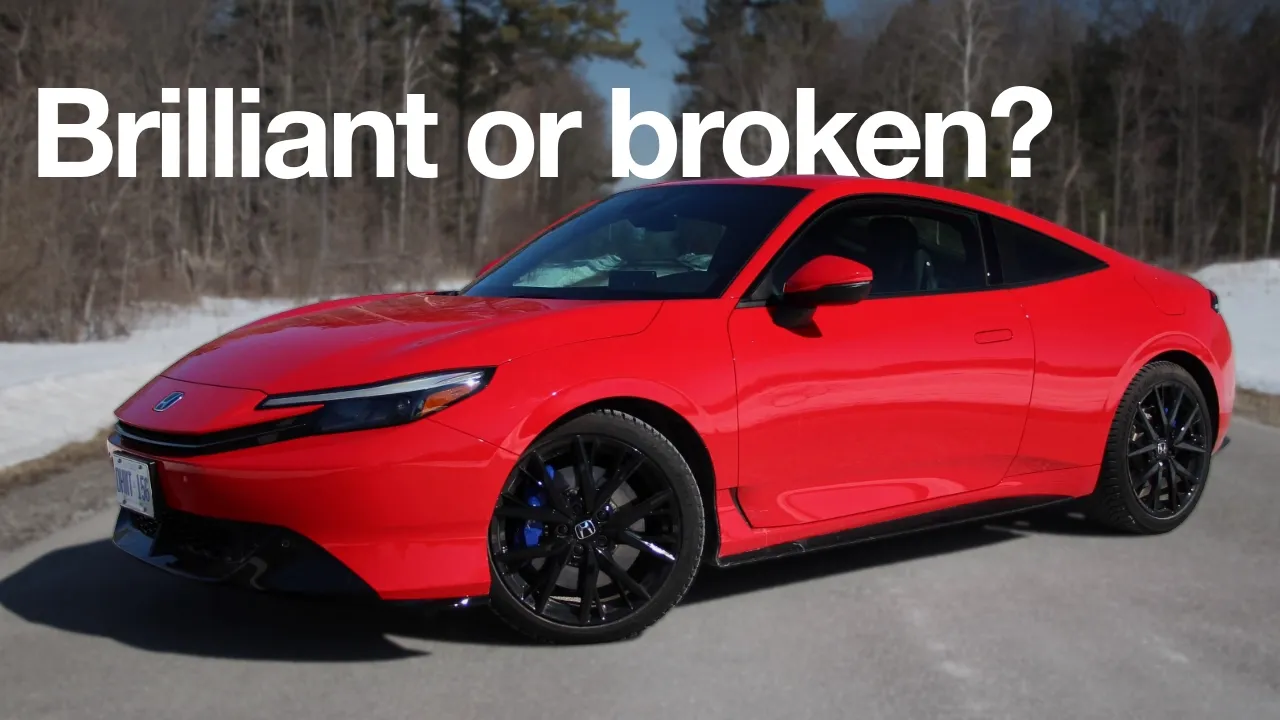
The internet has already decided that the Honda Prelude is a failure because it costs $43,195 and only has 200 horsepower. That's a very efficient way to review this car if you don't plan on turning. But reducing a car to a spreadsheet misses the point.
Honda took a hyper-efficient powertrain and bolted it to the suspension geometry and braking hardware of a Civic Type R. The question isn't whether this is quick in a straight line. The question is what happens when you have to turn.
200 horsepower is only disappointing if you planned on driving this car only in straight lines. If that's you, good news, the Dodge Charger exists in several shades of poor decisions. 232 pounds of torque from a dead stop means that this powertrain earns its keep when exiting corners.
You roll into the throttle mid-corner, and the torque fills that gap instantaneously. Those front tires load predictably instead of clawing for grip. Acceleration's adequate.
Now, this 2-liter 4-cylinder in this application has the personality of a metronome. It spins up when the system needs electricity, idles down when it doesn't, and it's completely indifferent to what your right foot's doing. Most modern powertrains at least pretend to care when it comes to driver intent.
This one seems to have filed it under "not my department. " Do not wait for this engine to entertain you. It's been specifically engineered not to.
The engine locks to the front wheels through a clutch at highway speeds for direct mechanical drive. It's the only moment when this powertrain feels conventional. It's also the moment when this car is at its most boring.
Drw your own conclusions. Sport mode sharpens throttle response, which in a hybrid means the electric motor reacts faster to your right foot. The difference is noticeable.
Honda's engineers probably spent months calibrating that, you'll notice the difference for maybe one afternoon before you forget all about it. Honda's S+ Shift simulates an 8-speed automatic by making the engine make appropriate sounds while the electric motor does all the work. Pull a paddle and you get a sound effect and some vibration that's trying very hard to convince you that something mechanical happened.
Nothing mechanical happened. And I was about to write off the entire system until I test it in the corners. In S+ manual mode, you downshift, lift off the throttle, and you get weight transfer just as you would with a traditional internal combustion engine.
The nose tucks in, and if you want, the car rotates. Honda buried a driver's tool inside of what looks like a gimmick, and every reviewer seems to have written it off as just fake gears. As well, there's 7 levels of regenerative braking that will actually give you finer control of deceleration on corner entry.
S+ changes how you can rotate the car. Regen changes how this car slows. Both are tools.
232 pounds of instant torque should be a recipe for torque steer and wheel spin. It's neither of those. No matter how hard I tried, I could not get those front tires to break traction on cold, dry winter pavement.
No torque steer, no inside wheel spin, no traction control light lighting up the dash. The geometry of the Type R suspension helps deliver torque to those front tires so cleanly that that front axle stays composed even when you're going beyond the tire's limits of grip. This is rated for 44 miles per gallon, which means the powertrain you're dismissing as too slow for a sports car will also take you 460 miles on a full tank of regular.
Pick your complaint, you can't have both. Subscribers get notified when new episodes drop on this channel. Non-subscribers hope the algorithm will show it to them eventually.
And if you want to control when you see our episodes on YouTube, YouTube. Well, that's what the subscribe button does. Oh, we're here to see how this thing handles, and it's time to find some corners, shall we?
Let's— this thing gliding over this road surface. But I'm really impressed with how I can control the attitude of the car with this S+ shift going on, because it does a great job of mimicking that engine braking effect. Now what is interesting, and the steering is very precise here, love this.
Brakes are incredibly strong as well. Tough corner here off camera on the exit, zero torque steer, zero wheel spin, and the car just tracks perfectly through the corner. Steering strong on center, it's accurate off center, but the feel, the actual information about what's going on at those two front contact patches come through the chassis, they don't come through the steering wheel.
You You feel it in the seat, in the way the car loads and settles, in the body language of the suspension. The steering points, the chassis reports. It's that Type R suspension doing the communicating, not the electric power steering.
And that matters because it means the Prelude's transparency is structural, not something a software update can fake. And yes, Honda put a Type R steering rack in a hybrid coupe. Somewhere there is an accountant looking at the Prelude's parts list as if it's a crime scene.
Yes, the front brakes are shared with the Type R, and where it should get interesting here is the handoff between regenerative braking and then those big Brembo calipers doing their work. In some hybrids, that handoff feels like the brake pedal changes its mind halfway through travel. Here, the blending is close to invisible.
You trail off into a corner, ease into the brake pedal, and you don't even notice the handoff. Deceleration stays consistent, and that builds trust. The dampers shared with the Type R, but in this case the Prelude weighs more and makes less power.
What that means for drivers like you and me is that they're optimized for the kind of corner loads that you'd get with a Type R, but in this case they make this Prelude much more interesting. In Sport, the front end loads cleanly, holds camber through the corner thanks to the Type R suspension geometry, and rotates predictably on trailing throttle. The rear is not inert either.
There's a multi-link setup there, and it's quite happy to tell you that it's participating in whatever you're asking of the Prelude. And here's where the Prelude does something that most cars twice the price can't do. It tells you exactly where the grip is, how much is left, and what happens next.
The chassis is having an actual conversation with you, and most cars at this price will simply deliver you a monotonous monologue. GT is the default mode, and for most occasions, it's actually right one. Now, the dampers are tuned more softly here than in the Type R, even the Integra Type S, and this suspension absorbs broken pavement that would have you bouncing out of your seat in a Type R.
Honda retuned their excellent hardware for a car that has to spend 365 days a year driving on real roads. A stiff car that skips over surface imperfections is fast in San Diego and miserable everywhere else. This Prelude stays composed on roads that would expose most cars with Sport in the brochure.
Honda's enhanced Agile Handling Assist now operates under braking into corners. It'll tighten your line if it detects some understeer approaching, but it won't rewrite it for you. At its limits, the chassis is genuinely neutral.
Not it understeers, but the marketing team said neutral. Mid-corner, a lift off the throttle tucks the nose in, gets it to rotate a little bit. A stab of the throttle, of course, will push it offline.
And the transition between the two is progressive enough so that you always know where you are in the envelope. Sure, you can make it understeer, but drive it properly and that rear will rotate exactly when you ask it to, and it'll tell exactly how much it's giving you before it gives you any more. That kind of confidence is rare in a front-wheel drive car at any price.
If you approach this Prelude like a hot hatch— brake late, turn in hard, pick up the throttle early— it'll push and it'll bore you. If you approach it like a momentum car, carry as much entry speed as possible, load those front tires gently, pick up the throttle smoothly, and let the throttle manage your line through corner exit, this chassis is almost as pointable as a Type R and communicates nearly as well. Most reviewers never found that because they were driving it wrong.
If you want to support the channel beyond just watching, well, the merch store is open, and your support there means more time for us to produce episodes like this and less time worrying about manufacturer blacklists. No pressure, just an option. The fundamental seating position seems a little bit lower than in a Civic, but what's more important is how low that cowl height is, because you can actually see the tops of the fenders, which help you place this better in the corners.
And in general, visibility is excellent— thin A-pillars up front, large outboard mirrors, decent view out the back through the rearview mirror. It's all top-notch. And on top of that, you have cameras to help you park.
The asymmetrical driver's seat has firmer bolstering and stiffer urethane in the cushion than the passenger side, which is Honda's way of saying that one person in this car is supposed to be working harder than the other. And there's a lot of talk about screens. We're going to forget the screen for a second.
All the important controls are physical dials and buttons— climate controls, the drive mode selector. Everything is a switch, not buried in a submenu. This cockpit was designed by people who believe that drivers should keep their eyes on the road rather than troubleshooting a user interface.
The S+ button is large, it's centrally located, it's impossible to hit it accidentally, which is appropriate given how often you'll be looking for it on a straight highway. Never. This interior is basically a Civic with a better wardrobe, but what we do have is a fantastic steering wheel.
Save for the flat bottom bit, it is the perfect shape perfect size, rim thickness is spot on, and there's enough adjustment that I'm perfectly situated in this cockpit. You'll recognize a lot of elements from the donor car, but Honda put the upgraded materials exactly where your eyes see them and your hands touch them. The parts of the interior that you touch to control the car feel special.
The parts you don't are someone else's problem. The rear seats exist the same way an appendix exists— technically present, vestigial, and a great way to learn who your real friends are. In S+ Shift mode, the digital cluster displays a beautifully rendered tachometer with a 6,000 RPM redline for an engine that isn't directly driving the wheels.
It's a high-resolution instrument measuring something that doesn't matter. Honda committed to the bit. There is no sunroof.
Honda says structural rigidity. The cynic immediately assumes cost reduction. Either way, the double-bubble roofline keeps headroom alive and there's one less thing to rattle.
The flush door handles look clean and because it's a Honda, they work perfectly fine. They'll also be the first thing to annoy you the one time they don't pop out after a storm of freezing rain. Every design choice has a cost.
This one's cost is seasonal. The like button tells YouTube to share this episode with more people like you interested in an episode like this. And if this video gave you more information than a brochure or a press release, well, that's the entire ask.
That's my take after a week behind the wheel. Here's what people who actually bought one are finding, and right now that owner pool is fairly tiny. It's roughly several hundred units sold in the US through January, but early reports are consistent.
First, the most important discovery: one owner tested 0-60 with S+ Shift Off and recorded 6. 63 seconds. With S+ On, that number climbs to over 8.
The simulated gear changes that Honda markets as enhancing engagement are costing the car 1. 5 seconds in a straight line. Every widely reported 0-60 time that made the internet angry was tested in the wrong mode.
So congratulations everyone, we argued about the settings menu. Second, real-world fuel economy is tracking slightly above EPA. One owner logged 45.
2 mpg combined against the official 44 rating. The recurring theme across every buyer is the same: they've stopped comparing it to sports cars before they bought it. The ones who paid MSRP describe it as one of their favorite cars they've owned.
Owned. The ones who paid $20,000 over sticker are considerably less philosophical about it. Third, the one thing no one is talking about yet: the brakes.
Those Brembo calipers and Type R rotors will eventually need replacing, and the parts bill will land like a Type R's too. Now the good news is the regen handles most of your daily deceleration, so these brakes are barely working compared to the same hardware in the Type R. They'll last longer than you'd expect.
The invoice when they don't will be bigger than you expect too. If you own one of these or have some quality seat time in one of these, let me know in the comments what I got right and what I got wrong, because real-world ownership experiences are much more valuable than anything I can learn on a week-long press loan. And I always read those comments.
I asked what you wanted tested. 498 of you showed up, 476 votes, 22 comments, and the majority of you had roughly the same question, and it was some variation of "Did Honda ruin it? " First poll: What does Honda Prelude have to mean?
37% said a real driver's car, 17% said a bargain. So the majority of you are evaluating this based on driving merit, not price, which is the entire opposite of the way other channels have reviewed this car. Noted.
Second poll: What should I test? 43% wanted highway refinement, 35% wanted S+ versus normal on the same road, 21% wanted to know if it rotates or washes out out. And 1% wanted to know about brake feel consistency.
That 1%, I see you. I tested it anyway. On-highway refinement—ride quality is excellent, seats are comfortable, but there's no lumbar support, and these winter tires add more noise than the OEM rubber would.
Does it deliver on the GT promise? Yes, absolutely. Honda's version of a GT means composed and quiet, not soft.
S+ versus normal on the same road—well, everything I said earlier about S+ being able to get you a little bit more weight transfer onto that front axle and get the car turned in a little bit better. It's sharper in S+. On fun roads, turn it on and leave it on.
On the subject of being able to rotate this or whether it has a tendency to push, well, fact of the matter is, as we discussed, you can rotate this like a properly tuned front-wheel drive car. The Momentum car only reveals itself when you ask it to turn. Every review that called this boring was either testing it in a straight line or at a about 60% of the tire's ultimate grip.
Brake feel consistency, to the 1% who asked, the pedal's firm, the Brembos stayed linear across repeated hard stops, and I could not find the seam between regen and actual friction braking. The 1% asked the right question. @wyw201 asked about NVH, which is an important question.
The cabin's well isolated for a coupe at this price, and wind noise is minimal at highway speeds. What you feel through the seat is a chassis that's more rigid and better screwed together than the Civic it's based on. That's where the GT character lives.
Madcow582 asked me to describe the soul of the car. Quietly over-engineered and completely uninterested in proving it. The soul of this car is Honda's engineering culture.
Spend the money where it matters, don't talk about it, and trust that the right buyer will figure it out. My old pal Vito C misses his '95 SR, and I understand why, and wants to know if this resembles a 4th or 5th gen Prelude. Honestly, Luckily, the interior doesn't.
Those cars had their own identity. This is a Civic in a nicer jacket, but the chassis is more serious than any previous Prelude Honda has ever built. The mechanical connection moved.
It used to live in the drivetrain. Now it lives in the suspension. 498 of you told me what to test, and that's better research than any press kit, that's for sure.
Keep your eye on the community tab. Next car, same deal. The question was whether an economy-focused power unit and track-focused suspension components can coexist in the same chassis.
The answer is they were never in conflict, because the chassis doesn't know what kind of power unit was bolted to it, and it doesn't care. The Type R suspension geometry manages load transfer whether torque comes from a turbo, an electric motor, or a team of highly motivated hamsters. Honda figured this out.
The internet has not. If you need horsepower to feel something— the Prelude isn't your car. If you compare every coupe to a Miata or a BRZ, the Prelude will lose that argument on paper, and it should.
But if you have ever carried speed through a corner and felt through the seat and the suspension exactly how much grip remains, and if that sensation is worth $43,195, then Honda built this for you. This Prelude's real competition is a fully loaded Civic Sport Touring Hybrid. $35,000.
The $10,000 Delta buys you Type R suspension, the Brembo brakes, the adaptive dampers, and a body that sits lower to the ground. And there might be 4,000 of you per year. Honda seems to agree.
I raced Hondas for years, and momentum is how you win in an underpowered car, and it's how you make 200 horsepower feel like enough. At some point during this review, 100,000 people will have decided that's worth subscribing for. No one is more surprised than me.
If Honda put a manual transmission in this car, there would be no criticism whatsoever. The same chassis, the same power, the same price, but with a manual, the enthusiast internet would be calling it a masterpiece. Honda's chief engineer said that this Prelude was designed to feel like a glider, not a fighter jet.
He was being more honest than anyone gave him credit for. A glider, after all, has no engine. It converts energy through precision and efficiency.
And that's exactly what this car does with momentum and chassis balance. They just forgot to mention that flying a glider takes more skill than flying a jet. That's the Honda Prelude.
Subscribe if you enjoyed this, don't if you don't, comments are open if you disagree, and the merch store is open if you want to support more of these. See you on the next one.