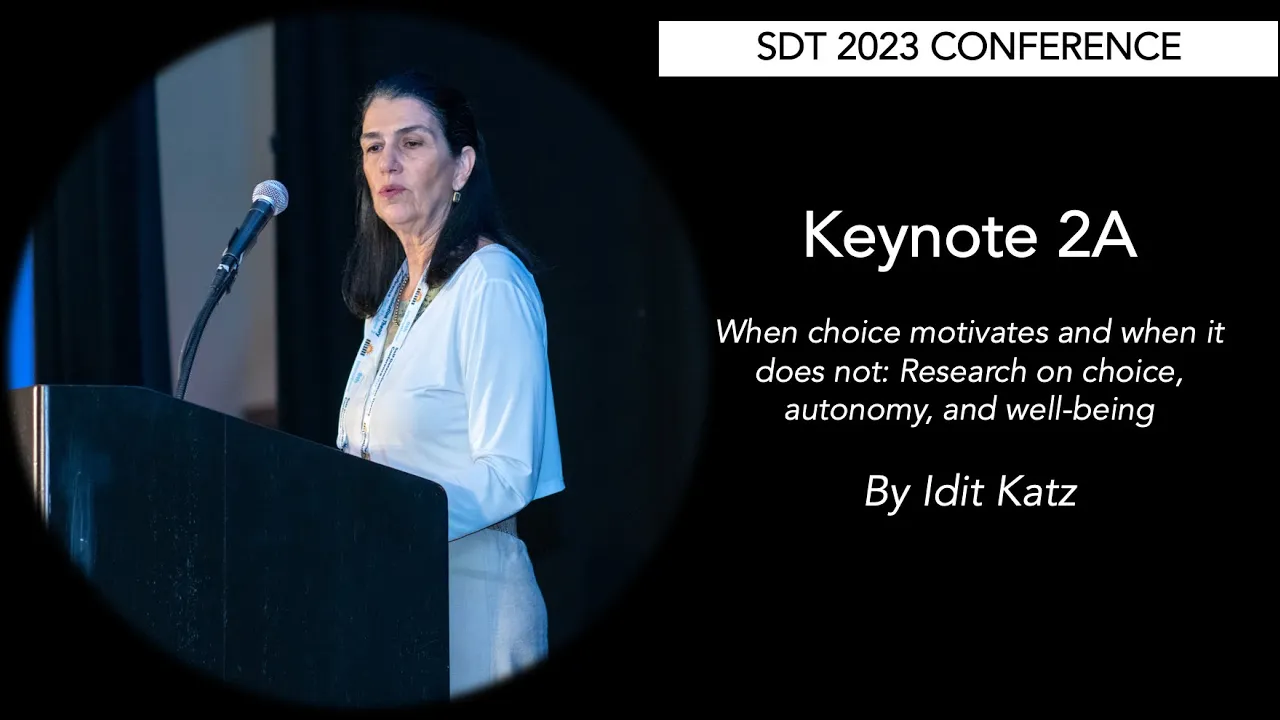
then I would like to welcome our second keynote of this morning edit Cuts who is based in Bangor University she has been around for quite some time doing intriguing I think sdt related work in particular about the workaround homework homework involvement by parents also factors that explain why parents are capable of indeed developing a motivating style some work with teachers of course also and also the work with Choice which dates back I think to 2007 a paper in contemporary educational psychology which I find very interesting and is I think still relevant at this moment and
so I'm really pleased to to see that your talk today addresses the issue of Choice by itself so either maybe what I say said about uh on a more personal level what I like about Edith is I think she is a very sweet person [Applause] wow after such an introduction what can I say so good morning everyone and thank you so much for choosing the to attend my presentation today we will talk about this choice in a minute I'm excited to share some of the research I've been working on with dear colleagues and students about
how Choice motivation autonomy and well-being are related I will share some research and theoretical ideas to answer the questions the question when does Choice motivate and when it does not as we go through our day we made many choices some are small and some are big some have long-term consequences as they are essential for our health and well-being While others are not it means that it will not affect us this way or another no matter what option we choose for example this morning we all made choices about what time to wake up what to wear
what to eat for breakfast and of course whether or not to attend this presentation which was hopefully the most significant good decision you may today as there are great other presentation to choose from all of these choices you made this morning regardless of the level of Consciousness out which you perform them were motivated by a reason suppose I will ask you to reflect for a minute on why you chose to attend this session and not another you will probably find a reason lying on the Continuum ranging from autonomous reasons such as this topic is so
interesting to me to controlled reasons such as I must be there otherwise I will feel bad when I'll see Deeds during breakfast tomorrow so either way your choice was motivated you had a reason to prefer one option over the other however this is not always the case in many choices we make during the day we do not have a preferred option sorry um and choosing one option over the other doesn't really makes a difference in this case the options you have are considered empty and thus the choice you make is regarded as an empty and
not okay and the choice to make regard is empty and not meaningful choice when you choose between empty Alternatives you actually pick one of the options but do not choose peaking can be conceptualized according to self-determination Theory as activation the questions of the question of choice preference and motivation was previously asked by philosophers economists Educators and researchers who observe this question from various angles for many years now the Paradox of bori dance Donkey by January Den or it's in its early versions by Aristo is an example of a philosophical starting point initiating extensive research on
this topic the story refers to a hypothetical situation wherein a hungry donkey is a placed precisely midway between two identical piles of hay since the Paradox assumed that the donkey will always go to the whichever is closer that it will prefer one pile over the other the protein dies of hunger since it couldn't make a rational decision between the two identical piles of hay so let me now give you an example of choice without preference or an empty choice that has nothing to do with donkeys or branches of hay and resembles a a common misconception
regarding the provision of choice when my eldest son eval was in the first grade he came home one day handing me a letter from his teacher Mary this wasn't the last letter I got from his teachers during the years aim this is the letter autonomy program it's called Yuval is asked to choose a personal researcher topic he is asked to choose from the following topics domestic animals the flowers of our country and flags unfortunately eval did not choose a topic which is holding him back in preparing the project please help him choose so that he
can move forward this was teacher mirror eval who is now 31 years old has been an autonomous independent young man since then this is why it surprised me when he said you can choose for me I'm not interested in either of this subject I want to do my project on chocolate and this is not one of the options so what do we have here we have a teacher a good teacher who had good intentions she learned that providing choice is an autonomy supporting strategy this teacher gave you Val empty options options that were meaningless to
him Yuval is not a donkey thank God so he picked or asked me to pick for him one of the options sure enough his teacher's mirrors good intentions in trying to enhance eval's Motivation by providing him with choices didn't work this is a typical example of a misconception regarding the provision of choice namely thinking that Mary choosing between options will support the chosen choosers autonomy and enhance motivation this misconception is apparent in teachers and parents practices able to also made distinguished researchers such as a younger and leper in 1999 question the universality of the need
for autonomy in their research a younger and leper provided what we consider and we know now they provided empty choices such as the option to select the color or the crayon to wheat in which they write the answer with they provided this choice to children from collectivist and individualist cultures this type of option is empty because even if the child does prefer one color over the other choosing a less desired color has no long-term consequences if it has it all so it is really easy to give up the person preference in this case in the
research they've they found that this empty Choice positively affected the individualist participants and negatively affected the collectivist ones thus they challenge the sdt basic assumption that autonomy is a universal human need however while these researchers intended to investigate the universality of the need for autonomy they actually investigated the effect of the action of choosing for myself they were right though oh I forgot to they were right though and they were correct in suggesting that asking to whom does the provision of choice motivates and to whom does it not is an important question to be asked
and this is actually what we did a in the following studies We call we conducted a series of studies to explore the potential cultural differences in the significance of cell choice and the impact of meaningful choices on the motivation of children from different cultures my PhD thesis which was many years ago served as the foundation of much of my later research together with Avia so we investigated a three groups of adolescents we investigated Jewish secular Jewish religious and Bedouins this group differed in their level of collectivist and individualist values providing us a unique opportunity to
explore these questions we approached the adolescence from these three groups in school and provided them with a list of extracurricular activities to be available in the upcoming upcoming semester the students were asked to indicate which activity they most like and the one they didn't want to participate in whatsoever after a few weeks we returned to the school and we divided the participants into three experimental conditions which isolated the potential impact of the self-choice action from the effect of the condition in which participants had no choice but the option chosen for them was aligned or mismatched
their their initial interest and preference which they indicated a few weeks before in the first conditions condition participants were given the freedom to choose the activity they preferred to participate in in the second condition participants were informed that they had no choice but the selected activity for them aligned with their initial preference preferences in the third condition participants were informed that the selected activity for them was the one they had initially indicated as their least preferred option we then measured participants various various indicators of motivation and well-being and the results of this study have generally
suggested that a the value of making my own choice is rooted in is indeed rooted in Western individualism therefore the mere opportunity to to choose for themselves had some impact on their adolescence from the Jewish secular group but no impact on the bedroom participants however the desire to pursue one's genuine interest is the fundamental and thus Universal aspect of being a human supporting it enhance motivation and well-being while depriving it reduce motivation and well-being regardless of the participants cultural background social current conducted a PhD research under obvious source is supervision using a similar experimental methodology
however her study investigated the the the impact of choice and not Choice conditions on activities that either supported or deprived the participants disposition for example activities requiring speaking in front of audience which I don't know May not account for the shyness of some participants thus choosing such an activity for a shy student May hinder their disposition so we did the same manipulation that we did in the previous a a study and the studies finding revealed that even in collectivist cultures the in which the like the Bedouin were choosing for oneself is not highly valued parent
choice of activity that contradict the child's disposition resulted in negative emotional and motivational outcomes even if they are not a verbally spoken although the lessons May permit the parents to choose from them for them it was implicitly agreed upon that parents should consider the child preference interest personality and impairment to select the most suitable activity for him or for her this study reinforced the notion that of the importance of a a self the an importance of self-choice a this can be very the course cultures but the necessity for autonomy then the need to pursue and
fulfill one's authentic interest and disposition is universal in the following studies we aim to understand the contextual factors under which the provision of choice is a motivating and what are the mechanisms explaining why and when some people are motivated by having a choice While others are not building on the inside from the previously presented studies we realize that if we really want to understand the benefits of choice we should evaluate it in situations where meaningless and not empty choices are provided and taken namely situations in which choosing one option over the net over the other
has significant consequences therefore we designed the next set of studies in a to investigate participants level of autonomy in meaningful life decision making scenario which is adolescent choice of a high school major and let me just for a few minutes explain why choosing a high school major during the ninth grade is a crucial first career decision for the lesson in general but specifically in Israel firstly this decision is a considered to have a long-term consequences as it determines what academic and professional roots are valuable in higher education and professions this decision is also highly pressuring
and parents are usually highly involved in this decision which allowed us to investigate the familial context in which this decision is made adding to this pressure Israeli Jewish boys and girls must serve at the Army for at least two years in the Israeli Army after graduating high school causing them to start their academic studies much later than a youth in other countries changing the academic route of studies after the service would make them start the start the academic studies even later increasing the stakes of this decision taking into account the importance of the decision and
the potential effects of making this first career decision autonomously or not we sought to understand how free and autonomous the Adolescent choice of a high school major truly was and under what conditions they could make an autonomous choice that reflects their authentic desires and interests without feeling coerced or influenced by external factors we used the the conceptualization of mother Desi and Ryan 2006 regarding autonomous or control decision and adapted it to the specific a context now you can look where were you on this Continuum deciding to come to this a to this talk in the
first study which was held which was published in 2018 we aim to investigate the context in which this decision is made namely we asked how autonomy supportive the parents were during the process of the child's choosing a high school major and we also asked whether this support is associated with the level of autonomy with which adolescents ultimately made this decision and the various outcomes such as motivation well-being and grades at the end of the first year of their major class as you can see here I hope that you can see it if it's not too
small a parental support was associated with adolescence making the major High School decision autonomously resulting in various positive outcomes or including grades almost one year later continue continuing our investigation in the content of choosing a high school major we conducted another study to explore further the association between parental support and Adolescence motivation for choosing a high school major we investigated the mediating role of identity formation Style by brazonski and the moderating effect of gender on this Association we hypothesized that adolescents will be more informative when parents support their autonomy they they will tend to employ
a more critical attitude toward their self um they will be open to new information and willing to revise aspect of their identity what am I good at what makes me excited and thus will be more autonomous in their choice of major regarding a gender differences as a moderator as you all know we have many gender differences between in within education in the context of choosing a high school major unfortunately girls are also less likely to choose stem which is science technology engineering mathematics professions and Majors than boys for many reasons one of the reasons that
is that stem professions are still male stereotyped professions and non-stem Fields like Arts literature and history are more female stereotype a professions accordingly we decided to investigate our hypothesis regarding the role of identity style and gender separately for those who chose stem and as a major and those who chose a non-stem a we conducted the two analysis one for non-stem and one for stem using the model 5 in process by highest let's look first at the result for the non-stem the results show that gender had a main effect on adolescent's autonomous choice girls experience more
autonomy during the choice of a non-stem major than boys moreover the indirect effect of the informative identity processing style a of choice was significant indicating its mediating role simple slope analysis of the interaction showed that the relationship between supporting parenting and the autonomous Choice was significant for both boys and girls the interaction plot in a indicated that this relation in non-stem fields were stronger for boys in all in other words although girls experience increased autonomy when deciding on a non-stem major boys autonomous choice of a non-stem major depended more on their parents support of the
psychological needs when choosing stem the picture is a bit is exactly the opposite gender had a main effect on a adolescence autonomous choice but this time boys reported more autonomy when deciding a on a stem than girls and the indirect effect was significant also here which means that we really had the mediation effect here um the simple slope analysis of this introduction effect showed that this relationship was Stronger this time for girls when the stem profession was investigated why boys experienced increased autonomy during choosing stem girls ability to through stem autonomously depended more on the
parents support let's go to General conclusions because I see that I have to do not have too much time and the general conclusion conclusion of this talk which I hope you do not regret choosing or let's summarize in answer to the question of when Choice motivates and when it does not the provision of meaningful choice is essential for promoting autonomy it is crucial to offer options that hold significance and value rather than presenting empty or trivial choices the context in which a choices are presented plays also a vital role autonomy is fostered when decisions are
made within a need supportive environments supportive environments are particularly important when making a choice that challenges traditional expectations and the last thing is that the informational informa informative identity style is the mechanism or might be considered the mechanism to explore all these aim This research should be continued I want to show you some of the contexts in which we study this a in parenting schools of course kindergarten we got to ask the youngest kids what do they think about choice and motivation surprisingly also we study this question in the prison the male prison in Israel
very interesting research unfortunately the student will not attend this conference so it won't be presented career decisions which you can hear about next Friday right with Regina and in a in relocation I want to thank all of you for attending this presentation but especially my colleagues Professor hotel slobodim and Dr rinat Cohen and my PhD wonderful students that I couldn't do anything without them where are you Regina when she treats ADI or Dan thank you very much thank you very much I should stay here for questions right questions yes um Hello thank you so much
for this interesting topic um as I work with the in the field of autism spectrum disorder so I'm really looking forward if you're gonna be doing any research regarding replication of the choice paper with people on the spectrum because I think according to CDC we do have now one in 36 children who are on the Spectrum so and I just want to pinpoint on how important it is to use maybe in your methodology the preference assessments where you where you said it means picking and the one that we call it reinforcer assessment where we can
see that the behavior will increase over time because it comes from the intrinsic motivation of having that stimulus or that let's say event that is going to happen so these two things preference assessments and reinforcer assessments are you thinking of including some of these Assessments in your study that can maybe change the the study results or maybe have different impact on that wow thank you for the question a the autism spectrum a population is quite unique they are quite unique in their interests also and I think this is a point that should be considered when
providing them with choice a in a few years ago I had a research with the Anne reninger who deals with the development of interest and we assessed a autistic people high functioning autism we didn't get to the question of choice and but if I imply the the the result that I received there if you give autistic people choice you should consider like other people people with Autism are not different this way you should consider their interests actually their interest was found in our research as the main route to their a behavior and a a adoption
adapting their adapting their behavior so if programs like Aba which are strongly behavioral programs to a promote the behavior of people with Autism a a when they get if they give choice between for example the the feedback different feedbacks they should also you can be very restrictive in this kind of a of program but you should also consider their interest in the feedback that you give them a I do not like I do not like this Behavior stay at a a style of education but if people do that they should consider it it's not different
the bottom line it's not different people have interest even if they are in the autistic spectrum and you should consider it when trying to help them adapt to the real world yes I'm really lucky thank you very much for the interesting talk so you mentioned that students have different preferences and differences to their choices for example some students they come from different cultural backgrounds and some are more shy so I was wondering in classroom with students that have different preferences how do you find a balance to Foster their interests overall or I can assure some
of your findings on this thank you very much yeah it is of course it is very difficult to to refer to the interest of all these students in the classroom which is this what we have in Israel regularly it but I think the teacher should I mean first of all providing choice is not the the only autonomy supportive strategy that teachers should practice I mean it's the most easier one I mean it's the most easy on one easier one to to to to to provide but then teacher malpractice this strategy as you've just seen in
my in my talk so maybe not exactly referring to each student a a a a preferences or interest because it might be impossible but asking the class or asking the students or even you know something if teacher Miri would provide this list of subject of topics and then would give the opportunity for a child like you Val was not interested in either of them to do his choice separately and talk to him about his choice that would do the job I mean you cannot refer to the interest of each of the 4D students in your
classroom but you can apply a more open and a in interaction with the students to ask them what they are interested in because giving an empty choice is just meaningless it has no effect go ahead Shannon okay sorry I think we have no other choice than to close the session thank you for being here