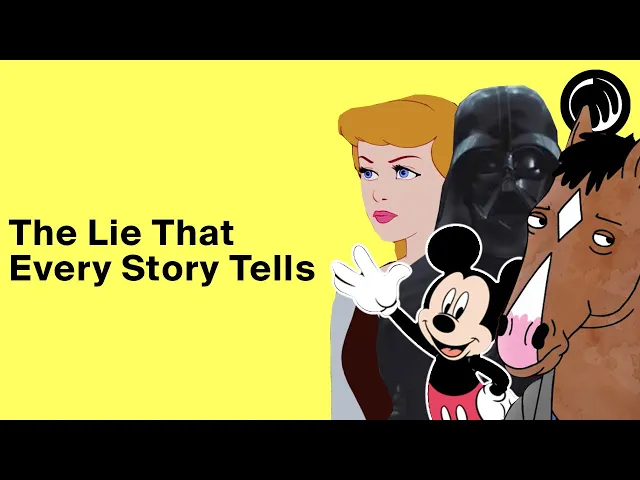
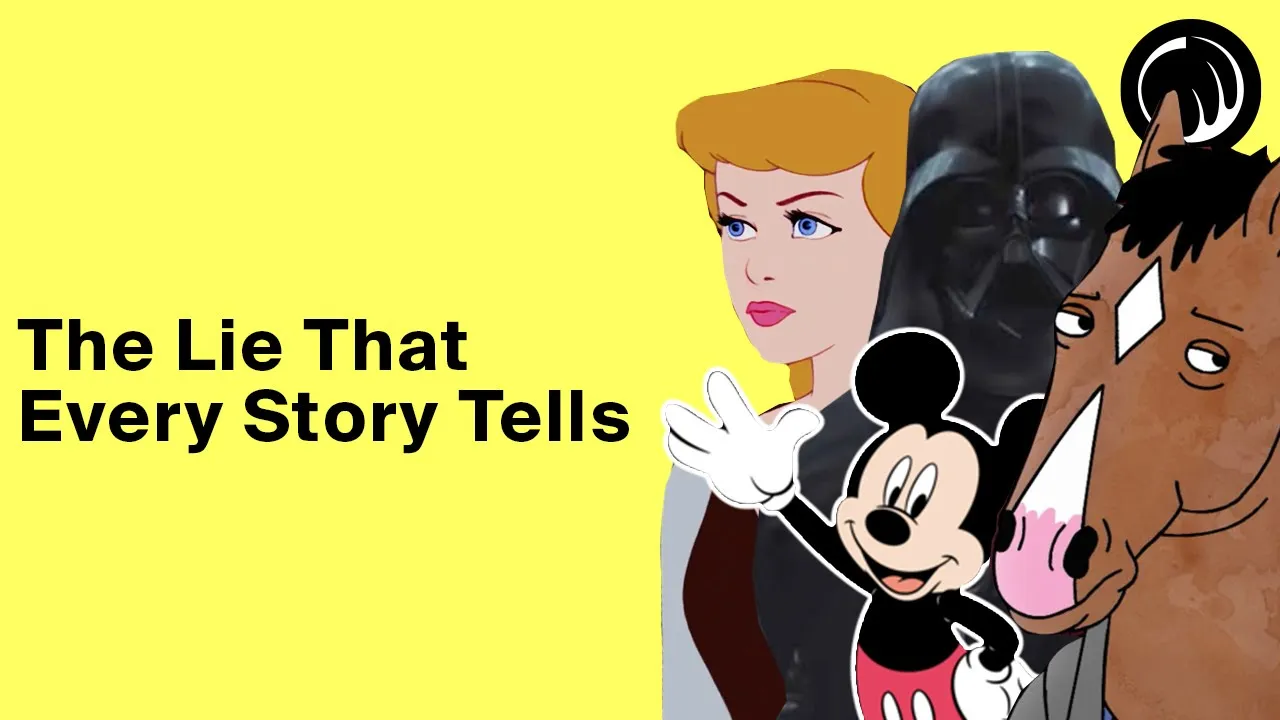
This video is sponsored by the Great Courses Plus Stories are in, under, and behind almost everything. Our identities, our beliefs, our friendships and families, our societies, and so on Stories have a way of not only entertaining, but training us. They can be incredibly powerful and beautiful devices that form and assist our perception and understanding of the world.
However, according to twentieth century American author Kurt Vonnegut Stories rarely tell the truth. After studying stories from an anthropological standpoint, examining their relationships with various cultures, Vonnegut found that stories and myths across many cultures share consistent similar shapes that can typically be broken down into just a few main categories These shapes can be found by graphing the course of a protagonist's journey through a story along an axis of good and ill fortune. In all stories someone or something starts somewhere Either in a good place, bad place, or neutral place.
Then things happen related to that person which are conveyed as good or bad bringing the character up and down the axis of fortune as they traverse forward through the story. Then, the story ends and its shape reveals itself Vonnegut discovered that many popular stories follow common, consistent curves and spikes up and down the good/ill fortune axis and that most end with the protagonist higher on the axis than where they started. However, what's perhaps most interesting about Vonnegut's analysis is his argument that these shapes, and consequently most stories, lie.
Vonnegut proposed that a more honest, realistic story shape is simply a straight line. In a story of this shape, things still happen and characters still change but the story maintains ambiguity around whether or not the events that occur are conclusively good or bad. One example of a story that Vonnegut references with this straight line shape is Shakespeare's play Hamlet A play that has and continues to be regarded by many as one of the best and most famous plays, and perhaps literary works in general, of all time In which the story moves forward and things happen but none of the events are conclusively good or bad and thus the audience is left unaware as to what is.
Which, according to Vonnegut, is the closest literary representation of real life We are so seldom told the truth In Hamlet - in Hamlet, Shakespeare tells us We don't know enough about life to know what the good news is and the bad news is and we respond to that One story medium that seems to inadvertently coincide with this idea is the medium of the television series The goal of a TV series is to keep viewers watching as long as possible. Each episode must be an engaging enough story to keep the viewer watching until the end but each episode must also be left unresolved enough so the larger season-long and series-long stories continue and the viewer is interested in watching all the following episodes. If enough people watch all the episodes in a season the show gets renewed for more seasons and the cycle continues for as many seasons as possible.
In order to keep the whole thing going, none of the stories can reach a conclusion and thus, the main characters can't find ultimate peace or freedom from the uncertainty between good and ill fortune. Of course, most shows don't qualify as the straight line shape in Vonnegut's analysis because most shows attempt to convey conclusively good and bad fortunes within them. However, merely by the requirements of the medium TV series are forced to self-impose the same sort of universal truth that Vonnegut suggests.
That neither the viewer nor the characters in a series can ever know what anything that's so called 'good' or 'bad' in one episode might cause in the next. And that on a fundamental level the changes in each episode are futile because they are a part of a never-ending cycle of change through conflict and resolution for the mere sake of its continuation with no aim of final resolution or reveal of what's ultimately good or bad. Of course, eventually a show reaches its series end when it stops working or runs its natural course.
But the show fights its whole life to stay away from this moment. A good TV series, a series that we don't want to end, is only a series that we don't want to end because it can't seem to resolve itself. In this, the format of a TV series also shows us that there is meaning, engagement, and entertainment within the endless cycle of change regardless of its potential universal futility.
And that perhaps change in life can exist not for the sake of some conclusion or ultimate state of peace but a continuation of itself for the sake of itself. A continual adaptation and movement in life, so to keep life alive and interesting. And perhaps the ability to be in this cycle of continued change for the sake of change is the actual good fortune.
Renowned twentieth century mythologist, writer, and professor of literature Joseph Campbell said: What I think is that a good life is one hero journey after another. Over and over again you are called to the realm of adventure, you are called to new horizons. Each time there is the same problem: Do I dare?
And then if you do dare, the dangers are there and the help also and the fulfillment or the fiasco. Stories help us see and understand various micro-moments and aspects of life. They help us better connect and share ideas, lessons, and meaning.
They are a beautiful, essential device of conscious life. And stories don't always have to be real or accurately representative of life to be helpful and important. But the truth is we appear to so often see life the same way that our favorite stories do.
It is no coincidence that most good stories share the same basic structure, ingredients, and shapes. They're a reflection of how we often like to think and how we often want the world to be. However, when we assume that our entire life can fit neatly into the templates of our favorite stories, or the Hollywood films we are so often inclined to believe and try to model our life after, when we expect or pretend to always know what ultimately good or bad fortune is we create an expectation in every decision, action, and event that carries so much pressure we are likely to fear any decision or action at all.
Perhaps the nineteenth century highly influential philosopher Søren Kierkegaard said it best when he said: Life can only be understood backwards, but it must be lived forwards. This unknown can be rather terrifying but the fear is only intensified to an unnecessarily immobile state of paralysis when we maintain the assumption that there can ever be a perfect, right decision in anything that will lead to an ultimately noble resolution of everything. Rather, we should perhaps work to simply have the fortitude to make decisions at all to forge onward through our story trying our best to navigate with decency, effort, and honesty Accepting whatever our decisions might cause and whatever events might occur onto us And understanding that so long as we are still alive our story will go on and maintain the qualities of all stories: an opportunity for further experience, adaptation, and triumph.
Even though we can't know what the good or bad news is within the bigger picture Vonnegut believed that we don't need to know to be able to look around and know when things are nice amidst it all To recognize the happy moments in our life, however big or small and stop and say: If this isn't nice, I don't know what is. Music, please! This video was sponsored by the Great Courses Plus.
The Great Courses Plus is an on-demand video learning platform that offers lectures and courses from leading experts and professors in a variety of subjects like literature, history, science, philosophy, as well as more niche subjects in areas like arts, media, personal development, and much more. A subscription to the Great Courses Plus provides you with unlimited access to a growing library of over 11,000 courses With courses provided by professors from Ivy Leagues and top universities around the world as well as experts from places like National Geographic courses are exceptionally well refined, reliable, in-depth, and at the cutting edge. One particularly great course is entitled, "The Story of Human Language.
" Taught by Professor John McWhorter, Ph. D. Professor McWhorter eloquently covers a wide range of topics related to the phenomenon of human language, including theories on the origins of language, its development through time and cultures, patterns and insights that varying languages provide into the human mind and much more.
If the topic is of interest, this course is certainly worth checking out. By visiting thegreatcoursesplus. com/pursuitofwonder or by clicking the link in the description below you can start your free trial of The Great Courses Plus today.
Of course, thanks so much for watching in general, and see you next video.