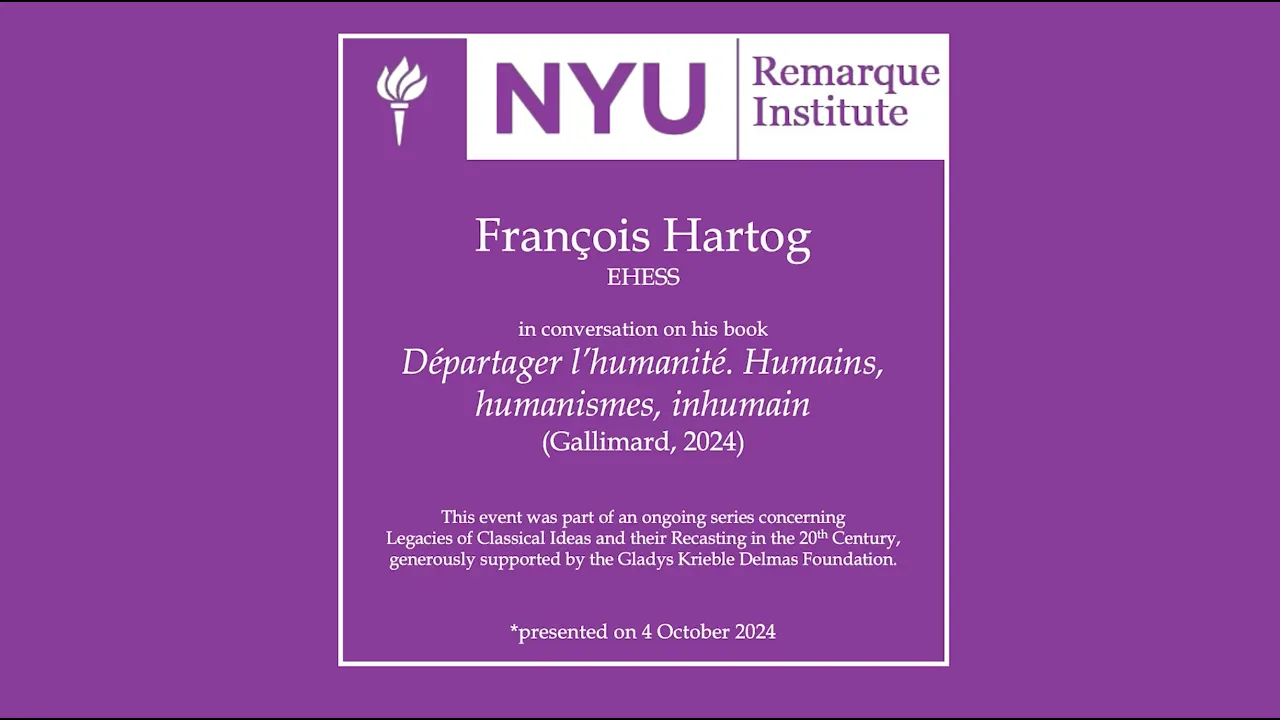
all right uh welcome everyone Hi everyone welcome to remark Institute um I'm Stefanos yanos I'm the director of The Institute and uh it's a pleasure to to to see you back here so many of you um for our event with f together with me today as usual uh our s Paul AMU and and Lauren Lee I think Lauren is downstairs hoping uh and above all and it's a pleasure and an honor to welcome you back to the Institute and this time to actually give you the chance to present your thought properly last time was was
shall we say somewhat abbreviated um uh if you're my age or older you probably first encountered FG with his classic the mirror of Herodotus which came out in 1980 uh I made an e florescence of writing on the Greeks by figures from nio to jeanpier Verno in the mirror of Herodotus famously picked up the question of the other and staged it across The civan Narrative of Herodotus histories um it was both a study of difference and if he wrote polarity and also a sort of a meta study uh at the historiographical level a field in
which she has been an absolute leader both in France and internationally and if on the one hand he has studied at length the 19th Century's historiographical constructions and claims and hopes from Fel deange to Reno to the establishment of the discipline itself on the other he has also been committed to questions of the frontier the border and withth them of of the other so um if I were even to list his books uh we would take way too much time and who wouldn't have enough time to uh talk and so you can go on Wikipedia
to to save yourself um on that front but I do have a particular life love for AR's regimes of historicity a book uh that came out in 2001 uh and took over a decade to uh be translated into English and one of the definitive studies of temporality and historicity for a time in regimes of historicity um details the treatments of relations between past present and future as Key Systems not for only for thinking historically but for thinking and for belonging belonging together he raises significant and enduring questions about the present times commitment to itself notably
in the conclusion where he writes quote the present can no longer be understood or only partially as an odd in between period and historical time during which this is a quote within this quote uh during which one becomes aware of an interval in time which is altogether determined by things that are no longer and things that are not yet and of the quote within the quote on the contrary this present is present seems to be determined by nothing other than itself in his more recent Kronos the West confronts time at continues along the side of
questioning of temporality presentism uh and history by following the Greek terms Kronos crisis and chyos which he treats as key concepts for The Ordering of time uh and he shows how the New Testament particular translation of the Greek term ones uh helped establish a specifically Western notion of time that has persisted this to morality may have emerged in Christianity but it continues into the ordering of the modern world um which makes this book Kronos a temporal study of secularization so to speak of a political philosophical theology now is bringing out human humanism and human with
galar next month um which is the book that he will present from and speak to us about today I think we would translate it as to share Humanity um but I wasn't sure how to make the infinitive and I thought I would leave you the version of this so um yeah all the more reason to leave the stage here okay well thank you very much stefanas and and of course thank you for this invitation and I thank the remark Institute and the staff of the American Institute and which made possible this meeting this today um
the this presentation comes as you said from a forthcoming book title of which is as you said in well by depart I mean to divide to distribute to allot it's actually the very Act of dividing that capture my attention and guided my questioning all the way long whether you read the opening verse of Genesis or the first lines of eard theogony these are all stories of dividing for God to create is to make divisions to separate for EAS we go from the initial initial chaos and through a series of bigots which are as many divisions
to the fixings of this order and finally to the delimitation of a human condition that is to tell the truth not very unvaluable here today I'll conf confin myself first to Greek anthropology alone with the aim of following the logic of its development from a central question mortality then we liap without transition from this constitution of anthropos in a universe which though long since bygone has nonetheless left its mark on the rest of European history to its to we move to its contemporary dissolution if at the risk of being caricatural I leave here aside all
the intermediate stages all the successive division between what is what is human only imperfectly so or not at all I am in no way suggesting that there was a theology theology at work leading from this initial constitution of anthropos to its dissolution so a few words about the Constitution anthropus all men are mortal Socrates is Mortal therefore Socrates is a man a famous syllogism if than there was one in Greece the recognition of this anthropological fact was thought out and instit institutionalized through a first great division the inescapable death of human beings was answered by
the immortality of other beings as if recognizing one's own mortality could could only be achieve by attributing immortality to other Superior distant and not necessarily benevolent entities The Human Condition is conceived from an initial Paradox anthropos man in the sense of the human race is opposed to Theos the Divine being in fact mortality is not conceived from immortality which would be Prim primary we go from the Mortal to the immortal Immortals are defined negatively are tanat they are exempt and as it were deprived of death the posi the positivity of immortality can only be conceived
in terms of its Antony the brief and ever precarious life of Mortals who or what are these radically other beings primitive Powers emerging from the abys superior entities such as the stars but also Supernatural forces gradally divinities emerge with their distinctive features genealogies attributes and a areas of competence they came to form pantheons which end up constituting veritable ever more ramified organic Rams of the Divine for Herodotus it is understood that it was Homer and hod who a quote established a theogony for the Greeks attributed to the gods their qualify divide among them honors and
skills Drew their figures if gods and goddesses last forever and resid reside resid in the lofty Mansions of Olympus they have not always been there in short they have a genealogy two points are worth noting Immortal the Greek gods are not Eternal but s Eternal they have a birth and and once born they last forever in those early days however the the boundary between Divine beings and Mortals was not absolute but th from the day BEC father of gods of men imposes his order he intends to forbid these transgressions with a god Eternal and creator
of all things one has to think and out a new anthropology by detailing the establishment of the sovereignity of those from whom nothing escapes isard also explains the misfortunes of The Human Condition this is the first important point for by establishing the respective lots of Gods and Men he puts into form a narrative an early Greek anthropology the Epic narrative becomes a learn theogony that is also an anthropogeny and aod in so far as IOD justifies world and social order from this point of view few words about the miseries of human condition as for humans
two passages one in the theogony the other in labors and days Define their condition the first first which bring those face to face with primatives also Immortal marks the separation of Gods and Men dividing the Orcs unequally with the Gods on one side and Morts on the other means that the initial commensality with the god with the gods is over for the gods it's the fat cover bones for human it's a skin flesh and entrails clearly the good bit while the gods seem cheated and the anger of those who was in fact plotting the ruin
of The Mortals he retaliates by depriving them of fire in reply promes ever benevolent manag to steal it and return it to mankind this is furious again and quote instead of fire he creates an evil Destiny Destin destined for humans Pandora the woman a deep and Dead End trap this confrontation where cunning and violence mingle first confirm those order then as the story progresses the conditions of mortal becomes clearer they must offer sacrifice to the gods to do so they must practic practice animal usband no wild animal animals are sacrifice sacrific as well as agriculture
to feed women's insaciable bellies it goes without saying that fire is needed to cook flesh and prepare bread the unique unequal dividing of the ox seems to favor humans at the expense of the god but in reality the smoke of the sacrifice is enough for the gods who feed on nectar and osia while mortals can only subsist on solid foods lastly although Pandora gave birth to the race of women she is nonetheless the necessary evil that through marriage ensures the succession of generations thanks where parents do not grow old in misery and escape a lonely
death This is how those meditating on the ruin of Mortals complete completed starting with the in unequal sharing of an oxs in labors and days isard again return to the miseries of The Human Condition a conflict with his brother leads asot to recall how hard labor was imposed on mankind following the confrontation between those and pretus and even more than in the theogony Pandora is presented at the main cause of the misfortunes that have become the lot of kind a veryit fabrication of AOS from earth and water she is also unded with all feminine trappings
and graces not to thus fashioned by all the gods according to their respective attributes she receives her name of Pandora Doran meaning the gift in Greek because it's all the inhabitants of Olympus who with this gift make a present of Misfortune of Misfortune to bread eting men from the outet the woman's lot is that a necessary Evil by means of which the god deive deceive mankind taking a revenge for promit deception for is what's important to reiterate that there is no escape from designs of Ze that is to say a life of toil where inevitably
the Sorrows outweigh the joys placed between the Beast and the gods man raises and sacrifices the former in honor in honor of the deities a central practice sacrifice is a celebration that brings together all the meaning of the word dividing separation from the god separation from the animals though not without a certain closeness you don't sacrifice a wild animal to sacrifice is to acknowledge that you are mortal in need of nourishment though unequal the dividing of the animal is also a form of sharing with the Gods who re rejoice in sacrifices in their honor finally
the sharing of the ghosts of the ox or the sheep in the occasion for a banquet a sharing with commensals relatives or fellow citizens a few word about it what I call a Tran horse that is an immortal Soul after his condemnation Socrates speaking for the last time maintains that there is no need to dread death heer he says it's a deep sleep where all Consciousness disappears and what could be better that than such a night or it's a journey of the soul to Hades where all the dead are met are met W Socrates will
then hen to question in any case those over there are happier than those here if only because they can no longer experience death you don't die twice this Pleasant Hades is closer to the islands of the bless than to the place populated by forgetful Shadows visited by Odus but the point to remember is that Socrates and vises Ed journey of the Soul p and of a soul which having left the body retain all its faculties whether death is sleep or travel death Socrates concludes must be seen at a good with this alternative Plato in fact
presents two visions of death for the Greeks the most common According to which there is nothing after or Beyond Death the other in which the immortality at least of the Soul emerges this alternative opens up the immense and long debated problem of the sou let's limit ourselves to this one remark inevitably the recognition of an immortal Soul PS into question all the division E to established by the first anthropology starting with the now insurmountable Frontier between mortality and immortality plate Plato has Remains the major architect of this reversal so I jump to the dissolution without
for the sole purpose of this presentation let's move on to the 1970s what was the intellectual conjunction like and in what terms did the question of dividing arise josing these two moments however far apart they may be had the advantage of highlight High highlightening the contrast between them casting a cross light on both during these years anthropos was called into question from a variety of quarters which varying degrees of radicalism from philosophy anthropology Neuroscience sciences and paleontology but also from feminist movement more recently from Echo feminism animalist movements transhumanist and finally from the apple or
apple Mis misname anthropos scene concomittant yet partially independent these multiple critics share a common recusal of something specific to human beings in 1966 in the final of Lio shows puko as you know diagnosed that man I quote is perishing at the being of language shines more brightly on the horizon ask three years later about this death of man which say the journalist with whom he spoke has AR aroused great emotion and in innumerable controversies among our good humanists he replies quote there is no need to be particularly moved by the end of man it's only
the particular case or if you like one of the visible forms of a much more General Demise by this I do not mean the death of God but the death of the subject of the capital sub subject with capital of the subject of the subject at the origin and Foundation of knowledge with capital Freedom language and history and about the so-called human Sciences I believe quote that the human Sciences do not lead at all to the discovery of something that would be the human the truth of man is nature his birth his Destiny what the
various human Sciences are really concerned with is something quite different from man they are systems structures combinations form and so on consequently if we wish to deal seriously with the human Sciences we must first and foremost destroy the obnoxious chimeras constituted by the idea that we must search for man man human being is not the game of the human sciences and the omo umus of the humanist tradition is nothing but Chima in fact he adds the idea of man of man work in the 19th century in much the same way as the idea of God
and work in previous centuries and yet says fuku we were still terrified by the idea of a Humanity that could continue to function without God hence the conviction that the idea of God had to be maintained if Humanity was was to continue to function and that in those years fuku use pretty much the notion of function function simp now you say to me he addresses the journalist perhaps it's necessary but the idea of humanity to exist even if it's only a myth for Humanity to function my answer is maybe but maybe not neither more nor
less than the idea of God though the general idea is clear man Humanity humanism are Miss and we are discovering that we can function without them as far as anthrop ology is concerned one of the great question of the discipline has been the division between nature and culture having in fact developed around this very division it will first question it then challenge it Philip Des Scholar's work the French Anthropologist is typ is topical in this respect indeed is questionnaire larg STS from the opposition between nature and culture but the further he progressed the more he
was led to go beyond this dualism to Advocate what he call a fully monistic anthropology Beyond nature and culture getting read of all dualism is in fact a major feature of the current of our current situation Beyond nature culture the book in which he set out his pass and proposed nothing less than a due departure for anthropology was born he says out of a feeling of dissatisfaction dissatisfaction with the way the way in which the relationship between nature and Society was handled if first effort at clarification consisted in demonstrating that the opposition between nature culture
does not possess the universality that is attributed to it because it's devoid of meaning for anyone other than models and he's using model in the sense of bolu one fre of this ethnocentric pres presupposition the Anthropologist is in a position to hear what they are for what they are other cosmologies which confer on animals and plants most of the attributes of humanity indeed many so-called primitive societies rights invites us to go beyond the division the division we have established between humans and non-humans who have never s i quote who have never thought that the boundary
of humanity stopped at the gates of the human species we do not hesitate to invite the most modest of plants the most insignificant of animals into the concert of their social life anthropology therefore faces a formidable challenge to quote either to disappear with an exhausted form of humanism or to metamorph by reing reinking its field and its tool in such a way as to include in its subject much more than just anthropos the entire collectivity of existing beings linked to it and now relegated to the function of Entourage naturalism which is typic specific of the
West according Des schola in is has increasingly separated humans and non-humans faced with this threatment of what exist animism occupies an anti antithetical position indeed it can be defined as quote the imputation by humans to non-humans of an interiority identical to their own this disposition Wom humanized plants and especially animals since the C there under which we enable them not only to behave according to the social norms and ethical precepts of human but also to establish communicative relationship with the L latter and which each each other the similarity of their inner selves thus authoriz an
extension of the state of culture to nonhumans however this humanization is not complete for in anistic system those kind of Disguise humans that are plants and animals are distinguished from humans precisely by their clothings of Fe of feathers hair scales or bark in other words by their physicality from this from this very rapid comparison of naturalistic and animistic ontologies we can see that naturalistic ontology in the scholar sense gives man a special status while animistic ontology does not does this mean that the human has disappear no on the contrary it extend it things plants and
animal share the same interiority as human the same soul in any case animalism can be said to be anthropogenic and of course not anthropocentric in so far as it brings about from humans all that is necessary for nonhumans to be treated as humans when all is said and done naturalism appears for what is one of the four ontologies one of the ways of putting existing things in order that was claim to be the standard for the other three are unfounded the dualism that runs through its long history up to the natur nature culture divide on
which ethnology has settled has made modern science possible which is not some which is something but it has also inscribed a boundary between humans and nonhumans leading to quot regime of aparted now very quickly also few words about putting an end to human exceptionalism with structural man we gave at the EP at the moment of the stru structuralism with structural man we gave everything to culture and nothing to Nature with I take this example jeanpier sh's neuronal neuronal man in 1983 the opposite is true he is fully and un uni uniquely natural so much so
that the animal human body cell brain Spirit divisions are no longer relevant I quote in terms of both the microscopic an anatomy of the cortex and its microscopic architecture there is no sudden qualitative reorganization from animal to human brain on the contrary there is a quantitative and continuous evolution of the total number of neurons and therefore of the complexity of the neural networks that make up the cerebral machine and of quote philosopher Francis Vol draws a general remark from sh Shan's observation under this condition he writes there is no longer an other of man strcture
man had broken with God the great H there was no Upward Bound boundary neuronal neuronal man breaks with the so to speak little other if you like the animal there are no more no more downward bound boundaries under the Empire of the bi biological man can no longer be defined in opposition to all other living beings neuronal man is one because he is a living being but because he is a living being he is no longer properly human this is the effect of the substitution of the methodical methodological monism of the Natural Sciences or the
method methodological dualism of structural man and of quot from the perspective of EV evolutionary biology man not only as a biological part he is human being is a biological being this is his identity at the result omanization must be seen at the result of historical sequences in the in the evolution of living things with no of course finalism at all work paleontology has shown that there is no one Humanity but many Humanities the vision of homo sapiens as the ultimate fruit of the ammonization process is no longer table Homo sapiens may be the most recent
human species but it has coexisted with other human species for thousand of years going back to our ancest makes it problematic to draw a line between man and non-man from this biologization of the human questions it follows that it follows not that social and cult and cultural facts are epiphenomena grafted onto a biological nature but that they are intrinsic aspects of human biological identity thus historical and therefore social and cultural time is a specific form of Humanity's biological time culture does not transcend the biology of the biology of man but is one of his major
features Beyond false opposition and in particular and in particular the most flown of them all that between nature and culture by actively promoting an augmented man transhumanist are working to lower or even eliminate the boundary not between animals and man but between human being and machine contrary to the teaching of evolutionary biology they remain dualists there is the brain and there is the body in an incredibly near nature near future as this philosopher Jean Michelle Ben B suaps technoscientific progress will enable enable us to escape the physical constraint characteristic of The Human Condition how will
we live without being born since we will be able to result from a technical production without suff suffering or falling Hill since nanom medine will prevent us from doing so and finally without dying since we'll be able for example to download the content of our Consciousness onto some inalterable material that can be implemented on demand in some substitute body our transformation into cyborgs will then be nearing completion the best known prophet of the coming description R vile predict the arriv of the singularity in 2045 when quote we will be able to multiply our actual intelligence
by billion by a billion by merging it with the artificial intelligence we have created thanks to the ever accelerating development of artificial intelligence combined with advance in nanot technology biotechnology and cognitive Sciences the union of the technical and the biological will produ an hrid being will we still need to speak of an augmented man or will it be a man machine in the sense of a human s sort of a humanized humanized m machine Nick bustr director of the future of humanity Institute at Oxford University while aware of the existential risk that artificial intelligence can
pose is convinced of the considerable benefits it can bring not surprisingly not surprisingly the elimination of poverty disease aging and deaths the downloading of our minds into computer and so on Sam Altman silicon Val's New Phoenix says it's all on his world to promoting chat gbt things are moving so fast that Ellen musk and his company neural link have obtained permission to test their brain implants on human enabling enabling them to control computers by S these technological Advance are cause for concern in a book published in 2023 an American philosopher and jurist Nita farahani Ur
urge legislator to concern themselves with the defense of what she called cognitive Freedom a dimension of personal Liberty now threatened by possible malicious Mal malicious intrusion into the brain and we know that the Ingenuity of hackers is always one step ahead with the prospect of augmented man the one receiving the most media attention could come At Last At Last the transgression and abolition of the oldest division men are mortal from which we start but where the Greeks set up a three- term scheme Immortals beast beast men transhumanists think they can get away with a single
term namely a technological reformulation of the Mantra man is a God for man in the form there is no other gun god than augmented man and it's within our reach better still it's already here other living beings whether animal or plants don't hold their attention anthropocentric if not exclusive transhumanist it's not inclusive transhumanist will save themselves provide they can get enough electrical power for long enough if human beings are no longer mortal do do they have access to immortality no having entered the afterlife of the singularity in a new space time their lot would be
rather that of a a mortality more or less indexed to the possibilities of successive uploading from one machine machine to the another with their immortality would come not anti-humanism or inhumanism but something like digital a humanism um a few words about feminism here again I will be following just one thread that of Nature and culture since women association with nature is a very old story and we'll be doing so only on the basis of historian of Science and feminist Caroline Merchant's book The Death of nature women ecology and the Scientific Revolution in which she studied
studied a Tipping Point in this long history a book was widely acclaimed for three reason and that's in the the preface of the last editions I quote it was one of the first critics of the problems of modernism and in particular of mechanistic Science and the world view associated with it which gave rise to the postmodern deconstruction of Enlightenment optimism and progress secondly as a co- feminism feminism came to the for during the 1980 and 1990s the book was seen as an avangard statement of the relationship between women and nature thirdly it paved the way
it PA the way for a reassessment of the ethical relationship between between humans and nature moving away from ideas of dominations and towards a dynamic new partnership partnership between people and their environment the period under consideration was between the 16 and 17th century when the Renaissance organic vision of the cosmos in which all elements were related to one another were replaced by mechanistic representation in which nature is reconceptualized as dead and passive to be dominated and controlled by humans remaining Bound To Nature women th find themselves doubly inferior they are on the side of this
SP passive nature to be dominated but they are also on the side of the that wild part of nature that escapes control it's the witch Loos diabolical sabath that must be HED down and burnt at the stake and so it was in other words the accentuation of the distinction between nature and culture was to the detriment of women yet for the Eco feminist of the 1980s and 90s the domination of Nature and that of women are in fact two intersecting domination that refer to each other Caroline Merchant's book provides a major reference point for understanding
how the two are interwin when we move from an organis vision of the universe to mechanis and suggest ways out since the Deep the deepening of the decoty between nature and culture has been a factor of the construction of modern Europe and is also in the subordination of or naturalization of women its recusal must enable women to break free from this ass assignment the rejection of this longstanding dualism while in line with that of the life sciences paleontology and anthropology does not mean that Eco feminist wish to abandon all reference to Nature indeed at the
end of her book Merchant suggests that a reassessment of the constraints and values historically associated with the organic worldview made be essential for a viable future and which ones those of cyclical processes the interconnectedness of all s and the assumption that natur nature is active and aive alive what's more organises which pre which preed mechanicism in Europe was widespread in societies on other continents and as remains so to this day this is why a co- feminist attentive to women's struggles around the world have put forward proposal for reclaiming the positive relationship between women and nature
without returning to some kind of Eternal feminity Don another harway polymorphist work is another example example of this refusal to accept the division between nature and culture and more broadly the dualism that accompanied the circumscription of human's own nature this TR full of theories which are always simplistic she seek to create and tell new stories that privilege improb improbable and significant encounters between all these Critter as she called them human and nonhuman g g are the days of the very history of man and history what we need today she said are Geo histories with a
test for etymologies to draw out the effects of meaning she brings human closer to thank you to humus the her something the Romans were not aware of but without stopping there she draws all the consequences if this is so I quote why not prefer compost more evocative than humus to posum and posthumanism or humus to Humanities humans are humus as humus May well have a future if only we can support you humans as homo the winning project of a selfman manum manager of a planet demolishing Enterprise and of course under these conditions to call the
anthropos scene an era in which man anthropos is stripped of all exceptionality seems highly inappropriate since neither the human species nor man with capital M and tool with capital T make history teras inhabitants events invent ways of living and dying that are inter intertwined and tentacular but they don't make history similarly again the transhumanist and posthumanist claim to are not AO pis of the human being she argues for sasis it's not true that mortal wordss by whatever name they are called happen on their own they are always Partners involved in the beginning she would say
was not dividing but interaction a significantly titled book staying with the trouble or better still inhabiting the trouble is dedicated to the makers of mismatch kingships in all cases the obsolete dividing line between nature and culture is erased while ibrid hybridity is valorized acknowledging that the times in which we live are troubled and troubling and proposing not to emerge from trouble but to inhabited also means opting for a relationship with time that privileges the present inhabiting disorder means inhabiting the present and only the present by making it habitable precisely so that a live livable future
for all living beings is possible rejecting futurism positive or negative The Proposal is to rather to thicken the present to enrich it with all the connections all the active reciprocities that make it a living nity so Donna harway while not dubling doubting the devastating effect of human activity on the earth system intends to use the ter anthropos scene sparingly in fact to do so would be to to do too much honor to this anthropos which she would like to chop up indeed it's inappropriate for him to give his name to this new heok which she
beli should more appropriately be called the capitaline because quote it's not anthropos who is in charge of his danet hydraulic roring rather we need to see and above all experience the epoch at the TW Twilight of this anthropos which lives be him behind him a world in Ruins and as the possible opening of a common World bringing together humans and nonhumans transcending masculine and feminine and cultivating inter relations and hybridization according to the new division proposed by the late Bruno L humans are those still living in the hosin era and clinging to what he called
the old climate regime while earthlings human and nonhumans combined are of the anthropos scene and have taken note of the new climate regime inevitable then is a conflict or the war between humans living in the Allan ook and Earthling of the anthropos scene from this last brief sequence in which feminism ecofeminism and climate crisis meet it's clear that if there is an anthropos Scene It means in fact the end of the human or man with capital letter the disintegration of the S humans as l f of analogy with the French Revolution put it for the
Anthropologist Edward Ed the Brazilian Anthropologist Eduardo Vios de Castro such a world with without man would in fact come to meet the all inperson World met made entirely of subjects of Amar Indian cosmogonies for which there is not the one on humanity and on the other the world on the one culture and on the other nature but a real consal consubstantiality of the two having followed very different different past the world after man and the world of animism not before man but where on the contrary everything was originally human would have thus come to correspond
the later the latter could if not propose itself as a model at least be seriously meditated upon by the former the anthropos of the anthropos scene concludes binu not hesitating to mobilize the Bible this time is Babel after the fall of the giant Tower at last he said human beings can no longer be unified at last is no longer off the ground at last is no longer outside Earthly history thus we have gone too fast from the circumscription of anthropos in the Greek universe through a series of division to its dissolution through the questioning of
these very divisions and the rejection rejection of all the dualism that had e to served to conceive of the order of the world a man's proper nature thank you very much um I wanted to I wanted to take chair privilege and ask one little question this which is want to to understand a little bit better the lineage that you draw from fuka onward is this suggestion that these are all is is there kind of direct line that you're following there from fuk through descola through to sh or is there a sense of mutual criticisms that
is played out in your analysis and what is the character of this analysis the reason why I asked is that in a way there is a sort of critical tradition uh in these so then way or but then there's also a very clear sense of a kind of Frontier of either real science or like fantasy money um so I would say that there's a stru I would have seen a structural difference the movement from Neuroscience in the early 80s when it's exploding in cash through chat GPT which is also what did they say yesterday that
it's 180 billion that uh open AI is now worth within a year and a half of of this operation so I'm very curious as to how if one is sort of proving the ugly side of the other argument uh or if you see it as a kind of depart that's that's a kind of consequence of the sort of pressure I am there is no direct line to to ch um and I been able to the fact well that or less around 1970 you had coming from wats this kind of question not necessarily being aware of
what they were doing their own logic but convergence and there you kind of way the smallest common denominator between is of something is [Music] there and for those who are online on Zoom feel free to put a question in the Q&A now so okay so uh thank you for this um very thank a lot I have a a very very easy question I mean as you mention yourself I mean all these kind of new ways of putting together nature and culture and so on so forth and machine and so on uh I mean the kind
of original PA is are the 1970s so uh historians have shown that the 1970s are decade as a kind of turning point in a lot a lot a lot of of of of issues in particular I mean we talk too often about neoliberal turn or these kind of things so how could you describe the historical context in which these kind of ideas are merging you have any idea about the Way You Could reconstruct this context uh in order to you know try to reconcile I mean all the other turn of the 1970s that's not an
easy question I know but it's a question which is and because wa I feel more with that earlier in the book but as far if we take Point of Departure is e of this we have to in order to understand we have to go back to what happened very clear that the as questioning of being of man earlier and is and and uh but with you if I'm extremely schematic would say that rism wa to while it was not possible is one and so and after that and it is most development of that perhaps Without
Really aware of new new conure as far we go to go to sh that's different interesting thing that it starts by by well that's by up now the human Sciences have had Ro and they give they give everything to culture and nothing to Nature and I'm going to say that doesn't work like that so his his positioning is at least in this group audience than the but he's positioning himself as think it's necessary start by well we have to rethink and to and doing that that's all have to do to be told in sure nothing
to thank you very much uh for this interesting talk which reminded me in many ways um can you hear me no yes of course I'm sure thank you very much um for this talk which reminded me can you hear me now is it um in many ways um of your work on presentism and time regimes Also regarding the chronology and I would interested to know how they connected but that is not my question I just wanted to wanted to drop that line my question refers to the um very interesting and also highly entertaining jump that
you made from hot into the 1970s um because I would I mean I would I would want to ask if you don't need an intermediary step um namely modern humanism early modern humanism um which refigures humanism I think with divisions you know to to speak in your terminology that are very different from the antique ones so that I would even say the anti-humanism of the 20th century is in many ways also the attempt to get back to the Ancients you know to break with early modern or modern humanism think of n think of Haider um
and many others they they it's not it's not a coincidence that we all that they were all in love with the Ancients and they anti-humanism and that's also true I think for you know late late 20th century versions of anti-humanism um kinds of anti-humanism were trying to break with a modern humanism and some of them did that with the idea to you know get back to Antiquity and I think I mean one of the defining divisions of modern humanism cor if I'm wrong which is really not part of the antique humanism is the division between
human and Cosmos right the modern human is um existentially has lost the connection Cosmos whereas the ancient human is you know like a um like a Cosmopolitan a citizen of of the cosmos that's this late late and um um idea of a Harmony between the humans and the cosmos even though they're they're Mortals um so that seems to me a very different kind of division and that of course is also strongly connected to the division between nature and culture that you refer to but that is exactly not an antique one so the say postmodern anti-humanism
20th century anti-humanism temporary anti-humanism has beef with early modern The Ear The Modern human but not with the antique to also ask questions um thank you uh so that follows the last question um which is if you can unpack for us a little bit the relationship between regimes of historicity Kronos and this book and just to um uh pinpoint what I find in need of unpacking um the some of the critique of the last two books um I'm thinking about the form that history and Theory edited was a the the Christian regime of historicity as
the core of that chronology right um or theil the the the historiosophy behind that chronology and I wonder if this um chronology now doesn't in a way double down immanentize that chronology or that um critique of presentness from that perspective and just to uh last thing about it is if the regime of historicity you seem to critique that that from the outside in here you seem to actually follow that the vision right um I don't think so but oh you are right I said I was to jump the wise and the day and and I
to take into consideration what you said an answer um it's clear that being change the they call omus um you had to rethink about are trouble I just that as soon as you have a god eternal pring change question is have we have we an access is and question yes and that that so then that's from then on what you mean by humanism changed and what mostly against Christian that and this population of 19th century of and um and protagonist of that your body after that I agree with what you say and not simply Tri
stles and of humanism anti humanis ISM there is some correlation from Christians which is who is in a way there forever or not Forever Until the End and and the end is something you have have to be prepared in the time regime realization of put in the future it's very clear or even earlier about right also is a Hing ReliOn of Man Marks and even nature is so anti-modern so much anti-modern has an opening the for human or Superman that is not yet and even of God announcements of God has not yet used so you
have also this Dimension and that's something which Des here well um yeah a characteristic sweeping um account and I'm going to try and tie together something from the beginning and the end but um you'll correct me if I if I get lost in the weeds um so one of the things at play here is in this story of division is also that which is uh indivisible you could say and we see this even at the very setup with the syllogism you provide about Socrates the man the Mortal man is well Mortals are subject to history
they have a lifespan that's absolutely divisible syllogism at least in theory is aderes to the rule of logic uh this is a permanent truth it's always the case even if you have some faulty syllogism the syllogism that works is always going to work um it's in that way indivisible I mean you could take it apart but it it's truth if it's truth is there for forever for always it is an eternal truth so you you get not only this kind of divisible indivisible but also this finite infinite or Eternal versus moral well but let's get
to the seital because that's different because I would say the the syllogism shouldn't be seetal it should be Eternal it should always be there it's not going to to disappear um but then in your in the story that goes on the division that seems to happen is a a losing of that infinite or that Eternal in favor of desent Eternal so an eternity that's on a timeline and along the way then we lose especially after the 70s or we seem to lose um what I would say is the indivisible the indivisible seems to have have
gone away as I guess on your account have the gods maybe the infinite I'm not sure I mean I guess both structuralism and deart could Marshall an argument for something that's infinite along this way but but at the very end when you get to the singularity the story you give of the singularity is of the cyborg right so that's the seetal but there's another version of The Singularity that's out there by these same thinkers which is that that intelligence will have no need of us this is to say that we'll become in essence Mortals in
once again in relation to whatever these new Gods future Gods moving on a future ocean to quoto uh coming in and that is a kind of reinstatement at least on your account of this infinite and of this relationship and so so I wonder first of all about these divisions between between divisibility and indivisibility whether they do play out in the way I'm characterizing or not second of all about this sort of alternative U end which does sort of that's chiastic we start off with the gods it's Immortal and infinite and the humans or I guess
Eternal eventually they become Eternal again once they become the Christian ones and then we end again with reinstating a god which is sen paternal in form of the one that needs power and a server all these things and yet endless thank you very much for your wonderful talk my question Rel a little bit to the one um I would like to ask you for your opinion about the possibility to differentiate the discourse a little bit so I I think maybe we have a discourse a theoretical discourse from the 1970s on so harway until New materialism
and then it's very much about Des centering you de centering so put it in a net of relations so it's decentering as anthropos and then I would say we have a scientific technological discourse on technological enhancement which is enhancing the human but it's not Des centering but it's making the human better so and making it even the the crown of everything and then we have this post biological discourse which is overcoming human Humanity humans atropos bi technology I think in my opinion it could be important to make this differentiation between three different kinds of overcoming
dichotomies don't know if it's um hement is enhancement betterment but um how do [Music] you valuate what kind of of this and is think that's I know that but I'm not sure to have clearly it just Dy with one I try to categorize this uh this discourse into three different threats it's not uh judging it by my own but try to say there are difference between this huge um this CA of overcoming d otomies it's a theoretical philosophical cultural studies discourse technological scientific discourse and this one I would split into two different um strands again
I can discuss it later with you now we are we coming back to some um pretending to being to are we not finally re introduce to think about in the bank and thank you for your talk uh let's just very quick comment in considering this uh question about the line from Fuko to Chad GPT I was just wondering if there isn't a more obvious line from know about death vithor to chat gbt but anyway that was just a straight thought I had my question actually relates a little bit to this intervening period of humanism um
that very understandable reasons wasn't there in your team but um I was thinking in terms of some of the Enlightenment views of humans and the sorts of Divisions created there you know not the humans God humans animals humans machines Etc were within humans themselves and so when you pick up fromo and uh the others that you discussed there's a assumed singularity in the notion of the human um and I'm wondering whether and I know that you've written elsewhere about this construction of humans and others but what happened to the those Enlightenment views of distinguishing between
humans um often as sort of um Superior humans and lesser humans have we now completely um gone beyond that is that period over now that we're contemplating humans in relation to machines humans in relation to Nature okay old DE very well um um being enlightened to have an extension should not being andion space and also in time comes question of the limits when human beings when human being starts for example buy someone like you and and also geographical is c some sort start to be active but as soon as you have this comes the question
of to have the question are others after way the question disappear not it's no longer I don't know what answer but I I think it would have say what is what is the point and um after what I was moment is humanization I wonder if your argument your narrative doesn't really end up in a more dystopian darker place than you indicate I mean aidian place where the the remaining Sovereign decides because of the O let me let me give you an example because of the overpopulation that would inevitably occur as a result of the augmented
beings someone is going to have to decide which beings get augmented and which don't That's The shidian Sovereign you restore the kind of Ze like sman figure at the end actually the end that's exactly the end by this vence of questioning around 197 and and umly at the same time same years you have development very quick Dev of humanitarian and and uh by near the same people on one side you see there is nothing as belongs properly to well on the other side you have all these young doctors they we have have to go where
and we have to in the name of the Dignity of man without asking the question name of dignity we have to be there and we have to be on the side of the victims whoever they are and so I simply noce I think we should let you off