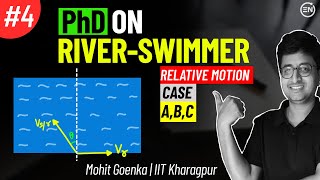
hey everyone in this video i'm going to teach you the art of solving riverboat problems this is one of the important topics and mechanics from which there is a very good chance that you might get a problem but you need exam first i'm going to explain the concepts behind it and then the different conditions on which there will be a problem well first let us consider a reverse system where i am going to consider the velocity of water as vr the arrow mark represents the direction in which the water is flowing now here is a
dude chilling in his boat at the back of a river i think he is adhering to music isn't it well anyway that doesn't matter no the velocity with which the board will be moving shortly that i'm going to consider it as v b where b represents a boat now there are three models of questions that can be asked based on the scenario the first one is to cross the river in the shortest path now you might know that the shortest path between any two points is a straight line our friend here also knows it and
he's going to paddle his boat towards a point b as quick as possible and look what happened here he crashed on the rock how did that happen i believe you already figured that out didn't you yes he did not consider into account the speed of the river you see when he decided to move towards the point b from a were the two velocities one is vr the velocity of the river the other is velocity of the boat vb both these velocities are perpendicular to each other this caused another resultant velocity which carried them in a
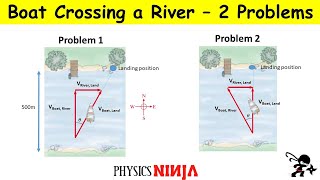
different direction and crash them let's run this scenario all over again but this time a little differently the target here is to reach point b from a right the best possible way to do it is find the particular angle in which you are going to row the boat such that the velocity of the river pushes you to point b and we are going to do it by moving against the velocity of the river such that the resultant velocity acts towards the point b but only if you row the boat at a particular angle theta this
is possible so first you need to find this particular angle theta now look at the blue line that represents the velocity of the river now i am going to move it up here now the only way i could find the right angle is by knowing the exact velocity of the river and the velocity in which i am going to row the boat right while the velocity of the river is on the opposite side the velocity of the boat is on the hypotenuse side so using sine theta to find the angle will be the best choice
here isn't it so the formula to find the angle in this scenario will be sine theta is equal to v r divided by v b now what if they ask you to find the resultant velocity that is acting towards the point b then you can write down the formula like this v square is equal to v b square minus v r square so v is equals to root of v b square minus v r square we minus the board velocity from the river velocity as we are opposing the velocity of the river in order to
reach b now if the question is about finding the time taken to reach from point a to point b then we can write the time period formula as time period equals to displacement divided by resultant velocity v since we are traveling through the shortest path the width of the river will be the displacement and hence we have taken it as d for resultant velocity v we can substitute the value that we found earlier that is root of vb square minus vr square here we are going to figure out how to cross the river in the
shortest time remember the mistake that we made earlier when we rode the board exactly perpendicular to the velocity of the river the resultant velocity took us somewhere else other than b well that is no mistake here we want to cross the river at the quickest first make sure there are no huge rocks lying around then when you feel it is safe row as hard as you can across the river directing your boat towards b you will cross over at the quickest though the only problem is you reach a different position c instead of position b
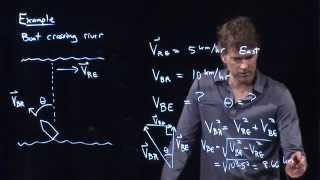
now that doesn't affect us yet as our target was just to reach the other end as quick as possible there might be a problem that they might ask you to find the angle through which you have deviated from your initial destination in order to find that we are going to do what we did last time but a little differently this time the velocity of the river still remains in the opposite side but the velocity of the boat is now on the adjacent side so now we are going to use tan theta tan theta is equal
to vr divided by vb this angle will be equal to the deviation that has occurred now in this case if they ask us to find the resultant velocity then the formula can be written as v square is equal to v b square plus v r square here we are adding the two velocities as both the velocity vectors are in a clockwise direction in order to find the time period we can write the formula as time period t is equal to displacement d divided by velocity of board v b here we have ignored the value of
velocity of the river because when you want to cross a river in the shortest time then it is best you do it at still water now there is one more possible question they might ask from this scenario yes you have reached the other end at the shortest time also but now the boat has reached point c rather than reaching point b then they might ask you to find the distance between point b and point c let us consider the distance between bc as ex then using tan theta we can find that tan theta is equal
to x divided by d we already know that tan theta also equals to vr divided by vb so vr by vb is equal to x divided by d then the value of x should be equal to displacement d into vr divided by vb so and finally there are just two more cases and we can get rid of this topic for very good the blue arrows here represent the direction in which the river is flowing our guy here still chilling with his music is also rowing his boat in the same direction as the river this condition
is what we call as down stream if a man travels downstream in a river then the time taken by the man to cover a distance d is given by t one is equal to displacement d divided by v b plus v r now what if the man wanted to row his boat opposite to the direction of flow of the river this is what we call upstream if a man travels upstream in a river then the time taken by the man to cover a distance d is t2 is equal to displacement d divided by vb minus
vr since is going upstream there might be some scenarios and problems where both upstream and downstream conditions might apply in the same problem and you will be asked to find the ratio of the time periods then the ratio of the downstream to upstream can be written as t1 divided by t2 is equal to vb minus vr divided by vb plus vr so these are the necessary formulas and possible scenarios from which there might be a problem based on the riverboat concept in neet exams make sure you revise all these problems and when the time comes
don't mess up if you do understand and like this video please subscribe to multimedia tuition