Okay, thank you all for joining timely. Thank you. Okay, please give dan for me. It's early morning dian time. See I have sacrificed puncha dan to come take your dion. Hey pus, today we will do the action learning project second assignment. Let me start sharing. The recording is on. Thank you for joining timely and I hope the rest will catch up soon. So let's go to We have to go through all of my screens. Just allow me a second, please. May prau Har Krishna Har Krishna. Okay. What do you see on the screen? Nothing as
yet. I'm just as yet I see uh action learning project 2025 in the what do you say? Yeah, let's let's let's wait for Mavawi Prabhu because he's a revolutionary. If he doesn't see, he's going to create a revolution. I don't know my I can't see nothing on the screen yet. Okay, please don't post it in the WhatsApp group that I did not show anything. Welcome to Armanu. What do you see? So I see uh ALP planning uh uh nine assignments. One is planning uh seven assignments and execution two assignments. Uh now now I can see
now I can see uh 7 + 5 12 assignments. And did that happen just magically or You know how to do that? Go from 7 to 12. No, no. You you you press that show all then it came up. Show more. Okay. Okay. Do you see some dates there? Do you see some dates? Listen. Listen there. Yes. Yes. What are these dates for? These are completion dates that we have to complete the assignment as those completed dates. Okay. and praise you are all very busy leaders and you require extension for every assignment that we post
right. So for all of those you are extension seekers your extension starts today. Today is 26th May for the second assignment. The extension is starting today. You have till 8th June to complete this assignment. Please stay on track with this. This is called action learning project. It's not passive learning project. I'm not seeing any smile on your face. Prau what happened? So Brahu my only question here is uh uh we are finding at least I'm finding difficult to get people on board because there are uh vacations so okay okay got it got it got it
so that's where I'm struggling at this getting people together okay babu I okay I I didn't mean to start off on a wrong note but uh the point here is that these assignment dates are mentioned. Midawi prau are you able to see it on your screen now? Yes. I I don't know on my my uh zoom screen something has changed because I I now see a whole of all the people screen on one and then I have to switch tab to another one to see the uh share screen. I don't know why. Okay. So, are
you seeing the share screen now? Yes. Yes, bro. Okay. All right. So, we can start then. Okay Pu. So if you have not browsed this page, this is the action learning project page. I told you last time also these are the assignments that are listed here. We'll go through these one by one. Don't jump too far ahead. Just just stay with us. Just follow each assignment as we're doing on the right hand side. Want to prau what do you see on the right hand side? where I am highlighting this. What is this called? Course handouts.
Course handouts. Okay. And some of these are as you can see these are hyperlinks. So there are sample ALPS. There are sample strategic plans. There are ALP presentations that have been done in the past. And then there are other things grading criteria etc. So and within each assignment. So for example, when I go into the first assignment which you have hopefully completed. So if I click on this, there are these different steps. We went over these steps at the residential that each assignment requires these four steps. So the so today we are going to start
the second uh assignment and in the second assignment I sent you the agenda. I have already lost the first 10 minutes which was the difference between a strategic plan and a project plan. So let me see if I can quickly show you. The reason I'm showing that is the strategic plan versus the other plan is this should help you pick your projects. Our plan is here. Our plan of the GBC college is to broaden your horizon of thinking. You are very accomplished leaders but you have some immediate responsibilities. So you're focused on certain things that
you have to do on a day-to-day basis, month-to-month basis. We want you to think 3 to 5 years out. And I know it's not easy to change that mindset is not easy. But our hope is that if we carry you along and if you stay with us for these six months, next six months, then it will become a part of your habit to think broadly and think strategically. Maybe all of you are already thinking like that. So in that spirit if we compare these two prahu please read one at a time the purpose and then
tell us what a strategic plan is and just pause there. So purpose strategic plan long-term direction and value creation. Okay. So, it's a long-term direction in value creation. Whereas a project plan is you have a defined initiative and you are executing that. So, some of you have proposed some projects that are kind of ongoing already. They are ongoing projects and because you have limited time you want to make that project as your action learning project. But please keep in mind it's not about execution. We will do this later but before we do the execution we
have to first do the planning part. Okay. For execution also we will make a plan but that plan is to execute the project. First we have to develop a strategic plan. So next core question is core question strategic plan what should we achieve? What should we achieve and in a project plan we are focusing on how to achieve how to deliver it under the scope please enterprise yeah enterprise uh slashf functionwide so whatever your area of influence is you are part of a zone part of a country part of a temple so that's the bigger
picture for you so our scope should be to develop a plan for that big thing. I mentioned last time also Prahuad was not thinking locally. He was thinking globally and whereas in a project plan when we come to that we will focus on a particular thing a particular objective a particular item. Okay. The time Horizon 3 to five plus years whereas in a project plan it'll be days to months and we will actually execute it. We will see the results when we do that. But this will come later. This part will come later. Okay. Ownership.
You are leaders, executive leaderships. Whereas there is project manager artifacts. What do we need? What we will we develop? We will develop a vision for this plan. We'll develop priorities, key performance indicators. We'll develop a road map when we do strategic plan. Whereas for the project plan we will develop work breakdown structure, timelines, budget, risk. Okay. So different focus in these and success is strategic outcomes and we will give you an example. So you will see soon what have we gained capability wise. Strategic means long-term long-term outcomes. Whereas in a project there are three goals.
The goals are scope. What you were assigned to do you have done that if you are assigned to develop a particular thing a particular system or service that was accomplished. It was accomplished within a certain time and it was accomplished within a certain budget. So these are the three primary goals of a project and all of this has to be done in a quality manner. So one strategy many initiatives. So through one strategy one strategic plan we will develop many initiatives. Whereas when we come to the execution, we will take one of those initiatives and
we will act on that. So there is one plan per project whereas strategy encompasses many projects. So this is the difference as you can see here we start with a strategic intent. What do we want to do? like today if we get the time to do it we will look at praupad's strategic in intent even though he did not do action learning project he did not uh at that time when praupadas died there was this topic did not exist as such there was something called corporate planning but it was in very early stages but praupad
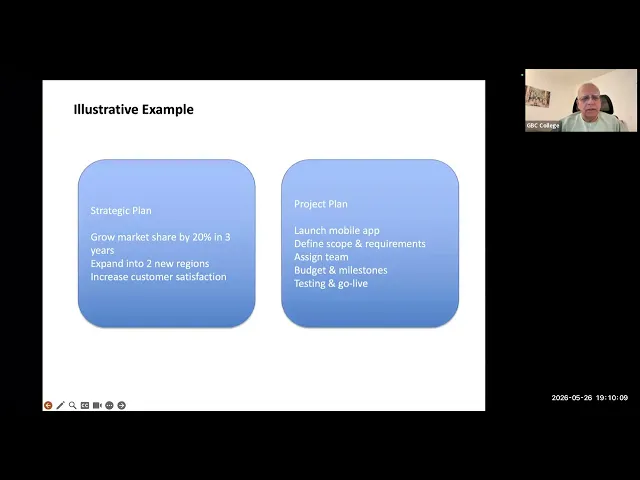
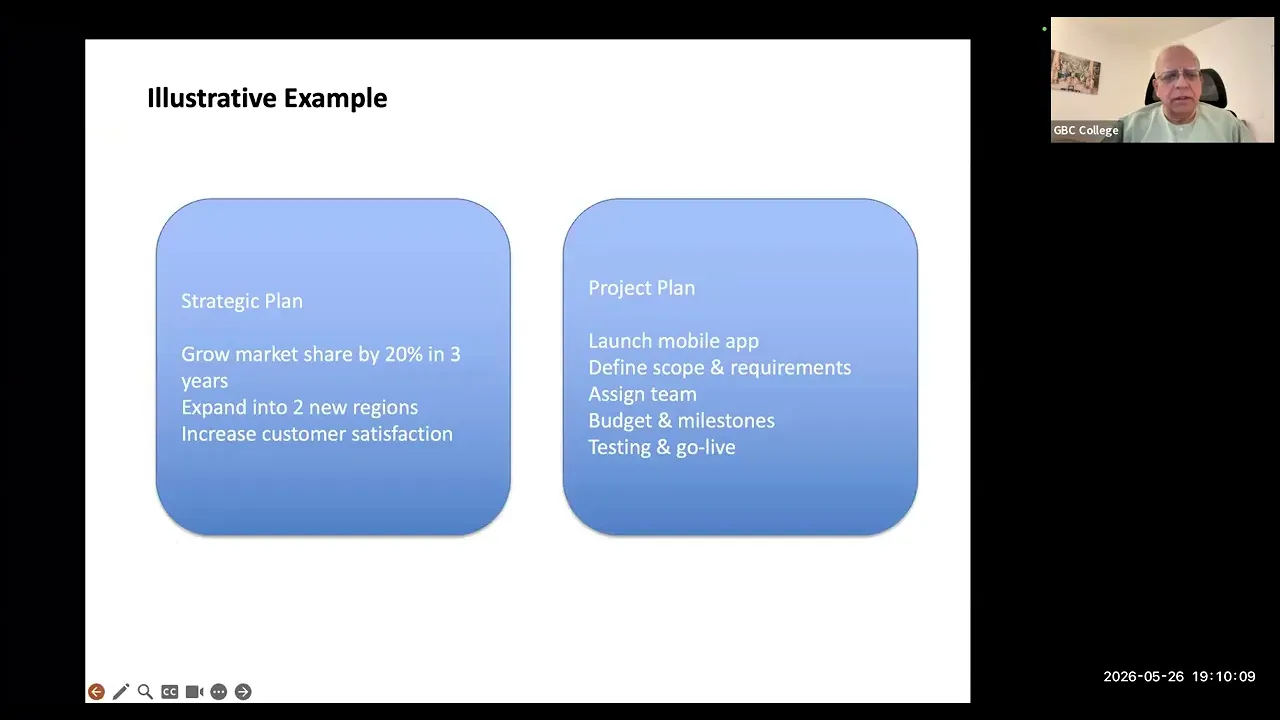
was a strategic thinker he was gifted and from that strategic intent we develop objectives then different programs and initiatives and then from there come these different uh so we develop project plans for each of those initiative each of those plans okay prau so here is an example um I should have changed this so for you grow your your devotey base your congregation base by 20% in 3 years you expand into two new regions. So these are some examples. Increase your devotey satisfaction. Whereas a project plan is launching an app, defining the scope and requirements. Okay.
So these are kind of the things that we do in a project plan. So I hope this gives you some idea when you are Selecting your project as to what you should focus on. And we are here to consult with you on a one-on-one basis not on this call because we want to utilize this time properly. Shast Prabhu please drive safely. Don't look at the screen and you can turn off your camera shastra. Okay. Don't don't try to unmute. It's okay. Drive safely. Okay. Please don't take these risks. And these recordings are available. If you
miss it, you can always go back and watch. So, Karan Gor prau, how are things going with you? Yeah. Yes. Pro trying to uh get your guidance. Waiting for your guidance. Oh, so I'm honored. Thank you. I am sitting in front of the car, not driving. Thank you, Pro. Okay. Okay. All right. Okay produce. So today's agenda as you can see here is strategic plan versus project plan and we are 8 minutes behind. Next we are going to talk about what is strategic planning. Please write your questions that you have as I'm presenting and we
will do Q&A at the end and after I have covered strategic planning and overview as to what this whole project is about action learning project then I will go over assignment two using a slide deck and I'll try to go over two assignments one was done for Romania the other one for Bashnabi ministry global assignment And then time permitting we will have breakout rooms so you get a better idea about what we talked about today. So we are grateful to the strategic planning team which was a committee created by the GBC. It still exists. So
this was back in the day when Gopal Bata Prabhu was the chair and then the co-chair that they created this and they allowed us to use these materials. They actually wanted us to do this because GBC College is also an initiative of GBC governing body commission. So these slides are their gift. We have modified it to suit our needs here. So as you can see here, Shankalin Gor pu please read. Everything has an original cause or seed. For any idea, program, plan or device, there is first of all the contemplation of the plan and that
is called the bija or seed. This is praupa's quote. So we're going to start with this bija seed contemplating to what we have to do. And this is in CC Madya and this is also prahua's quote some kash prahu please continue. So now uh you all GBC make a plan how to introduce the books in every home. Does this sound like a strategic plan? Yeah. Yes prau. It's a long-term plan. Longtime plan in every home. Not in your town but in every home in the world. Right. Yes. The GBC came from all over the world.
And this was in 1977. Okay. Please continue. The plans of the supreme person of God are understood by his mercy and the plans of the devotees are as good as his plans. Bhagat Gita 11.34 perput. So Brahus our humble request to all of you is please put forward a plan for Krishna to consider and don't shy away from making big plans because it will happen by his mercy. We are fully counting on Gurugoranga's mercy. So but if we do not put up a plan then what will they what will they bless how Will they empower
us? So this is our humble attempt here to encourage all of you to think big there is no harm in thinking but big but if we think small and if we come up with a small project then we will achieve small. If we think big there is a probability there is a potential for us to achieve big. We may not achieve that big but if we only think small or plan small we will only achieve what we plan for. Okay. So the essence of strategic planning there are three things in here as you know sa
abidea and priojana. So this is our current state our relationship our relationship with the zone that we are in with the stakeholders that we are serving and priojana is the goal where we want to be and to get from point A to point B we need aida we need a plan. So this part actually is the road map. So this is the road map as you see right here. But this whole thing is called a strategic plan because the road map cannot exist without the beginning and the ending. It cannot exist from the starting point.
It cannot exist without the starting point and the ending goal. So this in essence is what we are trying to accomplish here through this action learning project. And here is the BJA Part. So in this screen you're going to see a lot of things. Please don't feel overwhelmed. There are lot of new terms that are being introduced. But this is an overview session and we're doing it in hopefully in about 20 minutes or so. But we will actually work on it for the next about 6 months maybe little longer. So these things will become very
familiar to us. But today they may sound a little strange. So please please bear with us because at some point we had to introduce this terminology when first time when you heard these prayers that we sing now daily uh by heart they they felt a little different and it was we didn't memorize it from day one. So like this this process also may feel strange but ultimately it will become a part of us. We will start thinking in these terms and again we are not creating something uh something that praupad did not approve of that
praupad did not do himself. He might not have used some of these words but he actually some of these words he used that we are using here as well. So this contemplation is the bija part and there are different steps that we will do. One more thing before I go through these different things. You see these arrows? These arrows where do they start? So it's an ongoing iterative process. Meaning we do it over and over again. And we are doing what we are doing today is to help realize Sil Praupa's mission right here. That's our
goal. You are all very wonderfully engaged in this service and I know this is kind of an additional thing that you have taken upon yourself and we are not making it easy on you by dropping something new every week. But please trust me the process works and you will come out victorious and glorious if you just stay on the boat with us. So these are different phases of this strategic planning process that we will do. So first phase that we are starting is the contemplation the beija part and there are different uh steps in that
then we will get to formulating this road map formulating the strategy and after we have formulated the strategy this we will complete in about seven seven meetings then the last four or five meeting we will get into implementation of one of the initiatives ives that we that that we came up with formulation and as we are implementing we will also evaluate did it work or not work if it didn't work we are not going to give up we going to go back to the drawing board and we will contemplate further so this is an iterative
process so it's the uh what you call the probability of The probability of failure is already built into this process and that failure is not failure that will discourage us but that will strengthen our character. It will strengthen our resolve and with that experience we will go even stronger in contemplating the seed further in contemplating the bija further and to develop bigger better and stronger plan. So this is how the process works. Um so these are as I said some of the elements that we will go through. I will not talk about this in detail
today but this is these are the details that we are going to go through. So you can go through this at your own pace later on. But this is kind of a map of what we will do in the next few months. Here is another way of looking at it in a linear fashion. So your entire action learning project this starting here on the left hand side this is assignment number two which we are going to start today. This is called understanding our foundation. The next assignment three and four will be identifying our reason for
existence. The samba part, the mission part and our core values and vision. Values we will do in the second assignment itself. The mission and vision we will do in assignments third and fourth. Then we'll begin to scan the environment. And in scanning that environment, okay, we might have made some change this year. So I'm not 100% sure whether four is mission and vision separately or it's combined. So four might be here where we will do audience analysis and three might be just doing both mission and vision combined. Every year we are modifying this the loop
that I showed you. We ourselves are applying that loop to our offerings and making changes. So in this environmental scanning we will understand who are who are these devotees or different stakeholders who are assigned to us by Sri Krishna by our guru parumpara these congregation devotees temple devotees that we have to take care of or the audience in general and then we will do some other scanning so we'll look We talked about that I think last time also other organizations that are keeping these people from coming to us to learn this wonderful philosophy that we
have and the other environment like the political environment, economic environment, what impact do they have? Sociological environment, what impact do they have on our offerings? And so that's all environmental scan. This will be assignment four and five. So 4 + 5. Then we will do internal scan which is called the organizational scan. In that scan we will look at what are our strengths and limitations. What are the various resources that we have? And then so this will be assignment number six. And assignment number seven is when the plan the road map will evolve. And this
will evolve by considering all of these previous assignments especially by juxtaposing or combining the outputs of assignments four, five and six that will result into assignment seven. The road map. From this road map we will have many initiatives and we will pick one of those initiatives and we will roll into the implementation phase. So the execution will happen before the execution we will develop a resource plan. What do we need to execute it and then we will actually work on that one initiative. As we do, we will share another methodology with you how you can
monitor it as we're executing it and then review. So this is in a nutshell the overview of the entire action learning project. This slide was shared With you last time or at least I mentioned this. I did not go over it. I asked you to share it with your teams which I'm not sure happened or not. But here it is again. You can go back and do this. So this action learning project has four parts. You're familiar with this. I will not spend time on this. Each part has assignments. Teach to learn as an assignment.
Live the lesson as two assignments. Then learning journal. You have to enter Bihari Pu shared how you can go and po uh post your comment on discussions and then there is share your commitments. So each item, each step requires your action. You have to do something in each step. Some of these things here, they have to be done with your team. And these last two you can enter yourself based on what you did with your team. Okay, let's see. May pu. Yes bro, please read what's on the screen. We cannot solve our problems with the
same thinking we used when we created them. Albert Einstein. You might have heard this quote before. Yes. But very very significant point that he made. Albert Einstein also read Bhagat Gita. He was a devotey in his own right. So now the next part I'm going to briefly explain what a mission statement is and I'll give you some examples of a mission statement. So the reason uh the reason for existence is another way of saying what our mission is. Why do we exist? And when we exist, we are fulfilling some need. So what need do we
fulfill? So just think of your temple, your zone, the project that you have. Why do you exist? You exist to fulfill a certain need in the society. And what is that need? And to fulfill that need, their need, what is it that we offer? How do we fulfill that need? So there are three questions. Why do we exist? What need are we fulfilling? And how are we fulfilling that need? So what do you do means how are you fulfilling that need. So these are three questions that we generally answer in figuring out our mission. Okay.
So this is another way of seeing it. Why? The purpose, how is the process and what is it? Now this is slightly different terminology. Let me not confuse you but show you a mission through these pictures. So take 30 seconds and look at each picture and try to answer those questions. So let me take you back to those three questions. Why do you exist? What need do you fulfill? So for that particular project that you're seeing, why do they exist? What need do they fulfill? And how do they fulfill that need? Vishaka Devi G sorry
Babu I raised my hand are we we're supposed to answer right or we're just supposed to think I will take your answer that'll be very okay um I mean pro I think a space for newcomers where they can stay where they can study where they can have meaningful relationship and where they can also preach and distribute Krishna consciousness perhaps in the form of prashadam and have some fun outings So overall just like creating a habitat. Excellent. So what need are we fulfilling? I know you are involved in such a project with the academy in Canada.
So what need are we fulfilling of these people um people who are seeking we're Providing them that habitat that is the need is that will that count as a need? Yeah. Yeah. So let's dig a little deeper. So why do they why are they seeking this habitat? What are they looking for? Something permanent. Oh, sorry. I'm sorry. So, you finish and then we'll go to Andra Prahu. I was I was just saying maybe something more permanent. Okay. Okay. Let's hear from Andra Prahu. Krishna, people are looking for happiness. sharing that joy. Yes. They're looking for
happiness. They're looking for connections. You know, we are all social beings and through this project which is a Krishna house or bakti academy you are providing. How are we fulfilling this? Vishaka devi you raise your hand again. So please tell us. No prauts from before. Okay. All right. So now since you do it so you tell us how do you fulfill that need? Can you repeat the question? Fulfill the need um of the need of these seekers. These seekers, they they want to connect with others. They want to be happy. They want to they are
spiritual seekers. And when they come, they may not all be spiritual seekers. They just want to have fun. They say this is something new and unique. So what what do you do? What different activities do you do? You see it in the pictures also. What what you do? Yes. Yes. We um we systematically organize a program which has a defined mood at the same time have um have a goal or a navigation where we are going. Um so that both thing goes side by side. I think um I I don't know if I'm I I
have the answer within but I don't think I'm able to express it. No, that's that's okay. I know it's late in May or two for you but thank you. Thank you for doing the you're doing an amazing job. I heard wonderful things from Gova Priya about your projects that you're doing. Thank you. Okay propos I think you got an idea. So this is the reason for our existence. Here are some sample mission statements. I want to I know you don't drink coffee not even decaf but this one little coffee shop which became so popular that
this is all over the world Starbucks just look at their mission statement to inspire and nurture the human spirit one cup and one neighborhood at a time as if they took it from Iskan books instead of this. So this our cup is different cup of nectar. But the reason I'm showing these statements is they are very nifty. They're very inspiring for anybody who reads them for their own employees. So this is the reason they exist. Can you believe that a coffee shop exists to inspire and nurture the human spirit? How much more so for a
spiritual organization like us? Okay. So that's mission. Then the vision is the piojana where we want to go. So this is our future state and we will look at one example here. So once again the same bacti academy or Krishna house. Uh if I may invite somebody har krishna prahu from rishies or chopati you haven't turned on your camera today. Are you able to read? Actually, I'm traveling. I'm in a train. So, because of low data, I have kept the camera off. But yeah, I can read. Of course, there is some lot of background sound
in where I am in the train. But I'll still read. Okay. Please read. Krishna House Global. The sample vision statement is to have thousands of successful Krishna house communities worldwide wherein the essence of bacti is systematically shared with a diverse local population. So there are many key words here. I'm sure you noticed that. So their vision is they are looking at a future state in 5 years, 10 years. They want to have thousands of successful Krishna houses as you can see here on the globe on the right hand side. And what will be happening in
those Krishna houses? The essence of bacti is systematically shared with who? With diverse local population. Diverse local population. So each word is very significant. Okay. So core values we will do this in our assignment today but these core values are our moral compass. They are our guiding principles and for this same project this this team did they took out their core values from Bhagwat Gita Mad Kapu. Yes. Krishna Krishna G please read. Yeah. Sample values sama equal visiona choice aimsa nonviolence achara teaching by example humility affection. So in this so the devotees who worked on
this project they agreed that we are going to practice these Values while working with one another and also while serving the community at large. So choice, no force, you know, free will, right, no hurting feelings, nonviolence, teaching by example, not just expecting others to do and just giving instructions, humility, affection, equal vision. So there are many values that you can pick and choose from. you see what is important to you, what is important for your community, for your project. So that's the mission and vision assignment. Then the environmental analysis has different parts. As I said,
the first part is audience and competitive analysis and I will not go into much details on that. The next assignment is the part of the environmental analysis is um external analysis. And in this external analysis we looked at the opportunities and threats that are presented by the environment outside environment. And assignment number six if I um not mistaken was internal assessment which was organizational scan where we look at our strengths and limitations. So this is the external environmental analysis. There's a name for this Acronym that we use best analysis. There are many other acronyms but
we are basically looking at the political climate, economic climate of the country that we are in or the environment that we are in, technological, sociological. We will go into details of all of this later. And then we also do the strengths and limitations through this this part right here, the internal analysis. We put these two together, the strengths, weaknesses, as you can see here, strengths, weaknesses, opportunities and threats. And by putting them like this, we combine the strengths with opportunities. We use our strengths to tap into the opportunities. We use our strengths to overcome the
potential threats to our existence. We use our limitations as uh as as a motivation to overcome. So we recognize what we lack but we see these opportunities and we say if we have to tap into these opportunities let's overcome this weakness something we may not have. So we acquire that thing some skill we may not have we acquire that skill. So same thing we look at this combination of potential threats and our weaknesses. If We do not address these weaknesses then this potential threat will wipe us out. But we look at it in such a
way that we use this threat we convert this threat into an opportunity for growth. So this threat potential threat if we can identify ahead of time we can use that to grow ourselves to overcome our weaknesses. And this is the real beautiful part of strategic planning. This is where the magic takes place and we will do that together as well. And here is an outcome of a sample SWAT analysis. What you're seeing is a word cloud. The words that are bold, big and bold, they are most important. They are most commonly cited. So when you
ask around what are our strengths, people mention these words. Our reputation is our strength. Cooperation is our strength. Diversity is our strength for that particular project that they did. Okay. So like this we identified all of this and from this we will come to the strategic initiatives some key result areas. So this particular group identified that improving management systems is important if we want to have thousands of Krishna houses around the world. So we can import this like we create a franchise. You create these standard Operating procedures and you give them the manual and they
can recreate that. For them, constructing a new facility was important in that particular place and developing the communications department was key area. They were key to their existence. And from there we will develop objectives in each of these areas. We will pick one of the objectives and develop smart goals for each objectives. We will get into the details of that and then we will implement one of these goals or some of these goals. So here is an objective to create a manual for training new managers and here is the goals. The name of the person
is mentioned. Name of the persons. The timeline is mentioned. What will be done is mentioned. Exactly. So there is accountability. So these are smart goals. Okay. So this is what you are asked to share. Thank you Shilaska Prabhu for the encouragement. Okay, I will continue speaking Because I want to get through or get to a point where you can all start working on the second assignment. I'm going to go back to the agenda slide. I know you're not seeing it. So we covered strategic planning and uh now I will take you to the second assignment
and after that we will talk about if praupad had a strategic plan and if so what was that strategic plan and we will look at a strategic planning report developed by a temple. Okay. So, the next item is the second assignment. And for that also I have a Zoom deck. If I can pull that up. There you go. Oops. Mavi prau I'm sorry to torture you in the middle of your night but what do you see on the screen? Hi. Um, is ALP question ALP1 progress and questions and ALP2? What do you need to do?
Okay. So, now you are meeting with your team again. Hopefully, you have met with your team once and developed your team contract, done all the assignments that were expected of you. Now for the Second assignment when you go into doing the second assignment with your group you obviously ask them you know any questions based on the first assignment and I am asking you how is the progress. uh the progress that I noticed that maybe because we gave you extension I only saw about uh eight assignments uploaded from the first uh from the first assignment for
ALP and for the second assignment now I'm going to describe what you need to do there is a lot of information here on this screen so when you meet with your team this tells you what you have to do. So you will give an overview of strategic planning like I did with you and you will make them aware of through this assignment you will all agree to after you have done this assignment what's the purpose of our zone is that purpose consistent with the seven purposes of ISCO what are our core values and what are
local guiding principles if any from your local RGB the country that you are in. And the next thing that we will do is we will refine the scope of our project. If we did not do it in the first Assignment, you might have gotten some idea. But now in this assignment, we're going to further refine the scope and definition of that project. And another step will be after we have done this we will take blessings from Shilapad. There is a meditative session we'll talk about that. So this is what ALP2 is about. Now let me
walk you through these steps. So the first step as you know is teach to learn. So when you start teaching your team, please make sure you turn on the recording because you will need to submit this recording. So teach the team about strategic planning. I went over this already. So you can click on this link. I don't know if this will work for you or not because uh this is a local file on my uh my my local uh laptop. But this document is available um when you go to edX and I can show you
there again after I uh show this deck of slides and you can click on that and that's your PowerPoint that you can show please modify it to meet the needs of your team and then the after you have done that 15 20 minute of presentation overall what strategic planning is going to be what this project is going to be then we will specifically work on the second assignment ALP2 understanding our Strategic foundation. This you can tell them this is part of the contemplation which is the BJA and this is the seed for strategic planning and
the template will guide you step by step through what you and your need your your team needs to do and here is that template. Okay, I am not clicking on these yet. um I will show you but let me just uh for now go over these four steps first and then we will get into the details. Uh so there are also sample assignments there are at least two sample assignments for the second assignment. So you will share that if you're uh like I am going to do with you can share a strategic plan with them
as well. There are a few strategic plans and there are some sample ALP presentations also which is kind of the deliverable after seven weeks of work you know what you have done so there will be uh the plan part of it and after that there'll be execution part of it and after all these 12 weeks there'll be presentations you will present your work so you can see everything kind of a ahead of time so this is what you are getting into this is what you will be doing. This is what others have done in the
past. But one very important note, please note that assignments have changed this year from last year. So the overall framework is kind of the same but the details may be different. So we are trying to modify these older assignments and give you only that which is relevant to you. But if you talk to a person who did this GBC college last year or year before and they will tell you, "Oh no, no, we did it like this." Please note that they may have done it differently. You follow the templates that are provided to you this
year. Okay. So the next thing will be there are samples as I said. So this is a sample of the Vashnavies ministry assignment and again revised template this year. There's another example from Romania. So all these documents are available to you. Here are your sample ALP presentations. The links are here. So that was just step one. You are teaching them. You're showing them. I know you don't want to overwhelm them, but you want to give them enough information so they have an idea what they are getting into. Here is the second step of it. Now,
after you have explained what this assignment is about, now using the template that we have provided, you are going to work on this assignment with your team. And once again, do not forget to turn on the audio recording. This will be a separate audio recording. You may be meeting in person. So do that part. And now the second part. So turn on the recording again. And the deliverable from this will be a written assignment as well as an audio recording of this step. Then the third step is sharing your reflections in the discussions that Vipin
Bhari Prabhu has shared with you. This there in edX. Step four is checking off those boxes that yes I have done everything and hitting the submit button. Okay. Okay. So this is the second assignment. Now let me take you to to the edx page and with you I will click on okay let's See okay let's see who is there but Maharaj are you there? Yes I'm here. Okay, I'm sorry to burden you with so much new information. No problem. Okay, but this is as I said, this is what we will do over the next 6
months or so. So, at some point we have to introduce this. I'm giving an overview so we get clarity. So, Maharaj, what do you see on the screen right here where it says assignment two? Do you see that Maharaj? Yeah. Yeah. I assignment to understand studying our stud strategic foundation. Okay. Thank you. Thank you. Overview. Yeah. Overview. Okay. So when we click on this overview Maharaj. Yeah. You will see this screen again. This gives you an overview of the assignment. I went over this in my PowerPoints. So this tells you the purpose. And then when
we click next, it brings us to teach to learn. So it's okay mar you can mute yourself. Sorry that all these busy leadersh Yeah. Okay. All right. So, Maharaj, when we click on this, when we come here, intro to strategic planning, you will see the PowerPoint that I already shared with you. I'm not going to click on that. Yeah. And then here is the template. This is the step stepby-step guide. And when you click on this, you will see two samples. So I'm going to click on this assignment to template so we can go over
this template together. So this is what we will we are expected to do in this second assignment. So this purpose I have already explained but these are six steps. So the first thing we have to do is we will be Reviewing the purpose of existence of our zone. And before we do that we go over these seven um purposes of Iska that praupad put together. I'm sure you are all familiar with but you will be highlighting this to your team that these are the purposes of ISKAN. And then you say now what are what are
the purposes that are relevant to our zone? Which of these purposes are relevant to our zone? So you can identify this, we're doing this, we're doing this, we're not doing this. Hopefully you're doing all of these, but depending upon the scope of your project, you may be doing some of those. And then you have to work as a team to identify you know what is the purpose of our existence. What do we actually do? You you checked off we do this do this but the specific things that you do may be different. How you are
actually doing those things that may be different. So you will list here the purpose of existence of your zone. This is a discussion that you have with your team and one person is taking notes and you are filling out those details here. Once you have agreed to everybody has to agree to uh this. The second step is what are our core values? We went over some core values in Iskan in general. Our core values are sadena, sudha bakti, pure devotional service, devotey care, outreach, succession, planning, which is handing out to the next generation. But some
generic core values if you use chat GPT it'll tell you integrity is a core value, timeliness is a core value, respect for others, humility, compassion, honesty, etc. These are core values. So you as a team decide what are the core values for our team for our yatra for our temple and then you write down those core values on a piece of paper and you can then transfer them over here right here where my cursor is 1 2 3 and then the third step is you ask and I Most likely the senior most person in this
team will be you or if there is any other senior person you can check with them as well. Are there any special guiding principles for our yatra? For example, if you are in Singapore, there are governing principles. Even though here you know our one of our uh core purposes as you see here the seven purposes of Iskan is to do sankan right but in places like u like Singapore you cannot publically do Certain things. You cannot even publically propagate a Krishna consciousness. So there are specific guidelines for different countries. So you please write down what
those guidelines are and how those guidelines might impact your uh your priorities or your project. So identify those guidelines that are key or relevant to your region. So we want to be a breast of those guidelines. So you will write that. If there are none, you say none. The next part, part part four of this assignment is project definition. So once again, I know you talked about this in the first assignment. You have some idea. Now is your chance to refine that project and get a commitment from your team. Okay. So this is what we
are going to work on. This will be the definition of our project. Here it comes the most important part of the assignment and this may require for you to kind of you cannot do it in the same meeting. This will require for you to adjourn after you have explained this to everybody and then reconvene at a later time because this requires meditation. So as you can see here if I may invite my friend Vikuntaraman Prahu Vikuntan Prabhu you with me? Yes pu I am very much there with you. Okay babu. So please read this part.
This after teamwork what does it say? Prayer. Prayer meditation reflection on the way forward. Falling a shapa's lotus feet and praying for him to show us the way our future. study Shilapra's instruction relevant to the local context and in general. Please pause. Please, please pause here. Please pause here. So now you have identified a project. We are going to take this to Shilapraad. You have already shown your team contract to the deities, taken their blessings. Now we are specifically praying to Shilaphagat for guidance and for his blessings. And as we do that in our meditation
and as I said this will be done not in the same meeting but overnight over a couple of days everybody will do this and you will seek guidance from praupad both internally as well as externally through his letters through his writings through his conversations And you're going to search the veda place as to where did prahuad give instructions specific to this type of project that I want to do. And here's an example. For example, if you want to open a Govinda's restaurant in Israel, if that's your project, there are two things that you will search
for. One is Israel, the local context, and the second is Goindas, which is a general context. Prahuad might have said many things about Govindas in general distributing prashadam through this restaurant and praupad might have said something specific about Govindas in Israel which is which may not be so likely but there are a good chances for your project he might have said something directly for that particular location for that particular project. So that's what we are trying to extract from the veda base and we're going to provide those quotes as to this is what praupad wanted
us to do. The reason for doing this is that we are validating throughout this exercise that whatever we are trying to do is consistent with Chilap Praupad's mission is consistent with Shilap Praupad's instructions and his desire. We first did that with regard to the seven purposes. Now we are doing doing more specifically to what Shilap Prahuad Said about this particular context about this particular type of project and I will share with you the two examples they have done amazing job of you know pulling out praupa's quotes that relate to their particular project and once this
information has been collected you know you can divvy up the work you can assign to some people in the team that you know you you pull out, you pull out and then you come together the next day or the day after whenever you get a chance to do it. Then you discuss that with your team. You also discuss and seek blessings from senior devotees that you know this is what we are planning on doing this project and this is what praupal said in this context. So get their validation, get their blessings. The more you share
this project definition and scope with others in your yatra, the better the chances of its success and its implementation, its successful implementation. So please keep that in mind. And so now whatever your realizations are we want you to share those realizations here. If there are any relevant letters or quotes I we want you to put that here that this is what praupal said in this context. So this is a very significant part and when this is concluded this step this yeah step number five here is concluded don't confuse with those steps in the ELP this
assignment step number five is included then we will summarize and consolidate the points from understanding of our strategic foundation and here are the five questions that you will specifically answer in this template. Why does your zone exist? A refined version of what you put up there. What is of utmost importance or what are your core values? So in a summary form and how are your purpose and values inspired by Shilap Praupad's instructions and vision. We just did that in the step above. You're going to put that here in a summary form. and how are they
consistent and aligned with those of ISCAN in general and the national regional councils in particular and how will your project this is a new thing now how will your project contribute to the overall future of ISCO okay so this is the second assignment that you will all do with your with your teams okay I'm not taking Any questions? I want to show you one at least one example. So, let's Okay. So now you're seeing this uh edx platform uh assignment two right here. So we have done this strategic foundation. I just showed you the template.
Now before you work on it, you might want to share with them these two documents or just the highlights of these two documents and these are things that are done in the past by other devotees. So this one is done by the Vashnabi ministry. So as you can see here the examples are given. They say this assignment was done in 2019. So the template was different. Um I have pulled out only those sections that are relevant to us from that for that assignment. So the purposes of existence for this project. So they exist, Vashnabi ministry
exists and Vikuntaraman Prabhu once again back to you. If you can please read number one to systematically train and educate Vishnavis in Krishna consciousness by developing standard training programs. encourage better quality sadhena and study for Vishnavis as there are fewer scriptural study opportunities accessible to Vishnavis. This purpose of existence is consistent with purpose one and two of Iskcon. So as you saw here, thank you Vikun Pu. First they identified the reason for existence. Why do they exist? And then they referenced which purpose of isan does this is compatible with a consistent way. So like that
they went through this multiple times. The next reason for their existence is they want to uphold Shilaphra's legacy in relation to Vashnavis. No one is excluded from the movement. And they say this is consistent with purpose three of Iskan. We're all you know parts and parcel of the supreme personality of godhead and to provide platform for vashnavies to build strong bonds and get association via sungas and retreats. This is why they exist and they thought again this is consistent with purpose three bringing the people together. And finally to inspire and train Vashnabies to preach, distribute
books and spread outreach to connect and they thought this was consistent with 2, four and seven. So this is the first step. In second one what's important their values they identified their values again in much detail. Um I'm sorry this is not their yeah values will come what's important to your zone let's see how well they did it or not so upholding shallah praupad's legacy so this is important to them encouraging vashnavies to use their god-given talents that's important to them and they have given more details here encouraging better quality sadhana and study of scriptures
is important to them especially Especially for Vashnavies, promoting devotional training for Vashnavis is important to them. Developing a network, enduring network, not one time but network that will go on for personal support for Vashno is important to them. Counseling programs. So, so they have listed a lot of these things that are of value to them. This is what they value. The third step is any guidelines from the national or regional councils and they say there are no regional councils under which the Vashnavi ministry operates but it can be affiliated um it cannot be affiliated with
ISKAN worldwide. However, the Vashnavi Ministry accepts the GBC as the ultimate managing authority of ISKAN and the custodian of Shilah Prahub's teachings etc. So they are saying that there are no specific regional um guidelines but we abide by The uh global GBC guidelines. So then the scope and the definition it's not there because this is something new that we have introduced this year but their project I told you what it was reflection on the way forward. This is very significant what they did. Look here. So to uphold Praupad's legacy, they went point by point and
they found out what did Praupad say about this particular thing. So they have not referenced anything for the first one but they gave the generic u instruction and understanding that praupad gave to us. But as you go down here moving forward, in order to spread our Krishna conscious movement, Vashnavies must be given equal opportunities to get trained in various aspects of devotional service. And they found this quote letter written to Malati Mataj. So this is the type of references we are looking for in your assignment from you. Whatever is specific to your project, you pull
that out from the veab base and share with us. Another one, letter to Hansa. So they may be in the form of letters, room conversations, perports or other instructions. Look at this letter to Kchan Bala. So this is what I wanted to highlight that this is what they did. And so this will go on. The next step was okay. The meditation part. Okay. So the meditation part was this of which came out these different quotes and validation for their project. And here is the summary of what they will do summarize the key points. So again
this this summary is not exactly in this order because this is a new stuff that we are doing this year modified. So I tried to pull out whatever was consistent with this particular framework. So one is why does your zone exist? We exist to uphold Shilapa's legacy in relation to Vashnav's participation in Iska and then two and three four four was missing then five all of these things are here. So propose this is how this assignment will be done. There is another example from uh Romania that I will not go over. One second. Let me
go back and check if I have done everything that we're supposed to do. We have about 12 minutes remaining. We haven't had time for breakout rooms. But let me just ask since I mentioned that there will be a breakout room about Shilap Prahuad's uh whether Shila Prahupad had any strategic plan or not. I want to hear from at least one or two of you. Not simply yes or no. I want to hear from you what tells you that Shilap Prahuad in other words substantiate. When you say that Shilapad had or did not have a strategic
Plan, substantiate with some examples. Okay. Mavi prau. Hi. Um, poor me. Praupad obviously had a lot of strategic plans but also he demonstrated that very early on when he was asked by Ruben the bus conductor in the GU has a microphone on we can hear you very so um when he was asked by u Reuben the bus conductor in the park in uh New York even before he had incorporated even before anything had started even praupad said I have centers all over the world huge number of devotees books going everywhere he had the whole plan
thought out in his mind as to how this Krishna conscious movement would actually go about so it was very clear that he had a strategic plan in his mind and again reflected later on when he would just roll the globe and say you will go and start here you will go and start here. You will go and start. He had the thing of how devotees would go out and then he showed and of course the disciples reciprocated his thinking by actually executing them. For example, Um the three couples who went to UK, they set up
and they did everything for that. So for me was very clear that thank you. Thank you very much. And now uh that was prem prabhu. One second. Nam prehu. Sorry prau. Nam prem please unmute. Nam prehu we cannot hear you prau. So of how he got instruction from his spiritual master to distribute literature throughout the world and uh he made a very strategic plan for this. He incorporated this uh particular mission in his seven purpose when he established his con and not only that he made a separate trust BBT trust so that uh this remains
intact even if something happens to his spawn the literature should uh continue getting distributed throughout the world. So he had a very clearcut strategic plan of distributing the literature throughout the world. and he made a very strategic plan for that even when going on establishing a separate trust for it. Thank you. Thank you. Nu. Yes. Very significant. So prau can you can you can you imagine Sitting in a very small holy town in India in Reindavan thinking of spreading the wisdom in a different language. I mean obviously Prahad knew English. He studied in English but
that was not his mother tongue to go to these countries that he had never been to. Just just for a moment just think of that. That is that is strategic. You're not thinking I mentioned this last time. You're not thinking what to do within India. Even though he tried that too, but to go to a place which is so radically different from where you are, you have never been there. Just getting out of your comfort zone, right? This is we we don't even want to be inconvenienced by just tiny things. I mean all due respects
to Maharajis who do and all of you who do but generally our tendency is to just kind of hold on to you know what we got and just serve in that area serve in this yatra. Prahuad left that country went to it totally unknown place that he had never ever been to before. I know you all know this, but I'm just trying to emphasize and underscore to highlight the point that strategic Planning means thinking about something very different from what you are currently doing. He did not give up doing what he was doing, but he
brought it over to a different location and he had to adapt. So once again the purpose of underscoring this over and over again is when you are thinking of a strategic plan please think of the magnitude that prauad was thinking of. We cannot imitate prahuad but at least we can broaden our horizon a little bit in that direction and get out of the current projects that we are working on. See you all have responsibilities. Many of you have families, your work, service lives, work lives, and on top of that you are doing this college and
the tendency may be let me take this project that I'm currently working on and let me make this my ALP and check the box, get the certificate next year at the AGM. You can certainly do that. But this is also an opportunity for all of us to embive the mood of shalah prahuad. And as you saw praupad said devotees plans are Krishna's plans. Unless we put forward a big plan, a plan which is so radical than what we currently do. If we don't do that, then the probability of us ever doing it is almost zero.
Hey prahu. Yes. So my contemplation on Shre Praad is that uh Shreapad wanted to save each and every living entity in this world and that's what uh you know that is Krishna's plan but this plan it was given to Shila Praupath you know uh because and and it was bak This is Takur showed him how it has to be done. So the plan Krishna wanted that everybody should take up to Krishna and that that thing was given to Sha Praa that you know everywhere in the world Krishna conscious should be spread but how to do
it was guided by Shabbaktis's answer. So you know as you've been speaking you know we have to pray and you know Shropad did huge amount of uh you know staying in Vindavan you know praying to Rupugos Swami you know in samadhi requesting them you know wow I mean just just the amount of prayers he has done the amount of you you know tapasia is dead to save everybody. Uh I think that's you know there's something a leaf which we can take from and I like that whole thing what you're mentioning about praying to praad contemplating
which is there. So and then and then and then and then then when Praath went to America he was you know even though he was in America he had this globe it's a video and then he and this globe he's he's always contemplating on the globe that there are places that he wants to have uh iscon worldwide which is there uh things like that so and I think I you know I in all these I don't want to say it is my uh speculation but prop was taking every instruction from his spiritual master as he
was executing the plan each and every he was taking instructions he was talking to remedites and probably that's how we should be Doing our plan my plan at least that's what I think thank you thank you thank you prau and praupad had his Guru Maharaj and our good fortune is that we have his guru Maharaj, we have Shalaphuad and we have our Guru Maharaj as well. So we have more backing than Shilap Pupad had right in the paramara. So, triple engine. We have triple engine. Triple engine. Yes. Okay. Um, I'm looking at the chats. We
are almost at time Maduk Prahu. Shilap Prahuad planned to preach in western world and Shilaphra took so much time to prepare for the purpose and one thing I want to highlight it's not that Shilap Praupad was successful from day one Shilap Prahuad's plan was to go to Japan first how many of you know of that plan no for the world conference Is that what Yes. Yes. for the world conference. And because he was going to Japan, just look at the audience analysis that he did. Because he was going to Japan, he studied what Japanese people
like. They are more into nature. He pulled out from the 10th kanto that section which talks about the beautiful nature. And that was the manuscript that he developed for light of the Bhagavata which was discovered after his departure and that book was published after his departure. He did not get the visa to go to Japan. So it's not that all plans will become successful but he did not give up. So from his example everything that he did he considered the audience so carefully and he came up with the plan as per the audience. He looked
at the opportunities and those opportunities they were not so obvious. He he tried as you know in in America first he tried the elite. He used to go to the colleges. He tried to meet with professors in Pennsylvania when he was there but finally he accepted whatever Krishna sent him and he made wonderful devotees out of those hippies. So my again humble request to all of you is please use this opportunity as much as you can given your limitations. You have to do your own assessment as to how much resources you have. But at least
Develop this desire to learn this framework. You may not be able to apply it today, may not be apply it on this particular assignment for whatever reason. If you can, I would be very grateful to you and praupad will be pleased. As you all know, he's pleased with you. Whatever you're doing already, he's very pleased. And so let's use this opportunity to broaden our horizon to share our plans with Krishna and give them an opportunity to to Krishna to Chhatananya Maha Prabhu to Prauad and to our guru parumpara to bless our plans. So let's put
forth our plans and let's get their blessings. Okay. So on that note and yes uh should vas go prahu chasing rhinos. Thank you and ojasini radikam mat g prahupad wants us to go the rhino. Yes not mouse projects. Thank you ma g. If we cannot get it praupad says everyone will say that's a rhino very difficult to get it will not lose but if we get it that'll be glorious. Thank you ma g for that sharing that quote. Yes. Okay prabuz. So if you need to drop off please drop off. Thank you for joining. But
if you have questions I'm Happy to answer and these questions will be recorded in in our recording so that you can always refer to. So thank you for joining. But now let me turn to we have autam moan pu and then rahapati prabhu. uh pro I was just uh sharing about the prahupad's thing as you asked like so I was thinking he had clear uh vision and mission and in fact the core of his vision and confidence is revealed in his jaraduta prayers as well his uh his reliance on Shrimat Bhagwatam his confidence that Krishna
can if Krishna wants he can empower praupa then he can through the message of the bhagat dharma he and actually liberate all of all of the westerners also. And then Praupad had a clear clear institution in place in in his mind not just inspiration like he created a system which outlived him which is so rare actually. So that means even though he gave the system and the institution yet it was not exactly dependent upon him but it was dependent upon Krishna and he also gave uh uh he also gave what do you call a replicable
model like okay you you send a team of devotees somewhere and they they take a storefront or something and then they do some kan in the street they distribute the books and which he said were the basis of the entire power the books the transcendental knowledge and then So he gave this books and he gave the harinam sankitan and he gave faith in the parumpara and these three were the Things with which he also came these three were his weapons when he came from India to New York and then he gave the same thing to
his disciples that you go and if you have faith in these things it will work and his young American disciples did wonders in London while his decades old god brothers could not do anything because praa said you had faith in the holy name Shrimat Bhagatam And you had faith in the instruction of the spiritual master. And so we can see that prahupad had his priorities also very very clear that uh uh he gave so many things but he he had his priorities laid out very clearly. And then prahubad gave us vision in his letters in
his talks in his purpose about generations. He's showing concerns about society's almost every aspect of society you know social aspect and the society's values and how how the children should be taught in schools and colleges everything he's giving and praad would actually sit down with them and tell them that to his disciples you go to that continent I mean he had some geographical strategy as well you know I of course I don't have any quotes right now with me but yeah and and praal actually balanced principles and adaptation like so he was he he accepted
the modern things and yet he was very clear with the with the principles uh from Bhagwatam which are to be kept intact which cannot be changed. So yeah, so these are some thoughts in mind. Thank you. Thank you babu. Thank you for sharing those thoughts. And again whatever projects we do they are also iscon projects they are blessed projects and they will outlive us hopefully you know whatever temples that you are constructing they will they will continue whatever projects you're doing they will outlive. Thank you prabhu radati puh har krishna. Thank you Prau for your
wonderful uh class and very inspiring class. Uh I have just a practical question please. Uh can I record the the how do you say the in in French? I saw your text right. You want to record in French? Yes. Okay. Yes. Because my team is Yes. Thank you. Thank you. That's all. Thank you. Okay. And then we had Rajpati Prabhu. You've been very patient with me today. Thank you. Prau, please unmute yourself prau. You're driving. Please unmute prau if you want to say something. Yes. Sorry prau. Yes. Um prau. I just wanted to bring a
point on the strategic planning and you've answered part of it. You know if your project I'm just speaking on on uh in respect to my project if your project does not envision something in the future but is facing a challenge of already trying to accomplish a strategic a strategic aspect of what praupad wanted us to do prau I'm going to interrupt you because I already know your project we have had the discussion your project is glorious you Please continue. Okay. Okay. And we will we will continue to be friends after you graduate and then I
know you will do many more projects in in life. There will be very strategic projects. Okay. Thank you sir. You are you are a very special case. Okay. Thank you. Thank you. Okay. Anand prau. Har Krishna. You lowered your hand. Pro just I want to know the skilled talent is more important are uh mercy and uh prayer and blessings are important. Anand prau you have given so many classes on this topic. Why are you asking me this question? So I'm I'm asking because we are so so much we are doing for the talent skill and
all but if somebody has blessings And mercy they can do uh by blessings when they don't have much talent and skill can do a lot absolutely they can do a lot and now anand prau if you have the blessings and also have this skill then how much more can you do? Yeah. Then it can become double double, right? Multiple. Yes. So that's my prayer. Brahu. Yes. Thank you. Thank you. Thank you. Thank you. Harrishna. Okay. Jagat Guru Prau. Hi Gisha. Prau. Very nice to see you and listen from you again. Um maybe my question is
basic but it's according my my level development and uh is when you invite these devotees to join you to this project as a team you must go with him with the idea the aim say of your project already in your head. Share with them. Thank you. Or I'm just like you almost like you microphone on. Thank you. Or you just need to invite them as a team and then all together create a project or think on something. Um I think this is my this my question. Very good question. Very good question. So it it works
both it can work both ways. So you see your particular situation. Okay. My particular my personal preference is even if I have an idea in the back of my mind I don't say that idea. I don't say that this idea is coming from me. I present it in a way that it becomes their idea and is coming from them. When it's their idea coming from them, there is a higher chance of acceptance and implementation. Okay. I hope that answers. Yes, it's difficult. It it uh demands some quality, some skills to do it. But I'm pretty
sure that is the get higher the chances to fulfill it. So thank you. You you are an amazing inspiring leader Jagatu prau you will do well. Yeah. May prau. Thanks bro. Um just pondering over um the mechanics of getting all this done. I feel almost that it's it's it's it's an iterative process. You may have to do it once, leave it, go back to it again and then refine it because it's not going to happen in one meeting. Yes. Agreed. Agreed. So pu what we are doing is we are doing it step by step and
when we go to the next step we always revisit what we did and things will get refined and when you come to the later steps we will pull all the information that you have collected and we will distill it further and then it'll become uh more refined. And at the end of everything when we ask you to put up a report then you revisit everything and then you distill it and then you put what is uh essential and apply the same cycle to the overall plan as well. You may do it once for your area.
And then this strategic plan as you as I showed you the that cycle that I showed you where the arrows are going the contemplation and the formulation The strategy formulation then execution and you know monitoring and evaluation. So so it's it's a cycle. So the same cycle will continue. I hope that answers your question and it just the amount of time that we need to get off others that is the biggest challenge that's all. Yes. I had I had another the same question is the same question connected with the previous one but I forgot mention
it and if you allow me to to ask it's it's connected. is we can say the same question. Um and the question is if you are planning something u um a song not just your country your temple it's suppose the idea is that you invite devotees from other countries also to manage and to develop this project because it's it's not only on your country. Is this right? You saying you can invite team members from other countries? Yes. Yes. In that case the meeting in present meetings could be difficult but sure. No, no problem. No problem.
We are a global society. We're a global society. Okay. Yeah. Yeah. So prau Yes. I I understand if I I mentioned this that you do your personal assessment of your resources, what you have, how much time you have, what kind of turn off your mic. So you you make an assessment and do the best and this is not the end. This is just the beginning. If you appreciate this process, if you learn this process and if it becomes a part of you, then you will be able to do it from heart. You will not have
to go through these different steps. Your thinking will become Prau does this show pro. Yes. Okay. All right. Let's do the best that we have. As I said, praupad did the best. He did. He was not able to fly. He took the cargo ship, but he didn't give up the resolve. Right. He had the most limitations yet he made the most out of it. Sure. Right. no resources, no venture capitalists in United States when he came with a project. Nobody you know put forward millions of dollars. Okay, Praupad go start this, start that. So you
you see prau how much time you have, how much resources you have, how much I know you have conviction but do the best that you can and as I said this is not the end. This is just the beginning. Praupad invited the best partner that he could have Krishna. Yeah. So he's accessible to us also. We have Prauad and Krishna both available to us. They are just waiting for us to think big. Yeah. And I think sorry I just wanted to add this one other thing like well we are talking about praupad's vision and thing
but also the way in which he saw the people the devotees the disciples that came to help him as basically coming from his spiritual master that mode of trying to serve them is to serve their spiritual master is something that I think we need to have in in in in our relationships with those who will work with us on this project. Excellent point. Excellent point, Prahu. And as you know on that note, Prahuad also said that you don't need to go get a PhD, Right? You find who have PhDs. In other words, you don't need
to have all these skills yourself. You put a team together, they have the skills, they will do most of the work. You simply be the guide. Okay, you don't take everything upon yourself that you have to do it. We are you are our ambassador. We are having you share this with the team and there are many team members. We are so fortunate these days there are so many qualified devotees. In prop time all these devotees they were young they were college dropouts. Right now you have people who have IT degrees, who have management degrees, they
already know what strategic planning is. So much resources. Okay, Prau, wishing you the best. Okay, Har Krishna. Okay, thank you all for staying for so long. Vishal Goranga Pu, everything going well in UK? All good prau, thank you. Okay, thank you. Thank you prau for joining. Thank you all for joining Har Krishna. Thank you so much. Thank you for giving us thank you for sharing.