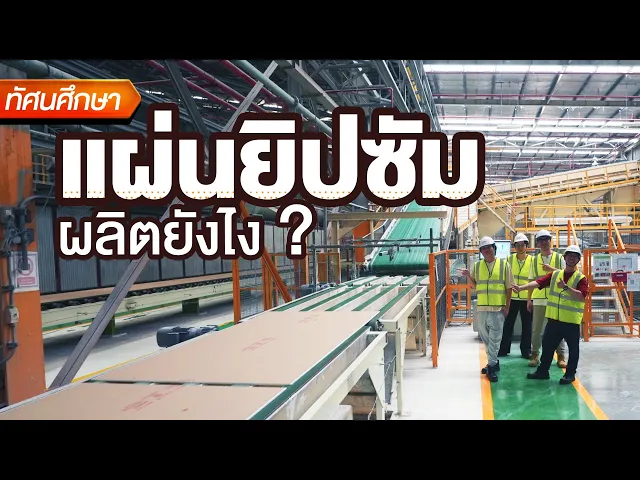
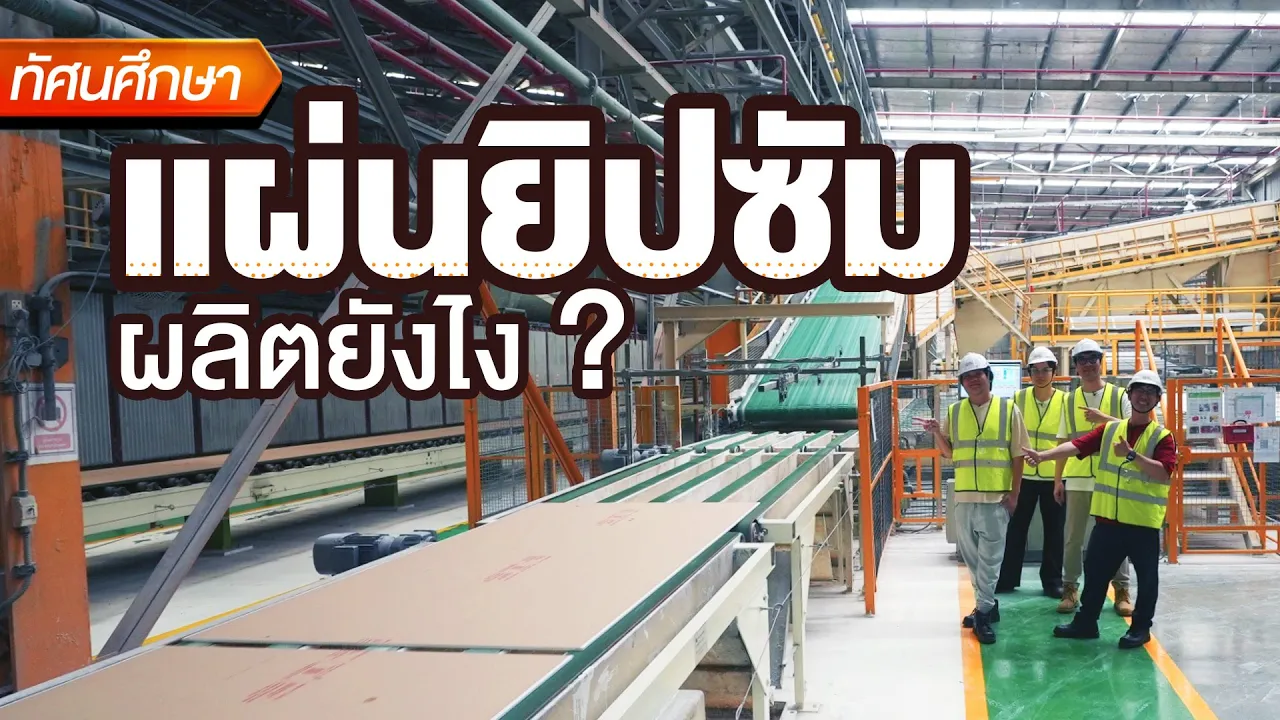
What is gypsum board? It's closer than we think. Gypsum board is the material used in the ceiling.
When we enter various buildings, or we look up, 90% of the area above our heads is gypsum board. Why do we have to use gypsum board? Why can't we use plywood or plastic?
1. Gypsum is a natural mineral that is smooth and strong. When installed, we get a smooth finish.
We can plaster the joints without seeing any seams. This is one of the strengths of gypsum board. If we use other materials, we will see joints, and the beauty won't be as good.
This is one reason why shopping malls, houses, or other residences use gypsum board for ceilings. This is Chang brand gypsum board, right? An elephant has only one pair of eyes.
So what size eyes do we need to use to make gypsum board? Why does it have to be gypsum board? Can't it be Gyp 1 or Gyp 2?
I prepared this as well. First, let Paiboon introduce himself. Okay, hello.
My name is Paiboon Thanomkitchai, Sales Director of Siam Gypsum Industry (Saraburi) Co. , Ltd. , or as we simply call it, Chang Gypsum.
You guys can call me Boon. I'll call you Boon, okay. I've seen news about Chang Gypsum.
How is it related to SCG? This factory was founded by SCG. Therefore, SCG is considered the leader in gypsum innovation produced in Thailand.
Started in 1982, that’s the technology has started. What will we see today? Today, we will see many things, from the production process, the storage process, and the storage method.
That's all here. Now we're in the factory, and this is our guide. Hello, sir / Hello.
What's your name? My name is Mr Nimit Damkham, the production director. Siam Gypsum Industry (Saraburi) Co.
, Ltd. I'll call you Nimit. Just call me Nimit.
/ Okay, sir. For your convenience. What is the thing I'm holding in my hand called?
This is gypsum in lump form. This is also gypsum. But is it powder or dust?
The gypsum that we see in sheets comes from lumps like this. / That's right. Yes, it comes from lumps like this.
Is gypsum an element in the periodic table, or is it a combination of many minerals? It's a combination. It comes from calcium sulfate.
At first glance, it's just a rock, right? / It's similar to a rock. It looks lighter than it seems, right?
/ It's lighter than a rock. What are the other advantages of using gypsum to build a house? After we produce gypsum board, it will be lighter.
The second is that it can prevent heat, making the house cooler. Oh, it's a little bit of insulation. Another advantage of gypsum board is that it's easy to install, smooth, and beautiful.
After plastering, it's smooth, making the house look good. Why do we need to use gypsum minerals in the ceiling industry or anything like that? Because gypsum minerals can be recycled by nature.
For example, if we demolish a building, we can take it back and grind it again. Oh really? / Wow, I just found out.
What is this zone? This is a factory for producing plaster that we call stucco. We start by grinding, baking, and burning it to get plaster.
It will be ground finely and baked to dry before sending it to be burned there. After burning, we will grind it finely again. The word plaster in my head is like a water-soluble artistic plaster / That's right, it's similar.
Yes, it's similar. But the burning properties are different because we burn it for the production of gypsum boards. This is plaster.
/ Oh. Try holding it. It looks colored.
. . It's plaster.
/ The color is bright. Yes. / It's plaster.
And once we have plaster, what do we do with it? We mix plaster with water and additives to set it into a slurry texture. Wait a minute, is it called slurry texture?
Celery means celery? They're different, meaning slurry. / What is slurry?
It's a mixture of water, additives, and plaster. Oh, when you mix these three things together, it's called slurry. / That's right.
And where does the slurry go next? It will flow onto Craft paper, which is the paper that wraps the gypsum board. Is the paper in question the roll here?
That's right. / But we may not be able to take pictures for you to see. Because many things are secrets in the production process.
But we will be able to walk around and see, just may not be able to takes. But when it is attached to this sheet, will it come out as a gypsum board? Yes, when lay it down.
There will be a front paper and a back paper. Then, in the production process, they will stick together naturally and become a gypsum board. It's still wet.
We have to go through the baking process again to dry it and harden it so that it can take shape. Let's take a look at the gypsum board and see what it looks like when it's finished. Before we go to the next steps of the production process, let's check the safety first.
Because this is a factory where we give the highest importance to safety, which we call Safety First. We are committed to ensuring that our factory has no accidents or illnesses from work. In addition to safety, our factory also focuses on quality.
We want customers to receive products with consistent quality. Therefore, in the next process, we will see that we test the production process periodically. The previous step that we saw but didn’t film was pouring cement through one pipe, and then spreading it out with a roller to make everything even, with a sheet of paper underneath.
It is for forming gypsum boards according to their thickness. We create the sheet to be thick, and we have a thickness monitor measuring it with a laser. It measures the thickness along the width of the gypsum board.
This way, we get gypsum boards with consistent thickness to ensure consistent strength throughout the board. The sheet we see flowing continuously now—has it been baked yet? / Not yet.
This is still wet. Then why doesn’t it flow out to the sides? Because of the properties of plaster: when it starts to mix with water, a chemical reaction occurs.
It starts to harden gradually. Right now, it hasn’t flowed out because it's covered with paper, and it's starting to harden gradually. Oh, so the white stuff we see on the edge is the paper that prevents it from flowing out.
/ Cover paper. It’s called cover paper. / Oh.
And the reason we make it long is to let it gradually dry according to the process, right? / That’s right. Let it gradually set.
We call it setting until it hardens. At this stage, if you have plaster mixed with water, you're almost there, just missing some additives. Still missing some additives and air bubbles.
Why do we need air bubbles? 1. To make it lighter, easier to install, and so the building structure doesn’t have to carry too much weight.
2. The air bubbles help as heat insulators. But the air bubbles you’re talking about aren’t big, right?
They're not big. They're air bubbles we create, not natural bubbles. We have to create the bubbles first.
Wait a minute, this line is very long. How many minutes does it take to get there? It depends on the type of product, whether it’s thick or thin.
Oh, it depends on the formula. / Production formula. And where is it going?
After being on the conveyor belt for a long time, the gypsum board will harden enough to be cut to length. While the sheet is flowing, do we need to give it heat or cold? / No.
The temperature that occurs is natural—it’s from the chemical reaction between the plaster and water. It gradually hardens and releases heat. Yes, I remember when I was a kid and mixed plaster for art projects.
It would get hot. / It's warm, the same. This is the tool used to cut gypsum boards.
We cut into sets according to the length, about 2. 4 meters long. After cutting into sets, the gypsum board will be accelerated to enter the process of turning the sheet to bring the cover paper up.
Why do we have to turn it? If we don't turn it, when it goes into the oven, the front side would be on the bottom. Now, we turn it so the front side is on the top and then pass it through a roller.
The front side of the sheet will be clean and white as before. I have a question: earlier, when the gypsum board was running, it seemed slow, so why does it speed up at this point? Because it needs some time to allow this process to work in time.
It seems like 3-4 pieces go in here. Yes, 3-4 pieces, and then they go through the process and stop here. Waiting for their pairs.
It doesn’t go in on one side—it has to go in pairs, left and right. It needs a lot of them to turn at once. Where does it go next?
After this, it goes into the Drer for the drying process. Let’s look at the baking process again. / Okay.
Why do we need rollers to send gypsum boards into baking in multiple layers? To give it enough baking time, we have to slow down the gypsum board. From the speed we saw earlier, it must enter each roller layer.
You can see that it comes fast, but once it enters here, it slows down. You see that it gradually raises the level? Yes, it changes layers.
Send the top layer, send the middle layer. That's right. Simply put, when it came in, the speed was tenfold faster, now it’s about onefold.
Actually, it’s reduced by about twentyfold. Wow, twentyfold. From here to there, is it the entire oven?
The entire oven. First, it gradually bakes at a low temperature, then increases the temperature, and then reduces it again, so the gypsum board doesn’t get damaged during baking. The oven here in the factory is a highly efficient oven.
In addition to saving energy, we can also recycle the water from the condensation process. After baking, are the gypsum boards ready to use? / They are ready to use.
But before sending them to customers, we will mark the length, to make sure they are the correct length. For example, 2. 40 meters will be exactly 2.
40 meters. We will pair them first to put the gypsum boards together, because we want to keep the gypsum boards clean at all times. Is it the white side?
/ Yes, the white side. Are there any customers who request a custom order, not cutting at 2. 40 meters, but requesting 6-8 meters?
/ Yes. But the maximum length our factory can make is 6 meters. Most of them are customers from abroad.
After we pair them, we will cut the boards, which is called edge grinding. After grinding the edges of the gypsums, we will attach tape to indicate the status and type of gypsum board. Normal type, moisture-resistant type, or fire-resistant type.
After attaching the tape, we will stack them in layers. Approximately 100 sheets per stack. They will be stacked and can be lifted to store in the warehouse, ready to sell to customers.
Product and System Testing Center--- Now at the Product and System Testing Center, Product and System Testing Center which is a lab that tests products and systems of gypsum board. We will test both the wall system and the ceiling system. You guys may see some equipment that is quite large and magnificent.
First, may I ask your name? My name is Thipawan Chutiphongnawin, Testing and Modeling QMR Engineer. Wait a minute.
Modeling? / Yes. I have to find a model.
/ No. I’m product testing and analysis engineers. Which one should we start with?
We will look at the ceiling system. This means that we will test the heat, rain, and cold. This is a test of the actual ceiling installation.
We will simulate. . .
/ Oh, hot Yes, the real climate in Thailand. This one we set to. .
. My glasses fogged up a while ago. Hot and humid.
/ Like a sauna. Right now we set it to 32°C with 90% humidity. It's similar to our rainy season because our country is hot and humid.
32°C? / Yes. I think the temperature should go up.
Which may be because we're in this room, it's probably around 26°C / Yes. The first hit was. .
. No / Yes. Sauna.
/ Oh, it has a lot of steam. Do we have to go in? Do you want to try?
You can try. I was the one who made him faint. What did we try?
We're going to. . .
Don't turn it off, this isn't funny. What do we do? We're going to install ceiling panels.
The panels we're installing are moisture panels, and we're going to install them on the actual structure and distance. And what you guys see is a sensor to measure the deflection distance. We will measure every 5 minutes to make sure that our gypsum board is up to standard.
So how long does it take to test like this? Actually, we usually test for 2 weeks. Because most ceiling boards, we usually check if they sag or fall.
For example, moisture boards, we use them in areas like bathrooms, garage ceilings, and eaves. Come out, guys, I forgive you. / How was it?
Wow, my glasses are blurry. There's one thing that I can feel when I stand in it. I don't have to go in there.
/ Yes. Yes, that's right. / Why did I go in there?
But you made the room cool, making it have heat and humidity. Yes. I'm sorry, it's like being in a studio scene.
/ Like a scene in a sitcom. / Yes. This is a test of the wall system.
Our lab is the first in Thailand to be certified by the Thai Industrial Standards Institute or TISI. This is the first lab to get this test. Door Slamming Test.
/ Yes. I'll show you guys. / Sure.
What is 60 kilograms? / Door weight. Door 60 kilograms.
/ Yes. We have a 15-kilogram counterweight. We'll open the door about 60 degrees and then we'll release the Free Fall down.
Okay. / Yes. Can I see it?
Here it is. / Here it is. It's a little loud.
It sounds familiar, like last night with my wife, this pose, my wife slammed the front door like this. The testing standard divides the wall system into grades. This is the Zolid Wall V.
2 sheet. The Zolid Wall V. 2 sheet will be in the Severe Duty Grade, which is the highest grade of this testing standard.
We'll open-close the door with a weight of 60 kilograms 100 times. What do we want to see in 100 times? 1.
We will look at the distance of the frame movement. Oh, see if it bounces off. / Yes.
See if it comes off the wall. / Yes. And the damage that occurs at the corner of the door or the position of various points on the wall, can it be repaired or will it break completely or something.
This is a test for houses that are a bit hot. Just now it was hot from the temperature, but this one is a bit worrying. How thick is this wall?
Our Zolid Wall V. 2 has a total wall thickness of 10 centimeters, which is the standard thickness of general walls. When we say Zolid Wall V.
2, what is it? Zolid Wall V. 2 is a sheet of Chang brand gypsum, a sheet that we designed to be suitable for the home system or use in your office.
It is gypsum, right? Yes, it is gypsum. But it is gypsum for construction to make walls, right?
Actually, it is not construction, it is installing gypsum board like installing general gypsum board. Oh, lightweight wall. / Yes, lightweight wall.
It means that there is already a steel frame, so just screw and fill in. / Yes. The advantages of Zolid Wall V.
2, as mentioned, are: 1. Can withstand a lot of force. Then you’ll see that there’s not only a door test.
There’s also a test called Crowd Pressure. Crowd Pressure assumes that there are many people leaning against the wall. Crowded means a crowd.
/ Oh. Crowd Pressure simulates leaning. Yes, like people leaning against the wall.
Standing and waiting for friends, leaning against the wall a lot, something like that. Test if it can hold up, if it’s strong enough. / Yes.
Actually, we have many parameters for testing. One of them is the equipment behind that you guys see that looks like exercise equipment. Oh, if we test this, we push this in and test it.
/ Yes. There’s everything from pushing, hitting, and swinging. / Yes.
Sandbags are used — sandbags that are thrown against the wall. Huh! ?
/ Yes. Oh, to see if it breaks, penetrates, or collapses. Yes, to see if the wall will fall or collapse.
How many times stronger is this wall than ordinary gypsum? If it’s a general gypsum wall like Standard Board, it’s usually in the Lightweight Duty grade. But this is the highest grade, Severe Duty, which is about 4–5 times stronger.
In addition to being strong, the benefits of Zolid Wall V. 2 are: 1. Fast installation, taking only 3 days to install.
2. Less dust than brick and plaster work. 3.
It can support 20 kilograms per point. Is this weight-bearing for leaning against or for hanging something on? / Hanging things.
Oh, okay. What is the size of 1 point? 1 point is 1 anchor bolt.
Let’s say about half a square meter. Anchor bolts are concrete anchors. Lightweight concrete anchors.
Anchor bolts are when you drill into the wall, you have to insert the dowel first. How should I explain this? They might not really understand.
That’s a hook! ! Let’s just say it’s a type of screw.
Simply put, it’s a device used to hold or hang things. / You can imagine it? For example, a kitchen cabinet or a TV.
I got it. It’s like if I want to hang something, I have to put this first. / Yes.
At this point, you can hang up to 20 kilograms, right? / Yes, 20 kilograms. If this point is close to another point, it can hold the same amount, right?
/ Yes. No problem, you can place them however you want, but 1 point must not exceed 20 kilograms. If you want to hang 60 kilograms, you use 3 anchor bolts.
/ Yes. 60 kilograms, right? / Yes.
Another advantage is that it can block 44 dB of noise. That’s around the sound of people talking. Yes.
Can you still hear it? You can hear a little — you have to be inside. / It can't block everything.
Are you kidding? No. / We’re filming a commercial.
It has to be a closed area. Mongkol, open the door for Piak! Can’t hear it.
The door won’t open. If this is a soundproof gypsum board, but if Kansaeng, then Thorani must be used. Oh, yes.
/ Hello! Come pick me up now. I’m going home now.
Sabai! ! Dad misses you so much.
Why did you bring me to the pizza oven, B? No, no. This is a Fire Endurance machine — a fire-resistant tester for fire-resistant gypsum boards.
Do you have fire-resistant boards? / Yes. We don’t just have standard gypsum boards.
We have both fire-resistant and moisture-resistant boards. How long can this fire-resistant gypsum board last? / We set it to pass at 1 hour.
Red-hot iron! Oh, red-hot iron! / The iron in front is red now.
I highly recommend it for any house that’s hot, use gypsum, specifically Chang brand gypsum, or even if you're hot-headed, you can use it. Hot-headed, gamers! I’ve picked it up.
. . / Yes.
In case Brother Ed plays Dota and gets hot-headed. Actually, there are 2 types of gypsum boards: fire-resistant boards and heat-resistant boards. Fire-resistant sheets really resist fire.
Like this. / Yes, like this. Heat-resistant sheets are called Heat Bloc, which help reduce heat coming into the house.
You might not even need additional insulation, or if you use it together, it’ll be even more efficient. But where do you use the fireproof type? Mostly in public areas, like hotels.
There are laws requiring a minimum fire resistance time in hotels and malls. Oh, so if an unexpected event like a fire happens, it helps prevent spread, right? / Yes.
Actually, we add weights on the board too. This is part of the standard testing method. If it falls off before 1 hour because of the weight, it won’t pass.
Passing isn’t just about surviving the fire — it’s also about not collapsing under pressure. In case it separates. / In case it tears.
Yes. / Oh, I get it now. Normally, how long does a fireproof sheet need to be tested?
At least 1 hour. For 1 sample like this. The temperature is about 1,000°C.
Huh! ? Is this 1,000°C?
/ Yes. Plus or minus 50°C. / Here it’s about 996°C.
999 flowers indicate a great truth. Oh, Gen X people. Okay, I think we’ll end here.
We don’t have to wait until it explodes or burns completely, right? We can close it now. / Okay.
That’s awesome. I’ve never seen this before. The place we’re standing at now is the Chang Gypsum factory, in the warehouse building or the werehouse.
To put it simply. I'll take you to see what activities Siam Gypsum is doing to save energy and reduce carbon emissions. It’s simple, right here.
Do you see the light shining here? This one works automatically when we walk by. If it’s nighttime or there’s no production or no cars running, the light will automatically turn off, which saves electricity.
It means we don’t have to keep switching lights on and off. We don’t have to think about it — it works by itself. Is that a sensor next to the light?
/ Yes. Right now, it’s bright because the factory’s full of people. Let's take a look at this car.
This car is an EV forklift. We chose to use the Gypsum Brand Elephant to replace the oil-powered forklift. We replaced it because we wanted to: 1.
Reduce electricity usage 2. Avoid using diesel. Diesel causes black smoke and smells bad, so we don't want to use it.
Most importantly, our staff are very happy because the noise is much lower. I have a question: When it's this quiet, does the car need a warning sound when it's moving? There is a synthetic sound to ensure safety.
This car must cost several million baht, because an electric forklift needs a lot of batteries to lift 7 tons of goods. It needs a lot of power. It’s quite an investment.
And here is the charger, right? The charger. We will have.
. . When the staff finish lifting sheets, like during lunch break or after work, they’ll plug the car in to charge.
Besides our EV forklift, we also have a lot of LED projects. Actually, we’ve been working on sustainability, and low carbon emissions for 10 years, since 2012. We were one of the first in the country to get the Carbon Footprint label.
And we’ve been committed to reducing carbon emissions ever since. But now, we’ve set a new goal — from this year to the next 7 years, by 2032, we have to cut it by half. What are the plans for reducing carbon emissions?
Mainly, it’s various energy-saving strategies. Both the R&D and Engineering teams are adjusting processes and adopting new technology. This is for creating more energy-efficient production.
We’ll start with a project that uses biomass. Biomass is an alternative energy source. Fuel that comes from nature, not coal or oil that takes millions of years to form.
Mr Boon, there are a lot of labels and colors here. Are they different? / They are different.
The one we just looked at was the Standard board. The green and yellow ones are the Moist Bloc and Heat Bloc. Is this about features?
What you’re about to ask is, how are they different? In terms of usage, the Standard is for general ceilings inside buildings. The green one is suitable for bathrooms because it prevents moisture — it absorbs very little water.
Perfect for wet areas. When you turn on the hot water in the bathroom, what happens? / It creates steam.
What happens if you live with it for 10 years? It becomes damp and starts to disintegrate. / Exactly.
If you use a Standard, you might see it starting to fall apart. But if you use the green moisture-proof — the Moist Bloc — it’ll last much better. That’s because it’s water-resistant and fits areas that are truly wet.
So, if you're building a house, and you're the one choosing the materials, you need to tell the shop: this gypsum board is for normal ceilings, and this one is for bathrooms. / moisture-proof gypsum board. Yes, exactly.
I get it. What about the yellow one? Yellow?
I have to answer Yellow just now. Oh, Yellow? / I'm sorry.
What about the yellow color? Yellow? Yes, that’s right.
/ Good start. Let's get serious. / How do you use it?
The Heat Bloc, the yellow one, is used for ceilings under the roof. You might ask, why do we need this type for ceilings under the roof? Because it’s a heat-resistant sheet with insulation built inside.
So, when you're under a hot roof, it helps keep the house cooler. It fits the Well-Being concept — making you feel comfortable, happy, and suitable for living. You need to pick the right sheet for the function you need.
So if it's a two-storey house, the ground floor can use the standard ceiling. But for the upper floor, it’s recommended to use the Heat Bloc. Yes, correct.
What do you use in the bathroom? / Moist Bloc. Very good.
And the yellow one? / Heat Bloc. I thought you would say Yellow!
Besides these, are there other types? Yes, lots more — because we aim to meet different consumer needs. We have another type called the Weather Bloc.
You might wonder, what is a single board that's good for the whole house? What are its advantages? This board is waterproof, heat-resistant, and mold-resistant — all in one.
Oh, if you're too lazy to choose different boards for different areas, you can just go with Weather Bloc. And it’s even better than the Moist Bloc because it absorbs water at a ceramic level. Meaning it’s great for outside garages, under eaves, in bathrooms, kitchens — anywhere with a lot of moisture.
If it’s under the roof, it works too. And it’s heat-resistant with insulation built into the same board. So that means if you want to buy something, you have to tell the technician exactly what function you need for each area.
/ Yes, that’s right. Last question. Here it says "eco-friendly gypsum board.
" How is it eco-friendly? Before I explain eco-friendly gypsum, let me first say: the construction industry worldwide, not just in Thailand. .
. Worldwide, from the production process, construction materials, to actual construction, it causes 40% of carbon dioxide emissions into the air. Which is very high — 40% of carbon dioxide.
The whole world's carbon dioxide? / Yes. It causes 40% of carbon dioxide.
What does 40% of carbon dioxide cause? It causes Climate Change. So, whenever we make any product, Siam Gypsum Industry (Saraburi) Co.
, Ltd. , or Elephant Brand Gypsum, we have a clear goal to reduce carbon, which we call Net Zero. Net Zero means reducing carbon emissions to zero.
Can we really produce without any carbon emissions at all during production? That’s called low carbon or Net Zero. We have set a goal to achieve Net Zero by 2045.
The process of making gypsum low-carbon has already earned us a label from TGO, the Thailand Greenhouse Gas Management Organization — for 10 of our products. This factory has 10 low-carbon materials. We have received a label from TGO.
Low-carbon means it’s lower than normal but not yet zero, right? / Not yet 0%. But it’s already starting to decrease.
/ Yes, that’s right. We have a plan to reduce carbon emissions every year. The real principle is that we aim for Net Zero — reaching zero emissions by 2045.
Right now, it’s not zero yet. It’s a goal that many companies are working toward. Yes, that's right.
/ And it’s a good thing. When we have children, we think about their future too. That’s a really good thing.
I have to leave this message with many factories, including Chang Gypsum. Finally, let’s talk about the shop. Lol / Yes.
Today, we’re presenting the factory. / Leave the warehouse behind. Present the product.
/ Okay. Before we present the shop, I’d like to invite my seniors and anyone interested to visit the Chang Gypsum Institute at Block 28, Samyan. There’s a showroom that showcases innovations for both interior and exterior gypsum.
Whether it’s ceilings, walls, home theater rooms, there are sample displays. Sound absorption materials too. You can go and talk to our experts at Block 28.
Also, if you need gypsum products, you can find them at SCG distributors nationwide. Our slogan is: Choose gypsum, emphasize Chang gypsum. Thank you.
Thank you to everyone. Thank you very much. / Thank you.