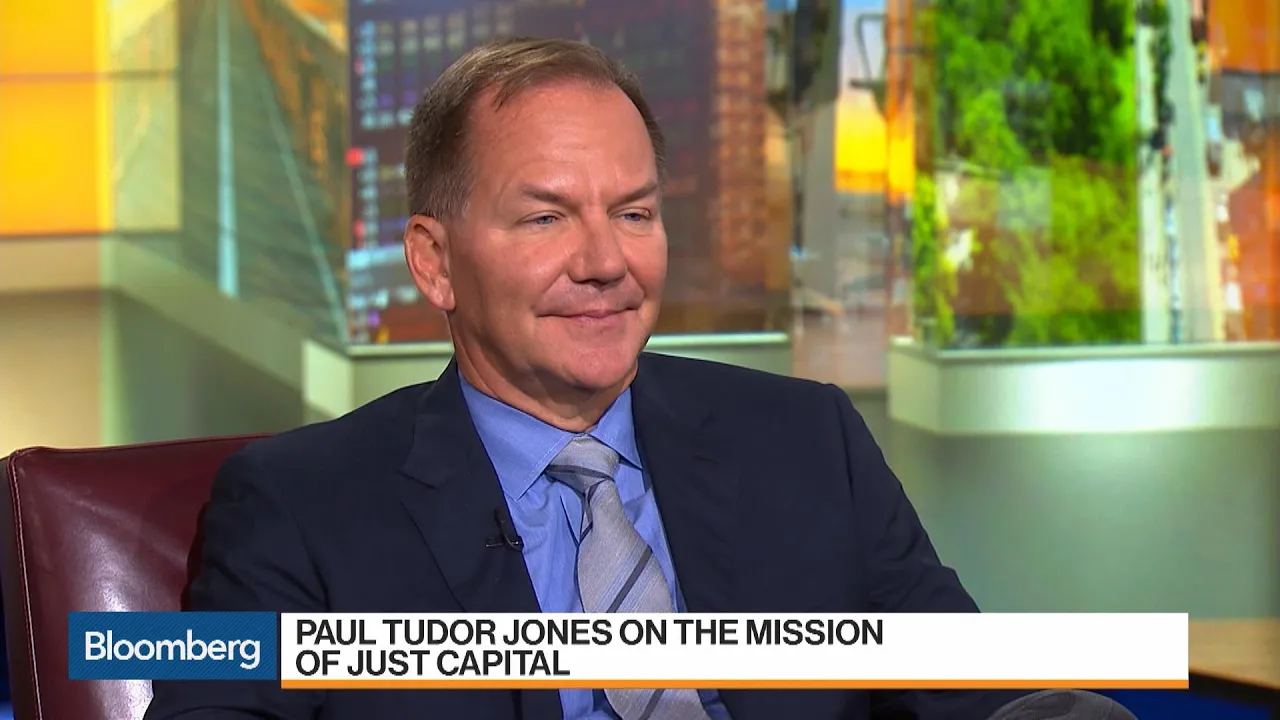
you and your wife signed the giving pledge last week also obviously co-founder of the everglades foundation have done tremendous work in florida and founder of robin hood which has been fighting poverty in new york city in a tremendous way so philanthropy wise you're already doing extremely well to say the very least now your next sort of target is corporate america and you have just capital research on the case for you as well as an etf which you'll get to in a moment but first of all tell us why just capital is so important well just capital was actually founded about five years ago and i think it's kind of recognizing two problems and and the first problem is is that our capital markets are working for some folks but there's a whole bunch of people that they're not working for that are being left behind um and so that's the first problem the second problem is that many of the people shareholders and ceos don't recognize that the first problem is actually a problem that our capitalist the way our capital markets work right now the way our companies work right now has evolved to a point that's probably not sustainable over time now philanthropy is massive in the us as we know but business is actually 40 times philanthropy so business could have an exponentially greater impact on this inequality that you talk about but what about shareholders because you know you along with everybody else would say shareholders you know must also be treated fairly by business where is shareholder primacy right so so i think that's really what what just capital is all about is that we've if you if you think about the evolution of capitalism right and next year is going to be an incredibly uh important milestone because september 13th 2020 will be the 50th anniversary of when milton friedman wrote a very famous editorial that went in the new york times and in that he said the purpose of business is to make a profit and that unleashed an unchained uh ceos management shareholders etc to go on uh one of the most incredible journeys that's ever been taken in in any society for that matter so in 1970 about six and a half percent of corporate profits went to shareholders uh fast forward to today that number's 13 so it's they've literally doubled their take of corporate revenue and they there wasn't a plebiscite there wasn't an act of congress there was no malicious intent it just happened organically as we actually took everything out of the equation of what a true purpose of a company is other than to make a profit and so what that did the consequences of that is we now have wealth inequality five times of what it was 50 years ago we have the top 20 wealthiest americans have as much net worth as the bottom 175 million americans and so we're probably at a point where we have enough fissures enough problems enough divisiveness in our society that if we don't address this allocation of resources so to speak in some way shape or form i don't think that we're on on a sustainable path i think 43 of people today would vote there was a poll just out would vote in favor of socialism over capitalism i'm a capitalist so i don't want to see that happen so i think we've got a we've got to get a new direction for capitalism and redefine it part of the problem is performance though particularly when a market keeps going higher and i know you're looking for the market to continue grinding higher if companies can only gain performance by buying back stock then you know what happens to their the other mandates that they might have their social inclusion their you know let's fight and equality mandates which really are you know they're not mandatory right right so uh one of the reasons i'm here we just had a little conference this morning where we announced a collaboration between just capital and the coalition for inclusive capitalism it was so interesting because i got to interview the cios of state of illinois state of florida state of new york is about 500 billion between them in terms of assets they manage uh and at the very end i said okay you know we we we just had gone on and we talked about the relationship between shareholders if you think about the corporate universe right you've got shareholders you've got employees customers communities the planet those are the five stakeholders in the business world and so right now we've had this massive movement over the past 50 years towards shareholders shareholder primacy so to speak to use your term so in that i said okay it's real simple um we had a tax cut last year and that tax cut if we just had a blank sheet of paper and we were starting that tax ship that tax cut x post we now know that 80 percent of the tax code tax cut which was an american tax cut 80 percent of that went to shareholders in the form of 1. 1 trillion of total profits went to buybacks in the balance and dividends so 80 of that tax cut that incremental about 300 billion were also in buybacks and dividends i so i asked i said i'm going to put you on the spot do you think that's the right number you're a fiduciary you're imagining this for millions of retirees was that the right and fair number or should it be something lower so first i said before i put you on the spot let me ask the audience we had about 150 people there most were business women and businessmen i said what do you think the numbers should be and let's break it into buckets so i said 60 to 80 40 to 60 20 to 40 00 to 20. before i give you the answer what's your number uh you're the person no no no no no no no no we're all gonna vote here i'm gonna tell you what my number was 80 went to shareholders bonnie what do you think because the other if it hadn't gone to shareholders it would have gone to employees customers communities in the plant what do you think the numbers should have been 50 employees 50 percent i don't i don't know i don't i don't okay okay okay so i asked go ahead i do want to ask you then at what point government needs to step in because there's only so much that corporate america can do correct i mean given that everybody probably gave you a different answer on that panel at what point does this need to be a policy framework and have you seen anything from the democratic presidential candidates so far that excites you given that the the the current incumbent put in place tax cuts that didn't excite you ultimately okay well i just i'm going to get to that i just want to go back to what that audience said three people out of 150 said 80 and up was the right number about 15 out of 150 said 60 to 80.
i'd say 50 people were in the 40 to 60. right so everybody had a different number but the average was probably below 50 just to put that in terms we can all understand that means that and then i asked the cios i got uh about 70 percent from the gentleman from florida if i remember correctly 50 from the gentleman from illinois 35 from napoli in new york so about around 50 so 30 if you just kind of crowd sourced everyone there including the guys that managed 500 billion that the difference between the 80 that went and the below 50 at least 30 percent 90 billion should have gone to employees customers communities in the planet 90 billion of that tax cut and so to me there's a huge message there to corporate boards to ceos like if i'm sitting on a corporate board i'm thinking well wait a second was the smell test right on what we did with the incremental profits that we gained last year therefore don't you need people in the administration and surrounding the administration to enact different you know types of policies and in that case have you have you seen any fix to this situation i mean should the president be re-elected or should somebody else maybe from the other side get into power okay so uh it's easy to default to government policy um and clearly i'm uh i'm i weigh that in my mind we started just capital because of the power of cultural change and our idea was to use markets to fix markets we rank we asked the american public how they what they consider to be a just company we then take those metrics and apply them with two hundred thousand different data sets to the thousand largest companies in america and we rank them from one to a thousand and they get a seal yeah and they get so customers can see it investors can see it prospective employees can see it's on our website please please visit it so we're trying to use social norming to give you an idea how how important and how cultures can change with norms in japan 2016 there was a there was a popsicle company a very famous japanese popsicle company that served popsicles to the public school system to virtually every child in japan they had not raised prices in 29 years since 1987. so in 2016 finally they came out and raised prices do you know how they did that the chairman the president the entire management team plus all the employees came out bowed down and apologized to the public for raising prices now there's no government policy that made them do that there's a cultural mindset of what is right what is just that made them do that we've swung we've swung towards shareholders and we probably need and i can the culture's changing right now you can you can see right now people realize we've gone too far it's gotta come back ceos see it hopefully corporate boards will start talking to their ceos and readjusting the mix and i absolutely wouldn't put it past you to actually change the mindset of the entirety of corporate america you know you're a one-man crusader who's extraordinarily efficient and effective so let me ask you this you do want the stock i mean given the trades you have on now you're anticipating that the stock market will go higher i mean at what point does that end will we see a federal reserve rate cut or some forward guidance signaling next month next week i answer that question i just want to just say one thing just capital is real simple we we ask the american public every year so it's not me it's not my thoughts on what's fair every year every year we ask the american public and we let so there's a guide of the people for the people by the people americans know what is justin's it's a blueprint for any investor uh any shareholder any company any ceo of how they should align their views with the american public to get to your point we're getting ready to have a rate cut so there's uh there's there's rate cut 101 first cut 101 trades they're long stocks at least initially long fixed income probably short the dollar long gold so so those are that's what you do into the first rate cut the stock markets are they're already trading right all those trades are already in process the question is how much further are they going to go into and pass the first rate cut i think they're all going to keep going a long way so so you think in 2019 we might see 50 basis point 75 basis points of cuts well so much of it depends on so much of it depends on the tariffs how far we go with terrace remember this rate cycle was cut short it really we never really got the rates that we've gotten too historically to interest to end an economic cycle they were cut short because of the tariffs so we really have to see the impact that they're going to have and whether this next round of tariffs gets implemented to me is a huge deal i would say if they get implemented if we go to the 500 billion then i think certainly um it's possible that could tip us tip us uh into recession we've never seen anything like this in 75 years right we haven't we haven't seen tariffs since 1929 30.
there's no playbook for this you've got this interconnected global economy that now all of a sudden for the first time in 75 years for the first time we're seeing free trade not being expanded but being diminished and so we just don't know because we haven't stress tested this system yet we just don't know what the impact is going to be so i would i'm more conservative so i think it'll have a bigger impact economically than what um the market thinks and it'll probably could possibly push us into a recession well exactly and and how do you trade this first rate cut if you don't know whether it's going to be an economy weakening moment or whether it's just an insurance cut yeah again i think we've only seen tariffs we only seen this tariff playbook once it was 1929 30.