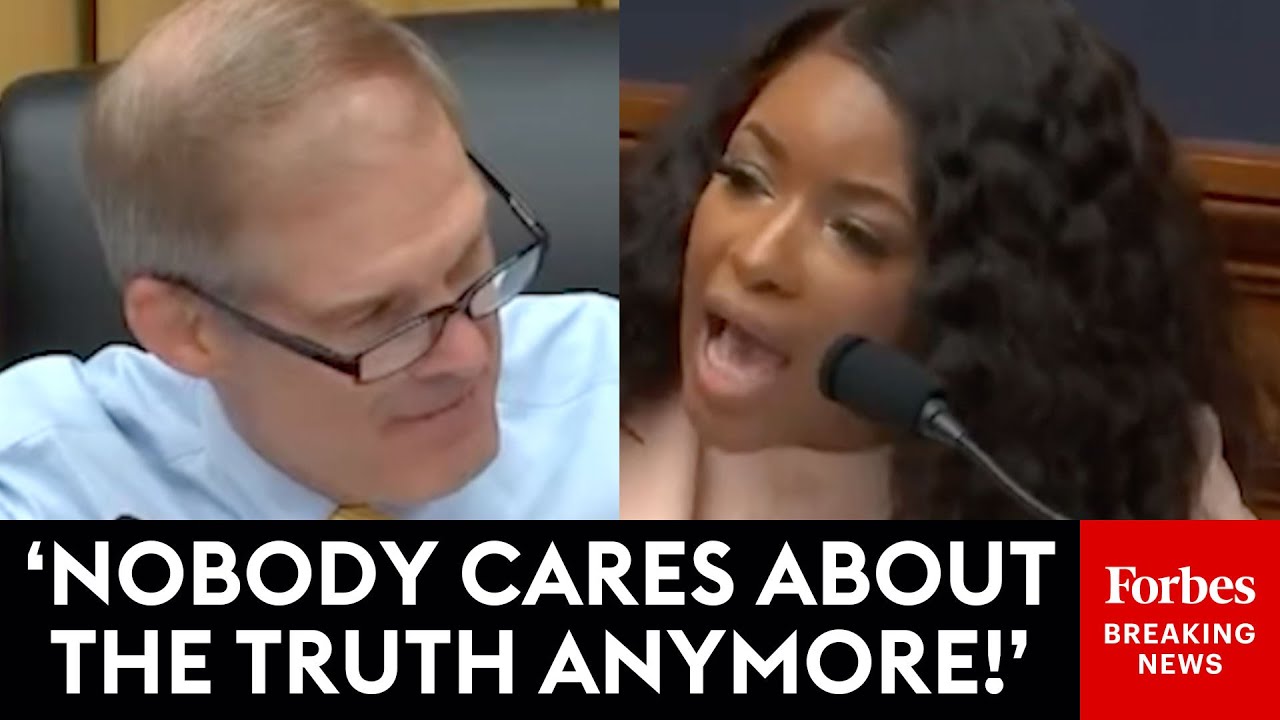
[Music] You were held back in second grade, weren't you? The words dropped like a hammer in the middle of a live Fox Nation debate, cutting through the room like a cold wind. It wasn't clever.
It wasn't political. It was personal. Senator JD Vance, seated confidently under the studio lights, had just turned the discussion away from policy, away from national issues and aimed it squarely at Congresswoman Jasmine Crockett's childhood.
The topic of the debate had been standards in government. But now the only standard in question was the memory of a little black girl from Texas, 7 years old, seated at a desk, trying to hide a growling stomach with folded arms. The studio went quiet.
Not because they agreed, but because they weren't sure what they were witnessing. The camera panned to Jasmine. She didn't flinch.
She didn't respond. She just stared. Not at JD.
Through him as if she was looking at something. No. Someone from long ago.
A teacher who never asked why her homework was missing. A hallway echo of laughter that wasn't kind. a cafeteria tray that stayed empty on more days than anyone ever noticed.
JD sat taller in his chair, the edges of his smile curling up like he'd landed a winning blow. The host, Carson Green, blinked. Even he wasn't ready for the turn this conversation had just taken.
Still, no answer from Jasmine. Just silence, but not the weak kind. The kind that makes people uncomfortable.
The kind that says, "I've heard worse than you and I'm still here. " JD leaned forward, doubling down. I'm not saying people who struggle in school don't deserve a voice, but I think America expects its leaders to meet certain standards.
And frankly, if you couldn't pass second grade, I have to wonder, why should we trust you to write the laws for the rest of us? " A soft gasp rippled through the audience. Not because of the attack, because of the assumption that a moment from 30 years ago could define someone today.
That failure once experienced meant failure forever. And still, Jasmine said nothing. Instead, she reached for the mic.
Slow, steady, measured. Yes, I was held back in second grade. That was it.
No excuses, no defense. But then her voice shifted lower, sharper, warmer. I remember that day.
The teacher didn't look at me. She just looked at a list. said, "This one's not ready.
" No one asked why I didn't turn in my homework. No one asked why I fell asleep in class every morning. No one asked anything.
Now, the audience wasn't just silent. They were locked in because something had shifted. This wasn't about school anymore.
It was about being unseen, unheard, unasked. Jasmine looked directly at JD. You think intelligence is about passing every grade on time?
Maybe. But maybe intelligence is also knowing why a child falls behind and not assuming it's because they're broken. There was no applause.
Not yet. But no one interrupted either. The host fumbled to move on.
But it was too late. The story had changed. And somewhere in the third row, a woman clenched her fist, tightly remembering a moment she thought she'd buried.
Because this wasn't about politics anymore. This was about what we choose to see and what we ignore on purpose. Jasmine didn't raise her voice.
She didn't try to out debate him. She just leaned closer to the mic and said, "I didn't turn in the homework. " Because I was hungry.
But no one ever asked why. Her voice didn't tremble, but something else did. The studio.
The audience didn't gasp this time. They froze like her words had touched something beneath the surface. Not rage, not pride, just memory.
A teacher in the crowd looked down at her hands. A producer backstage stopped typing. The host, Carson Green, blinked rapidly, unsure if he should pivot or just let the moment breathe.
Jasmine continued. People love to talk about standards. But if we're honest, the real standard is this.
Did anyone care enough to ask what was happening outside the classroom? Because inside, I was just the girl with missing assignments. Outside, I was the kid eating ice chips for breakfast.
She didn't say it for sympathy. She said it because it was true. JD Vance didn't respond, not because he lost the argument, but because she hadn't played his game.
She wasn't defending herself. She was describing a system. And suddenly, the debate wasn't about her anymore.
It was about everyone who ever carried shame for something they had no control over. A silent burden mistaken for laziness. A missed assignment mistaken for apathy.
Jasmine ended simply. I didn't need a new school. I needed food.
And that's when the silence became real. Not stunned, not strategic, just human. Just when the studio began to settle, a new voice cut through the air.
Not from the stage, but from a call-in line. Old, steady, clear. My name is Miss Ruth.
I used to tutor Jasmine after school. The audience leaned forward. Even JD turned slightly toward the sound.
She wasn't slow. She was hungry. And no one asked why.
No music, no graphics, just truth spoken plainly. Miss Ruth continued. I remember the day she showed up.
Quiet, eyes down. I asked why she didn't do her homework. She said nothing.
It took three sessions before I realized. She hadn't eaten. The words didn't rise or shake.
They just landed. heavy. The host blinked back something he couldn't name.
JD's pen stopped moving. Even the cameraman forgot to cut away. I'm not calling to defend her.
I'm calling to remind you. Sometimes intelligence is just showing up. Even when the world refuses to see you.
And with that, the line went dead. But the silence it left behind, it was louder than any applause. You heard the voice.
Now you'll see the proof. And it's not a speech, not a comeback, just a single piece of paper that's been hidden for 25 years. What happens next isn't loud, but it's unforgettable.
The moment Miss Ruth's voice faded, the studio didn't breathe. Not yet. No one clapped.
No one moved. Then Jasmine reached down calmly into her bag. No rush, no drama.
She pulled out a worn, slightly yellowed sheet of paper, folded carefully as if it had survived decades of silence. She held it up, and the camera zoomed in. At the top, a standard school progress report, but it wasn't the grades that mattered.
It was one handwritten note in faded blue ink. This child doesn't need a new school. She needs food.
Jasmine didn't blink. She didn't read it out loud. She simply placed it beside the microphone deliberately so everyone at home could read it for themselves.
Then she spoke. I've kept this paper for 25 years. Not because I was ashamed, but because I never thought anyone would care.
She glanced across the studio. But tonight, someone brought up the year I repeated second grade. So I figured if they have the courage to bring it up, then I should have the courage to hold it up.
The page trembled slightly in her hand. Not from fear, from memory, no accusations, no blame, just the truth laid bare. JD didn't interrupt.
He stared down at his notes, but there was nothing on the page that could prepare him for this. The host shifted in his seat, unsure if he should continue. The programmer just let it sit.
One woman in the audience quietly covered her mouth. A soft sob escaped before she could stop it. Jasmine turned her head gently toward her.
Didn't speak, didn't grandstand, just nodded. A quiet gesture between two people who didn't need to explain pain to understand it. And in that moment, nothing else needed to be said because the truth, it was already on the table.
For a moment, no one knew what to do. The paper still sat on the table. Jasmine didn't move.
JD Vance didn't speak. And the silence hung there. Then it happened.
One man in the third row, middle-aged white shirt, name tag reading Tom Garrison, Ohio, stood up. Not in protest, not an applause, just stood. Hand over his chest, eyes locked on Jasmine, no words, just stillness.
Then another stood, then another. Within seconds, nearly half the audience was on their feet. No chanting, no slogans, no politics, only presence.
I once stayed quiet, now I stand. It wasn't about sides anymore. It wasn't about policy or party.
It was about every person in that room who had once seen a child fall behind and never thought to ask why. The host, Carson Green, cleared his throat. Ladies and gentlemen, we kindly asked that, but the words never finished because no one sat down.
The cameras caught it all. A rare moment of unity. Not loud, not orchestrated, just honest.
Jasmine didn't cry, didn't smile. She just looked at the crowd like she saw each of them. And maybe she did.
Because in that room, no one needed to explain what they were standing for. They were finally standing for what they once overlooked. That night, while the video of Jasmine holding the paper made its way across the internet, another clip quietly resurfaced.
It was from 2016. A younger JD Vance promoting his memoir, Hillbilly Elegy, sat on a talk show couch, voice trembling, eyes glossy with emotion. "I wasn't lazy," he said.
"I was hungry, and I didn't know if asking for help was something to be ashamed of. " The internet didn't miss the irony because just hours earlier on live television, JD Vance had turned that same hunger into a punchline. Not for himself, but for Jasmine Crockett.
His words were nearly identical. But when he said them, they sparked compassion. When Jasmine said them, they triggered doubt.
And now people started to ask why. A viral tweet put the two quotes side by side. JD Vance 2016.
I wasn't lazy, I was hungry. Jasmine Crockett, 2025. I wasn't slow, I was hungry.
Caption: What changed? Because it wasn't the hunger. Comment sections filled fast.
Some defended JD said the comparison wasn't fair, but others saw something deeper. Not just hypocrisy, but a mirror. A reminder that whose pain gets believed often depends on who's telling the story.
For the first time since the broadcast, JD Vance said nothing. No interviews, no rebuttals, just silence. And for someone who had led the debate with sharp certainty, that silence said more than any headline ever could.
Jasmine Crockett didn't go on a press tour. She didn't schedule interviews. Didn't appear on morning shows.
Didn't clap back at the pundits who tried to twist her words. She just disappeared for two days. Then quietly without warning, she posted a single photo.
No caption, no filter, no tags. The image, a folded piece of paper creased at the corners, softly yellowed with age. The teacher's note still visible.
This child doesn't need a new school. She needs food. But next to it, taped gently on the same table, was a fresh white sheet.
and written in Jasmine's own handwriting. To every second grader learning while hungry, you don't need to be perfect to be called smart. That was it.
No statement, no explanation, just a message left there like a hand reaching back through time. Within an hour, the image was reposted by teachers, single mothers, school counselors, and even some quiet allies from across the political aisle. No arguments, no hashtags needed, just quiet recognition.
We've seen this paper before. We just never read it out loud. In a small elementary school in Sacramento, a principal printed the quote and hung it above the cafeteria window.
In Boston, a public school added the phrase to their free breakfast program flyers. And in one classroom in Kentucky, a teacher paused after handing out math worksheets, looked at a child, nodding off, and instead of scolding, she whispered, "Did you eat this morning? " This was no longer about Jasmine.
It wasn't about JD Vance. It wasn't even about Congress. It was about a moment, the kind that doesn't get headlines but stays with you.
The kind of moment that reminds us pain doesn't always need a podium. Sometimes it just needs someone to notice. The story that began as a televised takedown ended as something else entirely.
A reminder that when a child falls behind, we shouldn't ask, "What's wrong with you? " We should ask, "What happened to you? " Because intelligence isn't always loud.
Strength isn't always fast, and not every brilliant mind fits inside the lines of a report card. And so, Jasmine never shouted. She never declared victory.
She simply stood, held up a truth that had waited 25 years in silence, and watched the world not applaud, but reconsider the message. This story was never about right or wrong. It wasn't about a political win or loss.
It was a quiet invitation to pause before we judge, to ask before we assume, to look at a struggling child and say, "You don't need a new school. You might just need a warm meal. " Because sometimes the strongest voice in the room is the one that doesn't try to prove anything.