[Music] we are going to start with the second topic and this is on robot kinematics now here the purpose of kinematics is to study the motion of the robotic link but here we do not try to find out the reason behind this particular the motion for example say if it is a linear movement there must be some force acting if it is a rotary movement there must be some torque acting but here in kinematics we do not try to find out what should be the amount of force what should be the amount of talk but
we study only the motion of the different links the relative motion of the different links and so on so let us see how to carry out this particular the kinematic analysis now before I start with these kinematic analysis let me start with the very scratch like the very beginning I should say supposing that I have got a 3d object so this is nothing but a 3d object now this particular 3d object so I will have to represent so this is actually the 3d object which I will have to represent that means its position and orientation
so I'll have to represent in 3d space now here so you indicates the Universal coordinate system and it has got the axis like X u Y u and genu they are independent they are mutually perpendicular now we will have to represent so this particular 3d object in this 3d space so how to represent how to represent its position how to represent its orientation now here to represent this particular position actually what we do is we try to find out the mass center of this particular the 3d object so this is the mass center so at
this mass center we just draw one code in it system that is nothing but the B coordinate system and it is having xB YB and ZB now here so if I want to determine the position of this particular mass center so what I'll have to do is I have to move along X I love to move along Y and I left to move along jet just to find out this particular the position so I need three information and if I want to represent the orientation of this particular 3d object in this 3d space I'll have
to consider the orientation or the rotation rotation about X rotation about Y the rotation about jet so I need three more information so for position we need three information that is x y&z and for this particular the rotation or this orientation rotation or orientation so we need actually your the three more information so we need totally six information so this is the way actually we can represent the position and orientation of a 3d object in 3d space now let us see like how to represent the position what do you need to represent the position only
so representation of the position that means the position of the mass center of the 3d object now let me draw once again the same thing so I have got the universal coordinate system so this is X u Y u and genu and Q is actually a point whose position is to be determined so what we'll do is starting from the origin of this particular o so I'll move along X then I will move along Y then I'll move along Z so this particular point will having the coordinate like your QX qy q Jed this is
nothing but the coordinate and here so this particular the point this can be considered as a vector as a position vector so this is nothing but the position vector and that is denoted by Q with respect to U so this particular point is actually Q with respect to u that is the universal coordinate system and to represent that particular position vector so I need the elements like your QX qy + QJ so this is a vector and in matrix form this is nothing but a 3 cross 1 matrix there are three rows and one column
and this is nothing but a 3 cross 1 matrix so this is nothing but a 3 cross 1 matrix or a vector so to represent the position we need 1 vector or 1/3 cross 1 matrix so this is how to represent the the position now let us see how to represent the the orientation to represent the orientation so what you do is so this is one second my new coordinate system the universal coordinate system and this particular B is the body coordinate system which is attached to the the mass center of the body whose orientation
I am just going to represent now this particular B you can see that there could have been some amount of orientation change for example say xB is not parallel to X u YB is not parallel to Y you similarly Jade B is not parallel to Ju that means there has been some rotation so orientation of this particular B has been changed with respect to this particular the you now here the way we represent so this particular the orientation or rotation is like this so RB with respect to U is nothing but the rotation of B
with respect to u that is the rotation of body coordinate system with respect to the universal coordinate system is nothing but is your RB with respect to you now to represent this RB with respect to you we take the help of in fact three vectors so this is one vector this is another vector this is another vector so we need in fact a set of three vectors a set of three vectors we need now one set of vector is nothing but a 3 cross 1 matrix and this will become a 3 cross 3 matrix now
how can you visualize so this particular vector so I am just going to prepare one a rough sketch just to understand like what are those there are three vectors now let me just prepare one very rough sketch for a robotic hand or a robotic gripper sort of thing so this is one actually one two finger say very simple gripper so this is actually the gripper and so I have got two fingers here finger one and finger two now here so with the help of this particular gripper so I am just going to grip that particular
the 3d object now if I want to grip the 3d object the 3d object may have different orientation and depending on the orientation of the 3d object so I'll have to change the orientation of this particular the gripper or the finger then only I can grip it and here to represent the orientation actually we take the help of three vectors and this is actually one is called the normal vector that is denoted by n another is called your the sliding vector that is denoted by s another is called the approach vector that is denoted by
a okay so we have got actually normal vector sliding vector and approach vector so if I just write down in the form of the matrix n s a this is X X X n s a why-why-why n s a jet jet jet so in the matrix form so this particular orientation will be represented like this and this is in Cartesian coordinate system so I am now discussing here the Cartesian coordinate system Cartesian coordinate system how to represent that particular the orientation now here this M X NY and NZ are the elements of this particular the
normal vector so these are the elements of the normal vector these are the elements of the sliding vector so this one and these are the elements of this particular the approach vector so I need a set of three vectors and this is nothing but actually the 3 cross 3 matrix in the takes form so we have got three rows and three columns so this is nothing but a 3 cross 3 matrix so to represent the orientation we need a set of 3 vectors or we need a matrix and that is nothing but actually is set
up in a a 3 cross 3 matrix now I am just going to define this particular the frame now frame is actually a set of 4 vectors which carry information of the position and orientation we know that to represent the position we need only one vector and to represent the orientation we need in fact three vectors a set of three vectors that means to represent both position as well as orientation we need a set of four vectors now this set of four vectors is known as the frame actually what we do is we try to
assign frame at each of the joints now here in this schematic view if you see so this is nothing but the universal coordinate system and once again B is actually the body coordinate frame which is attached to the mass center of the body now this particular coordinate system xB YB and ZB is having some translation with respect to U so this is the amount of translation so this particular origin has been shifted to this particular point and this particular translation is nothing but QB origin with respect to u so in the vector form so I
can represent like this and here there are some rotation and that is why xB is not parallel to X u YB is not parallel to Y you and Jade B is not parallel to genu and they see the way actually we can represent the position and orientation with the help of actually the poor vectors now I am just going to concentrate on the prim transformation now Prem transformation means it includes frame translation and frame rotation so here actually I'm just going to concentrate on the translation of a frame fast so only translation the pure translation
I am just going to consider now once again so this is the universal coordinate system X u Y you Jen you are the universal coordinate system B is the body attached coordinate system and Here I am just going to consider only translation so there is no rotation of B with respect to your Xu and that is why you can see that so this particular XV so this is actually the xB is parallel to your Xu then comes here so this Y B is parallel to Y you and Jade B is parallel to your Jade you
but there is has been a shifting of the origin from here so previously the origin was here now the origin has been shifted to this and here I am just going to sway it with the help of one position vector so this is the situation so the frame B or the coordinate system B has been translated only with respect to the universal coordinate system but there is no such rotation now supposing that the position of a particular the point with respect to the B is known supposing that this particular vector is known okay so if
this particular vector is known and this particular translation is also known then how to find out this Q with respect to u so that is our M so our aim is to determine the position of these are the same point which is lying on this particular body B with respect to the universal coordinate system that means I am trying to find out so this particle the position vector and very easily I can find out that is Q with respect to you so Q with respect to you is nothing but Q B origin with respect to
you so this is nothing but Q B origin with respect to u plus Q with respect to B so this is your Q with respect to B so I will be getting that is Q with respect to u that means if I know the position with respect to the body coordinate frame very easily you can find out the position information with respect to the the universal coordinate system and Here I am just going to consider I have consider only the the translation now I am just going to consider only rotation that is pure rotation now
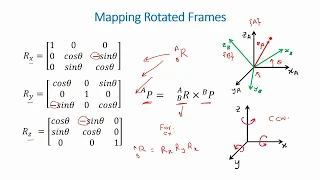
once again let me consider that Universal coordinate system you having X u Y u and genu and there is pure rotation with respect to the universal coordinate system by some angle say theta in the anti-clockwise sense now if I rotate by an angle theta in the anti-clockwise sense so my Jade B that is the Jade axis of the body coordinate system so Jade we will be different from Jade you initially they are coinciding now Jade B will be different from JD u xB will be different from X U and Y we will be different from
Y you okay and so we will be getting this particular rotated frame and supposing that the position of a particular point with respect to the rotated frame B is known to us so this is known so once again let me repeat the body coordinate system that has been rotated with respect to the universal coordinate system and I know the position that is Q with respect to B and our aim is to find out Q with respect to you the position with respect to the universal coordinate system so that we'll have to determine now this Q
with respect to U is nothing but the rotation of B with respect to U multiplied by Q with respect to B so this particular Q with respect to B is known and if I can find out so this particular rotation matrix that is RB with respect to u so very easily I can find out Q with respect to u now how to determine that RB with respect to u that I am going to discuss after sometime now I am just going to consider a more complicated situation where I am just going to consider both translation
as well as rotation and once again let me repeat that so this is the universal coordinate system X u Y you and genu and B is the body coordinate system there has been some translation that means the origin has been shifted so from here to this particular point and this is actually the position vector that is Q B origin with respect to u okay and so this particular be the B coordinate system has got some rotation with respect to this particular the Universal coordinate system you and that is why xB is not parallel to X
u Y B is not parallel to Y you and Jade B is not parallel to Ju so this is the situation so there has been both translation as well as rotation now supposing that so this particular point that is Q with respect to B is known so this particular point is known and what is our aim our aim is to find out say Q with respect to u so that is our M so this is known that skewb origin with respect use of this particular vector is known this particular position vector is known moreover the
rotation matrix of B with respect you say that is also known then how to find out this Q with respect to you now to find out this Q with respect to you so I'll have to find out like this so I have to find out so rotation of B with respect you x so Q with respect to B so both the things are known plus Q B origin with respect to you so this is also not so very easy we can find out Q with respect to you now this Q with respect to you is
nothing but this expression now here inside the expression there are two things one is actually the translation of the origin of be another is actually the rotation of B with respect to u so there are two things one is the translation another is your the rotation so now what I am going to do is I am just going to use a particular term which includes both translation as well as rotation and that particular term is nothing but transformation so this particular transformation it includes both translation both translation and rotation so translation and rotation are taken
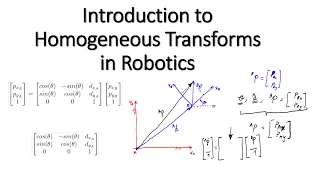
together inside this particular the transformation now here so this particular expression I am just going to write down in terms of the transformation matrix that is Q with respect to U is nothing but the transformation of B with respect to u so in place of this rotation and this position now I am using this particular the transformation so transformation of B with respect to u multiplied by Q with respect to B now if I know this transformation of B with respect to u now I can multiply so this Q with respect to B and you
will be getting this Q with respect to you so this is the way actually we can find out if we have both translation as well as rotation now let us try to check the dimension of this particular the the dimension matching of this particular thematics now if you see in the the last slide we wrote the equation that is Q with respect to U is nothing but the transformation of B with respect to a x actually Q with respect to B now here this Q with respect to u if you see in terms of matrix
so this is nothing but a 3 cross 1 matrix now these particular transforms our matrix has got two things one is called the rotation matrix and we have got the position vector now this rotation matrix is a 3 cross 3 matrix and position vector is nothing but a 3 cross 1 matrix so taken both the things together that is rotation as well as translation will be actually 3 cross 3 and 3 cross 1 so this will become your 3 cross 4 matrix so there will be 3 rows and 4 columns and this is nothing but
3 cross 1 and this particular Q with respect to B is nothing but your 3 cross 1 so that means I have to multiply 1 3 cross 1 matrix by 1 3 cross 4 matrix just to get a 3 cross 1 matrix which is which is not possible now to solve this particular problem to make it possible actually what he do is so here we we do some corrections of modification sort of thing so here on this position term Q with respect to u we add 1 and here just below the rotation matrix on the
port the row we use zero zero zero three zeroes we add and here we add one and here we add one and now this particular transfer matrix will have the dimension that is your 4 cross 4 so these are 3 cross 4 now I have added one more row here so this will become your poor cross 4 and this particular thing will become poor cross 1 matrix and this will also become poor cross 1 matrix now if I just multiply so this 4 cross 1 with 4 cross 4 so I will be getting this 4
cross 1 matrix so it is it is matching now my question is like why do you put 1 here why do you put 1 here why 1 here and why do you put these 3 zeros that I am going to discuss thank you