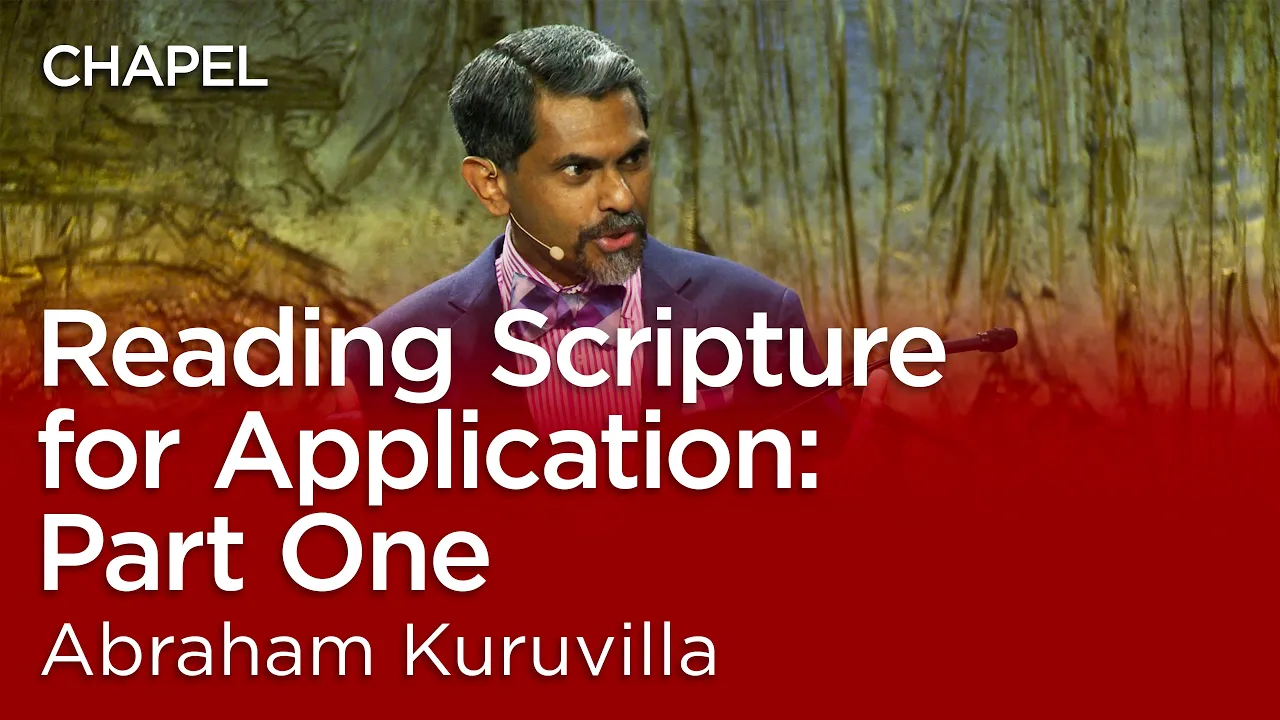
what I'd like to do in the two sessions that I have today and Thursday is to talk about reading a scripture for application and as Don said I'll try to illustrate some of that in the David and Goliath story on Thursday we'll talk about some theory this morning the other day in a church that I visited I found a copy of a popular devotional that can be found in the foyer of many of our evangelical churches and skimming through its pages in an idle moment I came across this particular devotional on acts 28 you probably know the story already paulus shipwrecked in Malta and he joins everyone else in picking up sticks to start a fire so the devotional recommended we too should be willing to do menial jobs in churches because if the Apostle Paul can do that so can we always be willing to do the lowliest job of course the writer of the devotional conveniently forgot about the snake that came from the cord and bit the poor apostle and now I being the clever guy that I am could use that part of Acts 28 to recommend exactly the opposite never do menial tasks because who knows a poisonous snake might sink its fangs into you and needless to say there are a lot of these species with two legs in many of our churches so never ever engage in lowly jobs for fear of those venomous beasts lurking in the shadows you see the problem there right away how do we go about this task of finding valid application from an ancient text throughout the two millennia of the church age this has been the striking hall in every hermeneutic in every reading of scripture for application how to derive valid application from a modern for a modern audience from a specific text and a robust hermeneutic for making this move from the den to now has been lacking and guess who are the most worried about this whole this lacunae they are the preachers because they are in the business of making application for their listeners so this complex task this critical issue of how the preacher can move from text to sermon from then to now has not been exploitative throughout church history this has been somewhat of a black hole but as you all know it's not just preachers who are and who ought to be concerned all of us should be concerned about how we can move from an ancient text to modern application every one of the children of God should be concerned about this issue how do we apply God's Word how our lives changed by scripture I am a preacher and in my seminary years and as I preached in pulpits I struggled with this issue was there a solution to this black box and somewhere in those days of darkness I caught a glimmer of light as I studied second samuel 11 and let me show you what I saw if you have your Bibles open please turn scroll to 2nd Samuel 11 the story of David and Bathsheba you've probably heard many sermons from this text giving five applications for men on how to keep them from falling into adultery don't stay idle don't climb onto your roof don't look into your neighbor's yard I hate to admit it but some of those sermons were preached by me but this morning I'm going to paint a different picture of that horrible story of David's adultery and murder Uriah the husband of Bathsheba has been killed by David by having him sent to the front lines of the battle Joab David's commander who was complicit in this killing sends word back to David saying that the task has been accomplished but he isn't too happy because in the bargain a lot of other good warriors got killed so when he David gets Joab message David has the gall the unmitigated insolence and disregard for God and His Holiness to reply to Joab do not let this thing displease you for the sword devours one as well as another oh it's only a few lives Joab just collateral damage who cares of a fewer killed life is cheap the sword devours one as well as the other look at 11:25 again do not let this thing displease you unfortunately for us English readers that's not what the Hebrew says the Hebrew literally reads do not let this thing be evil in your sight and we're going what let this thing not be evil in your sight this horrible gruesome sin not be called sin how could this not be evil to have one of your finest warriors deliberately placed in the line of fire and to get several others of your top-notch fighters killed in the bargain not evil how depraved can you get two verses down 11:27 but the thing that David had done was evil in the sight of God the exact words that David used to Joab are now being thrown back in his face the identical phrase your acts of sin that you so carelessly and cavalierly decided to overlook do not let this thing be evil in your sight are now being labeled for what they they are evil in the sight of Yahweh and that's the turning point of the whole story whose eyesight is better and more authoritative David's or God's who gets to call evil evil and good good David or God I want you to hold that talk for a second there is one word that curiously keeps cropping up in 2nd Samuel 11 I'm going to read those verses out and you can figure it out what that repeated word s here we go second Samuel 11 1 then it happened in the spring at the time when Kings go out to battle that David sent Joab and his servants with him and all Israel and they destroyed the sons of Ammon 11 3 so David sent and inquired about the woman 11 for David send messengers and took her 11 6 then David sent to Joab saying send me Uriah the Hittite Sojo absent Uriah to David you're getting it 1114 now in the morning David wrote a letter to Joab and sent it by the hand of Uriah and finally 1127 when the time of mourning was over David sent and brought her to his house and she became his wife what word is repeated the word send shelah an unusual concentration of the word here compared to the entire first end second samuel corpus send send send send send the King his word is command his sending is a picture of his imperial strength to be Emperor what he says will happen what he commands will get done he sends we jump okay hey if I want the woman I'll send for her and take her and if I want to dispatch her husband I'll send him away and then when he's been sent I'll send for his wife and take and make her mine I the king or so thought David now look at second Sam world 12:1 just the first three words then Yahweh Sam you don't even have to read the rest of the story to know that the tables have been turned listen up King David the center I am the sender with the capital S you small time this part of the Spoony piece of real estate called Judah who do you think you are I am the sender rusyns Adam spinning in planets orbitting I am the sender who sends the Sun on its way and the waves pounding on the shores I am the sender who sends the brain waves across your synapses the blood coursing through your arteries and the air through your lungs and what you have done with your uncontrolled passion and irreverence for my name mr. sender is nothing but evil God and God alone is the sender with the capital s the king of kings and the Lord of lords and he makes the call on evil and good step back for a moment and ask what happened here from the text itself the way the story was written we got a sense of what it's all about is that possible can the text itself give us its thrust and can that thrust force be caught by reading in a special way just like we did that's when I decided I needed to spend some more time on this and this has been my sole passion for over a crusade so what I'm going to talk about for the rest of our time is essentially a report on what I have found and continue to work on for the last several years and some of this has shown up in a bow published by Moody privileged the text so here we go the psalmist said give me understanding and I will observe your law and keep it wholeheartedly in other words if I don't have understanding I won't be able to obey I won't be able to grow in holiness and so understanding of what God demands for his people is critical for our faith and practice so how do we understand God's Word in order to apply it how do we read scripture for application how do we catch the trust the force of the text what it is all about every one of us who read scripture for application and life change has to understand this thrust of this text we've got to read scripture to catch it's trust no trust no application how do we do it with the blossoming of language philosophy in the late 20th century in the last 50 years the understanding of how language works has matured considerably communication of any kind sacred or secular spoken or scripted it's now increasingly being recognized as a communicator doing something with what is communicated authors including those of scripture do things with their words let me give you another example take the case of the narrative in 1st Samuel 15 which is the story of Saul being ordered by God to kill all the Amalekites the prophet Samuel passes on this message from God to King Saul that they should annihilate the Amalekites and this is how Sam will prefaced his remarks to Saul listen to the voice of the word of Yahweh sad to say once again you will not find the word voice in most of your English Bibles surprisingly such a literal translation of the Hebrew is found only in the King James and it's heirs the seeming redundancy of voice is swept under the rug in all the other major English translations that have listened to the words of Yahweh or the word Jiali I'll come back to the significance of that in a second Saul as you know does not obey rather than eliminate all the animals and humans as God commanded him he saves the good ones of the former and the chief human as his own trophies soon after Sam will the Prophet confront Saul the King declares he has done everything that God has him to do and then Samuel goes in those timeless words what then is the bleating of the sheep and the lowing of the oxen that I hear it's not bleating and lowing in the Hebrew I'll give you one guess as to what the word is it's voice did you now catch the thrust of the text the author is doing something here poking a finger into my sternum telling me the one committed to God listens to that voice not to the voice of the seductions and titillations of the world again most English translation translations render voice in each case here is bleating and lowing respectively and this combined with the omission of voice in translations of 15:1 the tech the thrust of the text is almost completely negated and these translational missteps are a clear indication that bible translators and scholars don't think in terms of what biblical authors are doing with what they are saying and herein for samuel 15 they trust the force of the text is clearly the issue of listening / obeying the verb is the same in hebrew - god only after grasping this trust of the text what the author is doing can one ever move to valid application so here is the scheme of interpretation reading scripture for application that i espouse text thrust application once he sees this even in folktales take the old one by ESOP about the dog that found a bone on its way home with its booty the canine happened to cross a bridge over a stream and as it looked into the water it spotted another dog with a bone will greed took over and the real animal barked at the virtual one and lost the bone that it had what does it mean what is the thrust of this text it's not don't eat bones don't climb bridges definitely don't bark while the story deals with dogs and bones and bridges and streams and reflections the thrust of the story is about being content and the loss one might incur otherwise this is what Esau was doing with what is he was saying in a totally uninspired way of course and that's what he would want readers to respond to one practices the prudence of contentment rather than lusting for the virtual so only after grasping the thrust of the text what its author is doing can one ever move to valid application so here we are text thrust application this notion of others doing things with what they say falls into the field of language philosophy called pragmatics pragmatics studying communication as an event deals with what authors or speakers do with what they write or say or as I was calling it the trust or the force of the text in other words it's not enough to comprehend what the others are saying the semantics the language grammar syntax one must also catch what others are doing with what they're saying the pragmatics that trust the force of the text in that favor by Esau for the semantics deals with the description of the specific events the dog and bone clear but the pragmatics or the thrust of the text is an endorsement of contentment this is what a sock was doing with what he was saying and without catching the pragmatics ie the thrust of the force of the text or the utterance valid application is impossible and of course that's what reading scripture is all about applying changing lives so for interpretation for application the trust of a text of Scripture what the author is doing with what he's saying must be discerned and only by catching the author's doing in and with that text can God's people discover valid application in for sam'l 15 unless one catches what the author was doing with those word plays on voice one will not be able to respond appropriately to the demand of the text it's got nothing to do with trusting guards fairness without bouncing from God's rather severe treatment of those Amalekites neither is it be wearing of sins serious consequences from the dreadful fate of those sinful people that might befall us if we are dissipating that's not at all what the text is recommending rather as we saw it is something like listen to God's voice not the voice of anyone else or anything else one might interpret the Bible in different ways for different purposes but when we interpret the text for application for application we must focus on what the author is doing with what he's saying in that particular text ie the texts trust its pragmatics in order to elicit valid application for readers any interpretation of scripture with a view to application in a sermon in your personal study wherever if you are planning to apply interpretation has to move from text to thrust to application now let me move this one step forwards a text is not an end in itself it's the means to an end it projects an ideal vision of life what the philosopher paul ricoeur called the world in front of the text we just looked at this thrust of Aesop's story of the dog and born in recurs terms then the story is projecting an ideal world in front of the text abbreviated here as wif OTT an ideal world in which its inhabitants practice contentment that's what he saw wanted us to catch or in there inspired for samo 15 narrative the biblical author is projecting an ideal world in front of the text in which inhabitants listen exclusively to the voice of God disregarding the seduction of all other voices in a sense these worlds are the Trust's of the text this is what their others are doing with what they're saying indeed this is what those writers would want us to respond to and readers you and I are being invited to come and dwell in such ideal worlds abiding by the requirements of those worlds here's uninspired ESOP come live in this world by practicing contentment and here is the inspired author of first Sam will come abide in this ideal world by obeying only God's voice and of course only the biblical text has the authority but in any case to live in those respective worlds is to abide by the values of those worlds practicing contentment in Aesop's uninspired world obeying God exclusively in the first Samuel authors inspired world so in texts an ideal view of life is depicted a new world is portrayed and an invitation to that world is being extended by God to us and our lives are changing as we listeners respond to and inhabit the world by living by the requirements of that world all texts work the same way so does scripture its interpretation must discern this world in front of the text or the thrust of the text its pragmatics what the author is doing so when the text is rightly applied readers are in effect inhabiting the ideal world that it projects so here we are again texts the thrust or its various synonyms and application all communication for application functions this way for instance if I am standing next to doctors anouk in here and he tells me hey you're standing on my foot the semantic meaning of his utterance or the author is saying locates the position of my foot on top of dr. solutions while the pragmatic meaning what the author is doing with what he's saying the trust of his utterance is a baguette your foot of mine but in fact what Don was actually doing when he said that was projecting a world in front of the text in which no one is ever stationed upon down Sunu Keens lower extremities to cause him distress and his desire for me was to come and inhabit such a nobody ever standing on Don's Anakin's foot to cause him pain kind of world and that inhabitation can only be accomplished by my conforming to the requirement of that world removing my foot off Don's alleviating his agony valid application because a key requirement of that projected world is that nobody ever stand aren't professor su Lukens foot to cause him pain unfortunately that's not how biblical texts are looked at in the standard mode of reading scripture especially when it's employed by a preacher if that statement by dr.
suno akin to me hey you're standing on my foot were an inspired utterance and if I were preaching that text on Sunday morning I would conceivably expatiate on the derivation of the word foot from the English fart from the Sanskrit part I would definitely discourse upon the foots kinase geology 26 bones 30 joins over 100 muscles tendons ligaments I would talk about its hematology its blood vessels its neurology its nerve supply I the preacher would no doubt wax eloquent about the pathology of their extremity the various abnormalities clubfoot flat for the athlete's foot skewed foot rheumatoid foot and so on and on focusing on all the ologies but completely missing the thrust of the utterance and its intended back application which is get your foot off my but it's not just us preachers who do that kind of stuff in our exegesis in our study of the text we dig and excavate and explore the text and unearth all kinds of things dirt stone rock potsherds arrowheads fish hooks most of it not much value if we want to validly apply the text you have to unearth the gold nuggets in other words unless one catches what Don solution was doing with what he was saying valid application is impossible without a comprehension of the pragmatics of the utterance without grasping the ideal world in front of the text a world in which no one stands on dr. solutions foot to cause him pain all this regurgitation of Hematology neurology pathology Christology ecclesiology or your favorite ecology du jour can never bring one to valid application so also for the biblical text text thrust application look at it this way the biblical Canon as a whole projects a world in front of the text God's ideal world individual segments of which are portrayed by individual Perry copies and I use the word perry copy in a non-technical sense here to indicate a small chunk of text an individual portion of scripture used for personal study or for preaching that leads to application each pair a copy of scripture projects a segment of God's ideal world in front of the text and taken together the integrated composite of all such segments makes up the canonical projection of God's ideal world in front of the text the primary canonical world so each teraCopy is God's gracious invitation to us to come live in his ideal world by abiding by the thrust of the Perry copy ie the requirements of God's world as called for in that perry copies world segment and as mankind accepts that divine invitation as we read scripture for application week by week and para copy paper copy you and I God's people are progressively and increasingly inhabiting God's ideal world abiding by God's will one para copy at a time the various aspects of Christian life are being brought into alignment with the will of God for the glory of God God's Word being applied God's world become a reality this is the goal of reading scripture for application because this world speaks of God and how he relates to his creation I call this theology but theology off the pier agape which is a better label for the world in front of the text so look at it this way so each Perry copy then is portraying a segment of theology and the integration of all of these per couple theologies makes up the plenary canonical theology so every time we read scripture for application we must seek to discern the theology of the Perry copy under consideration elucidating what that specific text and firms about God and how he would wish to relate to his people I submit to you that biblical interpretation that does not discern this intermediary peripheral theology is de facto incomplete for without discerning this entity valid application can never be arrived at so here again is the schema of reading scripture for application text Perry couple theology application God's called to be aligned to his will is a gracious invitation to us to inhabit his ideal world it's a divine offer that should capture our imaginations and set afire our affections for God's ideal world as theologian Miroslav Volf put it at the heart of every good theology lies not simply a plausible intellectual wishing but more importantly a compelling account of a way of life a vision of God's world the vision of God's world captivates us with a picture of what it looks like to flourish and live well in every facet of our existence a vision cast from the Word of God in the form of terrible theology this is a vision of a world in front of the text painted by Scripture and as this world is gradually unveiled Perry copy by Perry copy in faithfully reading Scripture as the community of God's people inhabits this world more and more teraCopy by Perry copay in faithful application the goods and aspects of human flourishing painted by these alluring pictures of the good life begin to seep into the fiber of our being ie our hearts and thus govern and shape our decisions actions habits attracted by that world and moving towards that we begin to live into this vision of the good life and start to look like citizens who inhabit the world that we picture as the good life we become little microcosms of that envisioned world as which try to embody it here and now this vision of God's ideal world is what has cast by the theology of the Perry copy so what is crucial for us interpreters who read scripture for application is to first grasp the trust of the text what the other is doing with what he's saying the theology of the peer agape so I propose therefore a theological exegesis that privileges the text that looks for clues to its theology within every text there are literary and stylistic traces of the author's agendas evidence pointing to the author's doings signs that lead to the discovery of Perry copal theology and such Clues can only be caught by a careful reading of the text and discerned and the level of exegesis theological exegesis in other words my proposal works at the level of the language and structure of the text s with the first sam'l 15 and second sam'l 11 examples we looked at the text is therefore not a plain glass window through which we look to see the world behind it for instance the bleating and lowing and stuff in for sam'l 15 scholars determined that what really happened was the Word of God came to sam'l so they swept the redundant voice under the rock likewise in 1514 the Hebrew voice was translated to bleating and lowing for after all cattle and sheep don't have voices do they interpreters seem to be more interested in what really happened behind the text then in what the text says happened let me give you a metaphor to understand this better the text is not a plain glass window through which we look to see the world behind it the bleating and lowing for instance it is also and I dare say primarily a stained glass window at which we look to see the world its projecting in front the voice of God versus the voice of the allures of the world you see in a stained glass window the glass and the stains and the mercury in the copper and everything that goes into its production are meticulously planned for the appropriate effect to tell a particular story so - with texts and so I claim that a text is primarily a stained glass window Act which we ought to look to see the world it projects not a plain glass window through which we look to see the world behind it and I've seen this wherever I have looked at in Scripture and so here's a shameless plug for my marker Genesis officiants and judges commentaries what I've attempted to do in all of those commentaries is go teraCopy by para copy another thing that clues in the text that point to the theological thrust of each perico be in the book paying attention to the language the struck the länder structure so mine is there for a plea to privilege the text to attend to the text itself which alone is inspired and not the events behind the text so here is my definition of peer couple theology the theology specific to a particular peer copy representing a segment of the ideal world in front of the canonical text that portrays God in relationship with his people and which functions as a crucial intermediary in the move from text to application let me say it again biblical interpretation that does not elucidate this crucial intermediary predicable theology is de facto incomplete for without discerning this entity valid application cannot be arrived at so how does per couple theology differ from systematic and biblical theology as at least as they are commonly defined systematic theology draws conclusions deductively from one text and integrates those with deductions from other texts slotting the information into a variety of theological categories so puri ology ecclesiology anthropology and so on the swinging connections between one part of the text and another dr. da Carson defines systematic theology is the branch of theology that seeks to elaborate the whole and the parts of Scripture demonstrating their connections so by watching of this connecting and correlating activity systematic theology operates at a level that is more general than is peripheral theology peripheral theology on the other hand is constrained by the particulars of a single pair copy it deals with matters pertaining to God and his relationship to his creation as proposed in that para copy so it's an expression of the Divine Will in that text that the people of God must abide by if they are to inhabit God's ideal world the operation of biblical theology also tends to be more general than peripheral theology because it develops common biblical themes across the Canon with an emphasis on lines according to Sydney great honest biblical theology helps us trace longitudinal themes from the old testament to the new but these big canonical pictures of systematic and biblical theology tend to miss the small pier couple miniatures and it is these miniatures ie the theology of the individual pear copies that are essential for the week by week life-changing applications in preaching or in reading Scripture for application so on the one hand with systematic theology or biblical theology is the basis of sermons distinctions between the theological thrusts of successive Peres copies are hard to maintain since these two forms of theology operated a much general level and at that general level of operation many Perry copies will look the same for instance mark 8 has the healing of a blind man and if we go ahead and understand it as teaching divine omnipotence Jesus power or the retina the optic nerve and the occipital cortex what will we do when we get to mark 10 when jesus heals another blind man is it simply a repeat no it isn't or the two feelings of thousands in mark 6 and mark 8 mark is actually doing two different things which each of those blind healings and with each of those crowd feedings you have to read my mark commentary to find out what so here again is the twofold aspect of the sermonic transaction the discernment of the theology of the para copy the move from text to theology and the discovery of how the latter may be applied in real life ie from theology to application and with that I see that our time is up on Thursday we'll look at a more extended example of how my proposal operates with a single text e David and Goliath story the story of the mother of all battles thank you very much for your patient listening god bless you all discover who you're called to be at Biola University a leading christ-centered University in Los Angeles with programs on campus and online subscribe for more of our videos and learn more at biola.
![Abraham Kuruvilla: Reading Scripture for Application (Part 2) [Talbot Chapel]](https://img.youtube.com/vi/sl5K6H-lc0I/maxresdefault.jpg)

![Clinton E. Arnold: Illumination Through The Holy Spirit [Talbot Chapel]](https://img.youtube.com/vi/Dc7WxxU4Uho/maxresdefault.jpg)