in this lesson we will look at our final class of reversible inhibitors and also look at some general lessons regarding irreversible inhibitors our final classification for reversible inhibitors is uncompetitive this type of inhibitor binds only the es complex never the free enzyme the equilibrium associated with binding is shown here since it binds to the enzyme of the presence of substrate it blocks the catalytic step and therefore lowers vmax product can be made once the inhibitor is released but the rate will be less than if the inhibitor were not present as we examine the equilibrium expression
we might assume that an uncompetitive inhibitor does not influence substrate binding in fact it lowers the value of km recall that a lower value of km indicates a higher binding affinity so in essence the inhibitor helps the substrate bind how can this be let's take a moment to review lishala a sprin scible that if stress is applied to a system at equilibrium it will shift in such a way as to relieve the stress in this case the amount of es complex is being lowered due to conversion to the EIS complex the system constant compensates by
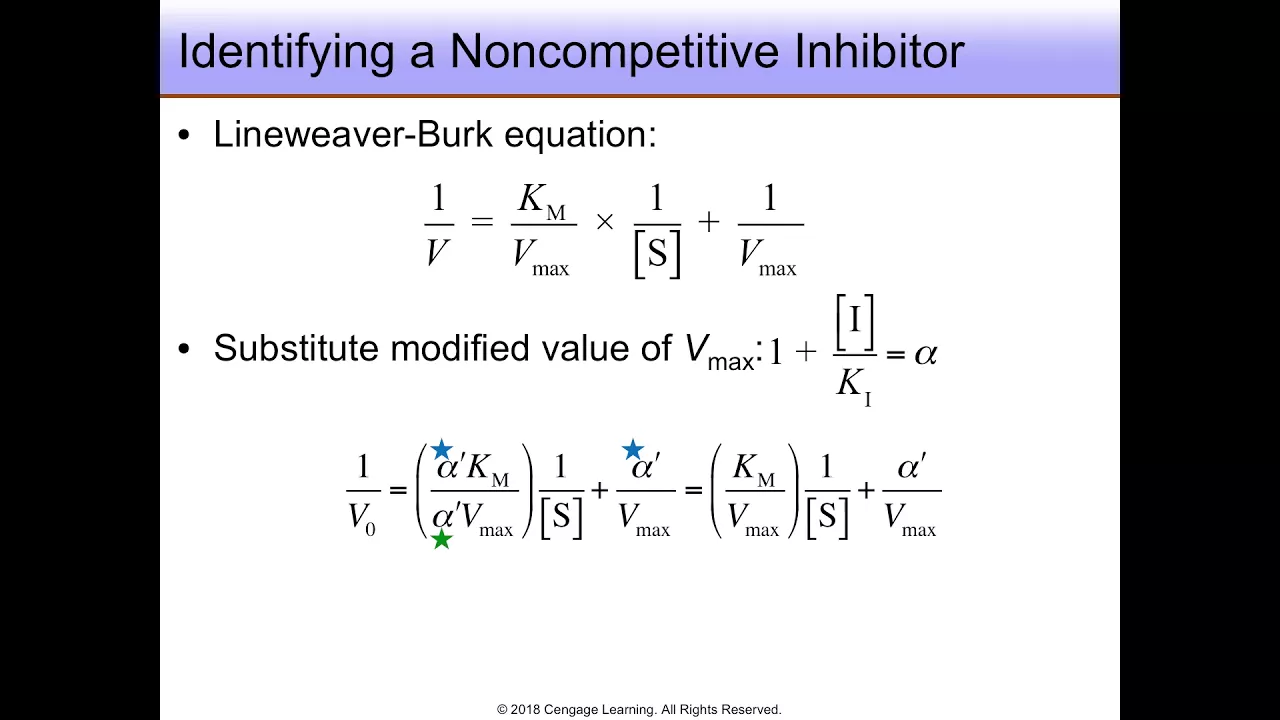
generating more es this means that formation of es is favored and km decreases don't forget though this inhibitor still lowers v-max and is therefore negatively affecting enzyme activity let's now look at the effect on the lineweaver-burk equation since an uncompetitive inhibitor lowers v-max it will increase both the slope and y-intercept by the Alpha factor as shown in the equation here however it also decreases km by the same amount when we modify all of the terms appropriately we see that the Alpha factors in the numerator and denominator of the slope cancel and our equation simplifies we
would predict therefore that the lineweaver-burk plot would produce parallel lines with increasing slopes just as we expected the lines don't intersect at any point but remain distinctly parallel one final word on inhibition has to do with irreversible inhibitors these inhibitors permanently alter enzyme activity in some way thus lowering the effective concentration of the enzyme some of these bind the enzyme covalently and thereby render it inactive unless the modification is reversed suicide substrates are molecules that combined at the enzyme active site but they cannot be released it's as if the enzyme trying to use the substrate
but then can't complete the reaction it cannot move through the reaction sequence but then it can't reverse it either it just becomes permanently stuck in place these are sometimes referred to as Trojan horse substrates since they sneak into the active site and then cause damage an example of a naturally occurring suicide substrate is the antibiotic penicillin it may not be apparent at this point but the study of enzyme kinetics can greatly aid the understanding of how metabolic and other systems function and that allows us to modify enzyme behavior in order to thwart potential disease states