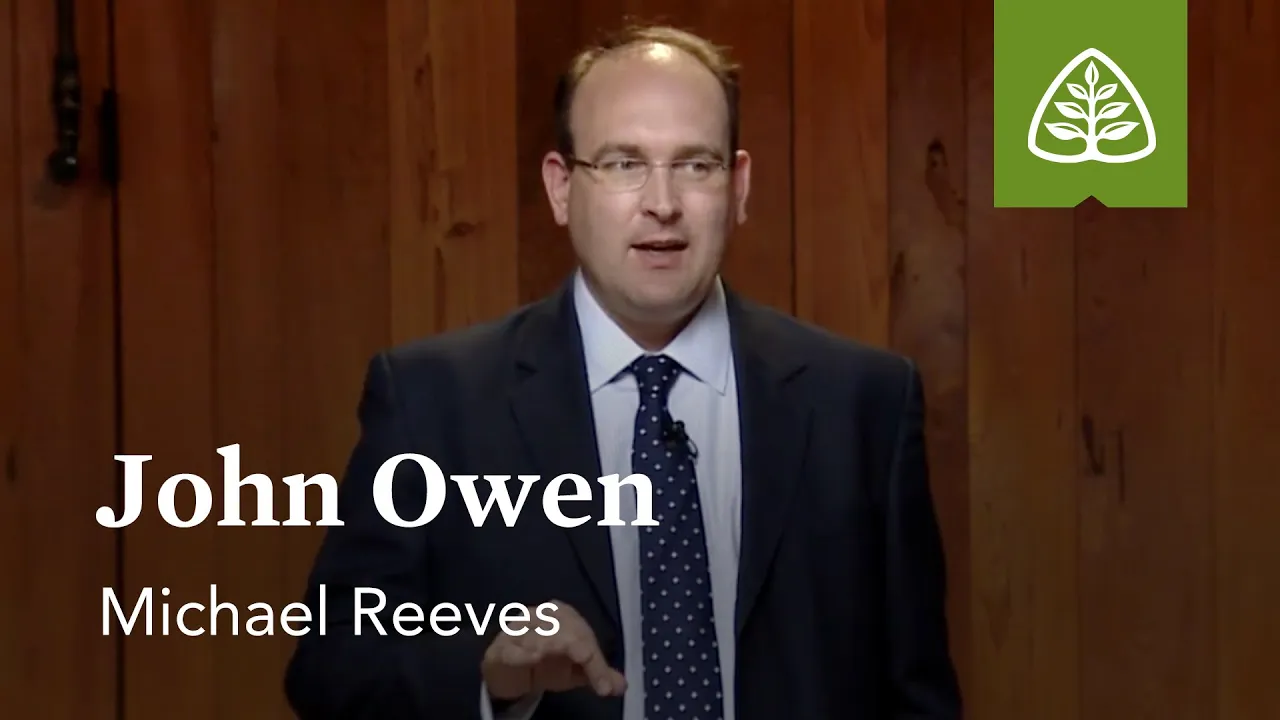
REEVES: Welcome back. So, to John Owen. Now, England, I confess, has never really been a great breeding ground for theologians.
Now, who knows why exactly? Maybe it's because the English are—well, we're a pragmatist people, and so the theory we're often suspicious of. Maybe it's because possibly the best-known British theologian ever was the Welshman Pelagius, and it is hard to follow him.
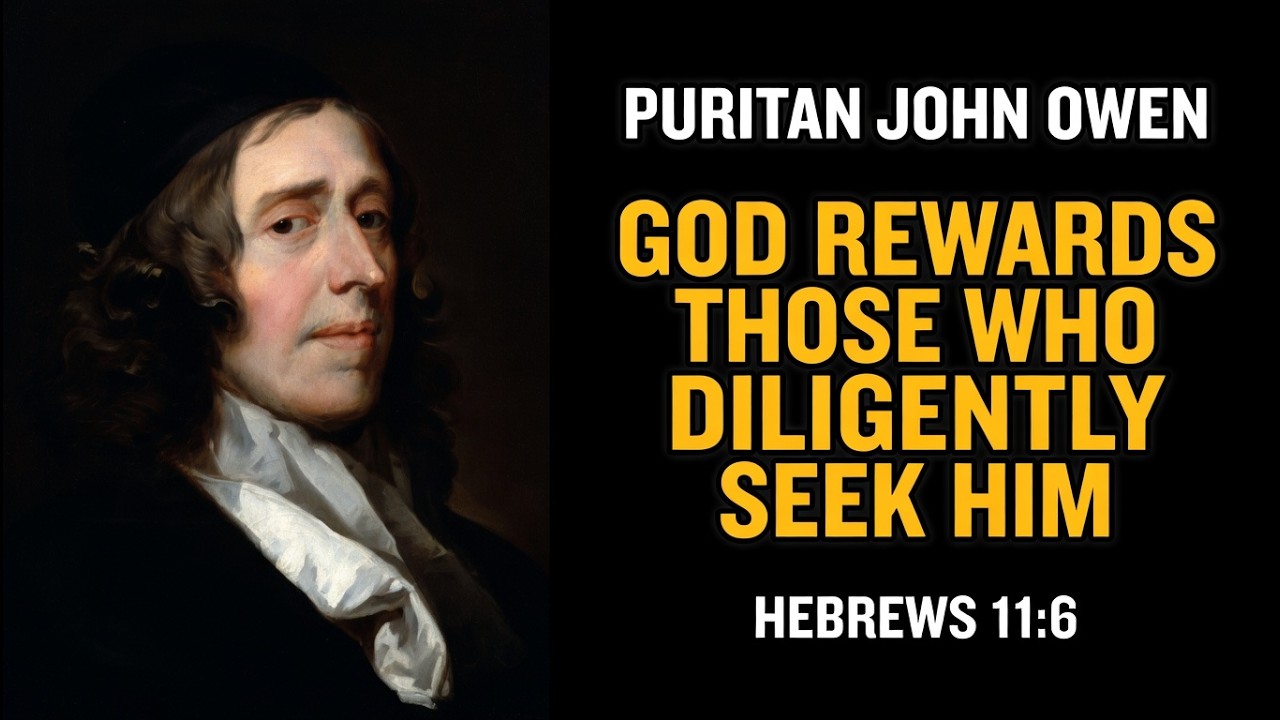
And so, the prize of being Britain's greatest ever theologian may be relatively uncontested, but one of the hottest candidates for it almost certainly is John Owen, once dubbed the Calvin of England. He was born, as we've seen, in 1616 in the little village of Stadham; it's now called Stadhampton. It's a couple of miles just south of Oxford.
At age 12, he went as a student to Queen's College, Oxford. It's being twelve that we tend to think of as the exceptional thing; that wasn't that exceptional at the time. What was surprising and exceptional was the manic intensity with which Owen drove himself to work.
At this age, he allowed himself just four hours of sleep at night, pushing himself to study hard and to learn faster. He did other things as well—he played the flute; he loved throwing the javelin, long-jumping—but he really loved hard work, and that would actually wreck his health with the intensity with which he worked. But at age 19, he received his MA (Master of Arts) and he was ordained.
But we've seen how, at this point, high church Oxford really wasn't a comfortable, easy place for someone with Owen's convictions to be. And so, what he did was he took some household chaplaincy jobs. This meant that in private homes, he could pastor and study unmolested by the authorities who were rather intolerant of his views.
Now, that sort of thing we've seen a bit of so far. What we haven't seen is this: what was going on inside Owen at this time? All this time, Owen was sinking deeper and deeper into depression.
Now, he'd spent his life in Puritan circles and was deeply conscious of his sin, but he didn't know the assurance of salvation that some preached. In 1642, then, in the midst of this dark period for him, he moved to London and he went to go and hear one of the renowned preachers of the day, Edmund Calamy, at St. Mary's Church Aldermanbury.
Now, he went deliberately to hear this famous preacher, but Calamy wasn't there that day, and he got to hear an unknown preacher. We don't know who it was. And so Owen's spiritual transformation happened much the same way as Charles Spurgeon would later.
An unknown preacher—though we don't know who it was—preached, and their lives were turned around. This unknown preacher took as his text Matthew 8:26: "Why are ye fearful, O ye of little faith? " That was just the text Owen needed, and with that message, Owen felt—though he was of little faith—an immediate assurance that he had been born again of the Spirit and was a child of God.
Now, around this time—so this is the early 1640s—the civil war had just broken out, and this was a civil war between the largely high church party of King Charles I and the predominantly Puritan forces of Parliament. It was, in many ways, a tragic civil war; families were torn apart, brother would fight against brother in their convictions. One Puritan might fight against another Puritan because one might say, "I need to be loyal to the King because that's the right thing to do," and another might say, "No, he's a bad king.
He must be disobeyed. " So it was a time of great division, but it was fairly obvious to Owen which side he should be on: the side of Parliament. And for his book, *A Display of Arminianism*, the Parliament awarded him the post of Vicar of Fordham, which is a little village just outside Colchester.
Interestingly, Fordham still has an evangelical church today. They've constructed a John Owen Barn in his honor, where they hold events now. Fordham gave Owen lots to do.
The previous vicar, Senior Pastor, had been an ardent high churchman, and so they simply hadn't received any evangelical education. And so, on top of his ordinary duties, what Owen did was write two catechisms—a list of questions and answers; one for adults, one for children—and he used them to instruct and educate his people in the evangelical faith. With the time he still had left for writing—there was a bit of time left for him to write—those Fordham years were some of Owen's happiest ever.
One other reason was that during the Fordham years, he met and married Mary Rooke, and Mary would be his wife for around thirty years or so. But while it was happy to meet and marry her, the marriage was, in many senses, a very tragic one. Mary would bear John eleven children, and John would have to bury all of them.
Only one of them would make it to adulthood. And so, just as we look at some of the reveling in Christ, the delight in God, the worshiping of God's glory and goodness, it was written all in a context of very real life and very real suffering. He's not a man, even though he's an academic, with his head in the clouds divorced from reality.
He was only then in Fordham for about three years; he then moved to nearby Coggeshall, and by now, Owen was starting to be recognized as a rising star. In 1646, he was asked to preach to Parliament; in Coggeshall, they liked having him. They were starting to enjoy evangelical preaching.
And he began to attract about two thousand people—that's a big number for a small village in a fairly cut-off part of the world. Two thousand would crowd into the church to hear him every Sunday. Then, we've heard, Oliver Cromwell heard him.
Oliver Cromwell asked him to be one of his chaplains as he went through Ireland and then Scotland with his armies, and then Cromwell got him appointed as Vice Chancellor of Oxford University. And we've seen briefly how he used those years in the 1650s to. .
. Transform Oxford, and he really did transform Oxford into a seminary to raise up a generation of young scholars and preachers educated in the gospel. And they were also golden years in his time in Oxford.
Oxford was transformed; it’s very, very different from how things had been when he was a student. It did help that he earned something like ten times the average wage of a pastor, and this just started to attract a bit of criticism. Because he wasn't flamboyant, really, but in his preference for fine clothes over academic garb—his Spanish leather boots—this attracted some criticism.
So there was one censor, who was, of course, from Cambridge University, who said of this Oxford man, "Dr Owen wears enough powder in his hair as would discharge eight cannons. " It was also complained that he was abandoning the local church. Now, in 1657, Owen felt it right to hand on the post of Vice Chancellor, and from that moment, he drifted out of the national spotlight.
That was really the height of his fame, and his great patron, Oliver Cromwell, who had enabled it, died the following year. With the death of Cromwell, life would become ever more difficult. The first stage of the difficulty was this: Cromwell had been a Congregationalist, like Owen, believing that each local church should be independent.
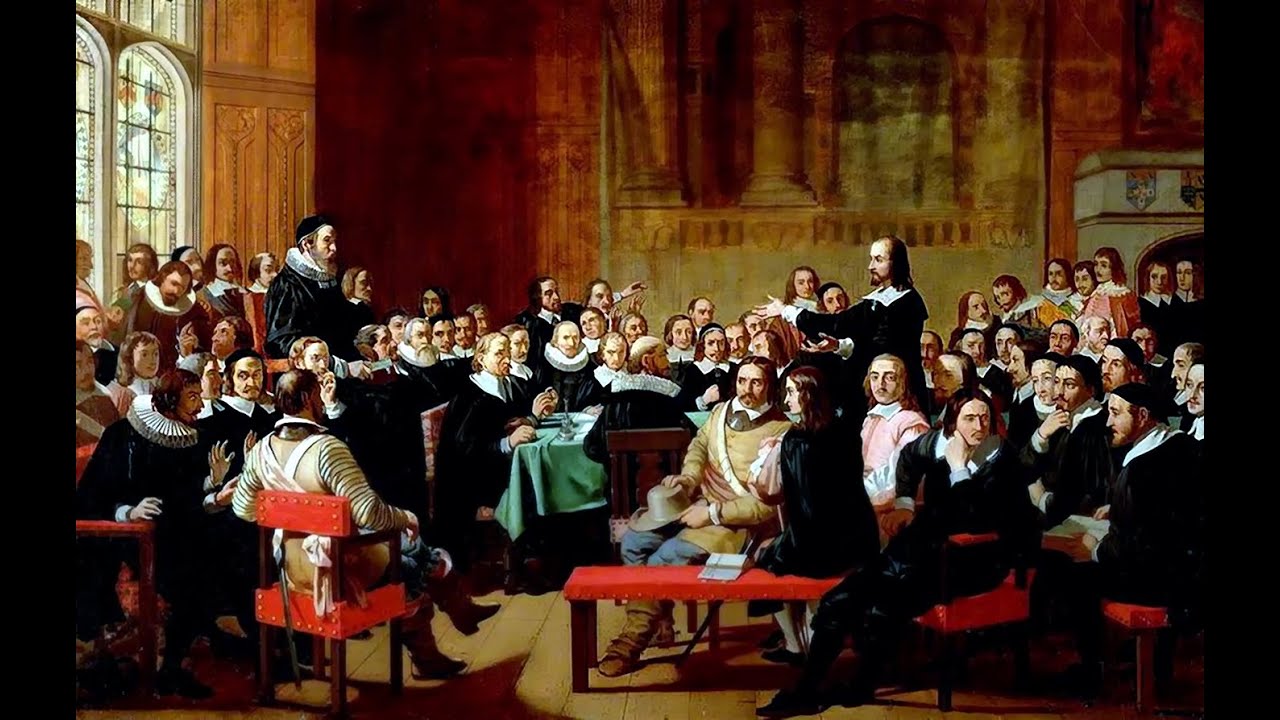
But with the death of Cromwell, that position was becoming increasingly a minority position, and the Presbyterians were in the ascendancy at the time. And so Owen was increasingly being sidelined as a theologian for not being a Presbyterian. He and some others, like Goodwin, got together at the Savoy Palace in London and wrote out the Savoy Declaration of Faith and Order to try to—well, everyone at this time wanted to find out where they sat on issues of church government and so on.
So this Savoy Declaration was trying to say, "Here is what congregational theology is saying: it's not a theology to be worried about. " He said, "We've written this to clear ourselves of that scandal which, not any persons at home, but a foreign part suffixed on us: that congregationalism is the sink of all heresies and schisms. " But this tide of Presbyterianism was irreversible, and Owen was left to a quiet retirement back in lovely Stadham.
Now, don't feel too sorry for him; he's an academic, remember? And academics are quite happy to be left alone in a bit of solitude. There, he used his time in Stadham to write, tucked away in rural Oxfordshire.
He managed to produce his monumental Latin treatise, Theologoumena Pantodapa, which was a monumental treatise in Latin. It's been translated into English under the title Biblical Theology, which doesn’t really capture what it's about. A better translation would be something like "Theological Statements of All Sorts," and it was really a grand—Owen loved grand projects; it's the way his mind works.
It was a grand history of theology from the time of Adam, looking at the growth of idolatry in the nations, the growth of true theology in Israel, right down to the practice of theology today. Then, King Charles II returned, and things got even more difficult. Owen then spent almost the rest of his life in London, pastoring a church there in the city, and he used his time to write about congregationalism, how churches should be independent.
He pastored there, and he continued to write some of his major works of theology while in London. His work on the Holy Spirit, his work on justification, the work on Christology (Christologia) was written in those London years. We're about to look at that.
In 1675, Mary, who had been his wife for just a little over thirty years now, died. We don't have a record of how Owen reacted to this, so we don't know. Within 18 months, he was remarried to Dorothy Doyle.
He was sixty years old, though now, and there were no children from the second marriage. Then, six years later, the one daughter who had made it to adulthood died. A year after that, Owen fell terminally ill, and it was on the 24th of August, 1683, that he died in what was then the quiet village of Ealing, just outside London; it is now a busy suburb of London.
It's not a quiet village at all. He took a long time to die. His doctor said, "Because of the strength of his brain"—whatever exactly that meant to a 17th-century doctor.
What I want to do now is start opening up Owen's head a bit. So we've seen the man in his life a little bit; we got to know him a bit. What I want to do is step inside his brain and have a poke around, just trying to get to know his thought and how he would pastor.
I'm going to introduce one work to you in this lecture, and we'll look at some more in the next one. The one work I want to introduce you to in this lecture is titled 'Christologia' or Christology, the work on the person of Christ, and it's a good work for us to look at now because Owen was a very Christ-centered theologian. Now, the point of Christologia was an argument written against Socinianism.
This was the official reason for it, anyway. His argument was against Socinianism, which was a heresy that, among other things, denied the deity of Christ. And against the Socinians, Owen wanted to argue that true faith is always faith in Christ.
But I said that was the formal reason why he wrote because there’s a broader pastoral reason. He didn't just want to argue the point "True faith is faith in Christ"; he actually wanted to build faith in Christ in his readers because true faith, he believed, could only come about when someone appreciates and apprehends Christ in his glory and love. And so he said, "The great end of this description, given of the person of Christ, is that we may love him, and that we may thereby be transformed into his image.
" And so, in Christologia, Owen set out to fix his readers' eyes on Christ so that he might roll the truths about Christ. around the minds of his readers that their affection might be warmed to him. He's very deliberate.
He's specifically reaching through the minds of his readers, specifically to their affections. It's not quite the same thing as simply emotions; he's reaching for their desires, their motivations. He said this: "Affections…" (Affections were a very important topic of thought for the Puritans).
"Affections," he said, "are in the soul as the helm is in the ship. If the affections are laid on by a skillful hand, he can turn the whole vessel whichever way he wisheth. " You see, reach for what people desire, what motivates them, what they treasure, and if you can get people to treasure Christ more than all things, then their whole life will be transformed.
So Owen starts out by affirming he is going to be Christ-centered because he said, "Christ, not Peter, is the rock and promised cornerstone on which the church is built. " Okay? That was a Roman Catholic claim that Peter is the rock.
He's saying, no, Christ is the cornerstone on which the church is built, for it is He who from eternity had been chosen by the Father to be the head over all and the Savior of the elect. And Owen argues we must be Christ-centered. For he said, "We can have no direct, intuitive notion or apprehensions of the divine.
Only in Christ, the exact representation, the image of God, the bright radiance of the Father's glory; only in Him is God's inmost shown into us. " "Therefore," he said, "faith in Christ is the only means of the true knowledge of God. " Now, Owen is absolutely unrelenting on this point, and he really pushes it hard.
He says it's entirely possible to have a knowledge of the Scriptures themselves and still have no true knowledge of God, as the Jews would prove. You can have a notional knowledge—this is John 5:39, John 5:40 territory—"You diligently study the scriptures because you think that in them you have life, but you refused to come to Me to have life," said Jesus. Now, Owen was really picking that point up to say you could have a notional knowledge of the scriptures, and still those scriptures aren't taking you to Christ who reveals God to you, in which case you don't have the true knowledge of God.
And Owen goes on to pile up proofs that it's only through Christ that God confers any benefit to us, and Owen is so strong on this. His affirmation: God only blesses through Christ. He's forced to deal with—can you see what the problem might be?
The question of the Old Testament. And this question—"Did God bless people without Christ, BC, in the Old Testament? " Quite simply, says Owen, no, he did not.
Then he says, "The faith of the Saints under the Old Testament did principally respect the person of Christ, both who he was then as the Lord God of Israel and who he would be when he was to become the seed of the woman. " He says, "This has been the foundation of all acceptable religion in the world since the entrance of sin. " Now, there are some, he said, who deny that faith in Christ was required from the beginning or was necessary to the worship of God or justification, salvation.
For whereas it must be granted that without faith it's impossible to please God, some suppose it is faith in God under some general notion of it without respect to Christ himself that is intended. Now, listen to the way he phrases it here: "It's not my design to contend with any nor expressly to confuse such ungrateful opinions, such pernicious errors (I won't debate with him, though there are pernicious errors), but such this is which strikes at the very foundation of Christian religion; for to say that they were blessed without Christ deprives us of all contribution of life, light, and truth from the Old Testament if effectively have a different religion. " Now, you could wonder, has Owen's Christ-centeredness got too extreme?
Has the Son effectively replaced the Father and the Spirit? Is it all just about the Son then? And Owen answers—and here I think is some of his genius on display.
He answers, "The very reason why we are called to so love Christ is because the Father loves him. " And he said, "All love in creation was introduced from this fountain (the Father's love for the Son), and all love that you see in creation was introduced to give a shadow and resemblance of that love that the Father has for the Son. " So in other words, what he's saying is, our love for the Son is an echo, an extension of the Father's love for the Son.
Right? And so to be lovingly devoted to the Son isn't to disregard the Father. In fact, here is a golden statement of Owen's: he said, "Herein consist the principal part of our renovation into God's image.
Nothing renders us so like unto God as our love unto Jesus Christ. " He's saying the Father has eternally been characterized by love for delight in His Son. If you would be like God, love Jesus Christ, for that's what He's like.
And when you trust the Son, you then become like the Son, because you become like what you trust; and so when you trust Christ, you become like the one the Father loves. We're conformed in the image of God. By loving Christ and trusting Him, you become Godlike.
The overall effect of reading this work of Owen's can be summed up simply: it's like an invitation. Owen says this: "Do any of us find decays in grace prevailing in us, deadness, coldness, lukewarmness? Do any of us find a kind of spiritual stupidity and carelessness coming upon us?
Do we find an unreadiness to the exercise of grace? Let us assure ourselves there is no better way for our healing and deliverance; yea, no other way but this way alone, namely (what's the relief? ) the obtaining of a fresh view of the glory of Christ by faith and steady abiding therein.
Constant contemplation of Christ in His glory, putting forth its transforming power unto the revival of all grace is the only relief. " In this case, "Spiritually cold? Consider Christ in His glory.
" Thank you.