watching them fly off up into the sky there seems no limit to how high a helium balloon can go in reality there are two major constraints the strength of the balloon material and archimedes principle as the balloon ascends the pressure of the surrounding air drops while the helium inside expands toy balloons burst at around 10 kilometers while professional meteorological balloons reach heights of 30 kilometers welcome to gnp animations in this video we are going to see how helium gas is made on earth helium officially called helium-4 comes from radioactive decay when a radioactive element like
uranium or thorium breaks down over time or decays it will occasionally lose two protons and two neutrons they will just break off this is called alpha decay if that alpha particle grabs a couple of electrons it forms helium-4 helium is usually produced as a by-product of natural gas processing natural gas contains methane and other hydrocarbons which are principal source of heat energy when natural gas is burned most natural gas deposits also contain smaller quantities of nitrogen water vapor carbon dioxide helium and other non-combustible materials when the gas contains more than about 0.4 percent helium by
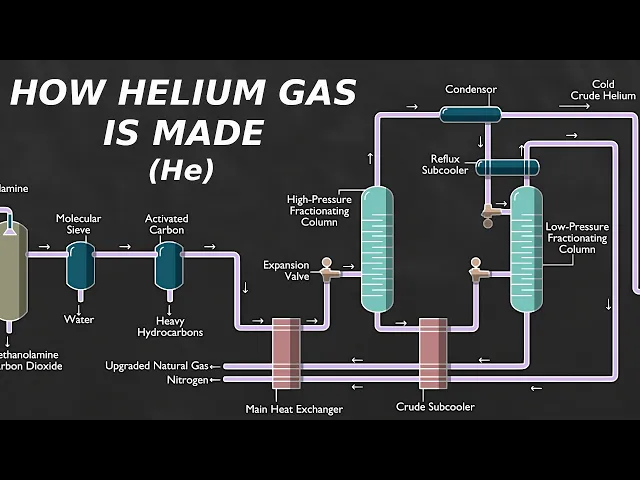
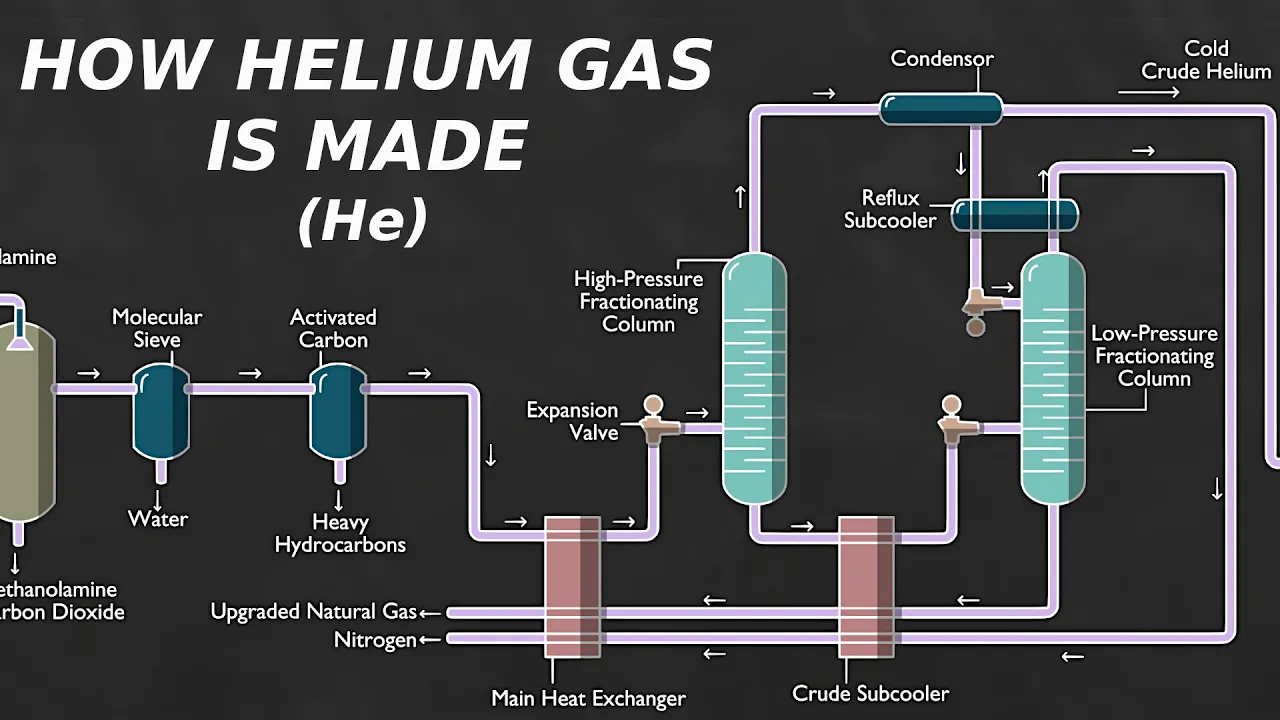
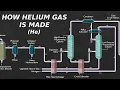
volume a cryogenic distillation method is often used in order to recover the helium content in this video we are going to see three parts and 10 steps of making helium gas part one is pre-treating because this method utilizes an extremely cold cryogenic section as a part of the process all impurities that might solidify such as water vapor carbon dioxide and certain heavy hydrocarbons must first be removed from the natural gas in a pre-treatment process step 1 removing carbon dioxide the natural gas is pressurized to about 800 psi it then flows into a scrubber where it
is subjected to a spray of monoethyloamine which absorbs the carbon dioxide and carries it away step 2 removing water molecules the gas stream passes through a molecular sew which strips the larger water vapor molecules from the stream while letting the smaller gas molecules pass the water is back flushed out of the seal and removed step 3 removing heavy hydrocarbons any heavy hydrocarbons in the gas stream are collected on the surface of a bed of activated carbon as the gas passes through it the gas stream now contains mostly methane and nitrogen with smaller amounts of helium
hydrogen and neon part two is separating natural gas is separated into its major components through a distillation process known as fractional distillation in this process the nitrogen and methane are separated in two stages leaving a mixture of gas containing the high percentage of helium the gas stream passes through one side of a plate fin heat exchanger while very cold methane and nitrogen from the cryogenic section passes through the other side the incoming gas stream is cooled while the methane and nitrogen are warmed step 4 the gas stream then passes through an expansion valve which allows
the gas to expand rapidly while the pressure drops to about 145 to 360 psi this rapid expansion cools the gas stream to the point where the methane starts to liquefy step 5 the gas stream now part liquid and part gas enters the base of the high pressure fractionating column as the gas works its way up through the internal baffles in the column it loses additional heat the methane continues to liquefy forming a methane rich mixture in the bottom of the column where most of the nitrogen and other gases flow to the top step 6 the
liquid methane mixture called crude methane is drawn out of the bottom of the high pressure column and it is cooled further in the crude subcooler then it passes through a second expansion wall which drops the pressure to about 22 psi before it enters to low pressure fractionating column as the liquid methane works its way down to the column most of the remaining nitrogen is separated leaving a liquid that is no more than 4 percent nitrogen and remaining methane this liquid is pumped off warmed and evaporated to become upgraded natural gas step 7 meanwhile the gases
from the top of the high pressure column are cooled in a condenser much of the nitrogen condenses into a vapor and is fed into the top of the low pressure column the remaining gas is called crude helium it contains approximately 50 to 70 percent helium 1 to 3 percent unliquefied methane smaller quantities of hydrogen and neon and the remaining nitrogen part three is purifying crude helium must be further purified to remove most of the other materials this is usually a multi-stage process involving several different separation methods step 8 the crude helium is first cooled to
about minus 193 degree centigrade at this temperature most of the nitrogen and methane condenses into a liquid and they are drained off the remaining gas mixture is now 90 percent pure helium step 9 air is added to the gas mixture to provide oxygen the gas is warmed in a preheater and then it passes over a catalyst which causes most of the hydrogen in the mixture to react with the oxygen in the air and forms water vapor the gas is then cooled and the water vapor condenses and is drained off step number 10 the gas mixture
enters a pressure swing absorption unit consisting of several absorption vessels operating in parallel within each vessel there are thousands of particles filled with tiny pores as the gas mixture passes through these particles under pressure certain gases are trapped within the particle pores the pressure is then decreased and the flow of the gas is reversed towards the trapped gases this method removes most of the remaining water vapor nitrogen and methane from the gas mixture the helium is now about 99.99 pure and this is how helium is made subscribe to gnp animations for more videos