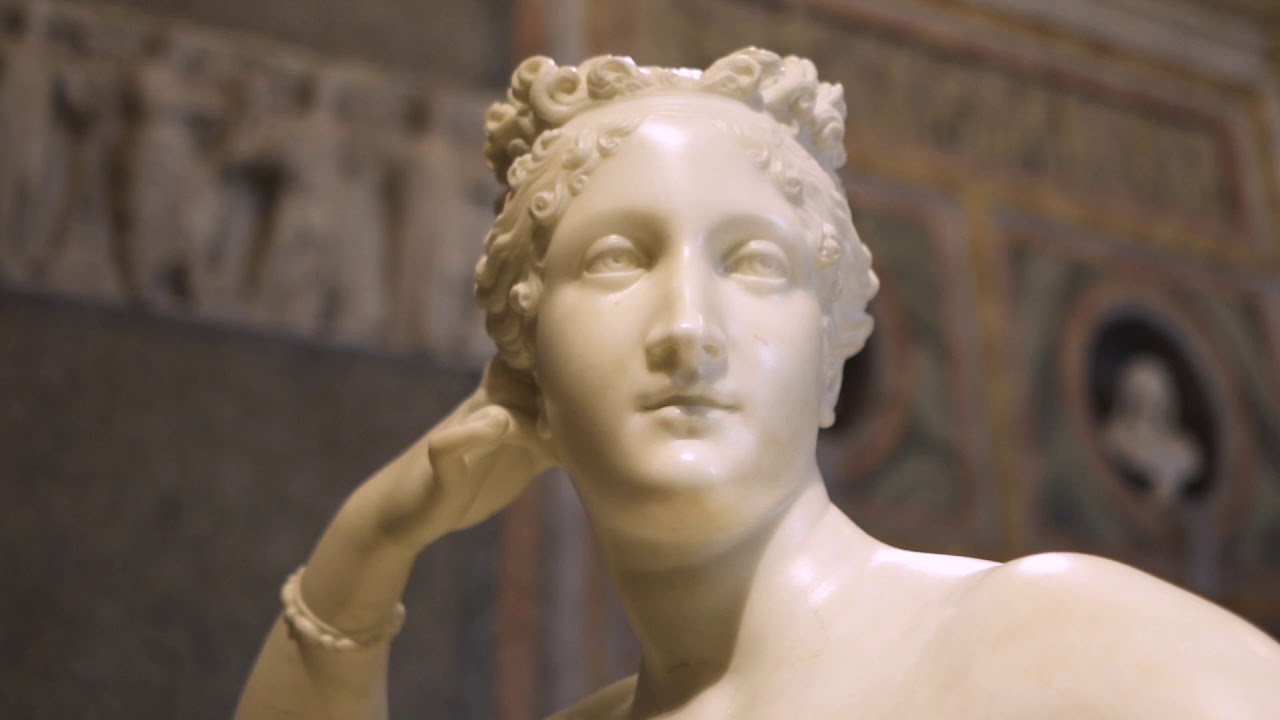
Antonio Canova, sculptor and painter, was born on 1 November 1757 in Possagno, a small town in the north-east of Italy. Considered the greatest exponent of Neoclassicism and therefore nicknamed "the new Phidias", the artist is the author of this splendid statue, depicting Paolina Borghese Bonaparte, Napoleon's sister. Here Paolina is represented as Venus: in her left hand, in fact, she holds the golden apple with which the beauty of the goddess was recognized by Paris.
In the episode of Greek mythology, the Trojan prince had to reward the most beautiful woman, choosing between Minerva, Juno and Venus. It is therefore an allegorical representation in which the young Pauline is immortalized in the role of a divinity, to celebrate her virtue and beauty. The sculpture was commissioned by the woman's husband, Prince Camillo Borghese, and sculpted in Rome between 1805 and 1808.
It is not known if Paolina posed nude for the artist or if Canova did nothing but insert the portrait of the woman. on a body made following the canons of neoclassical beauty. The work traveled a long time before finding its final location in the Borghese Gallery.
Once completed, it reached the residence of Camillo Borghese in Turin, where it remained until 1814. At the fall of Napoleon it was moved to Genoa and, by sea, reached Rome. The statue was exhibited in Palazzo Borghese, where it could be observed even at night, illuminated by torches: the refinement of the marble and the final wax patination given by Canova was thus highlighted .
After a short period in which the work was shown at Villa Pinciana, from 1889 it found its final location in the Borghese Gallery. A curiosity: the marble part of the work, which ends with the mattress, rests on the wooden structure of the bed. Inside this is a hidden mechanism that allows the statue to rotate around its vertical axis.
In 1953 two lion paws were added to the bed . The most surprising aspect of this portrait of Paolina is the way in which Canova was able to make different materials and surfaces: from the velvety skin of the woman, to the soft cushions, to the light fabric that rests on the legs. It can truly be said that marble comes to life.