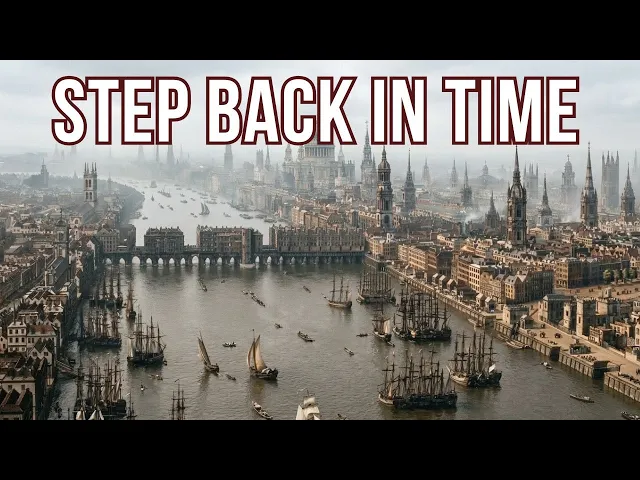
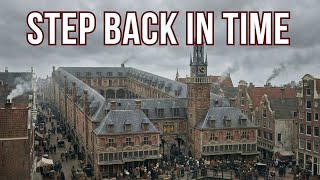
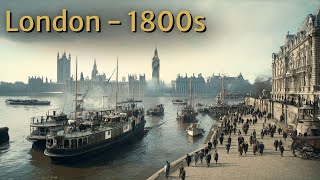
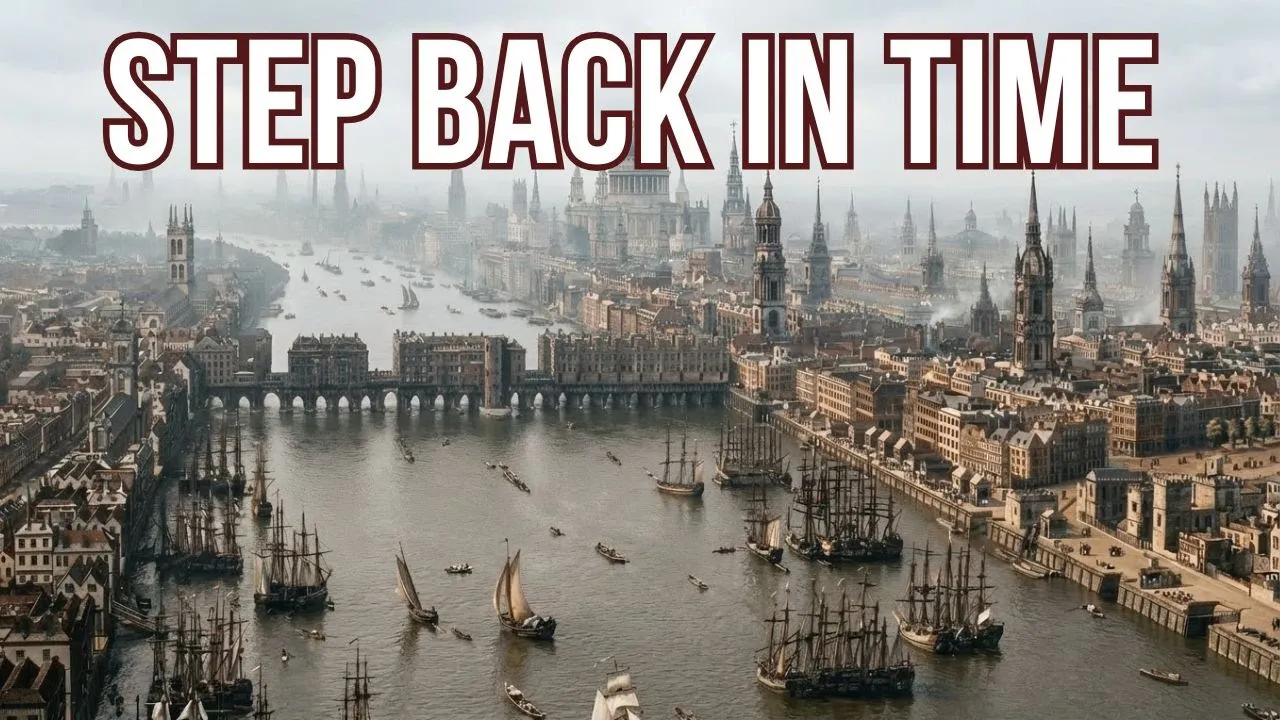
London 1750. Half a million people crammed into one square mile. This is the view from Soduk with St.
Paul's Cathedral dominating everything. It took 35 years to build and it was the most expensive structure in British history. Around 2,000 vessels pass through the tempames every day, more ship traffic than any port on Earth, carrying sugar, tea, tobacco, and silk from across the empire.
But you wouldn't see beauty. You'd smell sewage at low [music] tide, cold smoke from tens of thousands of chimneys, tar, rope, [music] and wet timber from the shipyards. This is a city already past bursting point.
wealthy, polluted, and growing faster than anyone knew how to control. On the edge of becoming [music] the modern world, you're looking east across [music] St. James's Park towards St.
James's Palace, an ordered landscape built for power. These formal gardens were designed to impress visiting monarchs and diplomats. Beyond them rises Westminster, the abbey, [music] the courts, parliament, and past the river, the forest of church spires marks the city itself.
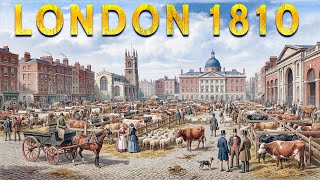
All of it connected by one unstoppable force, a growing capital reshaping its landscape to match its ambition. Covent Garden 1710. This was London's first planned piaza laid out by Inigo Jones in the 1630s inspired by the great squares of Italy.
At its center stands St. Paul's, the actor's church serving the theater world of Drry Lane and the market traders who would soon fill this open space. And what you're seeing is the last moment before chaos arrived, before the fruit stores, flower sellers, and crowds turn this quiet square into [music] one of the busiest markets in the city.
Westminster Bridge opened in 1750 after 11 years of construction. The first new crossing of the tempames in more than 600 years. Before this, you either went via London Bridge or paid a waterman to row you across.
Westminster Abbey is to the left. And the moment this bridge opened, land prices on the South Bank surged. Streets, [music] houses, entire neighborhoods followed.
Within a decade, thousands of watermen lost [music] their trade. This bridge didn't just span the river. It permanently shifted London's center of gravity.
Progress rarely arrives politely. the beating heart of London's commerce. The church you see there is St.
Mary Leau and it's said that if you were born within earshot [music] of its bells then you are a true cocknney. The definition of a Londoner right there and look at those shop signs hanging over the street. Goldsmiths, drapers, [music] habedashes, every trade you can imagine crammed into half a mile.
London's wealthiest shopping street. and the smoke. Well, every shop had a living quarters above.
Hundreds of coal fires burning night and day. Commerce didn't just shape the street. It filled the lungs of everyone on it.
Richmond House Terrace, 1748. You're standing where Canaltto stood to paint this view. Commissioned by the Duke of Richmond for 25 guineies.
A small fortune for a single painting back then. And look across the temps. This was the busiest river in the world.
Thousands of boats every day. Feries, barges, cargo vessels moving people, food, timber, coal. London didn't just randomly grow around the river.
It grew because of it. Coal fires in tens [music] of thousands of homes burning constantly. The air wasn't fresh.
Contemporary writers describe it as sharp, oily, uncomfortable to breathe. And dominating everything is St. Paul's Cathedral, designed to be unavoidable.
Wherever you were in the city, Ren wanted you to see it. This is London, 1748. Working, crowded, and unstoppable.
You're looking at the Tower of London from [music] the Tempames, the most heavily guarded building in the country. Back then, still very much in daily use. Those walls you see held prisoners, weapons, records, everything the state needed close to them, secure and visible.
The tower wasn't [music] a ruin. It was a working infrastructure. And notice how close [music] everything feels.
Houses crowd the walls. Ships tie up almost beneath the battlements. There's no separation yet between [music] city, river, and power.
This is London before embankments, before clearance, before distance was built in. Dense, functional, watched. Bloodgate Hill, 1795.
This is the main approach to St. Paul's, the ceremonial route into the city. Every important procession [music] passed through here.
State funerals, royal weddings, the Lord Mayor's parade, and the shops on either side, printers, book sellers, coffee houses. Ludgate was London's publishing district. Ideas were traded here, pamphlets, newspapers, sedition, the street where revolutions were printed.
And at the top of that hill, 365 ft to the cross, one foot for every day [music] of the year. The Strand, [music] 1750. London's main artery connecting Westminster's power to the city's money.
Every coach, every cart, every person traveling between government and commerce [music] passed down this street. And the building on the right, old Somerset House, royal palace [music] turn government offices. And as for the Strand itself, look how wide it is.
From power to money every single day. Black Fryers Bridge, 1768, under construction. You're watching London solve a problem that had existed for 600 years.
There was only one bridge across the tempames, London Bridge, and that was it for the entire city. Westminster Bridge opened in 1750 and changed everything. Suddenly, the idea of building bridges [music] became possible.
Politicians realized you could cross the river without paying a waterman. Revolutionary. This is the second new bridge.
Nine arches port and stone built by Robert Mil. He was 26 years old when he won the competition. Beat out the favorites.
Built something that would carry London for a century. And look at the scaffolding. Wooden centering holding those arches while the mortar sets.
Dangerous work. Men died building this. Fell from the scaffolding.
Drwned in the temps. That's the cost. And behind it, the city watching, waiting, knowing [music] that when this bridge opens, everything changes again.
Property values on the South Bank are about to explode. [music] >> [music] [music] [music] >> Heat. Heat.
[music] [music] >> [music] [music] [music] >> Heat. Heat. Oh, hey.