In today’s lesson, I’m going to teach you how to use indirect questions confidently. Indirect questions are also called embedded questions. Same thing.
We’ll go through this grammar step by step. My name’s Arnel. Let’s start.
Let’s start with the basics. If you want to learn about indirect questions, you have to review direct questions first. If you’re thinking, "I don’t want a review.
I only want to learn about indirect questions"—skip. Skip ahead to this point here. I’ll see you soon.
Direct questions are normal questions. These are the question types you first learn in English. Be as the main verb.
Remember your be forms: "Are you a teacher? " "Is Rebecca your sister? " "Was Harry angry?
" "Were they on time? " You can see be here is our main verb. Let’s move on.
Question type number two: yes/no questions. What are yes/no questions? Well, we expect the answer to be yes or no.
How do we form a yes/no question? Auxiliary verb + subject + main verb. Auxiliary verbs—what are those?
Let me give you a list: Do, does, did + subject + main verb Have, has, had + subject + main verb Modal verb + subject + main verb These are the auxiliary verbs you can use. And modal verbs in English are: can, could, will, would, may, might, must, shall, and should. Examples: "Do you like it?
" "Does she drive? " "Did they call? " "Have you finished?
" "Has she left? " "Had they arrived? " "Can you swim?
" "Would you like another coffee? " "Should I pay now? " You can see each question has an auxiliary verb, a subject, and a main verb.
And the answer to each of these questions can be yes or no. "Do you like it? " → Yes or no?
"Has she left? " → Yes or no? Okay.
Technically, be questions are also yes/no questions. If I ask, "Are you a teacher? " the answer can be yes or no.
But for today’s lesson, I’m going to separate those two question types. Number three: WH questions. Who, what, when, where, why, how, which, how much, and how many?
Let’s do some examples, of course: "Who are you meeting later? " "What can I do to help? " "When did David leave?
" "Where should we sit? " "Why won’t my car start? " "How could my computer just shut down?
" "Which color pen should I use? " "How much money do you owe? " → Owe means need to return.
"How much money do you need to return? " "And how many lemons did you buy? " In all of these questions, we have question word + auxiliary verb + subject + main verb.
Are these grammar rules necessary for today’s lesson? Yes—if you want to confidently use indirect questions and avoid common mistakes, you do need to know these details. You do need to know about direct questions.
But don’t worry—as your English improves, you won’t need to think about these rules anymore. Hmm. But what about questions like: "Hmm, what smells in here?
" I can only see one verb—and where’s the subject? In some questions, the question word is the subject. Keep this in mind.
Indirect questions. We are here. So, why do we need indirect questions?
What are they for? Indirect questions are polite. You sound nice when you use indirect questions.
Imagine you are speaking to someone you don’t know: "Where is the bathroom? " "Could you tell me where the bathroom is? " [Music] Indirect questions sound nice.
They sound polite. How do we form indirect questions? Well, we need a question introduction.
Question introduction is not official grammar terminology—it’s my personal way of teaching. Informal means in daily situations with people you are comfortable with. Formal means at work, in business emails, or with people you don’t know very well.
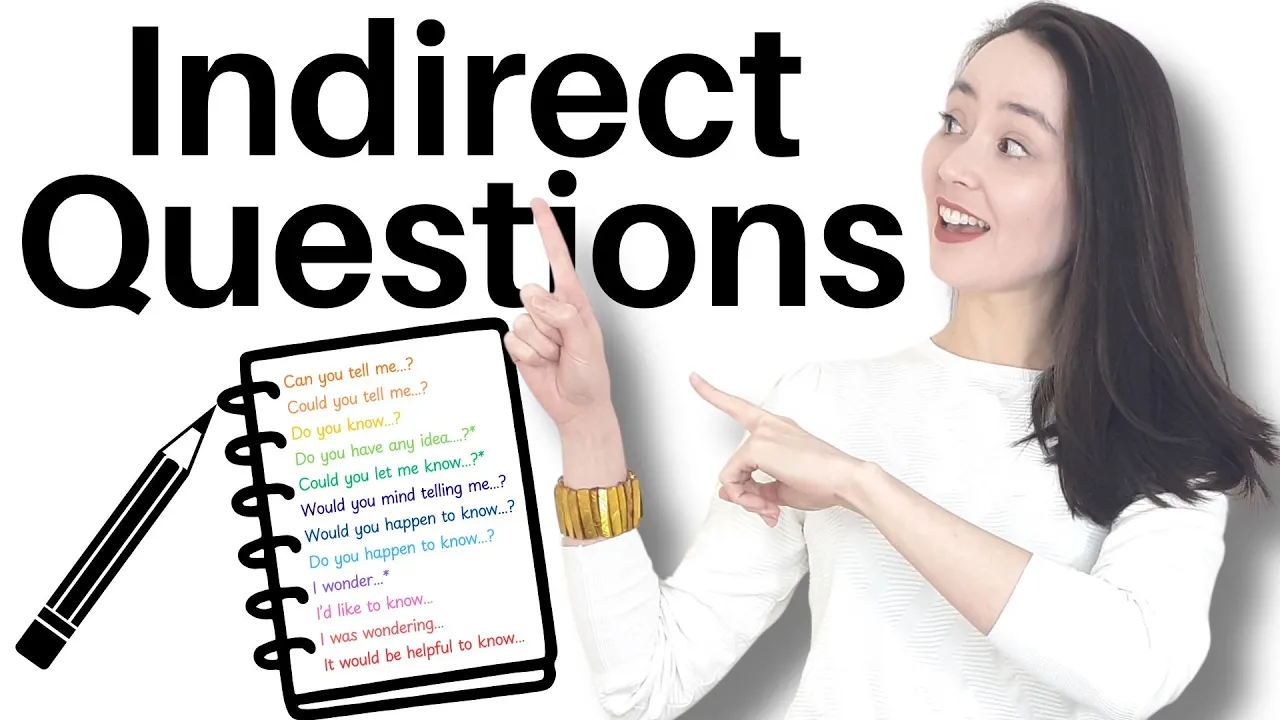
You need a question introduction and one of the question types we looked at earlier. And I have good news: these are set phrases. What I mean is that you need to memorize these question introductions.
Sometimes memorizing things is much better and easier than learning rules. And these are all very common. Yep—we’re going to go through each one.
And I’m going to give you lots of examples. I’m going to start with WH questions. But first—do you want the notes for today’s lesson?
Join Gravotion, my fast-growing platform where grammar, vocabulary, and emotion meet. Download the notes for today’s lesson, plus hundreds of other PDFs ready to use. You’ll also get access to my complete grammar course roadmap—so you’ll never wonder: "How do I learn grammar?
Where do I start? " And the best part: the community. Join and connect with English learners from all around the world—just like you.
Write Gravotion in the comments, and I’ll personally send you a link to join. Let’s get back to the lesson. Direct: "Where can I find an ATM?
" An ATM is a cash machine. Indirect question: "Can you tell me where I can find an ATM? " "Could you tell me where I can find an ATM?
" Question introduction + your WH word + subject first, then the verbs. You can see: in direct questions, we always have the verb before the subject. In indirect questions, the verb goes after the subject—like a normal sentence.
Common mistake: "Could you tell me where can I find an ATM? " → No. Remember: in indirect questions, it’s subject then verb—like a normal sentence.
If you can remember this rule, you got it. This will be easy. Direct: "Who has Yvonne spoken to?
" Indirect: "Do you know who Yvonne has spoken to? " "Do you happen to know who Yvonne has spoken to? " "Would you happen to know who Yvonne has spoken to?
" You can see there are lots of possibilities—and that structure never changes. Question introduction + WH word + subject + then the verbs. Direct: "Excuse me, how do I pay for parking?
I don’t see a machine or any information anywhere. " Indirect: "Excuse me, would you mind telling me how I pay for parking? " And I want to clarify one thing: direct questions are not rude.
You can use direct questions. You know, tone of voice is often more important than grammar. But usually, when you’re speaking to someone you don’t know, when you’re just being polite day-to-day, indirect questions are the better choice.
Hmm—do you notice anything different about this question? Right—grammar rule: we do not use auxiliary verbs do, does, or did in indirect questions. We do not say: "Would you mind telling me how I do pay for parking?
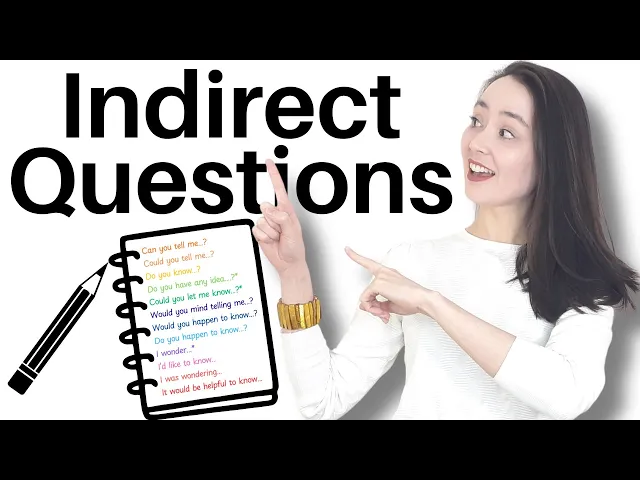
" Let’s get specific. You can see I have an asterisk by these two questions. In English, the little star is called an asterisk.
Asterisk. Asterisk. Do you have any idea?
Often gives a feeling of frustration or being annoyed: "Do you have any idea what time it is? You are so late. " "Do you have any idea how long I’ve been working on this project?
" You can see these people feel either frustrated or annoyed—but not always. Sometimes it is neutral: "Do you have any idea when Paige will be back in her office? " Could you let me know?
also has an asterisk. This question usually means could you tell me later—could you tell me when you have more information? It’s not about right now: "Could you let me know when Paige is back in her office?
" "Could you let me know how you did on your test? " These things are for the future—but here I see did. We can’t use do, does, did, right?
Here, did is the main verb, not the auxiliary—so it’s okay. Now, these three at the bottom—you can see they’re not actually questions, but we can still use them when we are asking for information. The same grammar rules apply: Direct: "Why was my appointment cancelled?
" Indirect: "I’d like to know why my appointment was cancelled. " "I was wondering why my appointment was cancelled. " "It would be helpful to know why my appointment was cancelled.
" Okay, again we see that asterisk with "I wonder". This is usually a question for ourselves—we are not asking someone else for information: "I wonder who called me earlier—they didn’t leave a message. " "Hmm, I wonder if it’s going to rain later.
" "I wonder how many balloons it would take to lift me. " WH questions done. Now I’m going to do be questions and yes/no questions together—because they both ask for a yes or no answer.
But here the grammar changes—it’s different. Direct: "Is this road closed? " Indirect: "Could you tell me if/whether this road is closed?
" Question introduction + if or whether + subject + then your verbs. With yes/no questions, we need if or whether. If is more common, whether is more formal—but both are fine.
Direct: "Was Violet given a promotion? " Indirect: "Do you happen to know if/whether Violet was given a promotion? " Direct: "Is there garlic in this sauce?
" Indirect: "Would you happen to know if/whether there is garlic in this sauce? " Direct: "Did you receive an email about our shifts changing? " A shift is a period of time you work—like if you work the night shift, maybe your hours are from 7:00 p.
m. to 5 a. m.
Indirect: "I was wondering if/whether you received an email about our shifts changing. " Direct: "Will the landlord pay for the damage, or will I? " Indirect: "It would be helpful to know if/whether the landlord will pay for the damage or if I will.
" Okay, I have one final point for today. Let me bring up two examples we just looked at. We often use "whether" and "not" together.
We don’t use "if" in this case: "Do you happen to know whether Violet was given a promotion? " "Do you happen to know whether or not Violet was given a promotion? " "Do you happen to know whether Violet was given a promotion or not?
" All three are perfect. Original: "I was wondering whether you received an email about our shifts changing. " Option one: "I was wondering whether or not you received an email about our shifts changing.
" Option two: "I was wondering whether you received an email about our shifts changing or not. " Okay—that felt kind of long, right? Many times option one is better for long sentences—because otherwise "whether" and "or not" are really far apart.
How are you feeling? Do you feel better about indirect questions? I really hope this lesson helped you.
And if you would like the notes, a practice worksheet—join Gravotion. This will all be on my platform. Thank you so much for watching.
I really appreciate you being here, and I can’t wait to make another video for you. Thank you so much. See you next time.
Bye.