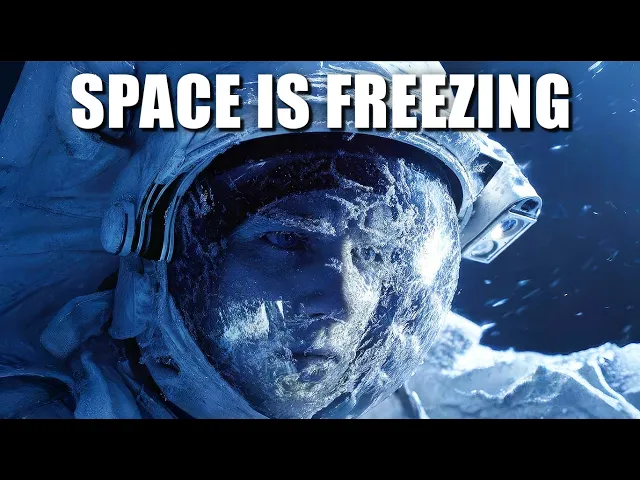
Right now, the space between the stars surrounding you sits at a temperature of -454° F. That is just a few degrees above the coldest anything can ever be. Scientists confirm that the average temperature of the universe hovers at 2.7 Kelvin, a number set by the fading afterglow of the Big Bang itself. But here is what most people get wrong. Space is not cold the way winter is cold. There is no Frozen air, no icy wind, no chill you could feel on your skin. The cold of space is something far stranger and far more terrifying. It
is the absence of almost everything. Heat, matter, energy, and it dominates 99% of all existence. If you enjoy journeys that completely reshape how you see the universe, do me a small favor and hit that like button and subscribe. It genuinely helps this channel grow and lets me keep making these deep dives for you. Make yourself Warm and comfortable as we journey together to find out just how cold space really is. Let's begin. Ask anyone how cold space is and they will give you an answer without hesitation. Freezing. Absolute zero. Colder than anything on Earth. They
will say it with confidence because the answer feels obvious. Space is dark, empty, and lifeless. Of course, it is cold. But that confident answer is wrong. Not slightly wrong, fundamentally Wrong. The question itself contains a hidden trap that most people never notice. And the real answer is so much stranger and more unsettling than a simple number on a thermometer. Understanding why requires dismantling everything you think you know about temperature, cold, and the nature of emptiness itself. Because the universe does not work the way your intuition tells you it does. Not even close. The misconception runs
so deep that even Educated people carry it around without questioning it. Students learn that space is cold. Documentaries describe the freezing void between galaxies. Science fiction films show astronauts flash freezing when exposed to vacuum. All of this reinforces an image that is at best a dramatic oversimplification and at worst completely misleading. The actual physics of temperature in a vacuum is one of the most counterintuitive topics in all of Science. And getting it right changes how you understand everything from spacecraft design to the fate of the universe itself. Here is the problem. When you say something
is cold, you are describing a sensation. You are talking about heat leaving your body and entering the surrounding environment. Step outside on a January night in Minnesota and the air attacks you. Molecules of nitrogen and oxygen slam into your skin billions of times per Second. Each collision stealing a tiny fraction of your body heat. Your nerve endings register this energy loss and send a signal to your brain. cold. That experience is so universal, so deeply wired into human biology that we assume it describes a property of the environment itself. We say the air is cold.
We say the water is cold. We say the metal railing is cold. But what we really mean is that those substances are conducting heat away from our bodies Faster than we can replace it. Cold is not a thing. Cold is the absence of a thing. It is what happens when energy leaves. This distinction matters enormously because it exposes a flaw in how we frame the question about space. We ask how cold is space as though space were a substance with a measurable temperature. Like asking how cold is the ocean or how cold is the arctic
wind. But space is not a substance. The vacuum between stars is not filled with cold Stuff. It is filled with almost nothing at all. Now remove the air. Remove the water. Remove every molecule of gas, every particle of dust, every atom of matter for millions of miles in every direction. You are floating in the vacuum of deep space. Nothing touches your skin. No molecules collide with your body. No substance exists to steal your heat through contact. So what temperature is it? The answer is that the question barely makes sense. Temperature in the way humans experience
it requires matter. It is a measurement of how fast particles move. In a gas, temperature describes the average kinetic energy of molecules bouncing around in random directions. Hotter gas means faster molecules. Cooler gas means slower ones. When those molecules hit your skin, the fast ones transfer more energy than the slow ones. That is why hot air feels hot and cold air feels cold. It is a story about motion and Collision at the atomic level. It is a story that requires actors on a stage. In space, the stage is almost completely empty. In the vacuum of
space, there are no molecules or more precisely, there are so few molecules that the concept of temperature becomes almost meaningless in the traditional sense. A cm of air at sea level on Earth contains roughly 25 billion billion molecules. That is 25 followed by 18 zeros. Every breath you take pulls in this Inconceivable swarm of particles. A cubic cm of interstellar space might contain a single atom, maybe less. The density is so extraordinarily low that calling it a gas stretches the definition beyond recognition. You could not measure its temperature with any conventional thermometer because there is
simply not enough matter present to transfer energy to the instrument in any detectable way. This is the first crack in the common understanding. Space is Not cold the way a freezer is cold. A freezer is full of cold air. Cold molecules. They press against everything inside, draining heat through direct contact. Space has almost nothing to press against you at all. If you placed a thermometer in deep space, far from any star or planet, it would not read the temperature of space. It would read its own temperature. And that temperature would depend entirely on what radiation
the thermometer was Absorbing and emitting. The instrument becomes the subject of its own measurement. It tells you about itself, not about the void surrounding it. This brings us to the crucial distinction that most people never learn. There are three ways heat moves from one place to another, and understanding all three is essential to understanding why the temperature of space is such a strange and complicated question. The first mechanism is conduction. Place your hand On a metal countertop and heat flows directly from your warmer skin into the cooler metal through physical contact. Molecules in your hand
vibrate and transfer that vibration to molecules in the metal surface. This is the most intuitive form of heat transfer. It requires two objects touching each other and it requires both objects to be made of matter. Metal feels colder than wood at the same temperature because metal conducts heat away from your hand more Efficiently. Your brain interprets faster energy loss as colder temperature even though both surfaces are identical in actual thermal measurement. In space, conduction is essentially irrelevant. There is nothing to touch. No surface presses against you. No material exists to carry heat away through contact.
The second mechanism is convection. Turn on a space heater in your living room and warm air rises toward the ceiling while cool air sinks toward the floor. This Circulation pattern distributes heat through the movement of fluid, whether that fluid is air, water, or any other substance that can flow. Convection is what makes weather possible on Earth. It drives ocean currents, stirs the atmosphere, and carries heat from the equator toward the poles. It is why a breeze feels cooling on a hot day and why a fan makes a room feel more comfortable even though it does
not actually change the air temperature. Convection depends on density differences in a fluid medium and fluids require matter in space. Convection does not exist. There is no fluid to circulate, no air to rise or sink, no currents to carry warmth from one region to another. The void is still and empty beyond anything human experience can approximate. The third mechanism is radiation. Every object with a temperature above absolute zero emits electromagnetic radiation. Your body Radiates infrared light right now invisibly, constantly streaming energy outward in every direction. The walls of the room around you radiate infrared light
back. The sun radiates visible light, ultraviolet light, infrared light, and radiation across a wide swath of the electromagnetic spectrum. This radiation carries energy through empty space without needing any medium to travel through. It moves at the speed of light and can cross billions of miles of Perfect vacuum without losing a single photon to friction or resistance. Unlike conduction and convection, radiation does not need matter. It travels through nothingness as naturally as sound travels through air. Radiation is the only mechanism of heat transfer that operates in the vacuum of space. And this single fact changes everything
about how temperature works beyond Earth's atmosphere. It means that the thermal experience of any object in Space is determined not by what surrounds it, but by what shines on it and what it emits. The void itself contributes nothing. It neither warms nor cools. It simply allows radiation to pass through without interference. Consider an astronaut performing a spacew walk in low Earth orbit. The sun is shining. On the sunlit side of the astronaut's suit, solar radiation pours in at roughly 1,360 W per square meter. That is Approximately the energy equivalent of running a small space heater
pressed against every square meter of illuminated surface. The suit heats up. Without active cooling systems, the surface temperature on the sunlit side can climb past 120° C. Hot enough to boil water. Hot enough to cause severe burns on unprotected skin. The astronaut's suit becomes an oven on one side, baked by the unfiltered fury of a star 93 million Miles away. Now, consider the shadowed side of that same astronaut. The side facing away from the sun receives no direct solar radiation. It radiates its own heat into the void as infrared photons streaming away into the darkness.
With no sunlight coming in and thermal energy constantly leaving, the shadowed surface drops. In the permanent shadow of space, surface temperatures can plunge below -100°. Some measurements in deep shadow show Temperatures approaching -170° C. Cold enough to turn carbon dioxide into dry ice. Cold enough to make steel brittle and crack under stress. Cold enough to freeze human tissue solid in minutes. This means that a single astronaut floating in orbit experiences a temperature difference of nearly 300° from one side of their body to the other. Not because space has two different temperatures in those two directions.
Space has no temperature at All in that region. At least not in the way we normally use the word. The astronaut is simply caught between a powerful radiation source on one side and the absence of any radiation source on the other. The suit responds to radiation, not to the temperature of some surrounding medium because there is no surrounding medium to speak of. This is what makes the thermal environment of space so alien and so dangerous. On Earth, air acts as a buffer. It smooths Out temperature differences. Step from sunlight into shade on a summer afternoon,
and the air temperature barely changes, perhaps a degree or two at most. The molecules surrounding you are roughly the same temperature whether the sun hits them directly or not. Because convection mixes the air constantly, wind carries warm air into cool shadows, rising thermals lift heated surface air upward and pull cooler air down. The atmosphere acts as An enormous thermal blanket that redistributes energy and softens every extreme. In space, there is no buffer, no mixing, no smoothing, no blanket. Radiation creates savage thermal gradients across distances as small as the width of a human body. The moon
offers one of the most dramatic demonstrations of this principle anywhere in the solar system. The lunar surface has no atmosphere, no air whatsoever. Not a single molecule of Protective gas stands between the ground and the void above it. When the sun shines on the moon's equator during the roughly 2 week long lunar day, the surface heats to approximately 127° C. That is hotter than boiling water, hotter than the maximum setting on most household ovens. The regalith bakes under direct solar radiation with nothing to moderate the input. When that same surface rotates into the 2 week
long lunar night, it cools to Approximately -173°. a swing of 300° on the same patch of ground driven entirely by the presence or absence of sunlight. Earth's surface, protected by its atmosphere, experiences temperature swings of perhaps 50 or 60° between the hottest day and the coldest night in the most extreme desert environments. The moon's swings are five to six times more violent entirely because there is no air to moderate the transition. The atmosphere Earth takes For granted performs a thermal service so profound that removing it transforms a planetary surface into a landscape of killing extremes.
But even the moon's temperature extremes tell us only about the lunar surface. They do not tell us the temperature of the space above that surface. A thermometer hovering 1 m above the sunlit moon would register a completely different temperature than the ground below it. Because the thermometer would be absorbing radiation From the sun directly and also absorbing infrared radiation emitted upward from the hot ground, it would simultaneously be radiating its own heat into space. Its reading would depend on its size, its color, its reflectivity, its orientation relative to the sun, and its distance from the
surface. change any one of those properties and the reading changes entirely. The space itself has no temperature to report. Only the objects within it do. Temperature is a Property of matter and where there is no matter the concept dissolves into abstraction. This is why engineers who design spacecraft do not think about the temperature of space. They think about thermal balance. Every spacecraft is simultaneously absorbing radiation from the sun. absorbing radiation reflected off nearby planets and moons, absorbing the faint infrared glow of the cosmic background and radiating its own thermal energy into the void. The spacecraft's
Temperature is determined by the balance between energy coming in and energy going out. When those two quantities are equal, the temperature stabilizes. If more energy comes in than goes out, the spacecraft heats up. If more energy goes out than comes in, it cools down. Managing this balance is one of the most critical engineering challenges of space flight and it has been since the earliest days of the space age. Spacecraft engineers achieve thermal Balance through a combination of multi-layer insulation, reflective coatings, electric heaters, and radiator panels. The International Space Station uses enormous radiator arrays spanning roughly
2,500 square ft to dump excess heat into space. Without these radiators, the station would overheat from its own electrical systems and the absorbed solar radiation. The six crew members aboard generate body heat. The computers generate heat. The lighting Generates heat. Every experiment running in the laboratory modules generates heat. All of this thermal energy builds up inside a sealed metal container floating in a vacuum with no air to carry the heat away. The radiators solve this by facing away from the sun and emitting infrared radiation into the cold void. They are the station's only exhaust vents.
Without them, the interior temperature would climb until equipment failed and survival became Impossible. Simultaneously, shadowed components on the station require electric heaters to prevent them from freezing. Batteries that sit in the station's shadow for extended periods must be kept above certain minimum temperatures or their chemistry stops working. Fuel lines can freeze solid. Optical instruments can crack from thermal contraction. Seals can become brittle and lose integrity. The station exists in a constant battle between Roasting and freezing, managed by systems that carefully control which surfaces face the sun and how efficiently heat is rejected into the void.
Flight controllers on the ground monitor thermal data continuously, adjusting the station's orientation and activating or deactivating heaters as conditions change throughout each 90-minute orbit. The thermal environment is not a background concern. It is one of the primary threats to crew safety And mission success on every single day the station operates. This thermal management challenge reveals something important about the nature of cold in space. The danger is not that space is uniformly frigid. The danger is that space does not care about your temperature at all. It provides no insulation, no buffering, no moderation. Whatever radiation you
receive determines whether you bake or freeze. And the transition from one extreme to The other can occur across inches. Shadows in space are not gentle cool spots like shadows on Earth. They are thermal cliffs. Step from sunlight into shadow in orbit and your thermal environment changes by hundreds of degrees in the time it takes to cross the boundary. There is no gradient, no gentle transition zone. One side of a bolt on the station exterior can be scorching while the other side is frozen, separated by less than a Centimeter of metal. This indifference extends in every
direction and at every scale. The vacuum of space is not trying to freeze you. It is not pulling heat out of your body the way cold air does on a winter day. Cold air actively steals your warmth through conduction and convection. Every gust accelerates the energy loss. The windchill effect exists because moving air strips heat away faster than still air. Space has no wind, no chill factor. It is simply Doing nothing at all. It offers no resistance, no warmth, no cold. It is thermally empty. Your body radiates heat into it because your body is warmer
than the void. And nothing in the void replaces that lost energy unless a radiation source happens to be shining on you. The cold of space is not an assault. It is an abandonment. It is the universe turning its back and leaving you to your own thermal fate. Now consider what this means at larger Scales. Forget astronauts and spacecraft for a moment. Think about the spaces between stars. In our region of the Milky Way, the average distance between neighboring stars is roughly 4 light years. That is approximately 24 trillion miles of vacuum separating one sun from
the next. 24 trillion miles where no significant radiation source exists to warm anything. The starlight from distant suns is so diluted by distance that it contributes almost nothing. The Inverse square law ensures that radiation intensity drops with the square of the distance from its source. Double your distance from a star and the radiation hitting you drops to one quarter. Triple the distance and it drops to 1 nth. At four light years from the nearest sun, the radiation from that star is so faint it would barely register on the most sensitive instruments ever built. Any object
drifting through that interstellar void, A rogue planet ejected from its solar system, a chunk of ice flung outward by a gravitational encounter, even a spacecraft traveling between the stars, would slowly radiate away its own heat, photon by photon, with almost nothing coming in to replace the lost energy. How cold would such an object get? It would cool and cool and cool, shedding thermal energy into the darkness. With each passing year, its temperature would drop past the freezing point of water, Past the freezing point of carbon dioxide, past the boiling point of liquid nitrogen, down and
down through the temperature scale, toward a floor that it can approach, but never quite reach on its own. That floor is set by the only source of radiation that permeates all of space everywhere in the universe without exception. The faintest, most ancient light in existence. A glow so dim that no human eye could ever detect it. Yet so Perfectly uniform that it fills every cubic cm of the cosmos. This is the cosmic microwave background radiation and it sets the fundamental temperature floor for the entire universe. Any object left alone in deep space, far from any
star, far from any galaxy, shielded from every local radiation source, will eventually cool down until it reaches thermal equilibrium with this cosmic background glow. At that point, the object absorbs exactly as much Energy from the background radiation as it emits through its own thermal radiation. Its temperature stabilizes. It stops cooling. And the temperature it settles at is approximately 2.7 Kelvin. That is 2.7° above absolute 0 -270.45° C. -454.8 1° F. 2.7 Kelvin is the closest thing the universe has to a baseline temperature. It is not truly the temperature of space itself because space is a
vacuum and vacuums do not Possess temperature in the strict thermodynamic sense. It is the temperature that any object will eventually reach if left alone in the void with no other energy sources. It is the equilibrium point, the resting state, the thermal default of the cosmos. And it is almost as cold as anything can possibly be. Absolute 0 Kelvin is the theoretical point where all thermal motion ceases. Atoms stop vibrating. Molecules freeze in place. Energy reaches its lowest possible quantum state. No physical process in nature has ever achieved absolute zero. And the third law of thermodynamics
states that reaching it precisely requires an infinite number of steps and is therefore impossible. Even the most advanced cryogenic laboratories on Earth, facilities that cool atoms to billionths of a degree above absolute zero using laser cooling and magnetic traps, cannot reach true zero. The Universe itself cannot reach it. But 2.7 Kelvin sits so close to that absolute boundary that the difference is almost negligible on any human scale thermometer. The universe's baseline temperature hovers just a breath above the coldest condition that physics permits. On a thermometer that runs from absolute zero to the surface temperature of
the sun, 2.7 Kelvin would be indistinguishable from zero. The cosmic baseline sits that close to the bottom. To appreciate how extreme this is, consider familiar cryogenic benchmarks. Liquid nitrogen, the substance scientists use to flash freeze biological samples and shatter roses on television, boils at 77 Kelvin. The cosmic background temperature is roughly 29 times colder than liquid nitrogen. Liquid helium, the coldest commonly used cryogenic fluid on Earth, boils at 4.2 Kelvin. The baseline temperature of the universe is colder even than liquid Helium. The only way to reach 2.7 Kelvin in a laboratory is through specialized cryogenic
equipment that costs millions of dollars and consumes enormous amounts of energy to maintain. The universe achieves it effortlessly, passively across almost its entire volume simply by being empty. On Earth, the coldest temperature ever recorded in nature was89.2° 2° C at the Soviet Vosto station in Antarctica on July 21st, 1983. That translates to approximately 184 Kelvin. Brutal cold. Lethal cold. Cold that freezes exposed flesh in seconds and makes breathing feel like inhaling shards of ice. The universe's background temperature is roughly 68 times colder than that Antarctic record. The comparison strips the horror from Earth's most extreme
cold. What humans consider the absolute worst that our planet's climate can produce is practically barmy compared to the Thermal baseline of the cosmos. Our coldest nightmare is the universe's room temperature. The difference in scale is not merely large. It is so extreme that the human experience of cold becomes irrelevant as a reference point for cosmic thermal conditions. Yet this number alone does not convey the full picture. 2.7 Kelvin is an average, a background, a floor. It tells you what the universe defaults to when nothing interesting is happening nearby. But the Universe is not uniform. It
contains stars burning at tens of millions of degrees in their cores and molecular clouds hovering at 10 or 20 Kelvin and accretion discs around black holes screaming past a billion degrees and glowing nebula at thousands of degrees and planetary surfaces at every temperature in between. The thermal landscape of the cosmos is not a flat plane at 2.7 Kelvin. It is a terrain of staggering extremes with towering peaks Of unimaginable heat separated by vast frozen valleys that stretch for millions of light years in every direction. The question is not simply how cold space is. The question
is how much of space exists at that killing cold versus how much of it is warm enough to matter. And the answer to that question is where the real terror begins. Because the warm parts, the stars and the planets and the glowing clouds of gas are exceptions. Rare scattered isolated exceptions Floating in an ocean of near absolute cold. The warmth is not the rule. The cold is the rule. It is the default condition of almost everything that exists in this universe. But before we can fully grasp why the cold dominates so completely, we need to
understand where that 2.7 Kelvin background came from. It did not appear by accident. It was not always this cold. The temperature of the universe has been falling since the moment of creation. And the story of that cooling is the story of cosmic history itself. It begins nearly 14 billion years ago in the first moments after the Big Bang when the entire observable universe was hotter than the core of any star that has ever existed. What happened to all that heat, where it went, and why so little of it remains reveals something extraordinary about the cosmos
we inhabit. Roughly 13.8 billion years ago, the universe did not exist. There was no Space, no time, no matter, no energy in any form that current physics can describe. Then something happened. The event we call the Big Bang was not an explosion in space. It was an explosion of space. Space itself came into being and immediately began expanding, carrying with it densities and temperatures so extreme that no laboratory on Earth has ever come close to reproducing them. In the first fraction of a second, the entire Observable universe, everything you can see through the most powerful
telescope ever built, occupied a volume smaller than a single atom. The temperature in that primordial instant exceeded 10 trillion trillion degrees, a number so absurd it has no analog in human experience. Every particle of matter and energy that would eventually become galaxies, stars, planets, oceans, and living organisms was compressed into a seething point of incomprehensible heat. That heat is where the story of cosmic cold begins because the universe has been cooling ever since. In the first second after the big bang, the temperature dropped from trillions of degrees to roughly 10 billion°. That sounds like catastrophic
cooling, and it was. But 10 billion degrees is still hotter than the core of the most massive stars. The universe at 1 second old was a blinding plasma of protons, neutrons, electrons, photons, and Neutrinos, all slamming into each other with energies that would vaporize anything in the modern cosmos. Matter and radiation were locked together in a violent embrace. Photons could not travel more than a microscopic distance before colliding with a charged particle. and scattering in a random direction. The universe was opaque. Light existed everywhere but could go nowhere. Every direction was a wall of blazing
fog. During the first 3 minutes, The temperature fell below 1 billion°, cool enough for protons and neutrons to begin fusing into the lightest atomic nuclei. Hydrogen nuclei formed naturally since they are just individual protons. Dutyium appeared when protons and neutrons stuck together. Helium nuclei assembled from pairs of protons and pairs of neutrons. Tiny amounts of lithium emerged from slightly more complex reactions. This process, called big bang nucleiosynthesis, Lasted only a few minutes. By the time the universe was roughly 20 minutes old, the temperature had dropped too low for nuclear fusion to continue. The window closed.
The cosmic forge shut down. The ratio of hydrogen to helium was locked in at approximately 75% hydrogen and 25% helium by mass. A ratio that observations of the oldest stars confirm with striking precision. But the universe was still extraordinarily hot. For hundreds of thousands of years after The Big Bang, temperatures remained above 3,000°. That is roughly the temperature of a blast furnace. hot enough to keep all matter in a plasma state where electrons roam freely rather than binding to atomic nuclei. Free electrons are phenomenally effective at scattering photons. Every time a photon encountered a free
electron, it bounced off in a new direction. Light was trapped, ricocheting through the plasma like a Ball in a pinball machine with an infinite number of bumpers. Information could not travel through this fog. No structure could be seen. The universe was a uniform, glowing, opaque haze stretching in all directions. Then, approximately 380,000 years after the Big Bang, the universe crossed a critical threshold. The temperature dropped below roughly 3,000 Kelvin. At this point, something remarkable happened. Electrons finally lost enough Energy to be captured by atomic nuclei. Protons grabbed electrons and became neutral hydrogen atoms. Helium nuclei
captured their own electrons. For the first time in cosmic history, matter became electrically neutral. Physicists call this event recombination. Though the name is slightly misleading because it implies the electrons and nuclei had been combined before. They had not. This was the first time atoms formed in the history of the universe. The Consequences were immediate and dramatic. Neutral atoms do not scatter photons the way free electrons do. When the electrons disappeared into atoms, the universe suddenly became transparent. The photons that had been trapped for hundreds of thousands of years were released all at once, free to
travel in straight lines across the cosmos for the first time. This liberation of light is called the surface of last scattering, and it Represents the oldest electromagnetic signal the universe will ever produce. Every photon released at that moment has been traveling through space ever since, carrying information about the conditions that existed when the universe was less than 1% of its current age. Those photons are still traveling today. They fill every cubic cm of the observable universe. They arrive at Earth from every direction in the sky. An omnipresent bath of ancient radiation That has been streaming
through the cosmos for nearly 13.8 billion years. This is the cosmic microwave background. But those photons do not arrive in the same form they were released. When they left the surface of last scattering, they were visible light. Orange red photons glowing at roughly 3,000 Kelvin, the temperature of a cooling star. If you could have been present at the moment of recombination and somehow survived the conditions, the entire sky In every direction would have glowed a deep dull red. There would have been no darkness anywhere. No shadows, no contrast, just a uniform dim red glow extending
to infinity. Since that moment, the universe has expanded by a factor of roughly 1,100. Space itself has stretched and every photon traveling through it has been stretched along with it. This stretching increases the wavelength of light. Longer wavelengths mean lower energy. Lower energy means lower temperature. The original visible light photons from recombination have been stretched so severely over billions of years that they now exist as microwaves. Their wavelength has increased from less than a micrometer to over a millimeter. Their effective temperature has dropped from 3,000 Kelvin to just 2.725 Kelvin. The entire sky still glows
just as it did at recombination, but the glow has been shifted so far into the Microwave spectrum that no biological eye in the universe could ever detect it. The cosmic microwave background is the afterglow of creation, dimmed and stretched by the expansion of space until it became invisible to everything except purpose-built instruments. The discovery of this radiation is one of the great accidental triumphs in the history of science. In 1964, two radio astronomers at Bell Telephone Laboratories in Hol, New Jersey were Trying to use a large horn-shaped antenna for satellite communication experiments. Ano Pensas and
Robert Wilson were meticulous scientists. They wanted their antenna to be as sensitive as possible, which meant eliminating every source of unwanted noise. They calibrated their equipment carefully. They accounted for radio interference from nearby New York City. They pointed the antenna away from known astronomical sources. They even climbed inside the Horn and scraped out pigeon droppings, suspecting the birds nesting in the antenna might be contributing thermal noise to their signal. Nothing worked. No matter what they did, a faint persistent hiss remained in their data. It came from every direction equally. It did not change with the
time of day. It did not change with the season. It did not change when they pointed the antenna at different parts of the sky. The noise was perfectly uniform, perfectly Constant, and perfectly inexplicable by any terrestrial source they could identify. The signal corresponded to a thermal source at roughly 3.5 Kelvin, just a few degrees above absolute zero. Pensas and Wilson were puzzled, but did not immediately understand what they had found. They spent months searching for an explanation. They had not been looking for cosmological signals. They were communications engineers trying to build a better antenna, not
cosmologists Hunting for the origins of the universe. The connection between their mysterious noise and the origin of the universe came from a group of theoretical physicists, working just 40 m away at Princeton University. Robert Dick, Jim Peebles, and their colleagues had independently predicted that the Big Bang should have left behind a faint thermal radiation filling all of space. They were in the process of building their own antenna to search for this Signal when they learned that Pensas and Wilson had already detected it by accident. The realization was electrifying. The persistent hiss in the Bell Lab's
antenna was not instrument noise. It was not pigeon droppings. It was not radio interference from human activity. It was the remnant heat of the big bang itself, the oldest light in the universe. Arriving at a radio antenna in New Jersey after a journey spanning nearly the entire history of cosmic Time. Pensas and Wilson had stumbled onto the most important cosmological discovery since Edwin Hubble proved the universe was expanding. They received the Nobel Prize in physics in 1978. The initial measurement was crude by modern standards. Pensas and Wilson determined the temperature to be approximately 3.5 Kelvin
with significant uncertainty. But the discovery opened a floodgate. Over the following decades, increasingly Sophisticated instruments refined the measurement with extraordinary precision. The first major leap came with the cosmic background explorer satellite known as Cove. Launched by NASA in 1989, COBE carried instruments designed specifically to measure the cosmic microwave background with far greater accuracy than groundbased antennas could achieve. Earth's atmosphere absorbs and emits microwaves, contaminating groundbased measurements. A satellite above the atmosphere eliminates this problem entirely. COBE produced two groundbreaking results. First, it measured the spectrum of the cosmic microwave background and found that it matched the
theoretical prediction for a perfect black body radiator with extraordinary precision. A black body is an idealized object that absorbs all incoming radiation and emits energy in a very specific pattern determined entirely by its temperature. The spectrum measured by Cove fit the black body curve so precisely that the data points were indistinguishable from the theoretical line. This was the most perfect black body spectrum ever measured in nature, confirming that the radiation originated from a hot, dense, uniform early universe, exactly as big bang theory predicted. The temperature was pinned down to 2.725 Kelvin with an uncertainty of
less than 1,000th of a degree. Cob's second result Was even more significant. The satellite detected tiny temperature fluctuations in the cosmic microwave background. The radiation was not perfectly uniform. Some directions in the sky were a few hundred,000 of a degree warmer than average. Others were a few hundred thousand of a degree cooler. These variations were minuscule, roughly one part in 100,000, but their existence was revolutionary. They represented the primordial density differences in the Early universe. The seeds from which all cosmic structure would eventually grow. Regions that were slightly warmer at recombination were also slightly denser.
Those denser regions had marginally stronger gravitational pull. Over billions of years, that tiny gravitational advantage would attract surrounding matter, growing denser and denser until galaxies, galaxy clusters, and the entire cosmic web condensed out of the initial smoothness. The Fluctuations in the cosmic microwave background are the fingerprints of quantum mechanics writ large across the sky. During the first fraction of a second after the Big Bang, quantum fluctuations, the inherent randomness of energy at subatomic scales created microscopic variations in density. The period of rapid expansion called inflation then stretched these quantum scale ripples to cosmic dimensions. What
started as uncertainties smaller than an Atom became density variations spanning millions of light years. The cosmic microwave background preserves a snapshot of those amplified quantum ripples frozen at the moment recombination made the universe transparent. After COBE, two more satellite missions pushed the measurements even further. The Wilkinson Microwave Anisotropy Probe known as WAP launched in 2001 and mapped the cosmic microwave background with roughly 35 Times the angular resolution of Cove. W map could distinguish temperature variations on scales as small as a fraction of a degree on the sky, revealing the detailed structure of primordial density fluctuations.
The map it produced looks like an oval covered in splotches of slightly different colors. Warm spots in red and orange, cool spots in blue and green. This map has been called the baby picture of the universe. It shows the cosmos as it Appeared at 380,000 years old. Billions of years before the first stars ignited, WAP determined the age of the universe with unprecedented precision, establishing 13.7 7 billion years. It confirmed that ordinary matter, the atoms that make up stars, planets, and human beings, constitutes only about 4.6% of the total energy content of the cosmos. Dark
matter accounts for roughly 23%. Dark energy, the mysterious force Accelerating cosmic expansion, makes up the remaining 72%. These numbers, extracted from the patterns in ancient microwave radiation, form the foundation of modern cosmology. Nearly everything we know about the large-scale properties of the universe comes from studying this faint cold glow. The European Space Ay's Plank satellite, launched in 2009, refined the measurements further. Still plank observed the cosmic microwave background At nine different frequency bands with angular resolution and sensitivity that surpassed W map by another significant factor. The resulting maps are the most detailed images of the
early universe ever produced. Plank refined the age of the universe to 13.798 billion years. It confirmed the background temperature first pinned down by Cob's Firus instrument at 2.725 Kelvin and mapped the tiny fluctuations around that average with unprecedented Angular precision. It measured the proportions of ordinary matter, dark matter, and dark energy with percent level precision. And it revealed subtle patterns in the fluctuations that constrain theories about what happened during the first trillionth of a trillionth of a second after the Big Bang. Three satellite missions spanning two decades transformed the cosmic microwave background from a crude
detection into the single most Informative observation in all of cosmology. A faint hiss that annoyed two radio engineers in 1964 became the Rosetta stone of the universe. But what does all of this mean for the temperature of space? It means that the 2.7 Kelvin baseline is not just a number. It is a fossil. A thermal relic of a moment when the universe was young, hot, and glowing. Every photon in the cosmic microwave background has been traveling since recombination. Each one carries a tiny packet of energy from an era when the cosmos was 3,000° everywhere. Those
photons have lost almost all of their energy to the expansion of space. They have been stretched, diluted, cooled from incandescent to microwaves over 13.8 8 billion years of cosmic evolution. The 2.7 Kelvin we measure today is the exhausted remnant of a once blazing universe. And the cooling is not over. The universe continues to expand. As it Does, the cosmic microwave background continues to stretch and cool. Every day, the background temperature drops by an infinite decimal amount. In the far future, billions of years from now, the temperature will be lower still. A universe twice its current
size will have a background temperature of roughly 1.4 Kelvin. A universe 10 times larger will glow at just 0.3 Kelvin. The cosmic microwave background is a dying ember, slowly fading toward a darkness that Will never quite become absolute, but we'll approach it as over cosmic time scales that dwarf the current age of the universe. many times over. This ongoing cooling reveals something critical about the thermal history of the cosmos. The universe was born hot, unimaginably hot. Every point in space was once a furnace that would have obliterated any structure, any molecule, any atom. But that
heat was not permanent. It was a burst of initial energy that has been Diluting ever since. The expansion of space acts as a cosmic refrigerator, stretching radiation to longer wavelengths and lower energies with every passing moment. The universe does not produce new heat on a cosmic scale. Stars generate heat locally, but they do so by converting matter into energy, a process that will eventually exhaust all available fuel. The total thermal budget of the cosmos was set at the Big Bang and has been declining ever since. Think Of it this way. The Big Bang deposited an
enormous quantity of thermal energy into a tiny volume. That energy has been spreading out as space expands, thinning across an everrowing cosmic volume. The density of thermal energy decreases with expansion. Temperature drops. What was once a searing plasma capable of preventing atoms from forming is now a whisper of microwave radiation so faint it took humanity's most advanced instruments to detect it. The universe Spent its thermal inheritance in the first few hundred,000 years and has been running on fumes ever since. The uniformity of the cosmic microwave background also tells us something remarkable about the large scale
structure of space. The temperature is the same in every direction to a precision of one part in 100,000. A photon arriving from a point in the northern sky has almost exactly the same energy as a photon arriving from the Opposite direction in the southern sky. Yet those two photons originated from regions of space that were separated by tens of millions of light years at the time of recombination. Those regions had no way to communicate with each other. Light had not had enough time to travel between them since the big bang. How did they end up
at the same temperature? This is called the horizon problem and it was one of the great puzzles of 20th century cosmology. The solution proposed in 1980 by physicist Alan Guth is cosmic inflation. According to inflation theory, the universe underwent a period of exponentially rapid expansion during the first tiny fraction of a second after the big bang. In roughly 10 to the - 36 seconds, space expanded by a factor of at least 10 to the 26th power. Regions that had been in thermal contact, close enough to exchange energy and reach the same temperature, were suddenly flung
Far apart by the inflationary expansion. By the time the cosmic microwave background was released, those regions had been separated by distances too vast for light to cross, but they retained the thermal uniformity they had established before inflation tore them apart. Inflation explains why the cosmic microwave background looks so uniform. The temperature was equalized before expansion spread it across the sky. The tiny fluctuations, Those one part in 100,000 variations, represent quantum disturbances that occurred during inflation itself, stretched to macroscopic scales by the rapid expansion. Without inflation, the uniformity of the cosmic microwave background would be an
inexplicable coincidence. With inflation, it becomes a natural consequence of physics operating in the earliest moments of cosmic history. The temperature fluctuations in the cosmic Microwave background also encode information about the geometry and composition of the universe. The pattern of hot and cold spots is not random. It contains preferred angular scales that correspond to sound waves oscillating through the primordial plasma before recombination. These oscillations called barrier acoustic oscillations left a characteristic imprint on the distribution of temperature fluctuations. The angular size of the strongest oscillation mode reveals whether the universe is flat, positively curved, or negatively curved.
Plank measurements confirm with high precision that the universe is geometrically flat, meaning parallel lines remain parallel over cosmic distances, and the angles of a triangle sum to exactly 180°. The acoustic peaks in the fluctuation pattern also reveal the density of ordinary matter and dark matter Separately. The height and spacing of the peaks depend on how much ordinary matter participated in the sound waves versus how much dark matter provided gravitational scaffolding without interacting with the photons. Fitting the observed peak pattern to theoretical models yields precise values for both quantities, establishing that dark matter outweighs ordinary matter
by roughly 5 to one. This measurement derived entirely from temperature Fluctuations in ancient microwave radiation agrees independently with measurements from galaxy rotation curves, gravitational lensing, and the large scale distribution of galaxies. The cosmic microwave background serves as an independent witness confirming the dark universe from a completely different era of cosmic history. All of these measurements depend on the exquisite faintness of the cosmic microwave background. The radiation that Fills the universe carries so little energy per photon that it contributes almost nothing to the thermal environment of any object in space. A spacecraft in orbit around Earth
receives millions of times more energy from the sun than from the cosmic microwave background. Even in the deepest reaches of intergalactic space, far from any star or galaxy, the background radiation delivers only enough energy to maintain an equilibrium Temperature barely above absolute zero. The ancient light that once illuminated the universe as a blazing plasma has been stretched into thermal irrelevance by the expansion of space itself. It surrounds everything. It permeates everything, but it warms almost nothing. This is the central paradox of the cosmic microwave background. It is everywhere. Yet its thermal contribution is negligible. It
fills every point in space with radiation. Yet that radiation Is so weak that it defines the coldest achievable temperature in the natural universe rather than providing meaningful warmth. The afterglow of the hottest event in cosmic history has become the marker for cosmic cold. The fire that once blazed at billions of degrees now registers as 2.7 Kelvin. The universe cooled itself by growing. The cosmic microwave background also sets a fundamental limit on how cold anything in the natural universe can become. No Object in space, no matter how isolated, how shielded, how far removed from any star
or galaxy, can cool below 2.7 Kelvin through natural processes. The background radiation bathes everything in a minimum energy input that prevents temperatures from falling further. In laboratory settings on Earth, scientists routinely achieve temperatures far below 2.7 Kelvin using active cooling technologies. Atoms have been cooled to billionths of a Kelvin using laser traps And evaporative techniques. But those experiments require continuous energy input to maintain such extreme cold. The moment the cooling apparatus is removed, the atoms warm back up. In the natural cosmos, without artificial intervention, 2.7 Kelvin is the floor, the absolute basement, the lowest temperature
the universe will allow any passive object to reach. This means that the cosmic microwave background does two seemingly contradictory things simultaneously. It provides the faint warmth that prevents the universe from reaching absolute zero. And it defines the extreme cold that characterizes nearly all of cosmic space. It is both the universe's last source of universal warmth and the thermometer that measures the depth of cosmic cold. Without it, space would be even colder, approaching absolute zero with nothing to provide even a minimal thermal floor. With it, space sits at 2.7 Kelvin, which is Warmer than absolute zero,
but colder than virtually anything humans have encountered outside of specialized research facilities. The cosmic microwave background is fading. The universe continues to expand. The photons continue to stretch. In the distant future, the background temperature will drop below 2 Kelvin, then below one, then into fractions of a degree above absolute zero. The afterlow of the Big Bang is slowly being Extinguished by the relentless growth of space. One day, trillions of years from now, the cosmic microwave background will become so faint and so cold that no conceivable instrument could distinguish it from true emptiness. The last evidence
of the universe's hot origin will vanish into the expanding void, leaving behind a cosmos with no memory of the fire that created it. But that future is unimaginably distant. Today, the cosmic microwave background still Fills the universe at 2.7 Kelvin. It still encodes the history of cosmic evolution in its temperature and fluctuations. and it still defines the thermal baseline against which every other temperature in the cosmos must be measured. That baseline, however, tells only half the story. The cosmic microwave background describes what happens in the absence of local energy sources. It tells you the temperature
of The void, the empty stretches between galaxies where nothing shines and nothing burns. But the universe is not entirely empty. Scattered through the cosmic darkness are objects of extraordinary thermal violence. Stars that burn at millions of degrees. Nebula heated by newborn suns. Accretion discs that reach temperatures rivaling the first moments after the big bang. These structures create local thermal environments that deviate wildly from The 2.7 Kelvin background. Some by factors of billions. The question now becomes how those scorching exceptions compare to the freezing rule. How much of the universe burns and how much of it
sits in the cold dark? The answer will determine whether warmth or cold defines the true character of the cosmos. And the answer, when the numbers are laid bare, is far more lopsided than most people imagine. Stars are the exceptions that prove the rule. In a universe that Defaults to 2.7 Kelvin, stars represent pockets of thermal defiance so extreme they seem almost absurd. Our sun maintains a surface temperature of approximately 5,500°. Its core reaches 15 million°. These numbers exist on a completely different scale from the cold that surrounds them. Separated from the cosmic baseline by factors
of millions, a star is not just warm. It is a sustained thermonuclear explosion, a Sphere of plasma held together by gravity and powered by the fusion of hydrogen into helium at pressures and temperatures that have no parallel anywhere else in the natural universe except in the hearts of other stars. Every star you see in the night sky is performing this same violent act, converting matter into energy at rates that would be incomprehensible if they were not so routine. The sun converts roughly 4 million tons of matter into Pure energy every second. Not 4 million tons
of fuel burned into ash. 4 million tons of mass annihilated, transformed into photons through Einstein's equation relating energy to mass. That energy radiates outward in every direction, crossing 93 million miles of vacuum to reach Earth in about 8 minutes. It warms our planet. It drives our weather. It powers photosynthesis. It sustains every living thing on the surface of this world. And our sun is Not even a particularly impressive star. It is a middle-aged medium-sized yellow dwarf. Unremarkable among the hundreds of billions of stellar furnaces burning throughout the Milky Way. Larger stars burn far hotter. Blue
super giants like Riel in the constellation Orion blaze with surface temperatures exceeding 11,000° C. roughly twice the temperature of the sun's photosphere. Their cores can reach hundreds of millions of degrees, fusing not just hydrogen, but Helium, carbon, oxygen, and progressively heavier elements in nested shells of nuclear fire. The most massive stars known to science, behemoths weighing over 100 times the mass of the sun, burn through their fuel with such ferocity that their entire lives span only a few million years. Compare that to the sun's expected 10 billionyear lifespan. These stellar giants live fast, burn outrageously
hot, and die in cataclysmic explosions that briefly Outshine entire galaxies. On the opposite end of the stellar spectrum, red dwarfs burn cool and slow. Their surface temperatures hover around 3,000° C. Dim compared to the sun, but still thousands of times hotter than the cosmic background. Red dwarfs are the most common type of star in the universe, outnumbering all other stellar varieties combined by an enormous margin. Roughly 70% of all stars in the Milky Way are red dwarfs. They are so Dim that not a single red dwarf is visible to the naked eye from Earth. Despite
being the most numerous objects in the stellar census, they burn their fuel so sparingly that their lifespans extend into the trillions of years, far longer than the current age of the universe. Every red dwarf that has ever ignited is still burning today. Not a single one has yet run out of fuel. Not one has died. These dim, patient furnaces represent the most numerous Thermal exceptions in the cosmos. each one a tiny hearth glowing in the cold dark. And collectively, they will be the last sources of stellar warmth the universe ever knows. Long after every massive
star has exploded, long after every sunlike star has swelled into a red giant and collapsed into a white dwarf, the red dwarfs will still be burning quietly, dimly, alone in the growing darkness. But stars are not the only sources of extreme heat. When Matter falls toward a black hole, it does not drop in quietly. It spirals inward through a structure called an accretion disc, a swirling vortex of gas and dust compressed by gravitational forces so intense that the material heats to temperatures rivaling the early universe. The inner regions of accretion discs around stellar mass black
holes can reach tens of millions of degrees. Around super massive black holes, the kind that lurk at the centers of Galaxies weighing millions or billions of solar masses, accretion disc temperatures climb into the hundreds of millions. The most extreme accretion environments found in active galactic nuclei and quazars produce temperatures approaching a billion° or more. These are among the hottest sustained temperatures in the modern universe, surpassed only by the fleeting conditions inside supernovi and particle collisions. Supernova explosions Themselves create momentary thermal extremes that dwarf everything else in the modern cosmos. When a massive star exhausts its
nuclear fuel, its core collapses in a fraction of a second. The iron core, roughly the mass of our sun, compressed into a sphere the size of a city, implodes at speeds approaching a quarter of the speed of light. The implosion rebounds off the impossibly dense core, sending a shock wave outward through the stars outer layers with an Energy output that briefly rivals the total luminous power of the observable universe in neutrinos alone. The temperature at the collapsing core reaches roughly 100 billion° for a brief violent instant. That is hotter than the interior of any stable
star. Hotter than any accretion disc. Hotter than the universe has been at any point since the first second after the big bang. In that instant of core collapse, a dying star briefly recreates conditions that Existed when the cosmos was less than 1 second old. The explosion that follows can outshine the combined light of every other star in the host galaxy for weeks, releasing more energy in a few seconds than the sun will produce over its entire 10 billionyear lifetime. And then it fades. The heat disperses. The expanding remnant cools over thousands of years, eventually merging
into the cold interstellar medium. The thermal violence is spectacular but fleeting. A Match struck in a dark room that illuminates everything for an instant before the darkness returns. Stellar nurseries present a gentler but still striking thermal contrast. Nebula, the vast clouds of gas and dust, where new stars form, contain regions spanning dozens of light years that glow at temperatures ranging from 10,000 to 20,000°. These emission nebuli are heated by the ultraviolet radiation from young hot Stars embedded within them. The Orion Nebula, visible to the naked eye as a fuzzy patch below Orion's belt, contains gas
heated to roughly 10,000 Kelvin across a region more than 20 lightyears wide. Surrounding these hot ionized zones are cooler molecular clouds where temperatures drop to just 10 or 20 Kelvin, barely above the cosmic background. Star formation happens in these coldest regions where gas can collapse under its own gravity without Thermal pressure blowing it apart. The process is paradoxical and beautiful. The coldest places inside galaxies are precisely where the hottest objects are being born. Stars emerge from darkness and the darkness is essential to their creation. Even within our own solar system, the thermal range is staggering.
Venus, shrouded in a dense carbon dioxide atmosphere that traps solar radiation with ruthless efficiency, maintains a surface temperature of Roughly 465° C. That is hot enough to melt lead with ease. Hot enough to destroy any spacecraft that has landed on its surface within mere hours. Meanwhile, in the outer solar system, Neptune receives so little sunlight that its upper atmosphere hovers around -214° C. Pluto, in the distant reaches of the Kyper belt, averages -230° C. The difference between the hottest planet in our solar system and the Coldest known dwarf planet spans nearly 700°. Yet even Pluto
at its frigid extreme remains substantially warmer than the cosmic microwave background. Pluto is bathed in enough distant sunlight to keep its temperature roughly 40° above the universal floor. Remove the sun entirely, and Pluto would cool further still, descending toward that final 2.7 Kelvin equilibrium over thousands of years. All of these thermal exceptions, From the hottest accretion disc to the coolest red dwarf, from supernova to planetary surfaces, share one critical characteristic. They are vanishingly small compared to the space between them. This is the fact that transforms the temperature question from a matter of physics into something
approaching existential horror. The hot objects are real. They are spectacular. They are powerful, but they are tiny. Incomprehensibly, Laughably, terrifyingly tiny when measured against the void that contains them. Consider the sun. It is large by human standards. You could fit approximately 1.3 million Earths inside it. Its diameter spans roughly 865,000 m. It dominates our local environment so thoroughly that its gravity holds planets in orbit billions of miles away. But the nearest star, Proxima Centauri, sits 4.25 lighty years away. That is roughly 25 trillion miles. If you shrank The sun to the size of a ping-pong
ball, Proxima Centuri would be another ping-pong ball sitting approximately 720 mi away. Between those two tiny spheres lies nothing. 720 mi of empty tabletop. Two specks of warmth separated by a wasteland that dwarfs them by a factor of roughly 30 million. You could line up 30 million suns between our star and its nearest neighbor and still have room left over. Each one of those suns would be a screaming furnace of nuclear fire, And the gaps between them would still be cold, dark, and empty. This is not an unusual arrangement. It is the standard spacing of
stars in our galactic neighborhood. Some regions of the galaxy pack stars more tightly, particularly near the dense central bulge, where stellar density increases by orders of magnitude. But even in the busiest parts of the Milky Way, stars remain separated by distances vastly larger than themselves. Stellar collisions are Extraordinarily rare, events precisely because stars are so small relative to the spaces they inhabit. Scale this up to the galaxy and the proportions become even more grotesque. The Milky Way contains an estimated 200 to 400 billion stars. That sounds like an enormous number until you consider the volume
they occupy. The galaxy spans roughly 100,000 lightyear across and 1,000 lightyear thick. Its total volume is approximately 8 trillion lightyear. Divide that volume by the number of stars and each star commands on average a private empire of roughly 20 to 40 cubic light years of empty space. Stars are separated by distances so disproportionate to their sizes that the galaxy is almost entirely vacuum. If you could stand outside the Milky Way and look at it with eyes that could resolve individual stars, you would see mostly darkness punctuated by scattered points of light. like a handful of
fireflies Released into a football stadium at night. The stadium is real. The fireflies are real, but the defining characteristic of the scene is the darkness between them, not the specks of light within it. The thermal consequence of this spacing is devastating. Each star heats a tiny bubble of space around itself, a sphere of gravitational and radiative influence that extends outward into the void. The sun's warmth is detectable out to perhaps a few hundred Astronomical units, the distance where solar radiation drops to levels comparable to the interstellar background. Beyond that boundary, the sun's thermal influence vanishes
into the noise of the cosmos. The habitable zone, the orbital band where temperatures permit liquid water on a rocky planet's surface, spans a narrow ring between roughly 0.95 and 1.7 astronomical units from the sun. That ring is roughly 70 million m wide. It sounds substantial until you hold it up against cosmic distances. Compared to the 4 lightyear gulf to the next star, the habitable zone occupies less than 1 trillionth of 1% of the distance between neighbors. The warm zone around each star is a microscopic dot embedded in a cold void that extends for trillions of
miles in every direction. Earth sits within that dot. Every living thing that has ever existed on this planet depends on its continued placement within that Dot. Move the Earth just a few% closer to the sun and the oceans boil. Move it a few% farther and they freeze. The margin is razor thin. The cold surrounding it is vast. Now zoom out further, far beyond the scale of individual stars and their neighborhoods. The universe reveals its large scale thermal architecture and the picture becomes even more lopsided. Galaxies are not distributed evenly through space. They cluster along vast
Filaments and walls called the cosmic web. A structure shaped by gravity acting on the density variations seeded in the first moments after the big bang. Where filaments intersect, galaxy clusters form. Dense knots of thousands of galaxies bound together by gravity and surrounded by superheated gas. Between these filaments stretch cosmic voids, enormous regions of space containing almost no galaxies at all. These voids are the dominant feature of The universe's large scale structure and their scale defies casual comprehension. A typical cosmic void spans 100 to 300 million lightyear across. The largest known voids exceed a billion lightyear
in diameter. The Bertete's void, one of the first supervoids discovered, stretches roughly 330 million lightyear while containing fewer than 60 known galaxies in its interior. To put that emptiness in perspective, our local group of galaxies contains over 50 Galaxies packed into a region just 10 million lightyears across. The boat is void is 33 times wider and contains roughly the same number of galaxies. If Earth existed at the center of the Boers's void rather than in its current position within the Milky Way, astronomers would not have discovered the existence of external galaxies until far more powerful
telescopes were available. The night sky would have been almost perfectly dark beyond the stars Of our own galaxy. Inside these voids, the density of matter drops to roughly 10 to 20% of the cosmic average. A few lonely dwarf galaxies drift through the emptiness, but they are so rare and so widely separated that you could travel for tens of millions of light years in any direction without encountering a single galaxy. No galaxy clusters form in voids. No rich stellar populations exist. No supernovi explode with any meaningful frequency. The thermal Environment inside a cosmic void approaches the
pure cosmic microwave background temperature with almost no local energy sources to deviate from it. Scientists estimate that cosmic voids occupy approximately 80 to 90% of the total volume of the observable universe. The filaments, walls, clusters, and galaxies where stars actually burn crowd into the remaining 10 to 20%. This means that if you selected a random point anywhere in the observable universe, the Overwhelming probability is that you would find yourself in a void. Far from any galaxy, far from any star, surrounded by nothing but the 2.7 Kelvin glow of the cosmic microwave background stretching to the
horizon in every direction. You would be floating in a region of space colder than almost anything on Earth, darker than any night sky visible from our planet's surface, emptier than the best vacuum chamber ever constructed by human hands. Even Within the filaments where galaxies concentrate, most of the volume remains cold. Galaxies themselves are mostly empty space. The Milky Way's stellar disc is thin and sparse. Stars occupy an infinite decimal fraction of galactic volume. The interstellar medium, the gas and dust between stars, sits at temperatures ranging from roughly 50 to 10,000 Kelvin, depending on its state.
But this material is so thinly spread that its thermal contribution to the Surrounding vacuum is minimal. Walk a straight line through the Milky Way in any random direction, and you would pass through light years of near vacuum for every fraction of a second you spent inside the atmosphere of a star. The numbers, when assembled together, paint a portrait of a universe that is overwhelmingly cold. Stars are hot but small. Accretion discs are hotter but smaller still. Nebula are warm but diffuse. Planets are thermally active But microscopic on galactic scales. Everything that generates or retains heat
exists as a sparse scattering of exceptions within a cosmos. that is by volume almost entirely at or very near the 2.7 Kelvin floor. The fraction of the universe's total volume that exists above. Say the freezing point of water is so small that expressing it requires scientific notation with a negative exponent so large it defies intuitive understanding. Consider one attempt to Quantify this disparity. The observable universe has a radius of approximately 46.5 billion lightyear. Its total volume is roughly 4.2 * 10 80th cub m. The total volume of all stars in the observable universe estimated at
roughly 10 24th stars each with an average volume somewhat smaller than the sun comes to approximately 10 to the 51st cub m. Divide stellar volume by total cosmic volume and you get a fraction on the Order of 10^ the -29th. That means the hot interiors of stars occupy less than 1 billionth of 1 billionth of 1 billionth of the total volume of space. The rest is vacuum at or near the cosmic microwave background temperature. Warm matter is not rare. It is essentially non-existent when measured as a fraction of cosmic volume. This is the thermal reality
of the universe laid bare. The hot objects that dominate our experience, that fill our Sky with light, that sustain life on Earth, that power the chemistry of every habitable world, account for a share of cosmic volume so negligibly small that rounding it to zero would introduce less error than the uncertainty in our measurements of almost any other cosmological quantity. The universe is not a place where hot and cold compete on roughly equal terms. It is a place where cold has already won totally and completely across essentially all of Space and most of time. The intergalactic
medium drives this point further. Between galaxy clusters, thin strands of gas thread through the cosmic web along filaments. Some of this gas is surprisingly hot, reaching temperatures of 100,000 to 10 million Kelvin, where gravitational shocks have heated it during the process of structure formation. This warm, hot intergalactic medium contains a significant fraction of all ordinary matter in the universe, Perhaps as much as 40 to 50% of all barons. But the word hot here is misleading in a thermal sense. The temperature of a gas measures the average kinetic energy of its particles. A gas can have
a very high temperature while simultaneously having an extremely low density. High temperature and low density together mean very little thermal energy per unit volume. The intergalactic medium may be technically hot in terms of particle velocity, but It is so sparse that a cubic meter of this material contains only a handful of particles. Standing inside it, you would feel nothing. no warmth whatsoever. It would be indistinguishable from hard vacuum for any practical thermal purpose. Your body would still radiate heat into the void and receive almost nothing in return, regardless of whether the surrounding particles happen to
be moving at velocities corresponding to a million°. This distinction between Temperature and thermal energy is essential for understanding why the universe is cold despite containing hot things. Temperature is an intensive property. It describes the state of whatever matter is present. Thermal energy is an extensive property. It depends on how much matter exists at that temperature. A single particle moving at a velocity corresponding to 1 million° carries an almost unmeasurably tiny amount of actual energy. A room Full of air at 20° C contains astronomically more thermal energy than a cubic lightyear of intergalactic plasma at 10
million°. The intergalactic medium is hot in name only. In practice, it contributes nothing meaningful to the thermal environment of anything passing through it. This is why the universe can contain stars at millions of degrees, accretion discs at billions of degrees, and intergalactic gas at millions of Degrees, yet remain overwhelmingly dominatingly cold. The hot stuff is either too small or too sparse to matter thermally at cosmic scales. The cold vacuum wins not because it is powerful but because it is everywhere. It does not need to defeat warmth. It merely needs to exist in vastly greater quantity.
And it does by a margin so extreme that all the heat in all the stars in all the galaxies amounts to a rounding error in the thermal ledger of The cosmos. The cosmic web itself illustrates this imbalance with striking visual clarity. maps of the large scale distribution of galaxies assembled from surveys like the Sloan Digital Sky Survey that measured the positions and distances of millions of galaxies reveal a structure that resembles foam. Thin, bright walls and filaments surround enormous dark voids. The bright parts where galaxies and galaxy clusters trace out the scaffolding of the web
occupy a Thin minority of the total volume. The dark parts, the voids dominate overwhelmingly. Looking at these maps, you see a universe where structure is the exception, and emptiness is the rule. Filaments are cobwebs strung across cathedral-sized spaces of darkness. Galaxy clusters are small knots where a few gossamer threads happen to intersect, and the vast interiors of the voids stretch on and on for hundreds of Millions of light years with nothing but the fading afterglow of creation to fill them. It is a map of loneliness drawn at the largest scale imaginable. Within those voids, the
temperature story is simple and absolute. Nothing heats the void except the cosmic microwave background. No stars burn there in meaningful numbers. No accretion discs rage. No stellar nurseries glow. No supernova remnants expand and cool. The void sits at 2.7 Kelvin. Decade after Decade, century after century, eon after eon, unchanging and undisturbed across time scales that make the age of the earth look like a heartbeat. The cold in these regions is not the temporary cold of a winter night that will end when the sun rises. It is not seasonal. It is not cyclical. It is the
permanent cold of a universe whose original heat has been stretched and diluted beyond recovery. The voids were never warm after the first few hundred,000 years of cosmic History. They were never going to be warm again. They represent the natural resting state of a cosmos that was hot for a brief moment after its birth and has been cooling relentlessly, irreversibly ever since. Even galaxies themselves are thermal deserts when examined honestly. The Milky Way is often depicted as a glowing river of light. And from a sufficient distance, it would indeed appear as a luminous band. But that
luminosity comes from Billions of point sources. Each one tiny and isolated. Between those point sources lies cold, empty interstellar vacuum. The average temperature of the interstellar medium in our galaxy's disc hovers around a few thousand Kelvin in ionized regions and drops below 100 Kelvin in molecular clouds. But the density of this medium is so low, typically a few atoms per cubic cm, that it is thermally insignificant in volutric terms. A galaxy is not a warm Object. It is a collection of warm specks embedded in a cold matrix. And the specks are outnumbered by the matrix
by factors that stagger comprehension. The thermal portrait of the cosmos then is not a balanced landscape of hot and cold regions competing for dominance. It is a portrait of almost total overwhelming cold interrupted by pinpoints of heat so rare and so small that they barely register at cosmic scales. The stars are real. The heat They generate is real. The warmth they provide to orbiting planets is real. And in at least one case has given rise to life and consciousness. But measured against the volume and duration of the universe as a whole, that warmth is a
statistical anomaly, a deviation from the norm so extreme it borders on the miraculous. The question that remains is what all of this means. Not just for physics, not just for astronomy, but for our understanding of where we fit in the Cosmos and what kind of universe we actually inhabit. The numbers are in, the measurements are precise, the proportions are established beyond reasonable dispute. The universe is cold, nearly all of it, nearly all of the time. And the warmth that sustains us, the narrow band of temperature that makes water liquid and chemistry possible and life conceivable
occupies a fraction of reality. So small it challenges the limits of human language To express. What that smallness reveals about the nature of existence and about our place in a cosmos defined by its cold emptiness is the final chapter of this story. Gather everything we have learned and hold it together in your mind for a moment. The universe began in unimaginable heat. It has been cooling for 13.8 billion years. The expansion of space stretched the primordial fire into a faint microwave whisper at 2.7 Kelvin, barely above the absolute coldest Condition physics allows. Stars burn as
local exceptions, furious but tiny, scattered across distances so vast that the space between them is overwhelmingly permanently cold. Cosmic voids spanning hundreds of millions of light years sit at the universal baseline temperature with nothing to warm them. The fraction of cosmic volume that contains stellar interiors, the only places where nuclear fusion generates new heat, is so small it vanishes into the noise of any honest Cosmic census. And the fraction of cosmic volume warm enough for liquid water, for chemistry, for anything resembling the conditions that sustain life on Earth is smaller still. so small that expressing
it in ordinary language requires stacking negatives upon negatives until the number loses all intuitive meaning. We have moved through this story in stages. First, we dismantled the simple intuition that space is cold in the way a winter night Is cold. Then we traced the source of the cosmic temperature floor to the oldest light in existence, the exhausted afterglow of creation. Then we surveyed the hot exceptions, the stars and accretion discs and glowing nebula and discovered they occupy a vanishing sliver of total cosmic volume. Each stage revealed a deeper layer of the same truth. Now it
is time to say what that truth actually means. This is the terrifying truth. Not that space is Cold. That much is obvious to anyone who has ever looked at a clear night sky and felt the ancient chill of distance. The terrifying truth is that warmth is rare. Staggeringly, absurdly, almost impossibly rare. The warm, habitable, life permitting conditions we experience every day on the surface of this planet represent a cosmic anomaly so extreme that the universe, if it could be said to have a default setting, would not recognize our environment as normal. We Live in a
thermal outlier, a statistical freak, a pocket of warmth so improbable against the backdrop of cosmic cold that its existence demands not just explanation, but something approaching reverence. Think about what is required for Earth to be warm. Start with the obvious. We need a star. Not just any star. A star of the right mass burning at the right rate, emitting the right spectrum of radiation to heat a rocky planet without sterilizing it. The sun Delivers this with remarkable precision. Its luminosity has remained stable enough over 4 1/2 billion years to permit the slow, patient accumulation of
biological complexity on at least one orbiting world. A star 10% more massive would burn hotter and die sooner, possibly before complex life had time to evolve. A star 20% less massive would emit most of its energy as infrared radiation, changing the chemistry of any atmosphere warmed by it. The stellar Requirement alone narrows the field considerably. Not every star in the galaxy is a suitable furnace for warming a living world, but the star is only the beginning. Earth must orbit at precisely the right distance. A few% closer and the oceans evaporate. A few% farther and they
freeze. This habitable zone, the orbital sweet spot where liquid water can persist on a rocky surface, is so narrow relative to the solar system that it occupies less volume than the gap Between Jupiter and Saturn. Step outside that band in either direction, and the physics of water changes irreversibly. Too close and it becomes vapor. Too far and it becomes ice. Earth threads this needle with a precision that looks from a cosmic vantage point almost unreasonable. Even within the habitable zone, distance from the star is not enough. Earth requires an atmosphere. Without one, the surface would
swing between brutal extremes with every Rotation, baking under direct sunlight and freezing in shadow, just as the moon does. Earth's atmosphere performs a service so fundamental that it is easy to overlook. It traps infrared radiation through the greenhouse effect, redistributes heat from the equator to the poles through convection, and moderates temperature swings between day and night. Without the atmosphere, Earth's average surface temperature would hover around -18° C, cold enough To freeze the ocean solid. The greenhouse effect, driven primarily by water vapor and carbon dioxide, raises the average to approximately 15° C, a swing of 33°
that makes the difference between a frozen rock and a living world. The atmosphere itself is a product of planetary history so specific that small changes at any point could have produced a completely different outcome. Earth's mass had to be large enough to gravitationally retain a Substantial atmosphere against the erosion of solar wind, but not so large that it accumulated a thick hydrogen helium envelope like Jupiter. Earth's distance from the sun had to be close enough for water to remain liquid, but far enough for the atmosphere to avoid the runaway greenhouse effect that turned Venus into
a furnace. Earth's magnetic field, generated by convection currents in a liquid iron core, had to be strong enough to deflect charged Particles from the sun that would otherwise strip the atmosphere away over geological time. Mars likely lost much of its atmosphere through exactly this process. Its magnetic field fading as its core cooled, leaving the solar wind to slowly erode its protective blanket of gas. Mars was probably warm once. It is not warm now. Layer these requirements together and a picture emerges of how many conditions must align simultaneously for a planet to Maintain warmth over geological
time. The right star, the right orbit, the right mass, the right atmosphere, the right magnetic field, the right geological activity to cycle carbon and regulate surface temperature over billions of years through a process called the carbonate silicut cycle, where volcanic emissions add carbon dioxide to the atmosphere, and weathering of silicut rocks removes it, creating a natural thermostat that has Kept Earth's temperature within a habitable able range through ice ages, volcanic cataclysms, and asteroid impacts. The right amount of water delivered by comets and asteroids during the chaotic early history of the solar system. Neither too much
nor too little. The right kind of moon to stabilize axial tilt and prevent the catastrophic climate oscillations that would result from a wildly wobbling rotational axis. Jupiter's presence in the outer solar System may even have been necessary. its enormous gravity deflecting many incoming comets and asteroids that would otherwise have bombarded the inner planets with sterilizing frequency. Each requirement is itself the product of a chain of physical events stretching back to the formation of the solar system. The collapse of the molecular cloud that birthed the sun. The supernova explosion that seeded that cloud with heavy elements.
The stellar generations that Preceded our sun. the galaxy formation process that concentrated matter into the Milky Way's disc and the density fluctuations in the early universe that seeded the galaxy in the first place. The chain extends across the entire history of cosmic evolution. Pull any single link out and the rest collapses. The warmth you feel on your skin right now is the end product of that chain, stretching backward through 4 billion years of planetary history, 5 billion Years of stellar evolution and 13.8 billion years of cosmic expansion. None of it was guaranteed. The chain did
not have to produce this result. Physics did not mandate a warm Earth. The equations that govern the universe are indifferent to whether any particular rock orbiting any particular star happens to fall within a temperature range compatible with liquid water. The warmth exists because of how things happen to unfold, not because they had to. Now scale this Perspective outward. Earth is one warm world orbiting one stable star in one spiral arm of one galaxy among trillions. Our galaxy contains an estimated 200 to 400 billion stars. How many of those stars host planets in their habitable zones
with the right mass, the right atmosphere, the right magnetic field, and the right geological history to sustain warmth over billions of years. The honest answer is that we do not know with any precision. We have Confirmed thousands of exoplanets through missions like Kepler and the transiting exoplanet survey satellite. Some orbit within their stars habitable zones. A handful are rocky and roughly Earth-sized. The Kepler mission alone suggested that roughly one in five sunlike stars may host a rocky planet in the habitable zone. That extrapolation would yield billions of candidates in the Milky Way alone. But confirming
that a planet sits in the habitable zone is Not the same as confirming it is warm in the way Earth is warm. Orbital distance is only the first filter. A planet can occupy the correct orbital distance and still be a frozen wasteland if it lacks an atmosphere, or a scorching hellscape if its atmosphere traps too much heat through an unchecked greenhouse effect, or a baron rock battered by radiation if it has no magnetic field to protect whatever atmosphere it managed to accumulate. Each additional filter Eliminates candidates. Each requirement makes the final count smaller. The number
of truly Earthlike worlds, planets where the surface temperature hovers within the narrow range that permits liquid water, complex organic chemistry, and biological evolution over billions of years may be vanishingly small, or it may be moderately common. We simply do not have enough data to distinguish between these possibilities with confidence. The James Webb Space Telescope is beginning to analyze exoplanet atmospheres, searching for chemical signatures that might indicate habitable conditions. Within the coming decades, we may have our first direct evidence of whether any nearby worlds are warm in the way that matters. But even the most optimistic
estimates place the fraction of potentially habitable planets at a tiny sliver of all planetary systems. And even those candidates represent only potential. The Vast majority may be uninhabitable for reasons we have not yet identified or cannot yet detect from across interstellar distances. Beyond our galaxy, the scale grows more daunting. The observable universe contains roughly 2 trillion galaxies. Each one harbors its own population of stars, its own scattering of planetary systems, its own vanishingly thin habitable zones surrounding its own isolated stellar furnaces. The total number of Potentially warm habitable worlds across all observable galaxies might reach
into the tens of billions of billions. A number so large it sounds hopeful until you remember the denominator. The total volume of the observable universe is approximately 4.2 * 10 80th m. The combined volume of every habitable zone around every star in every galaxy is a fraction so small that even scientific notation struggles to convey its insignificance. The warm places where life might exist represent a share of cosmic volume that rounds to zero by any reasonable standard of measurement. This is not a failure of the universe. It is not a design flaw or a missed
opportunity. It is a direct consequence of how physics works at cosmic scales. Gravity pulls matter together into dense clumps. Nuclear fusion ignites those clumps into stars. Radiation from those stars warms narrow bands of surrounding space. But Gravity operates on a tiny fraction of cosmic matter at any given time. Most matter sits in diffuse halos of dark material that will never form stars. Most of the ordinary matter that does collect into galaxies sits in interstellar gas too thin to collapse. And even the matter that does collapse into stars heats only the thinnest possible shell of space
around itself before its influence fades into the cosmic background. The universe is in The most literal physical sense a machine for producing cold. It was not designed to be cold. There is no intent, no plan, no purpose behind the thermal emptiness. It simply follows physical laws that when applied to the actual distribution of matter and energy across cosmic volumes and cosmic time scales inevitably produce a cosmos where warmth is the exception and cold is everything else. The laws of thermodynamics mandate that isolated systems evolve toward Maximum entropy toward the most probable distribution of energy which
is a uniform featureless cold equilibrium. Stars resist this trend locally by converting gravitational potential energy into thermal radiation. But they accelerate it globally by radiating that energy into the everex expanding void where it dilutes and cools. Every star that shines is hastening the universe toward its final thermal state. The very process that creates warmth locally Contributes to the ultimate triumph of cold universally. Stars are afterthoughts, thermally speaking. Brilliant. Essential for the existence of anyone capable of asking about cosmic temperatures, but afterthoughts nonetheless. The main product of cosmic evolution is empty, cold, silent vacuum. Stars and
their warm zones are a side effect, a glorious one, but a side effect. This perspective gains a new dimension when you consider Time as well as space. The universe has existed for 13.8 billion years. Stars have been burning for roughly 13.5 billion of those years since the first generation ignited from primordial hydrogen a few hundred million years after the Big Bang. But stars will not burn forever. The supply of hydrogen available for nuclear fusion is finite. It is being consumed in stellar cores across every galaxy and will never be replenished by any known physical Process.
When the hydrogen runs out, the stars go dark. The timeline of stellar extinction stretches across an almost incomprehensible future. Sunlike stars will continue forming and burning for tens of billions of years to come. The raw material for star formation, vast reserves of hydrogen gas distributed through galactic discs, is being depleted, but not yet exhausted. New stars ignite every year in the Milky Way alone. roughly three solar masses worth Of new stellar material collapsing and catching fire annually. But the rate of star formation has been declining since its peak roughly 10 billion years ago. The universe
is past its prime. The golden age of stellar ignition is behind us. Each passing billion years sees fewer new stars born than the billion years before. Red dwarfs, the most frugal stellar consumers, will persist long after every other type of star has died. Their internal convection fully Mixes their hydrogen fuel, allowing them to burn through nearly their entire mass rather than just the core. The most misily red dwarfs will burn steadily for perhaps 10 to 15 trillion years before exhausting their supply. That is roughly a thousand times the current age of the universe. After the
last red dwarf sputters out, no new stars will ignite. The raw material will have been consumed or dispersed beyond recovery. The universe will enter what physicists call The degenerate era, a period dominated by the cooling remnants of dead stars. White dwarfs, the compressed cores left behind when stars like our sun exhaust their fuel, will cool slowly over trillions of years. They begin their afterles glowing intensely with residual heat. Some initially hotter than the surfaces of the most massive living stars. But they produce no new energy. They are embers, not fires. Over time scales measured in
quadrillions of Years. They will fade from dim yellow to deep red to infrared to microwave and finally to an equilibrium temperature indistinguishable from the cosmic background. Each cooling white dwarf is a tiny reenactment of the universe's own thermal history. Born hot, fading slowly, approaching but never quite reaching absolute cold. Neutron stars will undergo a similar fade, radiating away their formidable rotational and thermal energy over comparable time Scales. Black holes will dominate the mass budget of the far future cosmos, slowly evaporating through hawking radiation over time scales that make the stellar era look like the flash
of a camera. A stellar mass black hole takes roughly 10 to the 67th years to evaporate completely. A super massive black hole at the center of a galaxy requires roughly 10 to the 100th years. A number so large that writing it out in full would fill volumes. When the final Black hole evaporates in a faint burst of radiation, the universe will contain nothing but diffuse particles and photons, drifting apart in an expanding void that grows colder with every passing moment. When measured against this cosmic timeline, the era of starlight is a brief flicker. The Stelliferous
era, the period during which stars exist and shine, spans roughly 100 trillion years at most. That sounds like an eternity, and it is by Human standards. But the eras that follow, the long cooling of white dwarfs, the slow evaporation of black holes, the infinite expansion of cold empty space, extend across time scales so much longer that the stellar era shrinks to a rounding era. If you represented the entire future history of the universe as a single year with the big bang on January 1st and the evaporation of the last black hole on December 31st, the
entire era of Starlight, all 100 trillion years of it would occupy the first fraction of a millionth of a second after midnight on January 1st. The rest of the year, every month, every week, every day, every hour, every remaining second would pass in total darkness at temperatures approaching absolute zero. The age of warmth is not just brief. It is so brief compared to the cold future that calling it brief is itself an understatement. The universe will spend the overwhelming Majority of its existence in total darkness and total cold. Stars are a temporary phenomenon. The warmth
they provide is a temporary gift. The habitable zones they create are temporary shelters against an eternal cold that will eventually reclaim everything. Every living thing that has ever existed on Earth or on any other world in any galaxy exists during this narrow window when the universe still produces light and heat. Before the First stars, there was only cooling radiation approaching the background temperature. After the last stars, there will be only cooling remnants fading toward absolute zero across time scales so long they make the current age of the universe seem like the blink of an eye.
The warm present is sandwiched between a cold past and a colder future. A thin bright line drawn across an infinite dark page. Earth itself is temporary. The sun has roughly 5 billion years of Stable hydrogen burning remaining. After that, it will swell into a red giant, expanding its outer layers past the orbit of Venus and possibly engulfing Earth entirely. The surface of the red giant sun will be cooler than today's photosphere, but it will be vastly larger, and its radiation will scorch the inner solar system into uninhabitable ruin. Long before that dramatic endgame, however, the
sun's gradually increasing luminosity will Render Earth uninhabitable through a more subtle mechanism. Stars like the sun grow slowly brighter over their main sequence lifetime as hydrogen fusion gradually changes the chemical composition of the core. In roughly 1 billion years, solar output will have increased by approximately 10%, enough to trigger a runaway greenhouse effect that boils the oceans and bakes the surface. Life on Earth's surface will become impossible. The warmth that has Sustained biology for 4 billion years will become the heat that destroys it. Even the sun's gift of warmth comes with an expiration date printed
in the physics of stellar evolution. Against this background of cosmic cold and temporal finitude, the existence of warmth on Earth takes on a weight that physics alone cannot fully convey. We are not merely warm. We are warm in a universe that overwhelmingly is not. We are warm during a cosmic era that will Not last. We are warm on a planet whose warmth depends on a chain of physical conditions so specific and so fragile that changing any one of them would break the chain entirely. The warmth is not guaranteed. It is not permanent. It is not
the natural state of things. It is a gift from a particular star at a particular distance during a particular epoch of cosmic history and it will be withdrawn. Every sunrise is an act of thermal defiance against the cosmic Default. Every ocean that remains liquid is a local rebellion against conditions that would freeze its solid anywhere else in the observable universe beyond the narrow orbital band it happens to occupy. Every living cell that maintains its internal temperature through metabolism is participating in a contest against the cold that the cold will eventually win not through any active
force but through the simple arithmetic of expansion, dilution and entropy. The Second law of thermodynamics guarantees that energy spreads from concentrated to diffuse, from hot to cold, from ordered to disordered. Stars concentrate energy temporarily by fusing hydrogen under gravitational pressure. Life concentrates energy temporarily by building complex molecules from simple ones. But both processes are local and temporary reversals of a universal trend. The trend points toward equilibrium. And equilibrium at cosmic Scales means cold. It means the background temperature. It means 2.7 Kelvin and eventually even less than that. The universe does not need to fight warmth.
It merely needs to wait. Time is on its side. The stars will burn out. The warm places will cool. The cosmic microwave background will fade towards zero. And the cold will be all that remains, stretching across every direction and every distance for a duration that has no meaningful end. This is not a reason for despair. It is a reason for attention. The warmth you experience right now, the specific temperature range that allows water to pull into oceans and proteins to fold into living machinery and neurons to fire with the electrochemistry that produces thought exists in
a universe that almost entirely lacks these conditions. You are listening to these words in a world where the average surface temperature sits comfortably Between the freezing and boiling points of water. And that fact is so cosmically unusual that it deserves to be noticed. Not with fear, not with sadness, but with the honest recognition that what we have is rare beyond calculation. The title of this story promised a terrifying truth. Here it is, stated as plainly as the physics allows. The universe is cold. Not in some limited local temporary way. cold in the most total, permanent,
and all-encompassing Way that the word can carry. 2.7 Kelvin across billions of light years of void, near absolute zero in every direction you could ever travel beyond the thin shell of warmth surrounding your local star. The hot objects are spectacular and real, but they occupy a fraction of cosmic volume so negligibly small that rounding it to zero would not meaningfully change any calculation in cosmology. The warm places where liquid water flows and chemistry builds and Life thinks and wonders are rarer still nested inside the already rare shells of stellar warmth dependent on planetary conditions that
must align with extraordinary precision. The terrifying truth about how cold space really is comes down to this. It is not the number. It is not 2.7 Kelvin. Although that number is harrowing enough, it is the proportion. It is the realization that warmth, the condition you take for granted every moment of every day, the Condition that makes you possible, exists in an almost immeasurably small fraction of all that is. The cold does not surround us the way darkness surrounds a campfire with the fire holding its own against the night. The cold is the night. It is
everything. And our warmth, the warmth of earth, the warmth of life, the warmth of consciousness contemplating its own improbability, is a single candle burning in a darkness that stretches Farther than light has traveled since the beginning of time. That candle is real. Its flame is genuine. The warmth it provides has lasted 4 billion years and sustained every living thing that has ever drawn breath or turned toward the sun. But the darkness around it is bigger than any mind can hold, bigger than any telescope can see, bigger than any number can capture. And the candle will
not burn forever. Look up tonight. See the stars. Know what they are. Each One is a furnace fighting the same cold that presses in from every direction. Each one warms a tiny sphere of space around itself, creating a brief local exception to the universal rule. Some of those stars may warm worlds where other minds look up at other skies and wonder about the cold between the lights. We cannot know. But we can know this. The warmth is here now on this world in this moment. It is extraordinary. It is temporary. And it is ours. The
universe Is cold. Nearly all of it. Nearly all of the time. But not here. Not yet.