okay folks welcome back this is lesson 2. 3 of the january 2017 ict mentorship we're looking at interest rate differentials okay central bank interest rates if we're going to be looking at a macro view it really needs to start here and there's several places on the internet you can go to get this list but this is the global currency interest rates from the central banks this is the list you can get from fxstreet. com you do a simple google search and in the notes for the pdf i'll have all the links for all these things even though they don't show up in the actual presentations in your pdf file like i said the notes will be rich with details about where to get the information from and what you can do with it but this list is from fxstreet.
com and what you want to do is when you look at the list and obviously it's a rather anemic list of interest rates currently in the current state of uh the global economy but generally there's always going to be a higher interest rate among another currency versus another country and basically what you're going to do is you simply look for a currency or country in this case that has a high interest rate as you see here the highest on this list is the reserve bank of new zealand the second in the high end of the interest rates would be reserve bank of australia and obviously the low end would be the bank of japan and the swiss bank and the european central bank at zero we're going to go through this in two passes in other words we're going to find two trading examples on a higher time frame basis using interest rate differentials starting with the interest rates that are pegged at the central bank level now again if we're looking at this this is going to cut to what fundamental basis there is to buy or sell a particular currency uh you can't get any more fundamental than interest rates so if we're going to look at these countries if we pick for instance a currency that we want to be a buyer of obviously money seeks yield so it makes perfect sense to be a buyer of australian or new zealand currency if you're expecting weakness in a particular country or in a country's economy you can see that in the form of a weak interest rate for that particular currency or that country uh swiss national bank bank of japan european central bank bank of canada bank of england even federal reserve really it's very low end on the interest rate curve based on this list here so if we were to take a look at these countries we could build a model on a higher time frame basis on long-term macro trades which have the most opportunity to move based on a fundamental establishment of interest rates being utilized for the selection process put in other words funds will seek to trade high yielding currencies and place that against a weak yielding currency and they will look to buy strong currencies and sell against weak currencies and they will look to sell against currencies and buy against strong currencies in other words they're going to be buying strong payers and selling weak pairs all right let's take a look at selecting a pair for trading first thing you do is you want to look for a country that has a high interest rate then you want to select a country with a low interest rate it doesn't have to be the lowest of the low it doesn't have to be the highest of the high it can be just a very strong difference between the two interest rates and then obviously once you select the high end and the low end currency or country in this respective currency obviously you're going to determine the forex pair coupling based on those two respective countries for an example we're going to assume that the australian dollar is our selection for our high interest rate yielding country and the interest rate comes in at 1. 5 percent and we're going to pair that up with a weaker currency from the federal reserve which is the u. s market with a 0.
75 percent or three-quarter point now i'm going to have to remind you that this data is factored in with a interest rate hike of 25 basis points so at the time of the trade we're going to actually review the federal reserve central bank rate was at 0. 50 but when we look at this the way we couple that up for a 4x pair obviously the australian dollar pair is what we'd be looking at once we arrive at our currency that we're going to be focusing on being a buyer of buying strength against a weaker currency for instance the dollar index here we're looking for strong support on a higher time frame chart now we're thinking long-term macro perspective so we're only looking for large moves in a fund level trend following idea but before we get to that point we have to expect some sizable move that's going to be positioned with big flows behind it again we're fundamentally aligning ourselves with the central bank interest rates we're coupling a pair based on a high yield interest rate 1. 5 percent versus a half of one percent at the time of the trade but in this case we have to show the numbers as they are here now uh 0.
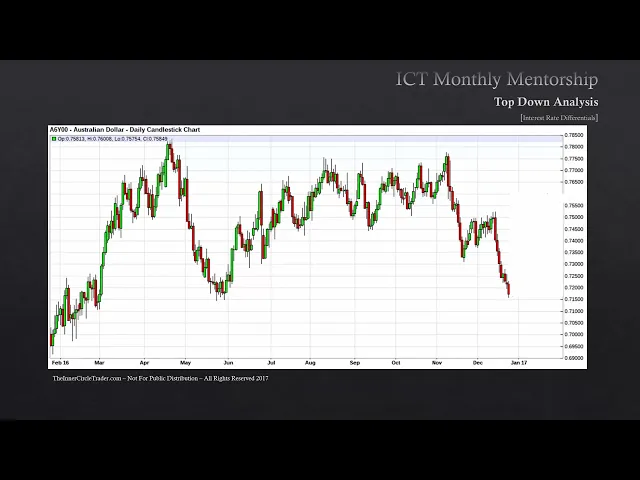
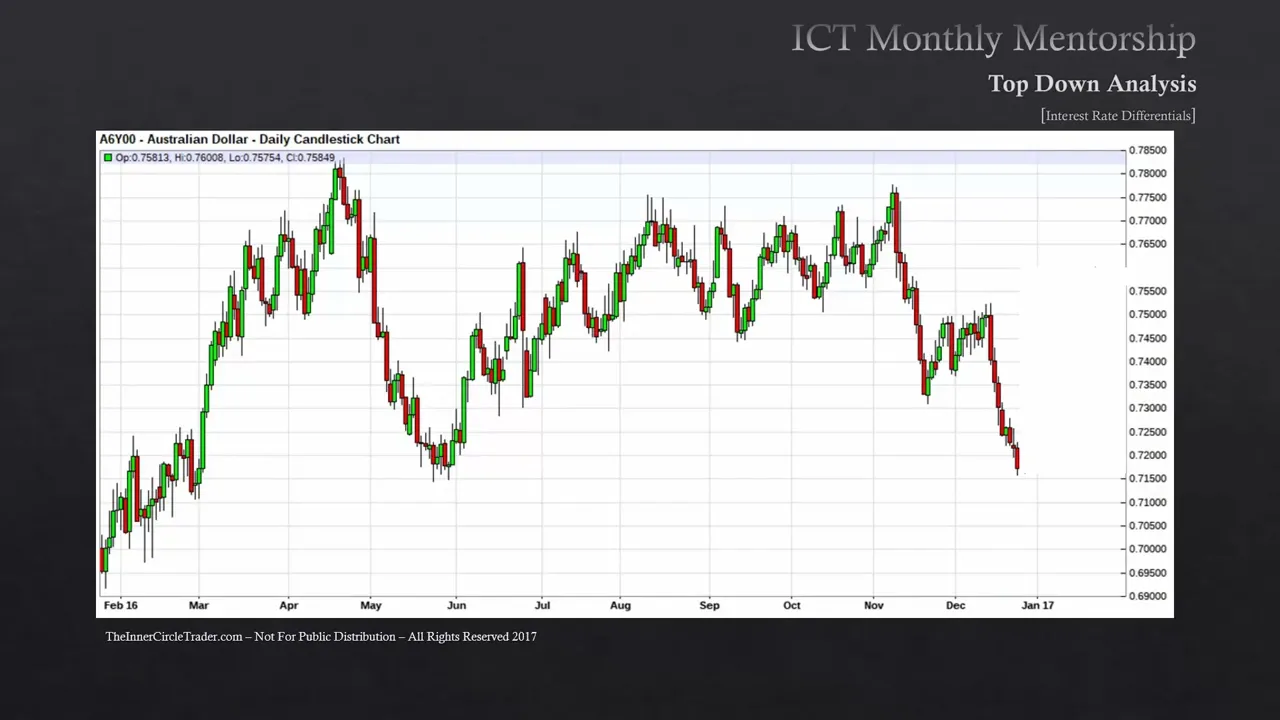
75 percent we wait for smart money clues that it's being bought now we went through several of those things that indicates that in the mentorship so far but we'll revisit a few of them for this example seasonal tendency and or open interest can confirm this so there's our two elements of smart money tools that we can use it doesn't have to use every possible scenario we only need one or two to confirm and we are looking for us dollar index directional confirmation that qualifies the setup okay we're going to look at the australian dollar this is the cash price for australian dollar and we identified a long-term support level old low in the form of 71. 50 and we move over to our march contract 2017 of australian dollar which would be the active contract that you would be trading at the end of december 2016. we're going to add that 7150 level on our chart you can see price has traded into that as support now i want you to take a closer look at what's going on with open interest as you see open interest has been declining and notice this big reduction here that purple line dropping like that that's a massive reduction in open interest open interest is going to be a indication that there's short covering by way of the smart money or large commercial traders if they're short covering that means that they're not trying to assume the other side of the trade for buyers they want to reset themselves because they anticipate what if they don't want to be short they're anticipating sharply higher prices and that's what you get here off that 71.
50 now look at the look at the magnitude of the move seen with the australian dollar here remember the payer that we're trading in the forex market is aussie dollar all z has that higher 1. 5 interest rate the federal reserve was offering 0. 50 to the latter part of december where it was adjusted for another 25 basis point pike so now it's at 0.
75 percent for the federal reserve rate it's still half of the interest rate that's yielding on the australian central bank consider how much this pair has moved from the 71. 50 level 400 plus pips have been seen from this rally off of a higher time frame support level 71. 50 now just because it trades in a higher time frame support level doesn't mean that it's going to trade higher but when you couple that 7150 level which is a higher time support level or an old low and you also notice that the market has seen a sudden reduction in open interest which is short covering on the part of smart money and you couple the idea fundamentally that the higher yielding interest rate of 1.
5 percent from the australian central bank coupled against the weaker 0. 75 percent or if you want to go back and use the half of one percent rate either way you're getting a higher yield off of the australian currency versus the dollar and that's why we've seen such a sharp rally and why i have been talking about the australian dollar going higher as a basis of our teaching throughout this mentorship we've been talking about the australian dollar going higher with respective levels that have just recently been hit with 75 80 as that level that we just mentioned from last week the fundamentals if you will okay were aligned with the central bank interest rate of one and a half percent coupled against a weaker federal reserve 0. 75 interest rate for the dollar when you have that basis and you have technicals to support it and you're looking at a hard time frame chart like this it lines your pockets with wonderful opportunities to continuously take large moves out of the marketplace and you don't need to be trading a lot by looking at these higher time frame interest rate yield scenarios coupling it with high odds probability technicals you get yourself in sync with the most significant price moves to are going to most likely surprise many of the neophyte traders you can see also that we had a higher high in the dollar index when we fail to make a lower low in the australian dollar okay we're going to do another example we're going to select a pair with a low interest rate this time and we're going to select a country with a high interest rate and we're going to determine the forex pair that couples for that trade in this example we're going to use a higher yielding currency 0.
75 percent which again that was actually half of one percent of the time when this trade is being shown so i have to adjust it show you for your notes versus japanese uh economy and their central bank rate was negative and the two respective countries and their currencies would be paired up in the form of dollar yen we're going to look for strong resistance on higher time frame charts we're going to wait for smart money clues that it's being sold in other words we want to see japanese yen hit resistance levels and show indications that it wants to sell off and we're looking for seasonal tendencies and or open interest to confirm the trade and looking for dollar index directional confirmation to qualify the up so if we have the expectation that the weaker currency is the japanese yen interest rate basis against the stronger of the two the dollar which has the higher yielding central bank rate we're going to see that u.