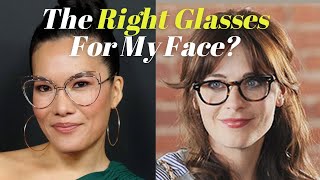
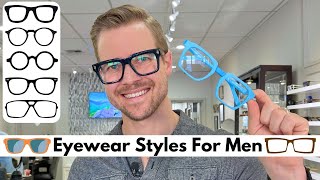
- Do you know what glasses look best on your face? By the end of this episode, you will know how to pick your perfect pair every single time. - Hello, and welcome to Amy's Optometry, where we have only the highest tech to find you your perfect pair of glasses.
I am a doctor, and we are going to go through each data point, and I will find out which pair of glasses best suits each face based on not only their face shape, but their actual features. This is Amy's optometry. Today, I have five patients on my schedule, Ash, Dan, Lee, Saunty, and Tom.
And here's the thing, none of them know how to tell which glasses make them look fire versus which ones leave them looking more like Benjamin Franklin. I cannot keep looking like these founding fathers. Don't you worry, Ash.
I am a professional, and I've come armed with a number of tests to help solve this spectacle situation. Oh my god, you have a whole, like, agenda. This is a doctor's appointment, and usually you get many tests.
Many tests, alright. Don't doubt the process, Ash. As my patients file in for their exams, let's talk about what exactly it will entail.
That doesn't break HIPAA, right? Nah, I'm sure we're fine. It was not fine.
We will be taking a series of measurements to figure out which key features to consider and picking which frames will best frame your face. While most places only rely on three measurements of the glasses themselves, when finding your fit, we here at Amy's Optometry are measuring you and being extremely thorough about it, with more than double the amount of measurements than any other eye doctor on the block. These will be divided into the three Fs of finding your perfect glasses, face, features, and fit.
Thirst, it's time to break out my handy dandy measuring tape and prepare my patients for a very eventful exam. Our face category contains one major test. What we are going to do here is take some measurements to find your face shape.
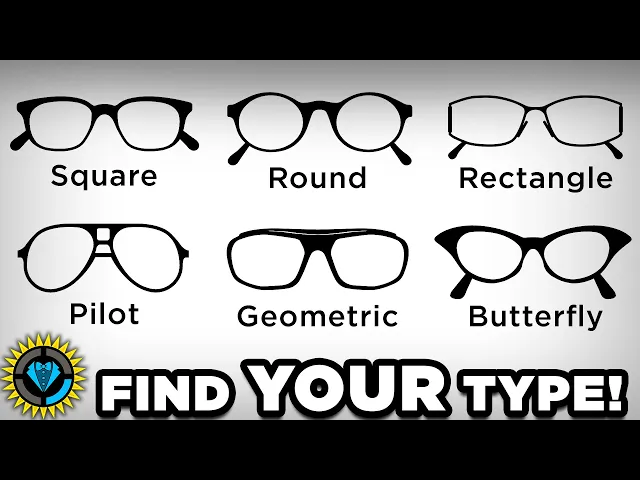
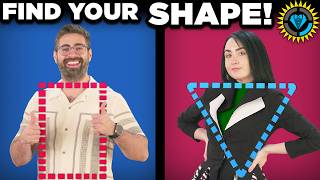
There are seven major face shapes, triangle, round, square, oval, diamond, rectangle, and heart. And each has its own set of variables to consider when choosing a pair of glasses, specifically which frame shapes will look best on your face shape and if you need wider or narrower frames from temple to temple. So how do you find yours?
We'll need to take four measurements. Let's go through them one by one. - We are first going to start with the length of your face.
So it's from your hairline to the tip of your chin. - Oh, this could be so humbling for me, yep. - Some patients were easier to measure than others.
- I have to find your chin because you have a beard. - I also have no chin. - That's not true.
- And I had no extra hands, Which is why I recruited my patients to take note of their measurements for me in my very special doctor's notebook I mean without their glasses. It's not like they can read it, right? Yeah, you have a bigger face than I do shut up Dr Patient Confidentiality look it at This is what I get for trusting people when they say I can't see without my glasses liars - My eyesight isn't that bad.
- Moving on, we next need to find your forehead width from edge of hairline to edge of hairline. - I'm gonna tuck your hair back first. - Yep, do whatever you need.
- You just have such a good swoop. I actually have a pretty good idea what face shape you are already. - Yeah, alright.
- Yes, I actually do. - Just from that? - Because I've been doing this for a long time.
- Years. - I am a professional. - And it's this professional's opinion that Ash and Santi should never be allowed in the same exam room ever again.
- This is so bad. - So we're at 14 . 8.
- Yeah, you big forehead havin' me. - Or someone is just like a pinky finger come to life. - It's important to note that the wider your head is, like patient Tom, for example.
- Ah, he got the noggin. - I do got the wide face. - The larger size your glasses will need to be.
This is because a wider head generally means that your pupils are a wider distance apart. Pupil distance, or PD, is usually listed in your prescription, but you can also find it with the help of a friend by measuring the distance from the center of your left pupil to the center of the right in millimeters. Just make sure that while your friend or friendly neighborhood optometrist measures, you should be staring at something 10 to 20 feet away to keep your gaze even.
You want your pupils to hit at the dead center of your lens. If you know this before going into your next eyeglass appointment, your eye doctor will be shook. Which is why I ask all theorists to please turn your eyes to the screen, because your eye exam is about to begin.
Look at the dot at the center of your screen. Can you read what it says? No.
Look closer. What about now? Still no?
Okay. Let's try size two. Can you read it now?
Oh no, that's not a good sign. Let's skip ahead to size 20. Can you see what it says now?
Let's read it together. This episode is sponsored by Manta Sleep. Good job!
And it's a good thing too, because after all that strain you just put your eyes through, they could use some pampering. Just like your everyday glasses, Manta Sleep masks come in a variety of options to suit your personal eye needs. Are your eyes feeling dry after staring at a screen all day?
Then try the Manta Steam Sleep that uses its custom warming beads to soothe and moisturize your eyes. It is a spa level experience right in your own home, and more than half the cost. But if you can't take the heat though, you can pop on their cool mask instead.
This is perfect for reducing puffiness. And uh, personally, it's my favorite. What can I say, I just like to feel like there's an Arctic circle on my eyes.
If you've ever used an ice roller, it's that, but constant. Mwah, so good. But maybe you're worried that your skin is too sensitive for all that.
Well, Manta is still here to help, with its silk -sleep mask designed specifically to be gentle on the skin. And here's a special tip. For your side sleeper, the tapered eye cups on this one are perfect for you, providing less pressure and friction on your sensitive eye areas.
And of course, for the everyday napper, the classic mask creates a cozy dark escape thanks to its breathable fabric and 100 % blackout guarantee. With Manta's premium fit, it can adjust comfortably to fit your unique face shape. But don't believe me here, try it on.
Isn't that cozy? No, no, no, don't fall asleep here. I have a patient coming in after you.
You can't sleep here. But you can get your own sleep mask by going to mantasleep . com and save 10 % on your order by using code STYLETHERY at checkout.
You'll find that if you do, you'll be able to nap anywhere at any time. Planes, trains, your next dentist appointment, whatever suits your needs. All thanks to Mantisleep.
That's mantisleep . com and code style theory at checkout to finally give your eyes the rest that they deserve. We have two of our face shape measurements down and two more to go.
Next is cheekbone width. So we're gonna go from one cheekbone to the other. 24 .
4. He a wide boy. I have a large face on a small head.
It's okay Tom. We accept all faces here, including Santi of the mystery head size. You see, Santi is typically told by others that he has a wide face, despite his regular glasses size not reflecting that.
And when you look a little closer, you can start to see why. Honestly, that's probably why you have the discrepancy between the wide face and the narrow face. You're wider here.
That's what people are telling you, versus where your glasses actually sit, which seems to be a very, very narrow part of your face. If our glass was a face shape, Santi would have it. But unfortunately, it's not.
In fact, this is a very unique feature of his face that has a huge impact on how his glasses fit. And it's why taking the time to get your own measurements is so, so important. The little details make a big difference.
But back to our final measurement, the width of your jawline, which you measure by going from the back of your jawbone to the center of your chin and multiplying by two. - Ooh, I have such a Chad Sigma Omega jaw. It's awesome.
(sighs) I'm just mewing. - Don't stick out your chin. If you don't have one, we'll find out now.
- Spoiler alert, he didn't. But we finally had all of our data to find their face shapes. - Ooh, wow, that was fast.
- If your measurements are all equal within a couple millimeters, then you are a square, like Tom. His head is basically straight out of Minecraft. Man, they should've really cast him in that movie.
He would've fit right in. Get it? 'Cause he's a square.
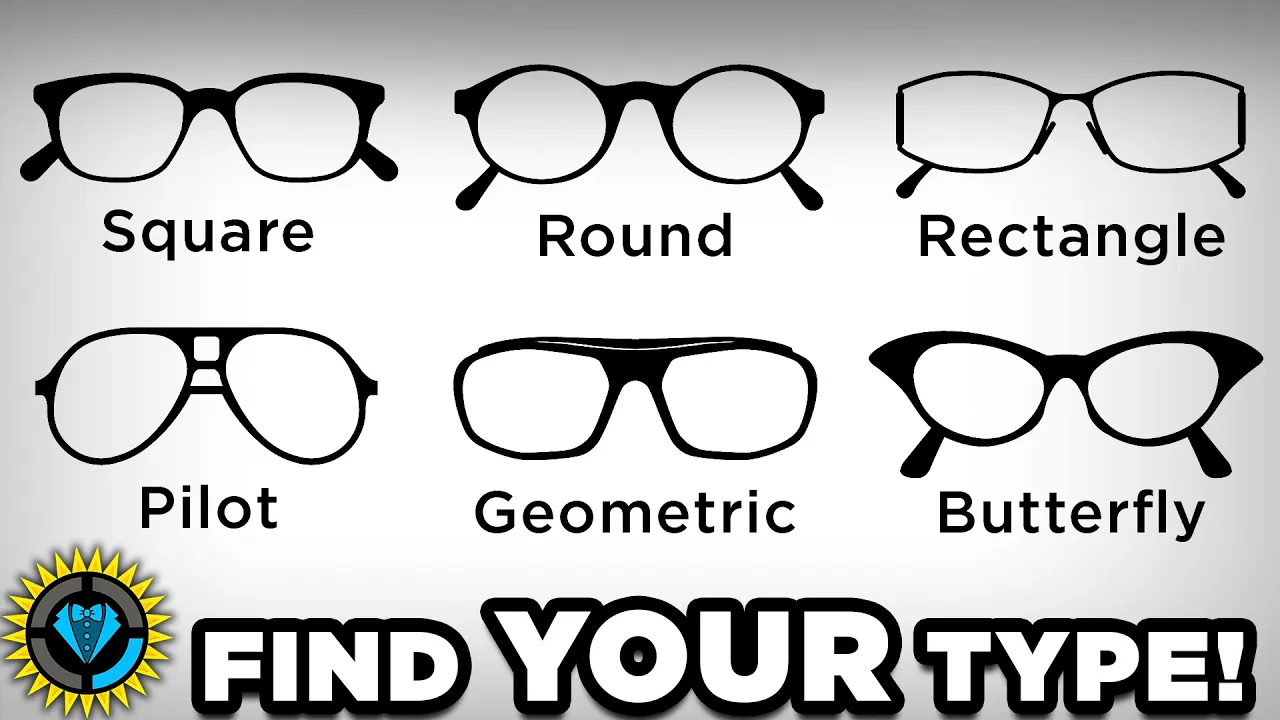
Anyway, as a square you'll likely have very angular features, especially your draw line. If you want to accentuate those angles, you should go for rectangular or geometric shapes. As Tom learned in his try -on session in my Examatron 3000, a very high -tech machine that allows you to experience hundreds upon thousands of glasses without spending thousands of dollars.
I - I know, I'm a genius. - Anyway, so that, I went to push my glasses up. (laughing) See, that's how good this is, I believe it.
- At Amy's Optometry, we aim to impress. During his session, Tom saw that rectangular and geometric frames mimic the shape of his jaw, making it look sharper, squareer, and more pronounced. - This angle, I feel like makes my jaw look funny to me 'cause it mimics that shape.
The angles feel very harsh, and so make my face feel more angular, which is not my preference. If you, like Tom, want to soften some of those angles, you can exchange them for some circle oval or rounded frames. Just be careful, because squares tend to have wider faces, making it difficult to find circle frames that will fit your face.
- I really like circular glasses. The downside is this, you can only ever normally get these in small because they don't want you to have glasses other than this big, which then means you end up with this very, very wide arms. - This can lead to your head looking wider while your face just looks itty bitty teeny, tiny scrunched in the middle.
Speaking of round, if your face length and cheeks are equal and your jaw and forehead are slightly smaller, you are either a round or a diamond shape. It all depends on the angularity of your jaw and hairline. All smooth, then you are round.
And you have the same issues as a square, but uno -reversed. Round oval or rounded frames will make your features feel even more circular, like in adorable little beach ball. More angular frames, however, will have the opposite effect.
If your biggest measurement is your face length, then you are either an oval or a rectangle, or, as we can say now, a saunty or a dan. Perspectively, if you, like saunty, have rounded features, then you are an oval face. Circle lenses will make your face look more rounded, while oval lenses will just soften your features, but not to the same extreme.
It can actually be very flattering, as saunty discovered. - Oh, I haven't Historically liked them round, but this actually doesn't look bad I think it's because that it's round but not like a circle. It's more like oval shape and since I have an oval face I've learned it actually doesn't look bad I will be expecting a five star review on Yelp from you, sir Now if you want to sharpen your features aim for a more rounded edge rectangular or square frame They will flatter you more than a sharp edge.
This is a lot more my speed to much softer like rounded shapes and it sits, this is more, hey Claudia, oh look at that! - If your features are more angular like Dan, then you are a rectangle. Angular frames will suit you best if you want to highlight those chiseled features, specifically rectangular or square ones.
Geometrics might not be the best for you. - I really like these a lot. It kind of feels proportionate.
This is so weird to be the first one, and I'm like, yeah, that's it, that's the one I want. - Yes, Thierrys, I'm just that good at my job. If you do want to round out your features, stick to ovals or rounded edge squares.
Circles are probably a little too drastic for you. Oh my god, these-- no! Triangle shaped faces have features that start wide at your forehead and get narrower as you go down, and are actually very similar to two other shapes, the diamond and the heart.
The key difference between all of them, the hairline. Triangles have a flat hairline, while a diamond's arch is upward like the tip of a diamond. And hearts-- - A pointed hairline.
- Thus, a heart -shaped face. - Aw, yay, that's so cute. - You also seem to be a heart -shaped face.
- I got the Vegeta going on. - A little bit. - He's actually met Vegeta, you know?
- It's just so cool. - But back to the shapes. Due to their similarities, these categories are able to wear the same shape options, which is to say, all of them, firing some wild card options.
- I'm running a science experiment. - Both angular and Grounded frames will flatter your face. Congratulations!
Your specific frame needs rely less on your face shape and more on your specific features. Which just so happens to be the next category of our exam. Now, the savvy glass buyers watching this may have noticed a few frame styles we didn't cover in our face category.
Cat eye, brown line, rimless, and aviator. That's because it's your features, not your shape that determines if they flatter you or not. But that's not all.
Your eyebrows, eyes, nose, cheekbones, even your facial hair all factor into what size and thickness of frames suit you and which leave you looking like music man. Throughout these exams, one thing kept coming up time and time again-- eyebrows. And how much was or was not visible above and below the top frame of your glasses.
I still don't love how high they kind of arch over my eyebrows. I like when the glasses kind of sit where my eyebrows are. If they sit right below, it makes my eyebrows look like way thicker than they are.
It can't even go past my eyebrows. Give me space. I just need some space.
Eyebrows come in all shapes and sizes. Some have defining arches, and some have laid claim to the full forehead. And those specific measurements can make or break your glasses, and some friendships.
- Oh, where's your eyebrows at me? - Oh, sorry. I'm a reactive person, so I'm like, you're saying things, I'm like, hmm?
- Control the brows, Tom. Don't let them control you. To give you some context for your eyebrows, let's talk size.
Vertically, that is, an average height at the widest part of your eyebrow is about one centimeter, like Ash and Tom. 1 . 1 to 1 .
3 is mid, not super short, but not super tall, like saunting. And 3 . 4 centimeters and above is considered a tall brow, if you will, like Lee and Dan.
I think I have pretty good eyebrows. You do, Dan. Now, the taller your brow, the more surface area is likely to have.
And the less area available between the top of your glasses frame and where your eyebrow begins. There is a personal preference aspect here on how much brow you want on display, but here are some best based on our collective data. Number one, frames that sit under your eyebrows leaving space so that they are not connected.
This helps keep you from looking like you have a unibrow or no eyebrows at all. Aviators can be a real problem here due to the double bridges. - That is a thick man right in the center.
It almost has like a unibrow effect on me because it goes right into the eyebrows. - I think that it gives unibrow in a way that just, I don't love. All aviators were found to be the least flattering of all of our shapes due to the specific issue.
All of our patients agreed that aviators should stick to being sunglasses and not everyday wear. Number two, have the frame cut partially into your brows but still let you create that space when you move them. - I prefer cutting my eyebrows a little bit.
I think it also softens the framing of the glasses because they're kind of blending into my darker eyebrows. You can see that one eyebrow is like being cut off way more than the other. If they are lower on the eyebrow it then means that one might be cut off but the other isn't and so it then highlights the difference.
However this only works with the thickest of frames. If you try this with thin frames it creates an unusual problem. Also the fact it's so humbling when my eyebrows are so thick that they protrude into the lenses of the glasses.
I refuse to make them thinner it's - Just humbling. - Speaking of, consideration number three. Glasses that extend above the eyebrow, causing the eyebrow to appear within the frame is typically not a flattering look to most features.
- Yeah, no, they're too big. The eyebrows are in the lenses and that feels weird. - I feel like my eyebrows get completely subsumed by the lenses in a way that feels weird.
- But hey, some people's weird is another person's perfection. So let me know in the comments if you like having your eyebrows inside your lenses. I'm super curious.
Now, the next feature to consider with frame size is the size of your eyes. Yes, the whole reason that you wear glasses gets to have a say in this too. It's only fair.
Your eye height and eye length play a huge part in what lens sizes you should be looking for. When your frames are too small, your eyes start to look claustrophobic. - This is even worse.
I feel like there's in less space here and it like makes my eyes smaller 'cause it like cages them in. - She is so small. It's not even getting to the ends of my eyes.
- They're taking up so much of the lens. It just makes it feel like it's all very compact. Whereas if you have bigger eyes with then having bigger frames, it makes it feel a bit more open and more evenly filled the face.
And I have the perfect method to find the perfect frame size every time. Start by measuring your eye height, the part that is actually exposed eyeball. Starting from the top waterline to the bottom waterline.
Yes I know, it's scary having stuff all up in your eyeballs, but it's for science! Then do the same for your eye width, measuring from the inner corner to the outer corner. Then divide your height by your length.
This is now your eye size ratio, which is a quick way to know at a glance what frames will fit you best. If your ratio is less than 0 . 29, you have small eyes and small to medium frames will look best on you.
A 0 . 3 to 0 . 59 ratio means that medium frames will suit you best.
And a ratio of 0 . 6 and above means that you can wear those extra large frames. Again, this is meant to be a fast way to narrow down your options really quickly.
If you want to go more in -depth with each specific option then this is what you should do. Look at yourself in a mirror with your eyes in their normal resting position. Now take a measurement of the space from the top of the water line to the top of the frame as well as from the bottom of your water line to the bottom of the frame.
This measurement should be equal to or greater than half of your eye height and then do the same for your eye width. Anything smaller than half your original measurement will make your eyes look too crowded inside the frames, which is why our small -eye squad, Lee and Dan, are the only ones to look good in short frames. The rest of our patients all have larger eyes, and so need larger frames.
And there's one other consideration to make. If you, like Santi, have that hourglass head that dips in at the temples, bear this in mind. You may find that wider glasses leave a gap at the edges due to your temples being narrower than where your ears meet your head.
And so if you want to avoid that gap, you want to stick to slightly narrower frames. Well, you know, maybe it's just saunting. Now, there is one other facial ratio that can help narrow down those options even more and lead you to your perfect pair of specs, your cheekbones and nose.
While we have already talked about the width of your cheekbones, we now need to talk about their This is really important because you want to see where your glasses are going to sit. If you have very prominent cheekbones, the glasses will actually sit on your cheekbones and affect the way that they sit on your face and how they look. Look at the profiles of all of our patients.
Tom, Dan, and Santi all have flat cheekbones, so they can sit this one out. Lee and Ash, on the other hand, have prominent cheekbones. You can tell by how they come out from the face towards the tip of the nose.
But that's only one part. Whether this will be a problem or not for them depends on their nose bridge depth. Yes, we are being that pedantic folks.
Sign where on your nose your glasses naturally rest and measure from that point to where your nose meets your cheek. This is your depth. Ash has a deeper nose meaning that their prominent cheekbones should not interfere with them wearing a larger frame which is lucky for them because they have larger eyes.
Conversely, Lee had a shallow nose meaning that large frames will likely not rest comfortably on his face. Let's look at those profiles again. Notice that Tom and Ashes cheekbones sit higher on their face, closer to their eyes, unlike the rest of our patients.
They have high cheekbones. For most glasses shapes, this doesn't play a huge role. But if you're a cat eye fan, pay attention.
Cat eye glasses curve upwards at the outer ends. On high cheekbones, this can give a very pretty lifting effect. I kind of dig the cat eye situation that's going on up here This is the kind of shape of glasses I feel like I see a lot on the internet especially amongst like readers and bisexuals on lower cheekbones However, you may find that this upward tilt competes with your natural features and the final feature of this category facial hair Let's use saunty as our starting example throughout our exam He learned that thin wire frames looked odd on his face.
Santi has many prominent features, with the dark hair, dark eyebrows, and mostly dark beard, which means that thinner frames start to get lost within his features. Instead, if Santi wants a thinner look, he should opt for something like a rimless brown line. The top of the frame still gives that definition, letting the rimless bottoms soften out the rest of his face.
It's balanced. The same can be said for Dan and Lee, who both enjoyed rimless options. But Tom, our only beardless man, and Ash, our only beardless snot man, found that the brown lines and other rimless options did not suit their face.
"It just feels like it's very, very top heavy. Especially because I can't grow a beard, so I haven't got anything down here framing my face. You then end up with just lots of dark and then lots of not very dark.
" I don't think I like rimless on the bottom that much. If there's no bottom rim, it does feel very barren. It feels naked and afraid.
Now, don't be afraid of all this new information. And don't be naked either. You're in my doctor's office, remember?
Don't make it weird. Anyways, now that we've shown you how to find your best shapes, sizes, and thickness, oh my! It seems like we know everything, right?
Well, no. You see, there is one eyeglass mystery that still has yet to be solved. No, it's not which frame shapes are his.
The arm, the ear arm, the earm, earm, we're going with earm. It's the earm that plays a secret and unexpected role in what glasses have the perfect fit. When it comes to earm fit, most people tend to look at the length of the earm, not where it connects to your frame.
The eararms are like higher on the lens, so they sit a little lower on my face. I don't really like that. I don't love how high these sit.
The earms are are on the middle of the frame as opposed to the top, and it looks very weird on me. They feel like they sit much lower on my face than they do, but it's like an optical illusion. - And I'm about to give you a peek behind the curtain.
You've heard of the golden ratio. You've probably heard of the silver ratio. Well, now get ready to meet the style theory ratio.
This ratio helps measure the degree of the angle from the ear to the eye and the eye to the bridge of the nose. And yes, I found each angle for each measurement on each side of every single patient. This number will tell you how low your eyes sit in the frame of your glasses and where your ear should connect for your best fit.
Think of it this way. Where pupil distance will help with the horizontal, this will help with that tricky vertical fit. Now, there is the factor of personal preference to consider in all of this, but the Style Theory Ratio, or as I like to say, the STR, will take a lot of the guessing out of the equation, with our equation.
This number will go hand in hand with your eye size, so keep that measurement handy. To find your STR, you will need to find the above angles that we already mentioned, and then follow this formula per side, ear to eye divided by ear to nose. This will give you the STR for both your right side and your left side.
You can pause the video and do this now if you want. It's okay, I'll wait, got it? Great, here is how to apply those numbers to your face and your glasses.
There are three categories, low str, mid str, and high str. If your ratio is between zero to 0 . 2, you are low str.
This means that your ear to eye to nose line is almost a straight line. If you have low str, you likely need frames with earms that hit between the top two fourths and the middle of the frame, and if you have larger or medium eyes, you likely want to stick to the top of that range, depending on the shape of the frames that you're using. Small eyes, on the other hand, should not have that same worry.
If your ratio is between 0 . 21 and 0 . 4, then you are mid -STR, meaning that your eyes sit slightly under that line between your ears to your nose.
You will likely want to stick to that top two fourths' earm -connecting point, as middle -connecting frames are likely going to sit a little too high for you. This is even more the case for bigger eyes as you have more space to cover. And finally, if your ratio is 0 .
41 or higher, you are high STR. This means that your eyes sit far below that line between your ears to your nose, creating a very deep V. Because of this, you likely want to stick to the top earm -connecting point or the top 1 /4.
This will mean that that connecting point will hit around your eyebrow line, or just under, and that the lenses will sit lower and more in line with your STR. Again, larger eyes will need to pay close attention to their lens size here as you have more eyes to cover. Middle connecting frames, however, you should avoid at all costs.
But you know what? We can take this one step further and we're gonna take your STR for your left and right side and subtract the smaller SDR from the larger. This is how evenly your glasses will sit on your face.
If your difference is less than one, you're pretty even. One to two and you may need to alter your glasses depending on the shape and size of the specific pair. And if you, like Santi, have a difference of more than two, you should probably spend a few extra dollars to get those irms altered for the sake of your eyes.
But hey, It's just a theory. A style theory. Keep looking sharp.
Next time on Style Theory. Everyone wants perfect hair, but not all of us can be as lucky as Zendaya. Or can we?