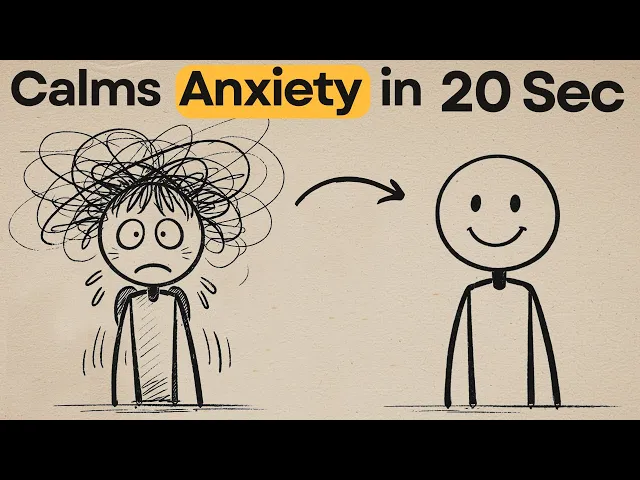
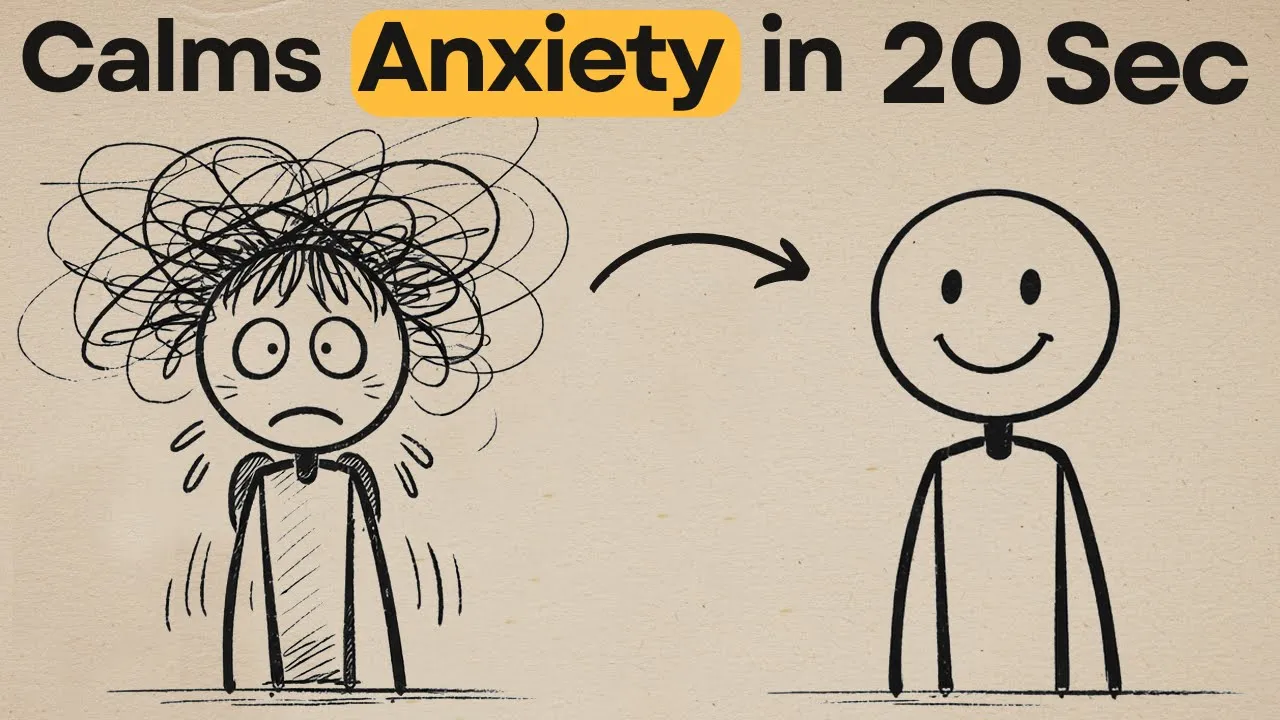
Is your brain screaming right now? Replaying awkward moments, churning on a loop. That's [music] anxiety, a noisy manager in your head, and trying to think your way out of it never works.
But what if you're fighting it in the wrong arena? What if calming anxiety isn't about your mind, but your body? A 20-se secondond [music] switch you can flip anywhere to force your nervous system to stand down.
[music] In the next few minutes, you'll learn five weird physical habits. Simple, fast, no meditation required. They [music] work from the outside in.
And habit number five, it's the stealth move. The one you use when you can't do anything else. If you miss it, you're missing the ultimate [music] anxiety override.
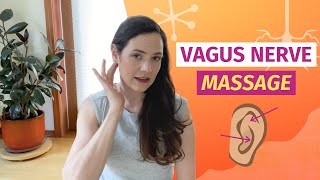
Let's flip the first switch. Habit number one, the ear massage trick. [music] Let's start at the top.
Literally, your ears. You think your ears are just for hearing, right? Passive little satellites.
Wrong. Your ears are a [music] control panel. They're covered, and I mean covered, in nerve endings that connect directly to your vag nerve.
Say hello to the vagus nerve, [music] your body's internal chill out supervisor. Stimulate it and you trigger a rest and digest response. You tell your fight orflight system to [music] take a coffee break.
So, here's the 20-se secondond ear massage trick. Forget polite. We're not being dainty.
Use your thumbs and index fingers. [music] Grab the entire rim of your ear, the outer curve, the helix. Just pinch it between your fingers all the way around.
Now, massage gently but firmly roll that fleshy rim between your fingers. Start at the very top of your ear, right where it connects to your head. That's a big nerve center.
Work your way down. Slowly squeeze and roll. Squeeze and roll.
[music] As you go down the rim, you're hitting different pressure points. When you get to the lobe, give it a gentle sustained pull. Do this for both ears.
10 seconds per ear, [music] 20 total. What's happening? You are literally physically dialing down the tension.
It's like you're manually turning a volume knob on your stress. That buzzing in your head, it gets [music] quieter. the tightness in your jaw and neck.
It often starts there and this [music] releases it right before you have to walk into a stressful room. When you're on a call that's making you tense, they can't see you. When you're lying in bed and your brain won't shut off.
It's [music] your instant physical mute button for internal noise. Think of [music] it as rebooting your head from the outside. Not by force, but by gentle, strategic [music] connection.
You're not fighting the anxiety. You're distracting your nervous system with a better offer, [music] a nice calming massage. On to habit number two, where we break the number one rule of breathing.
Habit number two, reverse breathing. Everyone and their mom tells you to take a deep breath when [music] you're stressed, and it's terrible advice. Why?
Because when anxiety has you in its [music] grip, trying to take a big dramatic inhale first is like pouring more air into a balloon that's already about to pop. Your chest is tight. Your shoulders are up by your ears.
A giant inhale just makes you feel more tense, [music] more pressurized. So, we're going to break the rules. We're going to breathe backwards.
This is called the physiological sigh, and it's your body's natural built-in reset button [music] for stress. You do it spontaneously when you cry or when you're about to fall asleep. We're just going to do it on purpose.
[music] Here's the 20 second reverse breath. Don't inhale. Start by letting it all go.
A long, slow, complete exhale through your [music] mouth. Empty the tank. Push out every last bit of stale air.
Feel your shoulders drop as you do. Now take a normal, gentle inhale through your nose. Here's the magic part.
Without pausing, take one more quick, [music] short sip of air on top of that first inhale. Fill your lungs just a little bit more. Now let it all out again with one long, slow, satisfying [music] exhale.
Make it twice as long as your inhale. That's one cycle. [music] Inhale with a sip.
Exhale long. Do that two maybe three times. That's it.
20 seconds. That long exhale is key. It directly stimulates your vagus nerve, again, that chill out boss, and tells your heart to slow down.
The double inhale helps reinflate tiny air sacks in your lungs that collapse when we're [music] stressed, boosting oxygen exchange. You are literally flushing carbon dioxide, the stress gas, out of your system and hitting the brake pedal on your heart rate. The moment you feel that flutter in your chest, when anger or frustration is bubbling [music] up, right after you get a stressful text or email, it's instant.
It's invisible. You can do it sitting at your desk and no one has a clue you just performed [music] a biological system flush. You're not just breathing.
You're exhaling the anxiety first. [music] You're making space for calm, not forcing it. Okay, we've reset from the top ears and from the core [music] breath.
Now, let's go to the bottom and get grounded, literally. Habit number three, [music] the foot grounding tap. Anxiety is future tripping.
It's your mind living in a whatif disaster [music] movie that hasn't happened. To cancel it, you need to come back to the present moment, to your body, to right here, right [music] now. And there's no better anchor than your feet on the ground.
But we're not just going to feel the ground. We're going to talk to it with a secret code. Introducing the foot grounding [music] tap.
You can do this standing or sitting. Shoes on or off. Off is better but not necessary.
Feel your feet. Seriously, just notice the weight of them. The pressure on your heels, the balls of your feet, the little toes.
Now, subtly lift your heels just a millimeter off the floor. [music] Keep the balls of your feet and toes planted. Gently, rhythmically, start tapping your heels down.
Tap. tap. Not a stop, a light, mindful tap, like you're sending a Morse code message to the planet.
I am here now. [music] As you tap, shift your awareness. Feel the sensation of the tap traveling up your legs into your spine.
With each tap, imagine you're driving a stake of calm, solid presence down into the earth. You [music] are a tree. The anxiety is just wind blowing through your branches.
Your [music] roots are solid. Do this for 20 seconds. Just 20 seconds of rhythmic [music] tapping.
What's happening? You're creating a rhythmic somatic body-based anchor. [music] The repetitive motion gives your busy mind a simple physical task to focus on.
It's boring. And [music] boring is the enemy of anxiety, which loves drama. You're also activating the nerve endings in your feet, which improves [music] proprioception, your sense of where your body is in space.
This makes you feel more solid, less floaty, and disconnected. When you're feeling dizzy, spaced out, or dissociated from anxiety. When you're waiting in a line, and impatience, a form of anxiety, is rising.
When you're sitting at your desk feeling untethered, [music] it's the ultimate get out of your head and into your body trick. >> [music] >> You're tapping your way back to the present, which is the only place where calm actually exists. Next [music] up, we're targeting a stress storage unit you probably never think about.
[music] Habit number four, the cheekbone press release. Where do you hold your tension? For a lot of us, it's the jaw.
We clench it all day and all night. We grind our teeth. We carry the weight of the world in these two hinges on the side of our head.
But the tension isn't just in the jaw muscle. It's in the attachment points. And the mother lode is right here.
Put your fingers on your face. Find your cheekbones, the hard [music] prominent bone under your eye. Now slide your fingers down about an inch towards your mouth.
You should feel a dip and then a little bump of muscle. That's your massitor muscle, the main chewing muscle, and it's probably as hard [music] as a rock. This is habit number four, the cheekbone press release.
Make a relaxed O with your mouth. Let your jaw hang loose. Using your middle or index fingers, press firmly into that little bump of muscle on your cheekbones.
[music] You'll likely feel a tender spot, a good hurt. Apply steady, firm pressure, not stabbing, just a deep, sustained press. As you hold the pressure, slowly open and close your mouth a few times.
You'll feel the muscle moving under your fingers. Hold for 10 to 15 seconds on each side. While you do, take a slow breath.
[music] Imagine you're pressing out the literal tension, like squeezing paste out [music] of a tube. When you release, you might actually feel a wave of relaxation spread across your whole face, up to [music] your temples, even down your neck. Your field of vision might even feel a tiny bit wider.
Why? You're releasing trigger points. You're telling the clenching command center to cease fire.
A [music] relaxed jaw sends a massive all is well signal to the entire nervous system. [music] It's hard to feel panicked when your face is soft. First thing in the morning before you even get out of bed during intense [music] focus or work sessions.
We clench when we concentrate. Before eating [music] helps with digestion, too. Anytime you catch yourself with your teeth together, this is [music] preventative maintenance for a calm state.
You're doing a manual release on your body's stress vice grip. Now, [clears throat] you've learned four powerful physical hacks. But what about when you're in a situation where you can't massage your ears or [music] tap your feet or press your face?
What if you're in the middle of a conversation or giving a presentation? That's where habit number five comes in. The stealth ninja of anxiety hacks.
Pay [music] attention because this is the one you can use anywhere, anytime, and [music] absolutely no one will know. Habit number five, the quick focus object trick. [music] Anxiety makes your world small and threatening.
Your focus turns inward to the chaotic storm in your mind. The solution is to force your focus outward, but in a very specific, [music] gentle way. Not by looking around the whole room wildly, but by choosing one single [music] meaningless external thing and studying it like it's the most fascinating object on Earth.
This is the quick focus [music] object trick, the 202 mental hijack. Here's how it works step by [music] step. The covert selection.
Wherever you are, whatever you're doing, look around and [music] pick one ordinary object. A pen on a desk, a crack in the sidewalk, a leaf on a tree, a button on someone's shirt, a coffee stain on the wall. It must be neutral, not your phone.
That's a stress object, [music] something boring. Now, for 20 seconds, you're going to mentally catalog this object [music] with intense, silent curiosity. Is it shiny or matte?
What color is it exactly? Is there a scratch? [music] How does the light hit it?
What's its shape? Does it look smooth or rough? Would it feel cold or warm, heavy [music] or light, flexible or rigid?
Where is it placed? Who might have put it there? What is its purpose in this exact spot?
If it could talk, what would it say? What was it like a year ago? Or what will it be like in a year?
Finally, [music] take one slow, quiet breath, still looking at the object. Then let it go. That's it.
20 [music] seconds. A complete mental hijack. What are you doing?
You are forcing your preffrontal cortex, the logical, observant part of your brain, to come back online. You're giving it a simple, concrete, [music] non-threatening job. This pulls mental energy away from the amygdala, the fear center, which is currently screaming about future disasters.
You can't fully engage both at once. By choosing to focus on the pen, you are choosing to starve the anxiety of your attention. It's a Jedi mind trick on yourself.
You're not saying, "Don't be anxious. " You're saying, "Hey, brain, check out this really interesting doorork knob. " This is your secret weapon for socially anxious situations.
on a date, in an interview, at a party, [music] during a difficult talk. When you're stuck in your own head, you can instantly [music] project your focus out into the world in a harmless, calming way. It makes you more present in conversations, [music] not less, because you've quieted the internal commentator.
This is the habit you use when [music] you can't use your hands. It's all in your gaze and your mind. It is [music] the ultimate portable, invisible, instant reset.