Intro It's a hot summer night in the land of the gods. Two samurai walk in a bamboo grove, moonlight reflecting on their armour. The older one is noticeably wounded on his left side and walks slowly.
Sensing his death, he asks his follower to assist him in seppuku, to cut off his head. He kneels and hears the bamboo rustling. He thinks for a moment that maybe he could escape all this, become a monk and live the rest of his life in peace.
Then, the cold steel blade of his comrade sharply descends. He had played the great game, and he had lost. This was his punishment for failing to win the most important battle of his life.
And while his star was setting, Hideyoshi’s was rising as bright as the sun over Japan. Battle of Yamazaki In the previous episode, we saw Hashiba Hideyoshi come into the service under Oda Nobunaga, then followed his rise from a simple foot soldier to a great general pivotal to Nobunaga’s plans for domination across Japan. Now, following the betrayal of Akechi Mitsuhide, the leader of the Oda clan and his eldest son and heir, were no more.
Following the events at Honno-ji, Mitsuhide’s men looted and largely destroyed nearby Azuchi castle, Nobunaga’s seat of power, taking many treasures. Akechi, probably unaware of Hideyoshi marching towards him at warp speed, did little to fortify his position. He tried to gather the support of Kyoto’s citizens by reducing taxes and even secured the gratitude and support of the Imperial court.
The only problem was that the Emperor at that time had no authority. Mitsuhide also extended a hand of friendship towards other former Oda allies like the Chosokabe, Hosokawa, Takayama, Nakagawa and Tsutsui clans with no success. Chosokabe Motochika was too far to intervene, not to mention embroiled in his own campaigns in Shikoku.
Takayama Ukon and Nakagawa Kiyohide sided with Hideyoshi, while Tsutsui Junkei stayed out of the conflict. The Hosokawa, despite their family ties with Akechi, were staunch Oda loyalists. In fact, Hosokawa Tadaoki, Mitsuhide’s son-in-law, was so appalled by his betrayal that he immediately divorced his wife.
His father, Hosokawa Fujitaka, opted to turn to a monastic life and became a Buddhist monk. Akechi Mitsuhide would have to face Hideyoshi without allies. At the Hashiba camp, the outgoing and silver-tongued Hideyoshi had no shortage of allies.
Just as his troops were passing outside Osaka, they were joined by Niwa Nagahide, another great general of the Oda clan, and Oda Nobutaka, Nobunaga’s third son. They were stationed at Sakai, making preparations to invade Shikoku when the events of Honno-ji occurred. For Hideyoshi, having Nobutaka on his side was a big advantage, as Nobunaga’s son added legitimacy to his cause.
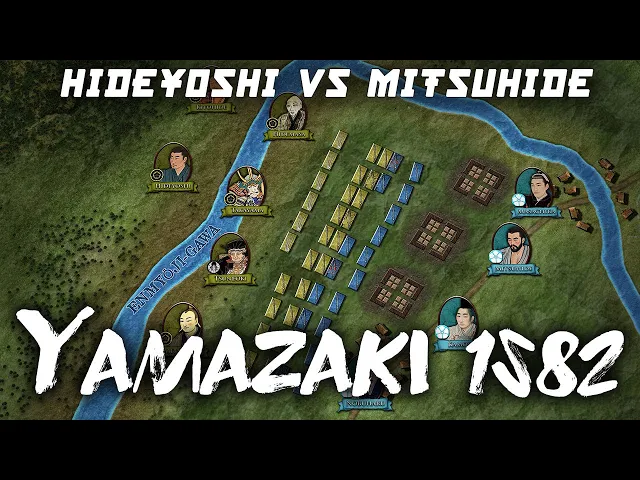
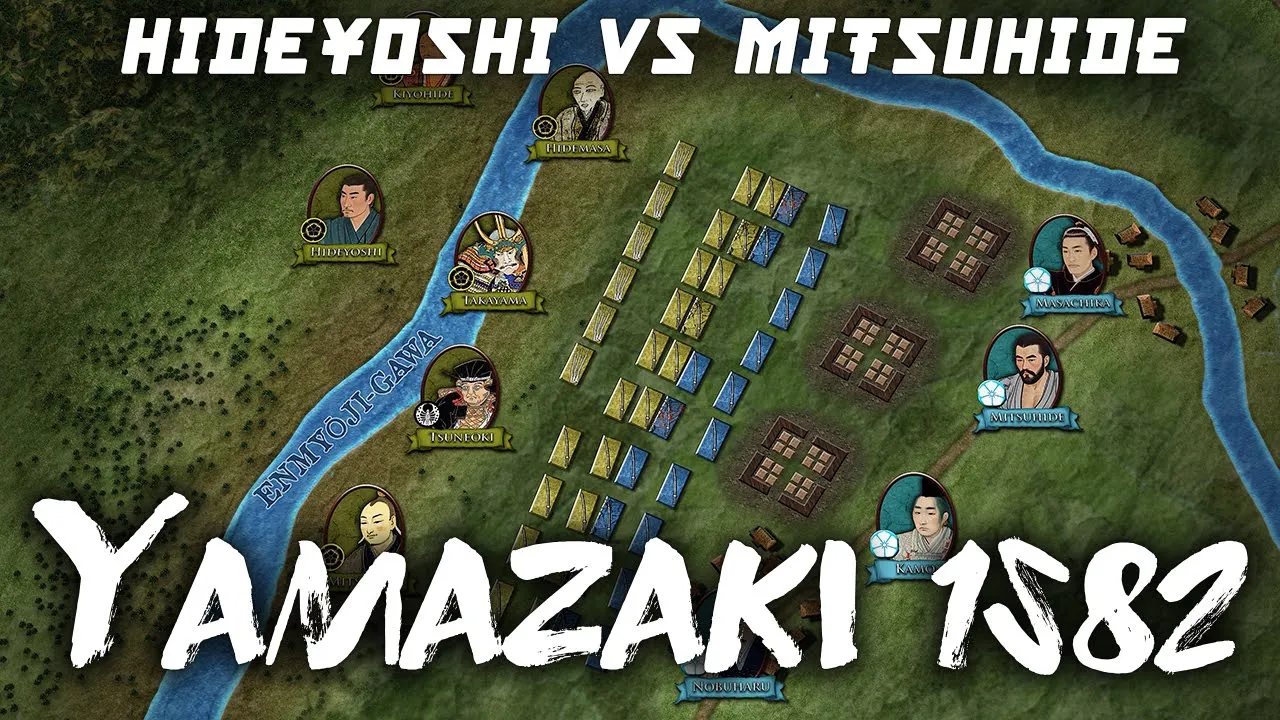
The stage was set for the two rivals to clash when the two armies met near the village of Yamazaki, an area advantageous for Akechi’s smaller army, as the nearby rivers and castles would prevent envelopment maneuvers from Hideyoshi’s larger corps. Upon reaching the area of the battlefield, Hideyoshi realized that the key to victory was the nearby forested hill of Tennozan that overlooked the road to Kyoto. For that reason, he dispatched a regiment under Nakagawa Kiyohide with the mission to secure it, which he did without any difficulties, thus giving Hideyoshi and his army the advantage of high ground.
That same night, he also sent a group of shinobi into Mitsuhide’s camp. The ninjas light fires in huts and other buildings where Akechi’s men were spending the night, causing much confusion among the troops and lowering their morale. The following morning, Hideyoshi deployed his troops behind the bank of the river Enmyojigawa, opposite Mitshuhide’s forces, with Takayama Ukon and Hori Hidemasa leading the vanguard.
The battle began with Mitsuhide’s forces charging forward, the hill of Tennozan becoming a highly contested point. Matsuda Masachika and Nabika Kamon tried to wrestle control of the mount from Hideyoshi’s troops but came under heavy fire from the latter’s arquebusiers. With Tennozan firmly under his control, Hideyoshi felt confident enough to launch his counterattack, ordering forces on his right flank, under the command of Ikeda Tsuneoki and Kato Mitsuyasu, to cross the river and charge Tsuda Nobuharu’s corps.
Despite facing stiff resistance, they managed to push and slowly turn towards the center of Mitsuhide’s formation. At that point, Hideyoshi also committed his left wing to the fierce melee. This proved to be too much for the Akechi forces, who broke rank and began routing in large numbers.
Watching the army’s collapse, Mimaki Kaneaki sent a messenger to Mitsuhide urging him to flee to safety while he and 200 of his men tried to buy some time by charging the lines of Hashiba’s troops. With no choice left, Mitsuhide initially retreated to Shoryuji castle, but understanding that he would be surrounded and would not last long in this position, he attempted to flee during the night with only 20 of his most trusted men escorting him. His goal was to reach his very own Sakamoto castle, but he wouldn’t make it past the village of Ogurusu.
There, while crossing a bamboo grove, he was ambushed by a band of peasants, with a villager wounding him at his side with a bamboo spear. Drwing his last breaths, Akechi Mitsuhide committed suicide, with his head later being recovered and given to Hideyoshi, who in turn brought it to Honnoji, presented it to Nobunaga’s spirit, and then placed it on a spike for the people of Kyoto to see; the fate of a common criminal. Akechi’s 11-day rule was over, but for Hashiba Hideyoshi to rule the land, he would first need to elevate himself above the rest of the Oda generals and Nobuanga’s sons.
While the prestige of being the one to defeat the traitor Mitsuhide was a significant boost, it was not enough. The Kiyosu Conference When Nobunaga died, his eldest son and heir, Nobutada, also perished, which caused a succession crisis between his remaining sons. Nobunaga’s generals were also daimyos and powerful men in their own right, and they, too, could seek a piece of the territory pie as well as leadership of the alliance.
To settle these differences, one of Nobunaga’s oldest and most trusted generals, Shibata Katsuie, called a conference at the castle of Kiyosu in Owari. Besides Nobunaga’s sons, Nobukatsu and Nobutaka and Katsuie himself, also present were Niwa Nagahide, Ikeda Tsuneoki, and, of course, Hashiba Hideyoshi. Katsuie was quick to throw his support behind Nobutaka, who had been present at Yamazaki and avenged his father’s death.
For Hideyoshi to rise above Katsuie, he would have to support Nobukatsu’s claim he was unlikely to win as his reputation was tarnished by military failures. This, compounded by his passiveness in the face of Akechi’s revolt, led many retainers to openly question his ability to lead. Nobutaka’s election as the next head of the Oda clan seemed inevitable when Hideyoshi had an epiphany, left the room and later returned holding in his hands the late Nobutada’s infant son, Samboshi.
Samboshi was the ideal candidate. He was the son of Nobutada, Nobunaga’s chosen heir, and his other grandfather was Takeda Shingen, thus combining two of Japan’s biggest names. More importantly, he was three years old and, therefore, not an immediate problem to the powerful Oda vassals.
One by one, the Oda generals supported Hideyoshi’s proposal. The land between the four powerful vassals was also equally divided, with the exception of Nobunaga’s personal fiefs that went to his sons. Hideyoshi was awarded Yamashiro, Kawachi and Tamba, while Katsuie received Omi and Echizen.
Kyoto, despite being in the province of Yamashiro, was decided to be jointly ruled by all four in equal measure, though Hideyoshi showed more interest in the city and practically exercised greater authority. The Battle of Shizugatake It wouldn’t be long before the rivalry between Katsuie and Hideyoshi would lead to open hostility. Oda Nobutaka quite understandably couldn’t accept the fact that a baby had beaten him for the clan’s leadership and still sought to reclaim his “stolen” position.
Shibata had supported him in the past, and their alliance was solidified through the marriage of Katsuie to his aunt, Lady Oichi, the widow of Azai Nagamasa. Shibata Katsuie wasn’t the only one who thought that Hideyoshi was planning to usurp the power of the Oda clan, and around him gathered many other generals who thought Nobutaka to be the rightful heir like Takigawa Kazumasu and Maeda Toshiie. The Oda-Shibata alliance would have been an incredibly hard obstacle for Hideyoshi to overcome had Nobutaka not given an unexpected gift to his enemy when he declared war in late 1582.
The timing couldn’t have been worse, as the winter snows had blocked the northern roads, trapping Katsuie and the bulk of his army in Echizen. A very grateful Hideyoshi marched quickly to Nobutaka’s seat of power in Gifu and forced him to swear fealty. While returning to Kyoto, he was informed that Takigawa Kazumasu and Shibata Katsutoyo, Katsuie’s son, had both raised their armies and were planning a two-pronged attack.
Hideyoshi first moved against Katsutoyo in Nagahama and, after subduing the castle’s defenders through bribery, moved against Kazumasu in Kameyama, which he captured after successfully using mines to blow up a section of the walls. As spring was approaching, the snow that thus far had kept Katsuie in Echizen would melt, and so Hideyoshi moved his forces to northern Omi once more, where he constructed a series of fortifications in anticipation of the arrival of his enemy. And so it happened as Shibata Katsuie, at the head of his twenty thousand-strong army, marched south and stopped before Hashiba’s defensive line.
Everything had gone according to plan, or so Hideyoshi thought, but as soon as his forces reached Kinomoto he was informed that Oda Nobutaka had once again gathered his troops. Nobutaka’s army posed a serious threat to Hideyoshi’s rear, and if he wanted victory, he would have to move quickly. Leaving behind his half-brother Hashiba Hidenaga with fifteen thousand men and Niwa Nagahide at the head of another two, he raced towards Gifu once more, but cleverly thinking that his presence might be needed, he set up his headquarters at Ogaki, leaving Nobunaga’s other son, Nobukatsu to command the siege.
Meanwhile, noticing the absence of half of the Hashiba troops, Katsuie began besieging the castles. He sent a detachment led by Sakuma Morimasa around Lake Yogo to attack the fortresses from the southwestern approach, while a regiment under Maeda Toshiie provided cover against a possible counterattack. He was thus able to capture the castles of Oiwa and Iwasaki, which were defended by Nakagawa Kiyohide and Takayama Ukon, respectively.
Kiyohide was killed, but Ukon managed to escape. Only the castle of Shizugatake remained under Hashiba control, and Morimasa was determined to change that. Ignoring Hidetaga’s army and orders from Katsuie to abandon the offensive operations and instead fortify the captured Oiwa castle, he pressed on.
When Hideyoshi at Ogaki was informed that Morimasa was besieging Shizugatake instead of seeking refuge inside Oiwa, he famously proclaimed, “Then I have won. ” The following day, he took his cavalry forces to quickly head back to Kinomoto, his infantry marching behind at a far slower pace. He stopped only to assume command of Hidenaga’s troops and to be briefed on the situation at hand.
Then Hideyoshi blew on a conch shell; it was the signal his men were waiting for, and like hungry wolves, they fell on Sakuma’s lines. As the sun was slowly rising behind the mountain peaks, the two forces clashed. Due to the mountainous nature of the terrain, battle lines soon dissolved, a frenzied melee and personal duels taking their place.
Amidst this chaos, individual combat skills would determine the outcome of the battle, and Hideyoshi’s elite horse guards proved pivotal. Seven of these men, most notably Kato Kiyomasa and Fukushima Masanori, exemplified themselves, earning the nickname “ The Seven Spears of Shizugatake”. Meanwhile, Maeda Toshiie, who was observing the events, realized Hideyoshi’s army would emerge victorious and decided to retreat to Fuchu castle, later coming to terms with the victorious Hashiba.
The force of the attackers, coupled with the abandonment by their allies, finally broke Sakuma’s troops, who hurled down their weapons and armour and ran to the valley. Shibata Katsuie, despite seeing them routing, initially wanted to make a stand but was persuaded by his advisors and ordered a general retreat towards the safety of the Kitanosho castle with Hideyoshi pursuing him and laying siege to the fortress. Katsuie, coming to terms with the fact that it was all over, decided to go out as a samurai.
It is said that he climbed to the ninth floor of the keep and announced to his men his decision to die by his own hand. He then ordered the keep to be set ablaze, and amidst the flames, Katsuie and his wife, Oichi, committed suicide. Following the fall of the castle, her daughters came under Hideyoshi’s protection, who promptly sent them to Osaka, where he was building a new and imposing castle over the ruins of the old Ishiyama Hongan-ji.
In a weird twist of fate, the eldest of Oichi’s daughters, Yodo-dono, also known as Lady Chacha, became his wife and mother to his heir, Hideyori, whilst the youngest would marry Tokugawa Hidetada, the second Shogun. Katsuie’s death pretty much signalled the end of the war. Maeda Toshiie had already shown his unwillingness to confront Hideyoshi head-on and now officially submitted to him, while Takigawa Kazumasu bent the knee a few months later.
But what about Oda Nobutaka? Besieged at Gifu by his brother, he was ultimately forced to surrender once more, but this time, Hideyoshi’s capacity for forgiveness had reached its limits. Neither would Nobukatsu show any mercy to a brother whom he considered to be an obstacle on his path to ascension.
Confined at a monastery in Owari, he was pressured into committing seppuku two months later, leaving behind a rather bitter death poem wishing for the gods to punish Hideyoshi. Epilogue However, Nobutaka’s death did not bring an end to the infighting of the Oda camp. Nobukatsu was now rid of his rival sibling, and all that remained between him and the kingdom his father had carved was 3-year-old Samboshi, backed by the Hashiba clan.
Therefore, Nobukatsu would need an equally strong ally to oppose Hideyoshi. His search did not take long as he found that partner in the face of Tokugawa Ieyasu. Ieyasu had perceptively remained on the sideline during the Hashiba-Shibata conflict, instead focusing on securing the former possessions of the Takeda clan in Kai and Shinano provinces.
His military might and ambition matched Hideyoshi’s, and with Nobukatsu on his side, he now had a pretext to advance against him. The following year, the two great men would clash in an epic showdown at the battle of Komaki and Nagakute. We will cover this epic showdown in the next video in this series.
To ensure you don’t miss that, subscribe and press the bell button. please, consider liking, subscribing, commenting, and sharing - it helps immensely. Recently, we have started releasing weekly patron and YouTube member exclusive content, consider joining their ranks via the link in the description or button under the video to watch these weekly videos, learn about our schedule, get early access to our videos, access our private discord, and much more.
This is the Kings and Generals channel, and we will catch you on the next one.