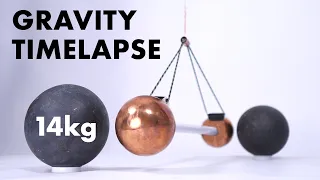
hi everyone so in the last video I introduced the concept of the two types of mass inertial versus gravitational and I talked a bit about the experiments that Newton did um to demonstrate that those two types of mass are really the same or at least proportional to each other so what I'm going to do this time is explore this idea a bit more and talk about the adverse experiment which is an experiment that was done around 1900 so much more recently than Newton's time and the result of this experiment was a conclusion to an even
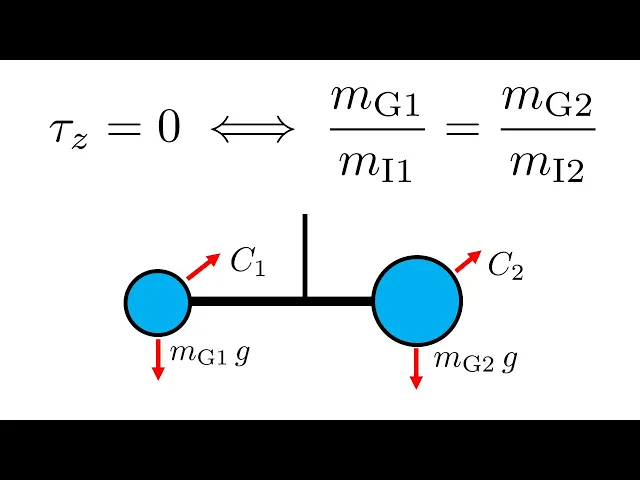
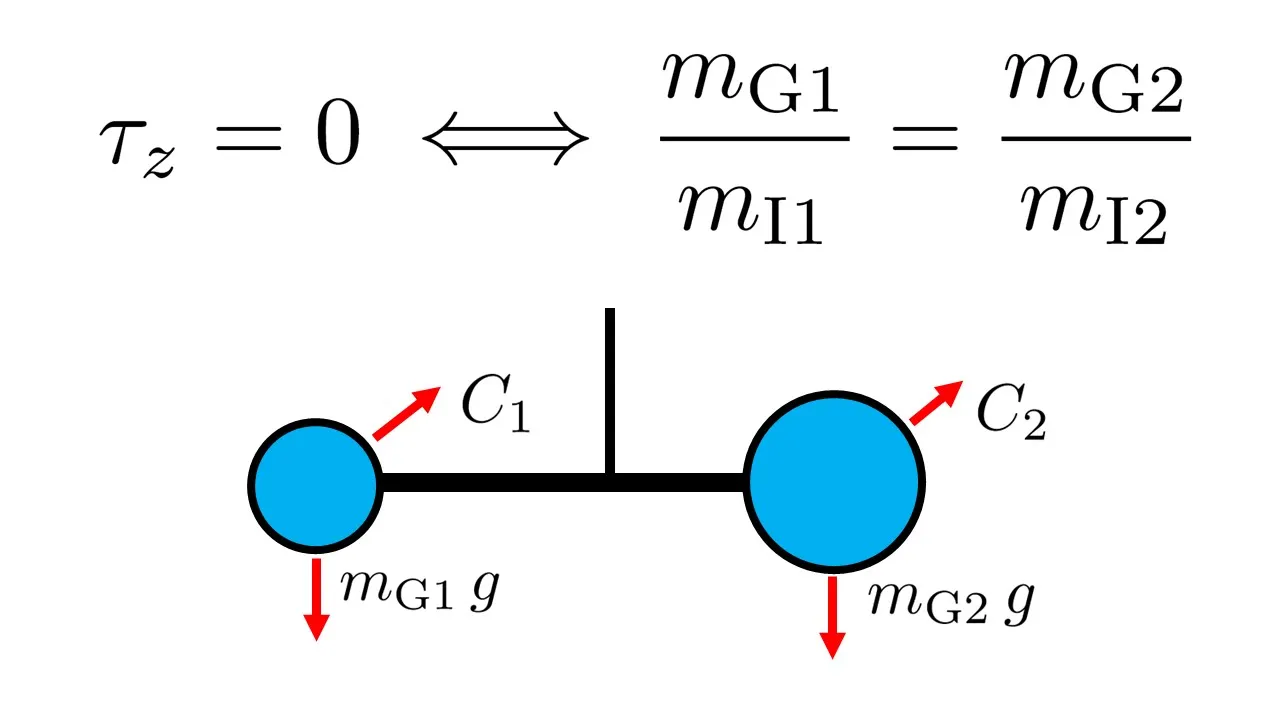
higher degree of accuracy that the initial and gravitational Mass are really the same as each other so we're going to have a look at the setup of this experiment and work through some of the theory behind the experiments so that we can understand how to interpret the results so the basic setup is shown on the diagram that I've sketched out here basically you have a piece of string maybe you want to be more formal and call it something like a torsion fiber but basically some kind of piece of string and from the end of the
string you hang a rigid Rod which is this horizontal line here and at each end of the rod you attach a mass now the masses can be different in fact they should be made of different materials and their masses don't have to be exactly the same I've drawn them as different sizes here um but we're going to end up putting this system in equilibrium and so the bigger mass or the the heavier mass is going to end up closer um to the place where the string joins onto the rigid Rod right and that will result
in a balance of moments so the aim is to set up this apparatus in such a way that it is initially in equilibrium and so our first step is going to be to think about what the condition for equilibrium actually is and of course to do that we need to think about the forces acting on the system and so let's think about the obvious forces first the most obvious forces are the weights of each of the masses at each end so I'm going to draw those on and remember the point of this is that we
have to distinguish between gravitational mass and inertial mass so the weight or mass 1 I'm going to write as M subscript G1 times gravitational field strength where m g is gravitational Mass right so gravitational mass of object one times field strength and then the equivalent for object two which is mg2 times field strength now there must of course also be some upwards tension in the string to keep the whole thing from falling down but more importantly than that this experiment was actually set up in such a way that it was sensitive to certain forces which
are often negligible which are the fictitious forces experienced by well every object that's co-resetting with the Earth in particular the centrifugal force now to understand what direction the centrifugal force is pointing in I think it's best to take a step back from our lab apparatus and look at the Earth rotating as a whole because that is the rotating frame that we're conducting the experiment in and so I've got a diagram down here of the earth rotating about its axis with an angular velocity of capital Omega and here is a not to scale version of our
experiment hanging down vertically towards the center of the earth now just to annotate this a little bit more let's draw a line from the center of the Earth um going straight up to the point where we're doing the experiment under a horizontal line as well uh the angle between those we could call Theta that's the latitude at which we're conducting the experiment and the centrifugal forces always just act directly away from the axis of rotation right so I could draw in a different color to centrifugal forces acting on the two masses let's call them C1
and C2 and they're just acting straight out and like straight out away from the the axis of rotation now what about the magnitudes well we could say the ith centrifugal force where I can be one or two is just to combine them into one convenient expression I'm going to use the standard expression which is Mr Omega squared how can we apply that to this particular example well the relevant mass is not the gravitational Mass it's the inertial mass right because the centrifugal force is a fictitious force that arises due to the inertia of objects so
it's the inertial mass that matters I'm going to say m capital i and then lowercase i weren't that really means inertial mass of object I object 112. um now if the radius of the Earth is capital r then we can put Omega squared here but the radius of the circular motion is not really R right because our object is not at the equator it's doing a circle um whose radius is actually given by R cos these and that just follows from trigonometry rights from there to there which is our cos Theta so this is the
magnitude of the centrifugal force acting on each object it's proportional to the inertial mass so if we add those onto our diagram we could draw them they should be pointing in the same direction right so let's say C1 is going something like that C2 is going something like that remember this is a 3D diagram so maybe we should introduce some Cartesian coordinate axes um just so that we can specify um you know we can we can talk in more detail about components of forces what direction they're acting in if we put the origin of our
coordinate system at this point where the string meets the rod um let's make a right-handed coordinate system where said points y points to the right and X is coming out of the screen then C1 and C2 have in general a component in all three directions right so the C1 and C2 may be coming partially out of the screen partially into the screen although it looks like a 2d diagram right so I've just put that coordinate system there to emphasize the fact that C1 and C2 depending on the angle at which we've set up our apparatus
may have components in all three directions so now let's start making this a bit more quantitative um we're going to take moments remember we said we arrange it so that the system is in equilibrium in particular the most important thing to start with is that there's no net talk about the x-axis right and that basically just means that it's not the case that one of the masses just sort of hangs down and causes the whole system to rotate about the x-axis now to take moments we need to Define some perpendicular distances let's say this bit
on the left is L1 this bit is L2 those are distances measured from the uh the center of our Cartesian coordinate system so what's the equation that expresses the balance of moments well so we just want to say that the um anti-clockwise moment caused by object one balances the clockwise moment caused by object two that anti-clockwise moment um we're going to start by multiplying by L1 and we need to times the perpendicular component of the resultant force on object one now of course there's the weight acting downwards that's M subscript G1 times G but there
is also an upwards component um of the centrifugal force C1 which is acting in the opposite direction to the way so um given that we've said that the upwards component um is the Z component we can write that as minus c 1 Z like we only care about the Z component when we're taking moments about the x-axis um and then for the same reasons our right hand side is going to be L2 multiplied by the weight of object two minus the Z component of the centrifugal force acting on object two basically because the X and
Y components of the centrifugal forces don't produce they don't have a perpendicular distance to the x-axis they don't tend to cause a rotation about the x-axis so we can rearrange this let me write this as a length ratio L1 over L2 is going to be M G2 times G minus C2 Z and then divided by the equivalent but for object one so mg1 times G minus c 1 Z right and so there's this certain ratio of these two lengths for a given set of gravitational masses certain length ratio um that must be satisfied um if
the system is to remain in equilibrium the tension T doesn't appear anywhere in this equation because again T acts through the x-axis so it doesn't have any perpendicular distance the x-axis um I'll also point out that there is not going to be any net talk about the y-axis in other words the system is not going to suddenly start spinning about the axis of the rod because all of the forces act through that axis however it would be worth considering whether there is any net torque um about the z-axis and this is actually the crucial part
of this uh experiment so let's call that talk Tau Zed and write an expression for it now the only forces that would tend to cause rotation about the z-axis would be the X components um of the centrifugal forces C1 and C2 now C1 the X component of C1 is acting in a perpendicular distance from the z-axis of L1 so we've got L1 times c1x and the X component of C2 is tending to cause rotation in the opposite sense so we give that a minus sign and it's going to be minus L2 times the X component
of C2 now we don't yet know what this is numerically it could be zero it could be non-zero but let's suppose for now um that it's zero in other words you do the experiment and You observe that there's no rotation about the z-axis and you can therefore conclude that there is no talk about the z-axis and so let's consider what that would imply well if Tau Z was Zero um then from the equation that we've just derived for tauze the length ratio L1 over L2 would have to be equal to C 2x divided by c
um 1X if that expression is supposed to be zero here is where that expression we we wrote down earlier on for the size of the centrifugal force is going to become relevant because the r Omega squared cos Theta is the same um for both of the masses but the inertial masses um may be different and so if we take the ratio of centrifugal forces or any component of the centrifugal forces that ratio is going to be the same as the inertial mass ratio right the r Omega squared of course these a bit will just cancel
out when we do the division and so we can write that as m i inertial mass of object 2 divided by m i the natural mass of object one but we already have another expression well L1 over L2 that must be true always um assuming that we've you know set the system up so that it balances about the x-axis so we can set that equal to this in the special case where we observe that there is zero talk about the z-axis and all of that reasoning Works backwards right we've said that if Tau Z is
zero then this equation must be true but you could follow all of those steps in reverse and say that if this equation is true um then Tau Z must be zero so I can turn this into an if and only if symbol to say that the the logic works both ways so to summarize so far we have said that the talk about the z-axis is zero if and only if this complicated looking condition is satisfied so the next step is going to be see if we can do any simplifications with that expression and therefore try
and get some insight into what it actually means because it's not obvious what the meaning of that is in the current form so I'm going to multiply both sides by the denominator of the left hand side and I'm going to divide by the numerator of the right hand side now if I do that term by term hopefully you'll agree that you're going to end up with the following equation mg1 over M i1 times G minus c 1 Z divided by m i1 is equal to the identical quantity but with twos instead of ones all right
so m g 2 divided by m I2 times G and then minus c 2 Z divided by m I 2 like that we can then group some of the terms that look similar together put them on the same side by that I mean you've got two terms which are proportional to both the mass ratio gravitational to initial um and so the gravitational field strength G so we could factor out a g put them on the same side and get M G1 over m i1 minus M G2 over mi2 times field strength G and that would
have to be equal to c1z over m i one just by moving the terms around to the other side right and then minus C 2z over um m I2 now we can refer back to our expression for the centrifugal force and as we were saying earlier the implication of that is that each component of each centrifugal force is proportional to the corresponding International Mass so if we take the Z component of the centrifugal force on object one and divided by the initial mass of object one and then we do the same ratio for object two
we're going to get the same thing right because C is proportional to m i and so if we subtract them we are going to get identically zero so here is the key idea of the experiment really right the conclusion is that Tau Z talk about the z-axis is um I'm just giving a head there so equal to zero if and only if um this entire bracketed term is zero right because gravitational field strength is not zero and that implies the mg1 over m I one is equal to M G2 over M I2 in other words
the gravitational to a national Mass ratio is the same for objects one and two now this is interesting because if you do the experiment and you find that there is no rotation about the z-axis then you can conclude that for if you do this for a range of different materials right you can conclude that the gravitational mass is directly proportional to the inertial mass now this is in fact what was discovered in this experiment there was no talk observed about the z-axis the experiment was done accurately by attaching a mirror to the rigid rod and
Shining a beam of light at the mirror and no deflection of the beam of light was observed and the conclusion was of course then the gravitational and National Mass are proportional to each other um universally right for for different materials um but this was done to a much sort of higher Precision than Newton's earlier experiments involving pendulums so that that was the key result and interpretation of this adverse experiment there have of course been other experiments since 1900 um that have basically confirmed the same results to higher and higher Precision so thank you for watching
and see you soon