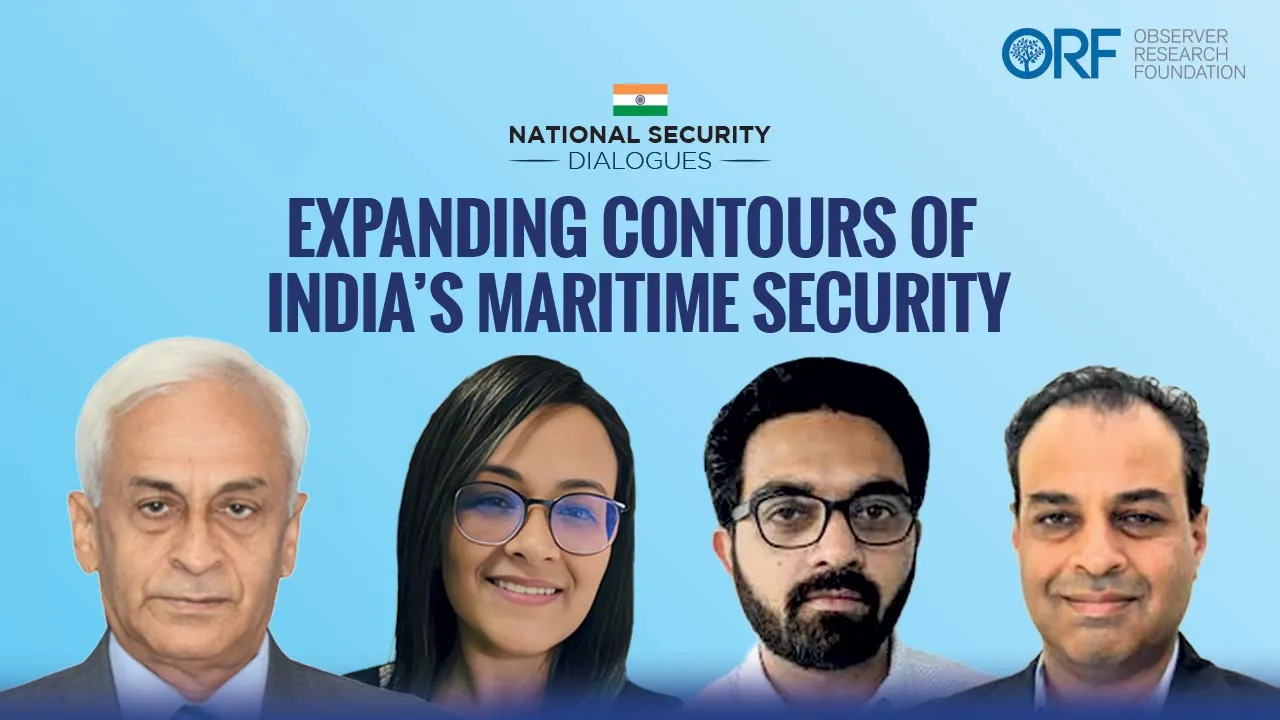
My name is abijit Singh and I am uh a senior fellow here I head the maritime policy initiative uh as I start I would uh first of all I'd like to thank all of you for coming uh on the past two or three occasions that we've discussed Maritime there's been a fair bit of interest but I'm very happy to see that as we are growing uh we are we have more number of people Participating in our events and that's very encouraging uh today's event as I said is on Maritime issues and the question that we
have asked is about India's uh the expanding Contour of India's Maritime security interests and we are saying that uh uh if India is now exercising its uh having engagements in the South China Sea uh as also in the Western Indian Ocean we now have ships that are going across to the Atlantic also and doing anti-piracy operations With EU ships in uh in the Gul of Guinea uh so we are posing the question are is the perameter of our interest or expanding and do we have the capability to stretch ourselves in all of these directions uh
we have an uh excellent panel today to uh debate this question uh I'd like to briefly introduce them uh Admiral Sunil lambar uh he's the former uh chief of Naval staff a very seasoned voice on matters Maritime uh has seen the shifts in policy happened firsthand So I'll be coming to I'll be going going to Adil lamba first uh second uh will be pratar Basu she's a uh analyst with us in ORF Kolkata has looked very closely at South China Sea issues and literal southeast Asia so I'll be coming over to you prri next and
Manu Pabi very well known he's senior editor at uh Economic Times writes frequently on defense issues but has also written a fair bit on India's uh Maritime modernization so uh you'll you'll go third but I'm going To come to uh you first admal ambasa I'd like to sort of pose this question to you that uh there is the sense that we have a more robust uh Maritime posture uh in that we're doing much more than we used to uh both in Maritime southeast Asia as also in the Western Indian Ocean uh but uh does that
have implications for uh Naval policy for you know Maritime strategy capability Etc how do you as as someone that's been uh you know at the Forefront of uh of Naval Policy and Naval strategy how how do you assess India's political stuns at least on matters uh Maritime uh you have the floor sir uh thank you Ajit uh it's an interesting topic indopacific what are the challenges and what have we been doing uh over the past decade or so and what we need to do when we look ahead I'll first talk a little bit about the
Indian Ocean region and then go on to the larger indopacific as we all know That the Indian Ocean is the third largest ocean in the world and Nations along its periphery and hinderland account for 35% of global population and as some of the fastest growing economies in the world and Indian Ocean has part of the larger indopacific has emerged as the S significant drivers for Global growth also the international sea Lanes in the IR and 2/3 of all Global oil shipment 50% of contain container Traffic and uh a bulk of the bulk caros Travers through
the sea lines of Communications in the Indian Ocean region and our Central position in the I site these important uh sea Lanes of the world give us immense strategic Advantage it facilitates reach sustainance mobility of our Maritime forces thereby giving us ability to effectively influence this Maritime space while the geography affords us the opportunity to harness the Seas to our Advantage it also places us the very center of the Strategic churn which is going or taking place in the larger indopacific and the impact on us in the future will determine what is our Outlook and
the choices we adopt today there's an old adage among Sailors that while borders divide the Seas connect so the Navies across the world we Endeavor to build Partnerships Mutual trust and confidence among friendly foreign Countries and the Contemporary Geo strategy space or landscape the Indian Navy provides initiatives the initiatives we have taken over the past decade provides us sufficient tools to the Indian policy establishment to take steps forward in the larger indopacific while we are all aware of the ongoing contest for influence in our region extra Regional countries particularly China have used the combin combination
Of economic diplomatic cultural and Military tools to gain advantage in the indopacific I'm talking about the Indian Ocean and the Western Pacific in particular growing Regional military presence coupled with overseas bases dual use Maritime infrastructure will not only allow Beijing to influence vital sea Lanes of the indopacific at 30 about 375 platforms numerically the Chinese Navy is the largest they have the largest Coast Guard in the World the largest Maritime Malaysia the largest fishing fleet the largest Merchant Marine Fleet they have 42% of the ship building capacity of merchant ships and in The Last 5
Years they have added over 80 platforms to the Chinese Navy which is combined more than the next 10 large navies put to together so at any given year they adding an average of 10 new platforms out of which four to five are destroyers frates and support Ships which are blue water forces including the third aircraft carrier now undergoing SE trial so it's a formidable force and capability which they building it also gives them the ability to interfere with our interest and and cognizant of these changing Dynamics the government and the Navy accorded high priority to
Maritime Security in bilateral relations and have stepped up effort to build a stronger Network in The Indo Pacific there has been a shift to look at Maritime issues in the past decade from a purely Continental Outlook that we had earlier and our engagements in the larger indopacific can be broadly divided under four categories namely capacity building capability enhancement Cooperative engagement and collaborative efforts and we have constructively Engaged with nations in the indopacific to take these forward to build and enhance the capacities and capability for any operations at C is determined and dependent largely on Maritime
domain awareness you need to know what is happening on the ocean above the ocean and under the water and to develop comprehensive Maritime domain awareness the Navy regularly patrols the far reaches of the Indian Ocean region by Mission deployed ships the longrange maritime petrol aircraft the Boeing pii also the sea Guardian uavs that we have and monitor it by satellites the Navy is also set up postal navigation surveillance chains for island nations in the Iowa that is Sri Lanka maldiv sels morus we have set up the international Fusion center for the i in gurugram we
have signed Uh exchange agreements especially for white shipping with over 20 countries which include uh to name a few Vietnam Japan Singapore Australia we are part of the international Fusion Center in Singapore we have had a leon officer there for over two decades and the IR IFC in gurugram they are now International officers also based in that so these inputs are correlated and the maritime domain awareness is shared with our Partners and this is also one of the focus areas of the B and in the statement put out after the foreign ministers meeting in Japan
a month ago this was also mentioned about comprehens in Maritime domain awareness in the indar indopacific we also extended our reach by bilateral logistic treaties operational turnaround facilities and ports we built Maritime infrastructure exercise make a large component the most famous and talked About is Malabar which is now all the quad partners are part of Malabar but our oldest bilateral exercise which has been now going on for over 30 years is with Singapore there also been greater engagement with Vietnam uh at least maybe once at least twice a year ship makes a port call in
Vietnam and there have Been other engagement which I'll cover slightly later in my talk Philippines is also a focus area we supplied them with brahmas a ship recently visited Manila post return from the rimac exercises so there has been a greater engagement the number of bilateral multilateral Tri Services exercises have grown by Leaps and Bounds over the years in the bay Bengal We Carry Out Coordinate coordinated petrol along the maritime borders with Bangladesh Myanmar Indonesia and Thailand and we carry out e at surveillance of island nations of morous and males as they lack the capacity
to patrol the Eed training also makes a key component where we train over 900 Personnel for example when Vietnam acquired the kilo class submarine from Russia we trained six sets of Crews for them also over the years we have Supported Vietnam by sending uh technical teams for repair and maintenance of the Russian platform which they have in the Navies and we've done this for maybe now over 15 20 years is taken place we've given a submarine a kilo class summar on Lee to Myanmar we also have a team which is there helping them to operate
this boort we we send mobile teams for training to a number of countries so this also makes an important engagement Tool uh Hydro Hydrographics is also one thing where we have agreements and a number of island nations we' carried out hydrographic service and lastly we continue you support multilateral initiatives such as ions which is now been close to 15 years in the making but all these initiatives which we have taken need to be backed by hard par if you have to be counted in the indopacific Region we need to invest more in military capability especially
in Maritime capability we need to have a larger force of Blue Water platforms now I'm talking about destroyers frigates um nuclear par uh submarines I'm not talking of the ssbn I'm talking about the ssns third aircraft carrier carrier with the air wings if you need to be counted among nations in the indopacific And as our stake rise in glal Affairs we will need we need to shoulder greater responsibilities in the Y I think I'll stop here and when you have the interaction we can take up more issues we can talk about Aus and all others
thank you thank you sir thank you for that very comprehensive perspective before we uh before I go to PR I have a a question for you uh and that is to do actually with China which really seems to be the driving Logic for uh most of What we are doing in the indopacific region there is this uh perceived China threat and the Chinese you rightly mentioned are modernizing but they're also growing their presence both in the Western Pacific as well as the Indian Ocean region uh my question to you would be sir that do you
uh see that uh that balance of power argument to say that you know we've got to somehow push back China uh that doesn't fully comport with the operational logic of being uh very Proactive uh player in the South China Sea perhaps or in the Western Pacific because the countries in that region do have some reservations against extra Regional Powers uh you know robustly uh projecting power in that region so so do you think there is there might be a bit of a sort of dichotomy there or maybe a contradiction of sorts in that the political
Logic for us to push back China is fine but uh operationally we've got to be careful about what we do in The South China SE because really our sphere of interest and a sphere of influence is the Indian Ocean this is an argument that we often hear from Maritime analyst but what's your take on this sir I agree with you our primary focus areas in is the Indian Ocean region and uh being the largest Navy in the IR we have the capabilities uh to Monitor and um the I and take oper action when if the
need arises I mean you're looking at the South China Sea and the Western Pacific we don't have the deployed in the South China Sea nor will the literal countries of the of the South China Sea would uh be very forthcoming for the permanent presence of Indian Naval platforms but uh we as a Nation as a as a maritime Force we need to provide uh Alternatives and engagements to countries of the Western Pacific in I And that is what we have been doing by say let's take the specific case of vetnam they have economic dependency and
relationship with China they have a maritime disputes over the islands in in the South China Sea they go about uh resolving their issues in the South chiny more quietly than what Philippines does Philippines is more vocal about their push back vnam does it more quietly but over the years we have Supported Vietnam we have provided them capabilities and capacities a number of avenues like I talked about the submarine crew which we have trained supported uh maintenance and upkeep of their Russian platforms and along with qu Partners we need to provide an alternative and push back
so that the UN Clause is followed in letters and spirits and I think that is a role India and the Indian Navy will need to play in the larger Indo Pacific especially in The South China Sea uh Prat can I ask you to make your remarks please uh thank you good afternoon everyone um I think I'll talk briefly about um from a geopolitical perspective the shifts that have taken place in India's uh Maritime strategy and we've seen how over the past decade roughly um uh there has been a significantly heightened interest in the country's focus
on Maritime matters uh which has reflected a shift uh in its foreign policy and uh defense posture And uh the country has done so by recognizing the geographical advantages uh that the peninsula shapee of the uh of our country uh has and it has leveraged this position to enhance Maritime connections and security networks across the Indian Ocean region and uh this shift is also evident in India's efforts to provide public goods in the maritime sphere um which includes assisting as Admiral LBA also pointed out smaller loral nations with managing Their uh exclusive economic zones responding
to natural disasters and so on and India has cultiv Creed um steady and strategic relationships with key Partners in the IR underpinned by initiatives um like the sagur initiative and Maritime Vision 2030 and uh now India's uh Maritime policy has evolved across multiple sectors uh from infrastructure development to foreign policy Outreach to of course strengthened uh Maritime Defense uh collaborations and I think that uh there are four key elements that inform this approach uh one is historical and societal factors the second is of course the maritime geography of the region the third is the political
geography that defines the approaches that all these countries including India Undertake and of course lastly the China factor and uh India strategy uh has evolved currently to becoming a much More comprehensive one than it was previously and it aims to address threats uh that arise both from and within the sea uh preserve Regional preserving Regional stability um supporting the diaspora in other countries uh developing a blue economy and maintaining a geostrategic maritime position that is favorable to the country and uh the Indian Navy has also gradually deepened its engagements with Southeast Asian Nations uh it
has Fostered robust uh security cooperation uh and emphasized Regional Partnerships even for non-military issues um we can see this approach uh as it was formalized in the 2015 Naval Doctrine uh which which acknowledged the uh importance of the indopacific concept and its implications uh for India's Maritime security uh and this marked a shift from the previous focus on the Indian o from uh the previous Focus being on the Indian Ocean uh to one that Now looks at uh broader acknowledgment of the developments in The Wider indopacific region including uh for instance the Red Sea Gulf
of Oman Gulf of Eden and also southeast Asia to the east all of which are crucial to the country's uh Maritime strategy um in all of this of course uh a major transformation has also taken place in the change from the earlier list to the acist policy which has marked a more strategic and a pro more proactive Engagement uh of India with the indopacific uh the acist uh policy emphasizes not only economic integration but also strategic Partnerships and expanded security cooperation particularly in the south east uh Asian region with Vietnam Malaysia Singapore and the Philippines
and uh India has bolstered uh its capacities uh through forward positioning Mission based deployments uh reinforced uh Maritime domain awareness initiatives and of Course uh the development of uh deep water um uh Maritime facilities uh there are um certain challenges however although all of these challenges that I'll be mentioning are you know in different stages of being worked upon by the country uh so for instance um uh India's deepening engagement in the maritime domain faces both operational and policy related challenges which has already been mentioned uh previously and and and While uh the Peninsular geography
of the country offers strategic advantages it also presents vulnerabilities particularly with respect to balancing uh blue water and brown Water Naval responsibilities uh Mission based deployments also uh do sometimes risk overstretching the Navy potentially leading to perhaps unsustainable aable operations but as I mentioned that these are all being worked upon and there is there are efforts being deployed to Sustain these uh initiatives and uh for many years also uh India's Maritime Ambitions have been constrained by uh persistently low budgetary allocations to the Navy um which again is another thing that has been changing over the
years we've seen an increase in this um capacity constraints in India's shipyards also stra train uh the Navy's limited resources and to overcome these India must deepen its defense collaborations Expand its diplomatic engagements and invest more in boosting uh its shipping and uh Maritime trade and and finally uh the indopacific region itself of course is significantly influenced by China's expanding presence and um it poses perhaps the most challenging yet uh promising aspect of India's Maritime uh engagements uh China's inroads through political engagements through Port Investments through military activities have all created a sort of u
a Competition Continuum uh that that is just short of uh full-blown conflict and um I think in response India must uh must engage extend its uh its operational reach Beyond uh the IR um and it it can also leverage uh the several minilateral platforms including of course the quad and other bilateral Partnerships that it has with countries in the region thank you thank you prri before I go to Manu I have one question for you to prri You've looked closely at uh uh you know Maritime security Affairs in Southeast Asia in the South China Sea
what's your sense of how uh countries in Southeast Asia look at India's bolstered Maritime posture we believe it's bolstered but do they think it's bolstered and also relatedly we have uh very clearly been focusing on capacity city building in Southeast Asia and defense trade the ad mentioned the brahos you know Tes Etc we we're trying to you increase our defense Trade in that region uh but is there a logic for India to do much more militarily in the South China Sea you know other than the Philippines at least I don't know of too many other
countries in Southeast Asia that want what they call what they see is extra Regional Powers having much of pres the region but what's your sense as someone that looks at southeast Asia what do you think that they would Welcome India to play a more engaged uh military role in That region or do you think that it's going to be much of what we've seen in the past um I personally think that um uh there is uh there has been a change actually uh in in how the Southeast Asian Nations uh perceive uh presence of any
extra Regional power within their in their Waters if I can put it that way and that includes India also there was much uh a more cautionary U approach earlier but that has been gradually Changing as the countries in this region in the Southeast Asian region also become more and more cautious about China uh themselves and they have also become uh increasingly more vocal about uh China's advances we've seen um Vietnam becoming increasingly vocal we've also seen countries who have been traditionally uh not uh you know inclined to comment or not inclined to take any position
such as Malaysia and Indonesia also speak up At various points in time um with Philippines of course it's a bit different because the Philippines is a treaty Ally of the US and they have uh sort of they have a backing in that respect and we've seen how throughout 2023 uh chin and it continues to to date China and Philippine navies have clashed repeatedly and very regularly in in the West Philippine Sea region but uh coming back to uh how they how these countries approach uh India and increase in India's military presence uh in the region
I think that this while India has to tread carefully uh it will not be met with uh a um a great degree of resistance um because we've also seen how I think it was in May earlier this year that India sent three warships uh to Singapore to Malaysia and to Vietnam and and all the response and the reaction of all these countries was actually a positive one they they welcomed the presence of uh the Indian Navy in their Waters and while maybe uh this cannot happen at uh you know very frequently uh I think that
India should uh gradually start to uh build a presence militarily in these Waters and of course but but that has to also be coupled with the non-military engagements as well that's very helpful Manu I'm going to come to you and I know that you've done a lot of work on modernization and perhaps that's one of the things that you'd like to touch upon But also this point that PR ended with non-traditional security why is it that I mean in your comments if you could also address uh the reason why we are so focused on the
traditional security challenges wherein the real demand for security seems to be actually coming from non-traditional security a lot of these count actually do want to do much more with us when it comes to you know trafficking and over fishing and pollution Etc so you know HR Etc so I Mean uh the military modernization that you talk about also at least uh this is the sense that a lot of us in the room have that caters to the traditional security challenges but isn't non-traditional security also thing that we should be talking about you have the floor
when you know a lot of it has been covered already but I'll just give a my brief understanding of the situation uh the start with what is India's key interest in the Indo Pacific uh I think Politically speaking it is peace and security uh basically for economic Prosperity I think the Indian position is very clear that we want this region to be peaceful so that everyone can have an equitable growth economically and lot of poverty exists in the region and people have to come out of it and an International Peace uh rules based order is
the best way to go about it and the challenge we see in this approach of ours the Indo Pacific is the the big the Chinese and how they are behaving uh their own disregard of international Norms the misinterpretation of laws uh and their expansionist rapidly expansionist approach is I think bringing uh this region to its one of its most worst security situ security scenarios in the past 40 50 years uh what happens in the indopacific has a very clear and direct uh linkage to India's land borders as well and and uh unfortunately India has been
sea blind For many decades it's been changing for the past few decades but we've always been land focused and if we had paid more attention in the past to what Chinese approach was in the South China SE we could have perhaps prepared better for ladak it is the similar model you're using your infrastructural might on increasing on to impose a a boundary change a change which is against uh what is internationally perceived to be right and uh in a sense you know coers a Neighbor with disproportionate power and then try to negotiate uh territory from
a position of uh influence and that's what they tried to do in ladak for us and uh We've shown a little bit how to work on that you stand up against the bully you stand your ground and you know they do back off so uh how is India going to how is India countering this growing challenge that China is posing to us in my opinion we're doing it through Partnerships uh it's it's been Spoken about before uh with the quad initiative and with our bilateral and trilateral Partnerships in the region um we very uniquely place
for that because we are a pretty acceptable country to most of the indopacific partners uh there's not too much Legacy there so we have can of a fresh start with many of the countries uh I think the qu partnership is the most exciting where you're pulling resources to ensure that uh you have domain awareness where four Countries can come together I'm very happy to note that the maritime domain awareness partnership the ipmd is going to be signed uh for has been signed but the enabling agreement will be signed for the Hawkeye 360 on the next
week or so and we are also going to be acquiring the mq9b drones and commonality of platforms like the pis ensures that you know we can exchange information at a very rapid and fast basis uh also uh like mentioned before that India's Approaches to build capacity of like-minded nations in the Indo Pacific I find the Philippines brahmos deal particularly fascinating because just look at what it is it is an indo-russian system sold to Philippines which has a uh American you know partnership in the past which whose biggest enemy is the Chinese uh you know there
was some trouble in this deal initially because the Russians were not too happy with that because they consider China as a Friend but all those things were you know smoothed over just an example of how India can be acceptable supplier of weapons to third Nations here even in Partnership uh you know with say Russia or for example if you do have to offer the LCA to any people in the region it will be in partners with the Americans because the engine is American I think the uh we have done a lot in the past 10
years and the biggest change which I was personally very happy To see was a decision to stop our approach that we will not do lethal weapons exchange uh exports in 2014 before that we had a very clear policy we will only sell non-lethal defensive weapon systems the result of that was China became the biggest supplier of all our neighbors Bangladesh Pakistan Myanmar even Sri Lanka and we have it will take us some time to overturn that but I think we need to uh focus more there um and uh you know on the question Of uh
resources uh that's what uh I want to address also uh you know currently like the Admiral also said we have the capacity to infuence the Indian Ocean region quite recently uh perhaps the merging challenges will make it more difficult we have seen more areas getting activated in the I itself but beyond that I think we are severely limited by a resource crunch uh now this is a question when you you ask a question as a journalist we'll ask a Question to the government or even to uh you know bureaucrats they will always say there's no
resource crunch you go to Parliament records you go to debates press conferences everyone says whatever the Navy wants we will give them and there is no resource crunch but this unfortunately is not the truth uh Whenever there is a requirement from the Navy uh and the uh government does not have money for it they just put it into this bureaucratic Black Box saying okay We'll have a committee to decide for example the Navy has been wanting a third aircraft carrier they publicly stated this for the past 7 years 6 years most strongly over the past
3 years there's been no movement on that and they will never tell you this but it is because at the end it all comes down to money um unfortunately uh while our focus on Partnerships is increased in the past 10 years the budget for the Defense Forces Has been steadily coming down we are at now at about 1.8 1.9% of the GDP which the number itself is good it is not adequate in my opinion to cater for our Disturbed neighborhood and over the past 10 years for example the Navy got 32% of the modernization budget
of the Armed Forces um as its role increases I think this number has to go up Air Force had the maximum share at 45% uh Air Force is still bigger in terms of personnel than the Indian Navy and seeing our Maritime Responsibilities I think is a huge case to increase both personnel and platforms other examples where resarch crunches come into uh capacity building is our project to uh buy new Landing platform docks lpds that program has been stuck for a decade Fleet support vessels are essential to sand ships to South China Sea or further away
they took a decade to be signed up we already spoke about the aircraft carrier the nuclear boats uh are still not signed still not Cleared uh the SSN and uh again I would suspect resource uh uh constraints are behind that on the positive side a lot of good initiatives that have been done in the past six seven years are promoting startups and uh schemes like the idex bringing Innovation to get over this resource crunch having Innovative approaches to meet challenges uh which have not been met in the past which includes you know uh non-traditional Security
and I think in the in the future we need to spend much more on these Innovations we have to increase idex by 10x or 100x you know bring in more money there we also need to utilize the capacity of our shipyards Indian shipyards are severely underutilized right now uh at today's uh date lnt the shipyard is empty a lot of our state front PSU shipyards are empty we have at one hand empty shipyards and capacity to produce on the other hand Partners or Countries in Southeast Asia who need those platforms the in between the bridge
of who funds them has to be uh figured out and I think if we can spend more money on capacity building in our neighborhood uh that could be the way to go uh that's my my view for now no uh Manu you've made some excellent points and I think on this matter of uh capacity crunch that you say uh the shortage of resources I think that that calls for a little more discussion in The room what I would like to just add a little perspective to what Manu has said before I sort of throw this
open for the audience and please feel free to shoot your questions at the at the panelist but this question of resources is very important so on the on the one hand there is the need for us to have aspiration uh not just in the Indian Ocean but in the uh larger indopacific because uh peace time Maritime security is also about perception management it's Also about psychologically dominating your perceived adversaries so you need you need to have presence in their back you know backwaters so if if if the South China sees a Chinese Lake we obviously
need some presence in Southeast Asia that logic is sound but when you don't have Maritime uh capacity uh you stretch yourself thin and the way that uh a lot of Maritime analyst I suppose look at Maritime security the Admiral is here I'd like to hear his Perspective on this but is that these three concentric circles there's there's you know literal security or Coastal security there's near Seas security and then there's far seas and if you're not adding capacity essentially what you're doing is that you're Distributing your resources in all of the three where what you
really need is to have more resources on your Coastal in your near seas and less in the far Seas but when you don't produce in more capacity you Stretch yourself thin so I mean I I would agree with you on that point uh but and I'm going to not throw this the floow open uh but sir uh can I just come to you uh with my first question and as you can as you put your thoughts together there is this narrative sir about the quad and we've pretty much heard uh you know all of the
three of few panelists mention the quad and quad to be honest was actually the uh the the logic for doing this this uh round table Because we sort of thought that uh if there's been a statement uh made at the uh foreign Minister's uh meet in Tokyo that uh you know calling out Chinese aggression and and China's uh aggress assertiveness in the South China see then definitely there's something to it that needs to be discussed but but this whole Narrative of the Quad being a Force for good the the quad being a sort of bullwark
against China uh is this sustainable over a long term because it Seems to sort of append the logic of the Quad which is that it's basically a consultative forum and it comes up with options for Regional countries uh you know development uh uh creating connectivity on on technology on climate change and and a number of other areas but if you militarize the quad uh could it be counterproductive in in the long run uh your your view on this sir among the quad members uh we are the only country Which has a common land border with
China which is disputed okay all uh the four members of the Quad are economically linked with China whether you want to college as suppliers importers across the Spectrum even India's trade with China has gone up despite galwan and the ban which were put in this a whole lot of issues so in my view I think we are a very long wave from quad having a Military segment or an element to it I think the biggest ners in all this would be uh would be us only because we have a very different security challenge Visa with
China than the other three members of the Quad so at the moment what the quad has been trying to do is you have come together to to push backs see that you have a free and open rule based order in the Indo Pacific and they have identified a Number of nonmilitary avenues which can be used to focus and get cooperation amongst the nations of the Western Pacific and the island countries in the Pacific and that is how the quad is going to go ahead in the firstable future that is my opinion I don't think so
there is going to be an military element to the quad there has [Music] been uh in the dialogue which took place With the United States in the past there was a suggestion made from their side of having a joint Patrol in the South China Sea which was a complete no no for India you're not going to do that you are just poking uh the dragon in the eye over that issue so so this is how the qu is going to develop you're going to give avenu you're going to talk of fre and open this thing
but I don't think so there is going to be a military element and the Standing Maritime force of coordinations and all that for the first right thank you sir that's very helpful uh the floor is now open for comments and questions uh please if there's anyone yeah ofon sir I am Colonel vid Sharma sir I am a serving Indian army officer currently visiting research fellow with ORF my question is to admin lambar sir sir there is lot of gas work with Respect to uh the Chinese probable Invasion or the occupation of Taiwan where people are
saying there likelihood by 2027 or different different timelines are being given and one of the reason uh that has been stated by many expert is that the China is yet not ready to undertake the complex amphibious operations which are required to take over an island territory like Taiwan it's quite large so uh I just want to know your Views on that with respect to the Chinese capability in case required to take over militarily because of this amphibious operations complexity involved and the second is uh with respect to the lots of feeling of regret with respect
to Indian inaction when the China occupied tibot in 1950 A lot of people who suggest that India should have done this and that and whatever uh things and uh multiple Regions are there but we still regrets and the repercussion of Chinese occupation of tibbet is still being faced by us now the second question is with respect to Taiwan contingency now do you Enis any military role especially the naval role Indian Naval role in the in a contingency where the China invades Taiwan it may not be direct Military Support there are multiple things which can be
done especially in a situation when uh The China is not respecting the Indian security interest whether it is support to the Pakistan or you know about all these things they are openly supporting our insurgents the northeast or supporting the anti- Indian forces all along our periphery in our neighborhood so they are not respecting that the or they're not reciprocating that feeling of friendship what we normally say and it has been done so your view on that uh do we envisage any Military role if yes what could be that just take uh one or two more
questions and then we'll go to the panelist so yeah at the back there I I just saw your hand yes please the question was that there are a number of accidents that the Navy has had to face up in the recent few months perhaps few years and uh is that bad for our reputation as a blue water Navy that's essentially the question but I'll take one or two Questions more and then yes please good evening Admiral lamba um my name is rajes I'm presently your lamb fellow uh my question is regarding as we expand our
Maritime interests beyond the Indian Ocean when we look at our Maritime security from from a coastal standpoint our Coast Guard pays a significant role when it comes to protecting our immediate borders but our Coast Guard has been significantly underfunded in terms of recruitment and also in terms Of infrastructure for many years now so as India seeks to expand our borders be for our Navy what do you think should be the focus for the Coast Guard because it appears that we will be placing a greater burden on them for our uh more local domestic security issues
right this is a question that I would like both ad lamba and you Manu to comment on on the state of the Coast Guard you know the the the fact that a lot of the Maritime security discussion Revolves around the Navy and perhaps the Coast Guard should get more importance than it does because it is increasingly playing a bigger role in the National Security Matrix so that's a very valid question yes sir one L sir my question is regarding recent statement by prime minister shik Hina about St Martin island he said it was to be
taken by us she refused it and that's why it happened so do you think it has implication with Indian Ocean Also India how India is going to react it thank you um so my question may not be as technically nuanced as everyone else but my question was particular to Mr Manu um which is do you think um we can use soft par in influencing for soft par in the sense journalism in influencing um a a stronger Voice or influence in Maritime Affairs in Southeast Asia Shi I would like you to to give your views on
the Taiwan question because you look at that area And what's your sense of what's happening between uh uh between the US and China on Taiwan and also what are China's real options there you know VI has asked a very very good question we here in India don't seem to give enough emphasis on that uh on that dimension of Maritime security but uh we'll hear but I'll but a lot of questions were addressed to you admal so I will come to you sir first uh you can start with the Taiwan question question then the Accidents that
have been happening uh Coast Guard uh St Martin island so four questions actually for you okay thanks um as for as Taiwan question I think U an amphibious Invasion across the taian STA or any large scale amphibious operation is one of the most complex military operation Any Nation can Undertake and in my personal opinion this is all Bluster I don't think So Invasion amphibious Invasion across the Taiwan stait as long as Taiwan doesn't declare itself to be independent and this thing of 2027 and Shi Jinping and all that the the probability of of it happening
is very low the cost of failure and loss of face to the Chinese or the pla Navy and the Chinese military establishment and the CCP is too high and the risk too high for them to undertake an operation like This okay and it's not I don't think it's going to happen in the near future they may talk they may carry out violations of the s space and number of flights across have been increasing over the years and all that that will go on but I don't think so there is going to be a physical Invasion
across the taian trade to overtake Taiwan that's not going to happen I think the issue of tiet was also rais I think it's too late to Regret its history now okay so there's no point lamenting over it tiit is a part of CH China is going to remain so what there also what milit role will India can play in case there's an invasion across the taian state the blunt answer we have no role to play and I don't think so we have the capability and capacity in the near future to play any role in that
conflict across the states and I don't think so Indian the Indian government or the security Establishment will initiate any action across the land border to draw out forces or this thing very unlikely in my this thing I'll come uh to the Coast Guard I'll take on the uh issue of accidents last uh post the terrorist incidents in Mumbai on in 2009 there has been a great deal of focus and expansion of capability and capacity of the Coast Guard there has been set up of AIS chain right across uh Coastal Coast Line including setting up a
radar chain which monitors the entire Coast the number of Coast Guard stations have gone up over the years a sure their capability in force buildup has also taken place including in aviation platforms so overall the capability and capacity to Monitor the Inland Waters of the Coast Guard has increased over the years also coordination for Coastal security issues between maritime agencies is also much better today than what it was over a decade [Music] ago um budget is limited across for whether it's for the Defense Forces or the Coast Guard should we invest more in Maritime Capability
in the Indian Navy and Coast Guard the answer is are definite yes but the government of India needs to find that money and invest in it St Martin's Island I don't know it's a political issue means I I don't know whether what sikina said is true or not and whether there was the American issue of getting St Martin's Island to set up an air strip or an air base [Music] there I really don't know what is behind It they have a base in Doo Garcia where the long range aircraft operate from and uh this is
the first time I have heard that they were looking for some facilities in the northern part of the Bay of Bengal the last issue of accidents uh in the Navy there have been accidents in the Navy there's no denying that but being a large Navy our accident rates are in line with any navy of this size Okay a ship is a dangerous uh environment and platform where you mix explosive highly inflable material on board and uh in case standard operating procedures are not followed by the crew markably well over the years and or overall when
you analyze our accident rates with other large navies I think we are much better off than it uh what should be do to prevent accidents I think there need to be greater focus on Operations of standard operating procedures check list and all that so that these don't take place and happen and in case they do take place then we should be able to Able for the crew to be able to fight say like the case of the fire on brahmputra uh I can say they did a remarkable job in putting out the fire but then
there was an issue of stability lack of stability in the ship when he tobl over and landed up on our side so there needs To be a focus on standard operating procedures to prevent any accidents taking place and there me a need to focus on training and moral thank thank you so that that's very uh that's very interesting particularly the the point that you made about the Hazardous uh conditions on a ship and there's a number of uh naval officers who wrote uh about uh uh this reality uh at the time that the accident that
you mentioned happened uh and uh this is something you Definitely got to consider that navies around the world have accidents it's something that you've got to live with and that's because in a little space you're all cramped up there's ammunition there fuel there's everything Admiral makes a very good point about uh the fact that uh you know we've we've got to somehow ensure that we have the Sops the protocols build up that we reduce the accidents but you can never come to a position where there's where you're Having no accidents at all uh accidents are
a part of life and you're in a in a force like the Navy or perhaps the Air Force but I'm going to come to you uh Prat nishri and I'm going to ask you to please comment on the Taiwan issue uh what's what are your thoughts about what's happening between uh between the US and China and also do you think that India the Indian Navy perhaps will ever ever play a role in in in in what's happening in that region thank you for The question um I I would agree with uh Admiral lanba in in
in the fact that uh not in the re near future uh is there a possibility of the Taiwan contingency actually playing out uh but having said that um Chinese gry Zone tactics or salami splicing Strate IES however one likes to put it that will of course continue and in all likelihood China may even step up the frequency of its activities we've seen the same in the South China Sea it can happen in the Taiwan Strait as well um there was in fact another recent incident uh I forget um uh in which month uh but of
CH of a Chinese vessel coming very close to another tanes vessel uh near the typing Island so these kind of incidents will uh likely continue and China is going to constantly uh try to uh use its gry Zone tactics to establish its claim as it has been doing for uh many many years um uh but in all of this uh again I would say that uh of course India's role uh is is Very very limited uh perhaps what India uh may do uh if if instances instances of grone tax scks increase is that India can
um bolster its security along its northern borders because as of course Admiral again pointed out earlier that of we are the only country that shares a land border uh with uh China and a longland border at that uh and of course other than precautionary measures uh of uh you know being ready uh being uh strengthening its positions and so on I Don't think that there would be a greater role that uh the Navy can play first I want to take on the question on accidents yes there have been accidents and we have been writing about
them a lot and uh they do you know show uh they do sometimes CRI negative impression but the good thing is in India you can write about accidents sir said there's no accident free Navy sir so the Chinese Navy is accident free they don't techn knowledge an accident so at least we Having debate here we talk about accidents and the correc measures are taken and a lot of accidents which happened in 2013 14 were because we had upscaled tempo of operations post 2008 uh and uh uh and I think it's good that we talk and
write about these accidents and I see corrective actions taking place so that's put the yeah so I think uh this is more of an exception than the norm because 201314 was a series of about 15 accidents which happened this Is a we still to see hope hope there they're not repeated here on the Coast Guard question I think there's a huge case for it to be uh unfortunately for a long time Coast Guard has been seen as her under the shadow of the Navy they've not been given independent role uh now for the past few
years we've had uh director General of the Coast Guard who are from the service unfortunately uh you know we had a inservice DG pass away a few days ago and but since that there Has been renewed focus and the Coast Guard's capacity has increased though there is a lot of scope to do it further more and I think the Coast Guard has moved proposals to increase their aerial capacity they're the only Force right now which don't have access to drone systems I think they should be given drone and counter drone capability uh so there there
are thoughts on that but it will require G resources to do um uh just a little thing on the Taiwan Question I mean I really don't think India can intervene directly but I think the most we can do is maybe have limited overflight or Logistics support capacity if you know there are things going through but I think what happens in ladak will can show what's going to happen in Taiwan if the Chinese really want to make a lot of Peace in ladak which they are trying to do now with the peace deal they're trying to
push back and solidify uneasy peace that could Give an inclination that they want to open up another front I don't think they would want two fronts open at the same time uh on the question of soft power and India's influence operations uh uh we have seen the role that you know Central uh like State supported or you know country Medias play BBC what Alia does uh India can have a lot of role to play in the in the Indo Pacific uh there are India's media is acceptable we have the language is English we have a
lot of Diaspora there but I have to say unfortunately the Indian media has failed the country in this we have uh it is I'm a bit ashamed to say this but that is how it is there is no Indian correspondent in any of the major indopacific capitals uh we have no mainstream newspapers or channels investing in sending permanent reps there in Delhi we have representation from 50 to 60 countries at least including from Japan from uh Taiwan from A lot of the indopacific partners Australia of course we don't have any people there and it's a
failure on the Indian media's part because it is seen as a commercial Venture do it's not making commercial sense to send that I think if the government pushes that more uh we should have our presence there and I hope that happens in the future thank you man that was uh very very uh ay tackled all of those questions I just want to make one observation before I Just open this up for another round our last round of questions please keep your questions ready so I I want to say that uh I attended a conference uh
in Vietnam a couple of uh months ago and uh a participan made a very interesting observation which he said that one of the things that we seeing happen in the indopacific region particularly he said when it comes to uh southeast Asia is that uh there is this uh Confluence of thought that is happening and a sort of Alignment conceptual alignment in that we agree on certain principles and there was a time when there was just two or three countries who were willing to oppose China but now principally whether it's freedom of navigation freedom of overflight
loock security rules based order uh and I would say that that applies also to the Indian Ocean region uh that there is this uh common narrative uh and and a common sort of appreciation of each other's challenges So I think that's what is driving indopacific Synergy uh the important thing is that we going to uh inevitably work towards greater interoperability between navies between coast guards but the point as some you know American colleagues pointed out it's not that you're interoperable the point is I you willing to work as an interop operable unit meaning are you
willing to integrate and work together because you know even when it comes to the China Challenge unless you don't develop those habits of cooperation of working together all of that interoperability actually you know uh is is pointless so uh so on that I will have to sort of agree that uh we are developing greater Synergy we are you know quad comes up we do a lot of these exercises the Malabar exercise happen we are in much better place than we used to ear here but we are still not where we need to be so that's
one of the things that that we Need to bear in mind of course the most important thing as Manu has pointed out and very correctly is the capacity constraint we've got to have our priorities right about where we need to be focused and I think uh adal also mentioned Indian Ocean is perhaps where we going to be primarily focused on but we also going to see what we can do in terms of pushing back China in in the Pacific but I'm going to open this up for another round of questions please Keep your questions ready
because after that then I'm not going to go to to open up uh the floor again yeah hello sir uh sir my name is hiroi Kalita currently pursuing Masters in international relation at southan University sir my question is uh for Manu sir sir as we uh historically we have seen that 50 to 60% of the defense budget allocation uh has been gone into uh the paying salaries and pensions of our Armed Forces uh and to reduce the long longterm pension Liability few years back the government has come up with the agnipath scheme so after the
introduction of the agnipath scheme can you see any changes did it bolster our capacity building in Navy or how do the Navy and the martime security has been impacted by after uh introduction of that scheme so uh yes sir this is my whole question this is not a question that's directly related to Maritime security but I'm still going to ask ad lber to address this question In case you have any views on agnipath and does it in any way help us in in building capability but uh the second question uh would be you yeah please
am I audible yeah hi I'm sash I'm a lamb fellow so my question is India's foreign policy has traditionally emphasized strategically uh strategic autonomy avoiding alignment with any major power block however increasing like the panel also talked about increasing Maritime engagement in the indopacific especially Through mechanisms like quod May challenge this stance so how does India's engagement in the indopacific maritime security architecture sort of aligns with its broader uh strategic autonomy goal and what are the sort of tradeoffs we're looking at uh through this I understand you correctly you kind of pointing out that there
is a bit of a contradiction between having self autonomy or Haring on your self autonomy and then saying that you know you're Going to be present in in spaces that are extra Regional to to you and perhaps somebody's backyard does that not impinge on their strategic autonomy is that the question that you asking also our strategic autonomy and also what are the trade offs we are looking for looking tradeoff that you're looking for again this question would I would ask Admiral lamba and you Manu to also look at uh yes good evening Sir good evening
Admiral Sir uh I'm there from University of Delhi I'm pursuing masters in political science uh sir I had a question since uh the past uh year there had been uh repeated questions about the impact of Western cord the i22 and um it's and shifting interests of USA and India towards i2u so would that in any way impact the significant role of quad in the IR and um their shifting interests from the I region to since the countries the four Quad members have intrinsic economic ties with China so uh would that in any way you know
make them rethink about focusing on I or strengthening uh Western Gold thank you sir right this is a good question and to this I'm going to actually add a question which prsh you should answer about the squad the squad which is the Philippines the US Japan Etc I mean those four countries what uh uh does that in any way clash with the with the quad's agenda I mean there's Been some writing on on this or do you think that they are complimentary and they can uh you know you have uh quadrilaterals of this sort I
to to Quad Squad Etc they can all work together what's what's sort of your view on that but there was another question that someone wanted to ask yes please thank you for the discussion my name is sidhant I'm a research associate at natad and we've discussed a lot with on regarding Indian Naval deployments in The SCS so if and when that becomes more frequent what kind of Chinese response can we expect is that something we are preparing for excellent I think sidan asked the best question so far how do you think China is going to
respond to this is J China going to take this very kindly to India's interventions I I wouldn't sort of uh call them interventions uh up until now it's just engagement but you know if we do much more with quad countries in the Western Pacific it could border on on interventions so and how what would be China's response to this uh anyone else that has a question yes please hi my name is San I'm from cips J MPS scholar my question is with regarding the resource resource crunch if we really have such resource CR with capital
expenditure for the Armed Forces why don't we get bring out a scheme like our NH does which which rolls out treasury bonds to fund such Expenditure because as we all know not only Navy but also the tri forces all of as long as Coast Guard all of them has huge requirements they which they can't fulfill with the current budet budgetary constraints so if we can allot the present capital expenditure which we are doing for a expanded out long timeline scheme of which which are supported by treasury bonds and which are funded through public you know
know in like a retail investment like People pitching out like during emergencies we collect National Security bonds and all the all the other things if we really have such a huge requirement why don't we do that as of right now because that way our Capital requirements can be fulfilled with uh the interest payments and it can be the payment for the capital capital equipment can be stretch out for a long time 20 30 years even more than what we are capable right now through the Regular funding yeah that's a radical suggestion I um haven't come
across many examples of this I don't don't know whether there any countries that float bonds to support the military but perhaps uh the uh panelists have a have a view on this but there was a question from a naval officer yeah good afternoon I'm left Commander nikil my question was while we definitely it was it was to all the panelists U the Question is while we definitely need a stronger Navy and Coast Guard there is no doubt about it but all these developments historically depend on the kind of objective that we have so historically it
has been protection of trade or influencing uh things influencing things ass sure so if the my uh if uh the panelist could please enlighten on what are the Chinese stakes in Indian ocean region Visa the Indian stakes in the South China Sea because we have been talking about should India be in the South China SE so it it would definitely depend on whether we have a stake there so the enl if the panelist could please enlighten on that uh just on this question I think uh uh this is a this is a good question and
I I'm going to add a couple of lines to what the commander just pointed out the fact that the China actually does have two different strategies for the Indian Ocean and the Western Pacific the Chinese are very aggressive they they call it full spectrum dominance in the South China Sea because it's their backyard but in the Indian Ocean they're not as aggressive uh in the Indian Ocean they have more of a uh strategy where they want to uh engage with regional partners and they're not actually looking to operate in any other country's you know territorial
Waters EES they they're not extremely provocative so given that there is a Difference in the way the Chinese operate uh should India recognize that uh there's limits to how much we can push back China in the Indian Ocean because really what they're doing is is is not illegal it's not something that's barred in international law so I mean this is just a point that uh that that the panelists could could sort of consider and talk about but I'm going to come to you uh uh is there another question uh my question is to Prat Nishi
Uh Japan uh the country of Japan from at least from the last decade has been trying to put some emphasis on the indopacific ranging from Shinzo ab's convergence of two SE speech in the Indian Parliament to um kida's efforts in the uh he's trying to put the efforts in the Indo Pacific and the claims that US Navy spread all across the uh Seas or oceans across the world so is Japan is Japan doing something which is commendable in the Indian uh indopacific Indo indopacific sea or all the attention which is required uh in the indopacific
has been deflected towards Ukraine PR the question is about Japan's indopacific strategy and what should India make of it and would could the Japanese play a more robust role in in the Indian Ocean they are fairly involved in maritime operations in on the Pacific side but but on the Indian oceans but but I'm going to come again start with uh you Admiral lamb if you can uh address some of these questions um perhaps starting off with the agnipath scheme okay it's a wide range of questions with a wide range of coverage okay see uh my
view on the Agway scheme is uh we have security challenges on our land borders uh we have a large standing army and uh if you have security Challenges you need to have military capability which needs to be there up and standing to meet those challenges whether they are on a land borders or on a maritime Frontiers and a maritime interest and for that uh the nation needs to find uh the budget to support and build that military capability okay if you are not not willing to find the money and build that military capability then you
cut your Cod and you talk Accordingly with what capability you have okay uh it is too early to tell what is going to be the Fallout of the agnir scheme the initial analysis which the Navy had done the scheme was introduced post my retirement so the what I know of the initial analysis with the Navy had done with the scheme in its present form was that it doesn't work for us we need technically trained manpow with experience to man platforms and operate the sophisticated equipment Which is fitted on board the real effect of the agnir
scheme on operational capability will come out in 7 to 8 years time where majority of personnel Manning platform forms and in units across the three forces will be aniv okay uh in my personal opinion in the long run um at the moment uh it's going to affect capability and capacity within the Armed Forces um but I'm quite sure the if the scheme continues in its Present form or there are going to be changes in the form if they increase the number of retentions from from 25% to over 50 I think the scheme will work and
uh I don't think so they will be effect on the operational capability but in case it continues with the 25% there may be an effect on operation capabilities across the board in all the three services this is my personal opinion okay uh strategic autonomy and Engagement and all that yes there are always trade in international relationships in across the board by being a member of the Quad or exercising uh with our partners in Quad and other nations like you take the issue of strategic aomy autonomy and what we have done during the Ukraine war and
the purchase of Russian oil just to our advantage okay so in international Relationships uh it's very unlike that India will become an alliance partner with any country I don't foresee this happening the present setup and the thought process which is there in the government of India for the past 78 years so we will exercise strategic autonomy we will be one of the issues which was to provide an alternate issue to brri to have interconnection between India the Middle East through Israel and onto Europe through the med it's an alternate route which I think would be
much cheaper to execute trade and ex and ex exchange of goods other than the B route which is going through from China through Central Asia going on to Europe okay so these are G these provide options to bring different countries together on platforms to take National interest issues forward in more cohesive [Music] Manner India's deployment and uh China's response in the Indian Ocean region see uh Chinese have genuine security interest in the Indian Ocean region a very large segment of the trade transits the slocks of the I whether it is the trade from China going
to Europe or there are energy deficient a large segment of the oil is imported from the Middle East which goes across the Slocks so they have security interest and vulnerabilities in the I okay they are much more uh robust in within the Western Pacific within the first island chain and the second island chain and they have a challenge there in the Western Pacific they have they have to break out from the first Island and the second island chain where in India's case we have a free run from a coast across the I and there are
limited Chinese capabilities To have longterm deployments in the I the only nation or the only Navy which has a global presence and the ability to op one facility which is there in jibuti okay so there are vulnerabilities and challenges in the I and they are more robust in their own backyard in the Western Pacific because they have issues and we also have vulnerabilities of a trade which is coming or flowing through The South China Sea so we have to balance both the do what we can do and what we need to do in the future
uh this idea of having bonds uh to get over the resource crunch I no country has done this uh I don't recollect but I think there were some bonds floated in the second world war in the United States if I correct but ultimately whether bonds or whatever you want treasury bills it is the government borrowing money which will Have to be returned uh sometime in the future so if you want to fund uh the capacity and capability building we need to government of India needs to find revenues in whatever ways in the form of raising
revenues and I don't think so this idea of having treasury bills or bonds is ever going to be taken up to fund defense budget because ultimately the money has to be returned to the borrowers that is you and me will Be funding these treasury bonds Japan um they we need to be cognizant of their constitution they've breached the barrier of the limitation of 1% of the GDP in building the Self Defense Forces in all the three elements I think there is a greater focus on spending money and building military capabilities in the challenges they are
facing and they are now more proactive and operational beyond their home water than the West and I think as time goes By you'll see more and more presence of Japanese military capabilities in the larger Indo Pacific I think I have covered most of the points uh raised yes thank you thank you I know that was uh quite a menu of questions but I'm going to now go to Prat prri we want your responses on three questions and short responses will be great uh one Japan the Japan question Japan in the Indian in uh indopacific the
squad question uh and uh the Chinese response To Indian uh operations in perhaps Western Pacific South China Sea three question questions for you uh yes thank you I'll be brief um regarding uh Japan in the Indo Pacific uh Japan has actually been present in across the Indo Pacific region in Southeast Asia in particular and later on in South in the South Asian region as well for many years much before even China entered with its infrastructural Investments and Japan uh I think if we are to consider For instance their free and open indopacific Vision uh which
was articulated by AB uh much before that this principle has its roots in how Japan has civilization engaged uh with this region so the foip is an articulation of the same and so Japan has a lot of interests in uh the indopacific it wants to maintain a free prosperous peaceful Indo specific based on uh with with strong foundations uh on on a rules-based order and Japan has Been doing a lot to uh to to to uh to maintain this to um show its support for this uh two key ways have been of course through its
developmental Assistance programs its ODI efforts and also internally gradually you know changing their own uh Constitution uh the reforms process of their constitution from a pacifist one to a one that enables it to engage militarily more uh overtly with countries in the region so the recent uh official Securities assistance act for Instance is a case in point coming to Squad uh I don't think that uh Quad Squad and other such arrangements are uh contradictory to each other I think they're complimentary uh the squad for instance uh and even AOS uh if if if that can
be mentioned these are all more military ones than uh the quad simply because these countries are aware that India will not engage in uh an open Alliance or or or an overt military Alliance uh grouping uh and which is why Uh the quad uh particularly focuses more on functional cooperation aspects uh which uh while they have a strategic Dimension they are based more on issues like climate resilience issues like cyber security digitalization and so on um so so they're not they're not conflicting at all whereas quad and other partners ship are more of uh of
a military nature uh regarding India's interests in the South China Sea of course trade is an important aspect and Second is from a geopolitical perspective India's support for a rules-based order freedom of navigation and so on India's uh uh I think presence in the South China Sea diplomatically and from a AAL perspective are all in support of these two uh principles finally if I could also uh respond to the question on strategic autonomy uh I don't think that they are the Strategic autonomy bit and India's engagements are contradictory in any way because Strategic autonomy does
not mean strategic isolation and as uh Minister J Shankar has pointed out on several occasions We are following a policy of multi-alignment so in uh forming engagements and forging and cultivating engagements with countries not only in our immediate neighborhood but also the wider indopacific region is part of our foreign policy thank you that was that was brief uh thank you uh now I'm going to come to Manu few things on the defense budget and the agnipath scheme I think ad is very beautifully captured the operational part of it but yes there is no doubt that
the ballooning pensions budget especially after orop was implemented uh was a big burden so there's two options to it either you reduce the budget or you take it off the defense front and you show it as general government pensions but yes it is a factor uh operational things will be Known in time as Sir said I think Miss Basu uh address the trategic autonomy thing well on the i22 and other formation Squad why are are we seeing all these multilateral smaller engagements I think the bigger question there is because the UN is defunct today the
UNC does not work we need to change it we need to have a whole new way of power which is not working that's why we seeing a much more of these things I think we'll see more of them in the Coming years uh for countries like India who don't have a voice in the UNC permanently um Chinese response to India going to South chinaa I think will be more alignments here they'll make bases around us they'll probably want to make a permanent base in Sri Lankan if we do go more into their territory we going
to be see that the String of Pearls will become actually real they will actually have basis right now they only have influence mostly uh on the treasury Funds thing I think it'll be political suicide for the government if they go for that because it'll show that you don't have money to you know fund your forces which is no works for you so I don't think they're going to do that but they were trying some other Innovative measures which was one was a fund which H had proposed for buys of Aerospace assets that they could put
their profits into a fund which could be used by the Air Force could borrow from there to Have sustainable order books that is not taken well by the finance ministry yet there's also a ro on roll on fund concept that every years whatever money's left back you put it into yeah and Roll It on even that has not taken because bureaucratic process is still not happen but yes we do need some the basic problem that industry sees is that there is no continuity of orders so they can plan to make 100 helicopters a year but
they need to have a firm order so it Can't be you order 100 today and then after 10 years you order thousand more and they need a sustainable plan for which funding is required that has worked with the CDs coming in place and the new mechanism standardization is progressing better they need continuity of orders which is still not uh taking place so that's I think I've thank you thanks I'm I think this is this has been an excellent discussion I'm not trying to I'm not Going to try to summarize everything that panelists have said but
I think there's been so many dimensions of Maritime security that have come out here I think it's important to recognize that uh firstly uh among the many dimensions Force projection is certainly important and we started out do this conference the logic was to talk a little bit about how India is projecting Force but really this is also about capacity as manuk rightly brings out and The Admiral also highlighted uh unless you don't have the capacities uh you not going to really be able to uh uh uh make a difference in the sense that what you
do isn't going to be perceived right by uh by countries in the in the neighborhood and also finally I think that whatever you do you have to have a sustainable presence uh something again that the Admiral sort of alluded to uh which is that uh if uh if you can't have consistent presence in any region be it The Indian Ocean or the Western Indian Ocean and the or the South China say again it's it's not going to appear on the adversaries radar uh but lastly I think importantly this is this is going to be sort
of final statement again that uh Maritime security I think is more than just uh military security there's so many other aspects to it a lot of it has been highlighted and a lot of capacities that we build is just not to make sure that you are a military Presence in your Waters or somebody else's Waters but the fact is that uh you try to do it so that that you can reach out to your partners you can engage with them you can build Prosperity you can do development and and so so one of the things
that hasn't actually been mentioned but blue economy is something that a lot of countries look at so I think uh we've got to be have a holistic sort of consideration of matter but with this I'm going to thank All of the three uh panelists it's been an excellent excellent discussion there's so many questions and so ay uh handled by the panelist thank you thank you Admiral thank you prri uh man Manu can I request you to put your hands together for our panelists this has been a wonderful wonderful discussion we hope to see you again
next time PR you to thank thank you so much thank you AIT thank you very much [Music]


![Chris Langan - The Interview THEY Didn't Want You To See - CTMU [Full Version; Timestamps]](https://img.youtube.com/vi/9miVG2xT5jY/maxresdefault.jpg)