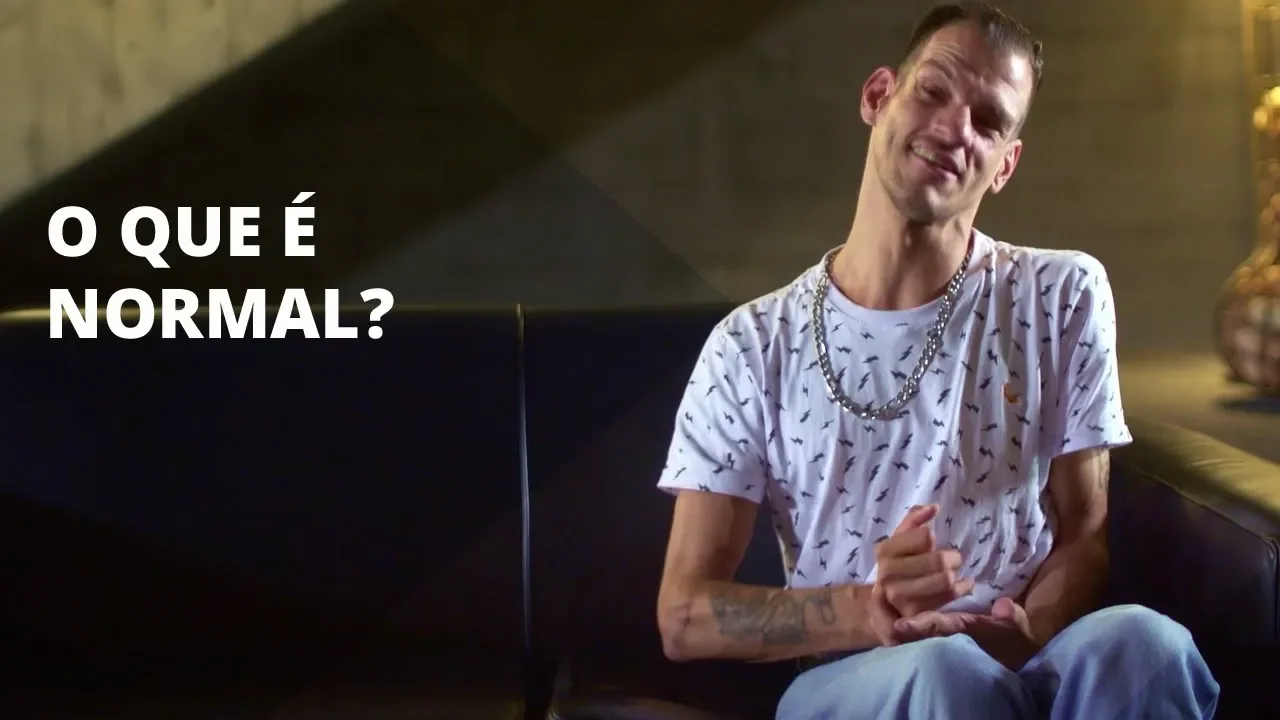
I call him Don Break. I’m not on the stage because I’m pretty. I’m on this stage ‘cause I’m an artist.
I do not want a cute one out of pity. Ah, the boy is sick. Sick?
How am I sick? I heard people say: “Come to my church. God will heal you.
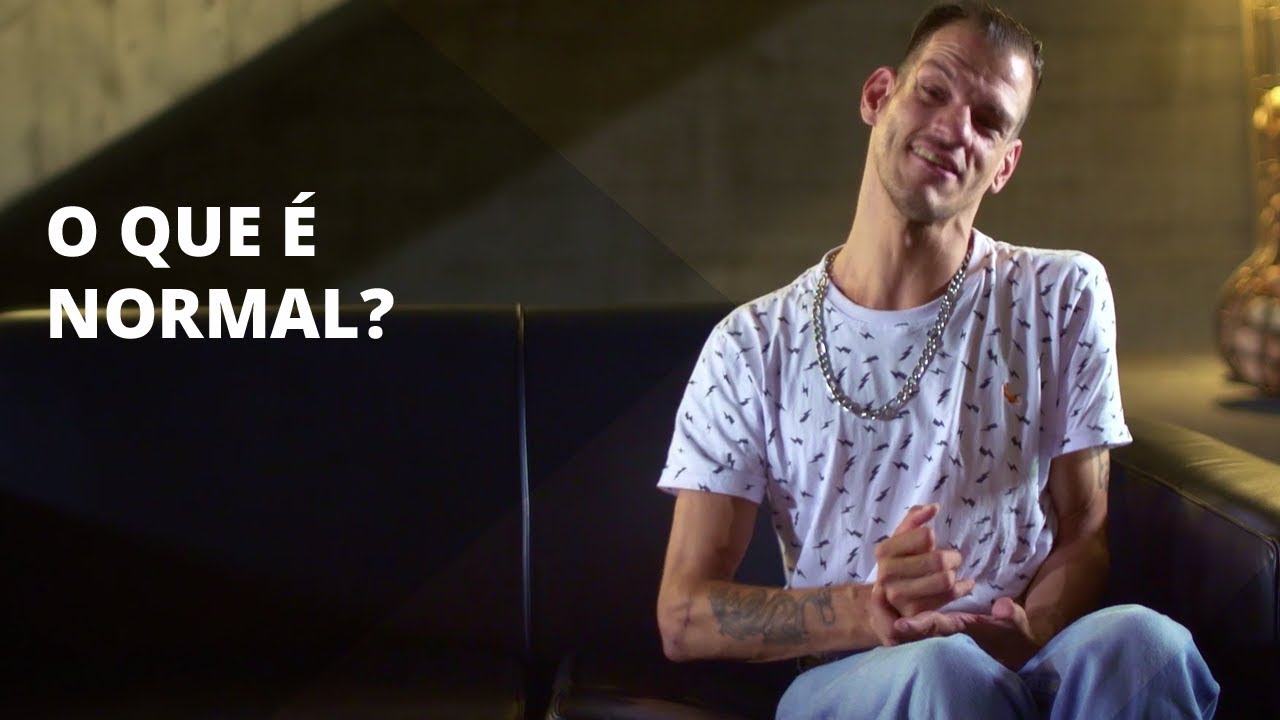
” Will He heal me of what? I do not want to be a poor guy. My name is Marcos.
Marcos Abranches. I need to take care of my son and of my life. WHAT IS NORMAL?
Before my illness I was quite active, didn’t sleep much and tried to make the most of my day. A sentence that I used to say looked like my subconscious predicted it would happen to me. I’d say: “I’d rather live 20 years at 100 mph to 100 years at 20 mph.
I was also very fond of sports. Before I was diagnosed, I was in Recife and would run every day, have tennis classes at the courts of the Boa Viagem beach, FUNDADOR DO PORTAL MOBILIZE ride a bike a lot, the bike was my only vehicle. I first saw something was wrong with my body at the fitness club in Recife when I realized I couldn’t bend my leg backwards during a workout.
Over six months passed between the first symptoms and the diagnosis. Just like me, people didn’t understand what was wrong with me. They couldn’t imagine what the outcome would be.
They had never heard about amyotrophic lateral sclerosis. I hadn’t either. Situations that affect my rights I face every day.
Since I have a relatively active life work for a big press organ I frequently feel I’m armored. FOLHA DE S. PAULO JOURNALIST Some people know me, so frequently my life is facilitated.
Accessible bathrooms, for example, are a public health priority. People don’t have an idea. Disabled persons need to touch more surfaces than non-disabled persons.
If I need to reach the toilet I will have to touch. The less used that bathroom, the better for everyone. I was born premature, DANCER AND CHOREOGRAPHER and for that reason I had this difference.
I don’t consider it as a disability, but as a difference. My mother didn’t approved of my sitting on a wheelchair. When I was eight or nine I asked my mother whether walking was difficult.
She said: “I don’t know. It depends only on you. ” I would go to the bakery.
. . hand in hand with my father.
I remember one day my mom asked: “Will you bring the bread? ” My dad said: “No. Today Marcos will.
By himself. ” “What? I go by myself?
” I got money from my Mom. . .
“I’ll go. I’ll go. ” It was approx.
two blocks away. around 100 meters from home. Those 100 meters tuned into 10 km for so many things that passed through my head.
“How nice! I’m going out by myself. ” I found out a door.
. . to my freedom.
I remember a very touching Peter Pelbart text of the time. It was when I realized I wanted to work in a museum. And Peter asks: EDUCATION DEPT.
COORDINATOR “This life we are going through, OF THE SÃO PAULO M. A. M.
the struggle we’re all fighting, a struggle against existential poverty our lack of possibilities. Why would an angel want to come down here? It’s up to us to create such possibilities heterogeneity and difference, and celebrate diversity.
For us, accessibility isn’t to provide access to what already exists. “You can come. We are accessible”.
As if the museum world were a given one, and people can come. Accessibility is to give access, think, desire, and dream the reality one wants to exist. How can we get there?
Enter the art. Someone may try to imagine what would I and what does he do without a vision? It’s difficult for people to know, but based on the idea SCULPTOR AND TEACHER that she judges who doesn’t see.
So here comes the low expectations of those who don’t see. I produce some sculptures. So if I tell people, “I am a sculptor”, people think: “He does anything.
” And he shows what he does. And then, “Ok, but can you see a little? ” “No, I can’t.
” “Does anyone help you? ” “No, nobody helps me. ” Disability is not in the person.
The disability is in the interaction with such barriers DIVERSA PROJECT COORDINATOR in order to live in society. When I say we have to turn the key of common sense I mean stop thinking that disability is in the person. For example, if we think of a space that has been made accessible for disable persons the disability disappears.
But if the same disable person goes to Ouro Preto that person won’t be able to walk in the streets as such spaces have not taken urban mobility into account. The concept of disability has to do with the interaction with those barriers. So the person has to always come before disability.
Many people say, “So you are deaf. ” When people see what I do, they say, MAM SÃO PAULO COORDINATOR “So it’s not true. AND ARTIST How do you do that?
” Then I stop and think. It looks like deaf people can’t do anything. I frequently travel.
It’s curious: I went by myself to Europe and spent a month. . .
going up and down by myself. My mom gave me my first guitar when I was 7. At night I’d read and play guitar, and train soccer during the day.
PIANIST AND FORMER SOCCER PLAYER When I was 14 years I joined the Palmeiras, my favorite soccer team. I joined Palmeiras and after a year I received a proposal of much better conditions from Corinthians, its main rival. So I began to imagine My premiere would be in a crowded Morumbi, in a Corinthians versus Palmeiras soccer game.
From 12 to 17 I kept fathoming that every night before sleeping. When Mario Travaglini came and said I would play that was the first thing that came to my mind. I asked him, “Mr Mario Where is it going to be?
Against whom? “It will at the Morumbi against Palmeiras. ” The artist is useless for the society.
We don’t produce anything. We offer no concrete things, nothing that is possible or tangible, but we work on the subliminal creation of values. DIRECTOR AND PLAYWRIGHT I play with that uselessness thing.
How could the useless value the being? In the middle of our experience, we felt the need to talk with different audiences. So we saw the chance to reach out to two audiences.
We call it specific sensory identities, the deaf and the blind. So we began researching a theater play that is still running named “Feio”. “Feio” is the story of the ugly duckling that is accessible to the deaf and blind without the need for assisted technologies.
What are assisted technologies? Assisted technologies are mediation mechanisms. An interpreter of sign language is an assisted technology.
Since thanks to our creation we can talk to these identities so that I don’t have to create an afterwards translation process, we kept thinking how to transform that visual spectacle into sounds and words. MUSICIST AND CONDUCTOR How is the sound of cold? And when the ugly swims in a frozen lake?
The other day I was at the Municipal Theater to attend a premiere of choreographer Sandro Borelli. Afterwards there was a cocktail party and through my stepfather Sandro wanted to talk with me. Sandro told me: “Marcos, do you like acting?
I said: “You mean like on a stage? ” That day I almost died of joy. My first life died there.
Why? Because I had an epiphany. A real epiphany in my life as a man.
I began to think about the future. Critics loved it. Once I discovered dance, because I had been born different.
I’m sure it was the work of God. A contemporary God. He made that project possible.
“I want to make Marcos’ body different. ” “You suffer a dramatic loss, and all of a sudden you are awarded. In my 40 years as a doctor I’d never seen something like that.
” He said something that touched me. It seems that God wants you to become deaf. It was then that I got the Mayor’s invitation saying: “Julio, since you are deaf why don’t you do a project for deaf children?
” I realized that I had a mission to accomplish. I had been over 2 years under treatment to try to heal or at least slow down the illness. I wanted to do something that made sense to me.
I wanted to feel useful for the society again, and maybe leave a legacy. I started to research a lot about urban mobility, a subject that fascinated me for years due to the experience I had while living in Barcelona. Due to my motor limitation in the hands, I had enormous difficulty to find content on the Internet.
As I found lots of loose pieces of information I had the idea of putting up a portal to gather, produce, and disclose content relevant to sustainable urban mobility. Also the name came to me: it would be Mobilize, a word combining mobility and mobilization. In early 2010 it was evident I had speech difficulties, and by late that year I wasn’t able to walk anymore, not even with a walker.
The most striking and traumatic event of the disease evolution happened in June 2012. Following a few days having difficulties to breathe, I was taken to hospital for a tracheostomy. This dramatically changed my situation.
Though it gave me important breathing comfort, I completely lost my voice, couldn’t swallow any more, and virtually prevented me from leaving home. I don’t know whether we feel or hear more. I think we learn to pay more attention and better use those senses.
In fact, we use all our senses for that. I say that whenever people approach the face to see something better, I think that they don’t approach the face because they want to see better. It’s the body asking to get closer for the skin to feel the air displacement and better realize what is all about.
Our concern is not let the people attending the show know what’s going on but we want them to feel the emotion through their priority channel, and let it be a compatible emotion. Fabio is deaf, and one of our mentors, so to speak, Fabio turned to me and said, “You gather a group of deaf and blind, sit down and watch. If you feel they react more or less at the same time is because it’s working fine.
” So I consider blindness not as a disease not as a disability, but as a sort of identity, and I look at the chance to talk to them, and more than answering questions I listen to what they have to say. That’s what we work on. An English newspaper recently published a survey showing that.
. . I’m going to guess.
. . a high percentage of English people would never approach a disabled person on the street.
It happened to me once. . .
I was with my wife in a motel and asked for the check. The clerk looked at her and said, “Your credit card please? ” She said, “It’s his credit card.
Ask him. ” He looked at me and. .
. “The card, the card. ” I gave him the card.
. . We were laughing a lot.
We went through that kind of situation several times. He took the card, inserted it in the machine, and gave it to her, “Will you enter the password, madam? ” One day I went to the school door after the training.
There were over 50 moms knitting, doing crosswords. I asked them what they were doing there. “We’re the moms of your students.
” “But my students are 13, 12, 15 years old. ” “We have to bring them here. We live far outside São Paulo.
Our sons are dumb. They can’t be trusted to cross the street. We can’t leave them alone.
That much struck me, so I put two groups aside and made one group to kick and the other to head. I saw that the boys jumped five, ten meters away from the ball was falling. So I thought, “That’s not about soccer, but about physics.
” Those boys don’t know how to calculate the ball’s trajectory because they have never tried. So I stopped the training, had the boys stand in line, and I stood one meter from them with the ball in my hand. I started to throw the ball for them to head it.
Boys headed the ball and went back to the end of the line. For the next training I would stand one meter farther. At the end of two months I was throwing the ball with my hands from the corner flag, and they were heading it right.
Three months went by. I got to the school’s door. No mom was there anymore.
During our meeting I asked the mom who was kind of leader of the group. “You said your son was dumb and couldn’t be sent across the street. He’s not dumb anymore?
” She said, “Julio, I don’t know what you’ve done with my son, but he’s happier, more confident and full of joy. He doesn’t look down to his toes anymore. He looks at the world.
” They even learnt to go across the street. Now we’re confident to let our children go to school by themselves and we can go to work and help our families because we’re very poor. ” Then I remember that the ball’s trajectory is exactly the same as the car’s.
What distance is the car? At what speed is the car traveling? At what pace should I run?
Should I let the car pass by, or should I cross ahead of it? After a year, a German movie director sent me an invitation for me perform at the Berlin Opera. I thought, “Wow!
I’ll go to the Berlin Opera. ” When I stepped on that stage I thought, “Wow! I certainly am at the top of the world.
” Because I was the one different, the only Brazilian in that opera. I don’t look at my life from the perspective of limitations, and the things I can no longer do, but of the infinite possibilities that came along with the illness and I didn’t know of. I believe that’s the secret.
I don’t know to be different. Besides that, I count on the unconditional support from my family. It depends a lot on how you deal with the illness.
We can have a temporary sensation of nervousness in joyful situations, or be depressed for a sad thought that comes to us, but our state of mind tends to always go back to a line of reference. I’ve always wanted to learn to play the piano and never had time. Piano is really difficult.
I looked for a school and began to learn the piano. Since I already had good musical memory it wasn’t as difficult as I had expected. I’d take the guitar and play the only one note, the G that I already had in my mind.
The teacher would say, “The note you are playing, the G, on the piano it’s here. ” The only thing I had to do was to memorize it. I was so happy and excited that I could hardly sleep.
Since I couldn’t sleep, I’d lay on my bed with my headphones on and listen to music. When I tell this people laugh. They think I’m joking.
I say that one of the privileges of being deaf is that I don’t have to buy CD or download music. I began to pick up some chords that I found nice and harmonized them. Then I’d go to the piano and play that note.
The following night I’d do the same. I spent three years composing very late at night. I’d compose late all night, go to sleep at sunrise, wake up after midday, and go to the piano play the concert I had composed the previous night.
What we see today are collective monologues. One guy is waiting for the other guy to stop speaking so he can speak. It’s not a real dialogue.
So I have no doubt that coexistence with different audiences makes that teachers and all the museum team look at themselves and rethink what it is that might be affecting their potential. . .
why it’s not being properly used. My biggest learning is what I still don’t know. I discover that at times ignorance can be a gift.
When in the 1990s I started in theater professionally, in the early 1990s, I knew how I had to do the show because I had studied at school. I knew what I had to do, the lighting and the like. And it’s very good to know that I don’t know, that is always a jump into the unknown, and there are questions to which I don’t know the answer.
It’s very good to know the world is much bigger than I thought In the cinema workshop there was a scene by Edgar, who was blind, together with Leticia, who can see and hear. Jorge, a deaf man, was director. Everybody was, “How will Jorge be able to direct Edgar, who is blind, and how will they understand each other?
” The question, “How does it feel to be directed by a deaf man? How does it feel to direct a blind actor? ” Edgar said, “Normal”.
It’s curious that sometimes they ask me. . .
Do you have a disabled relative? Why do you work with that? I always found that question curious.
Why should I work with that? Only if I had a disabled relative. No, I don’t, but that’s not a specific question.
It’s everybody’s question. Like today they say in a racist society: Not being racist is not enough; you have to be anti-racist. With so much violence against women.
. . one can’t help being feminist.
The issue of disable people is everybody’s issue. So I feel part of it, I can’t imagine myself not being part of it, I can’t imagine my life differently. People need to be aware of the deaf.
In fact, it’s learnt at school. And also because. .
. it’s fashionable. Living with it helps create awareness of the deaf.
As I said, in fact the deaf is more visual. Those who can hear feel the obligation to hear the words, their meaning. .
. What does the concept word mean? What word?
If there are no words. . .
those who can hear are like deaf. . .
They will have to be more visual, too. It opens more. .
. Perceives and understands people more, understands body language better. Let’s color.
Let’s color. I woke up one Sunday and my room’s window was all dirty. Then I go some white paint, oil-based paint, and began to paint the window.
When I finished, I was more cover in paint than the window. One day I said to myself: “That thing that happened to me, that I ended up covered in white, why not include it? ” In regards to the disabled people the world is still too dark and we can color it up in the way they think, not only with regards to people with disability, but to everything.
Human beings are human beings. What is normal? What is a body?
What is difference? What is beauty?



![O que é Patologia? [por Dra. Karla Kabbach]](https://img.youtube.com/vi/9sg6h6LHriQ/maxresdefault.jpg)