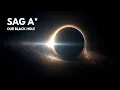
You're moving right now. 230 kilometers per second. Around something 26,000 light-years away.
You've been doing this your entire life. Your parents did it. Every ancestor you've ever had.
Every human who ever lived. Every star you've ever seen in the night sky. All of it.
200 billion stars, gas clouds, planets, everything in the Milky Way. moving in vast, patient orbits around the same invisible center. At that center sits a supermassive black hole.
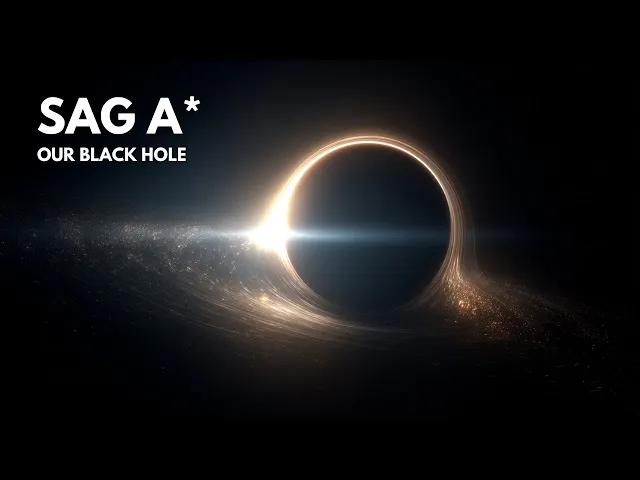
Four million times the mass of the Sun. And for most of human history, we didn't know it was there. Tonight, we're tracing the story of Sagittarius A*.
the invisible center of everything we know. The dark heart of the Milky Way. Let's begin.
For thousands of years, people looked up and saw the Milky Way as a band of light stretched across the sky. Faint. Diffuse.
Beautiful. But just light. By the early 1900s, we understood what it was: a galaxy.
Spiral. Vast. With us off to one side, about two-thirds of the way out from the center.
We assumed there was a "center". some dense region where starlight pooled. But we thought it was just… more stars.
Closer together. Brighter. Nothing special.
The problem was visibility. Between us and the galactic center, enormous clouds of gas and dust block optical light completely. When you look toward Sagittarius with a normal telescope, you see nothing but darkness.
For centuries, the center of our own galaxy was hidden. Then, in the 1970s, radio telescopes began scanning the galactic center. Radio waves pass through dust.
And they found something strange. A powerful, compact radio source. Bright.
Concentrated. Unmoving. Too bright to be starlight.
Too small to be a star cluster. Too concentrated to be gas. They named it Sagittarius A*.
after the constellation where it appeared in our sky. Something massive was there. Something invisible.
Pulling everything toward it. But you can't see a black hole. You can only see what it does.
In the 1990s, two teams of astronomers began one of the most patient experiments in the history of science. Keck Observatory in Hawaii. The Very Large Telescope in Chile.
Both aimed at the same patch of sky: the galactic center. Using infrared cameras. watching in wavelengths our eyes can't see.
they tracked individual stars near Sagittarius A*. Not hundreds of stars. A few dozen.
Year after year. Image after image. Watching them move.
And the stars moved fast. Not the slow drift you'd expect from distant objects. These stars were whipping around something invisible.
like planets around a sun, but far more extreme. Tight orbits. Elliptical.
Violent. One star became the key. A blue-white star.
Unremarkable except for where it was and how it moved. The teams called it S2. And S2's orbit would prove everything.
S2 orbits Sagittarius A* every 16 years. That's extraordinarily fast for something orbiting the center of a galaxy. Our Sun takes 230 million years to complete one orbit.
S2 does it in 16. At periapsis. the point where S2 comes closest to the black hole.
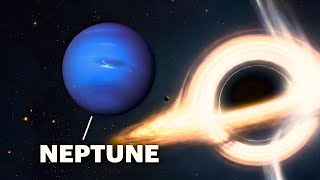
it gets within 17 light-hours of Sagittarius A*. Neptune is about 4 light-hours from the Sun. S2 gets that close to a black hole.
And at that distance, it accelerates to about 2 to 3 percent the speed of light. Around 7,000 to 8,000 kilometers per second. Fast enough to cross the distance from Earth to the Moon in less than a minute.
Scientists followed S2 for decades. tracking its motion year after year. They watched it sweep past the black hole in 2002… and again in 2018.
one full 16-year orbit from close pass to close pass. And the next orbit is already underway. Frame by frame.
Year by year. They could see it accelerate as it approached periapsis. They could see it decelerate as it moved away.
The path was perfect. Keplerian. Exactly what you'd expect from an object orbiting a massive point source.
And then they did the math. To make a star move that fast, in an orbit that tight, there has to be something incredibly massive at the center. Concentrated in a space smaller than Mercury's orbit around the Sun.
The numbers were precise: roughly 4 million solar masses. No star cluster could be that dense without collapsing. No gas cloud could stay together under that kind of gravity.
No normal object could hide that much mass in that little space. Only one thing fit the evidence. A supermassive black hole.
By 2002, the case was closed. Sagittarius A* wasn't just a radio source. It was a black hole.
Our black hole. For decades, we knew it was there. We could measure its mass.
Track stars orbiting it. Map its gravity. But we'd never seen it.
In 2019, the Event Horizon Telescope. a planet-sized network of radio dishes working together. revealed the first-ever image of a black hole.
M87*, at the center of a galaxy 55 million light-years away. A glowing ring. A shadow.
Proof. And then, in May 2022, the EHT released a second image. This time, closer to home.
Sagittarius A*. It took longer than M87* because Sagittarius A* is more difficult to photograph. M87* is massive and stable.
it changes slowly, over days or weeks. Sagittarius A* is smaller, and it flickers. Gas swirls around it on timescales of minutes to hours.
Brightness shifts constantly. Like trying to photograph a child who won't sit still, while the child is also 26,000 light-years away. But the teams synchronized data from telescopes across the planet.
Chile. Hawaii. Arizona.
Mexico. Spain. And the South Pole.
Multiple observatories, working as one. Combining signals. Compensating for Earth's rotation.
Adjusting for atmospheric distortion. Building an image pixel by pixel. And then they had it.
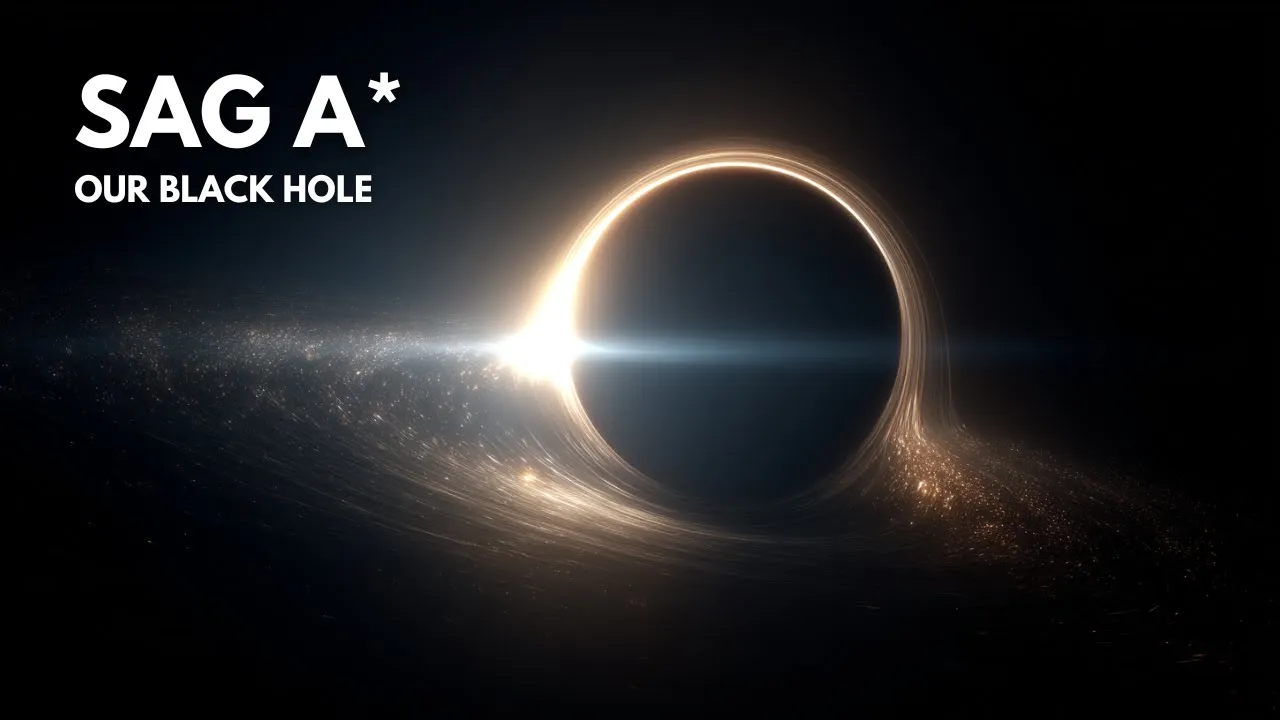
A bright ring of hot gas, its light bent into a circle by gravity, circling the event horizon. And in the center: a shadow. A dark silhouette where light is captured.
52 microarcseconds across. Like seeing a donut on the surface of the Moon from Earth. Or reading a newspaper in New York from Los Angeles.
For the first time, we saw the face of the thing we'd been orbiting our entire lives. And here's the strange part. Sagittarius A* is not a quasar.
It's not blazing. It's not devouring stars every night. Most of the time it's quiet.
Starved. A giant with its mouth closed. Which means we're looking at something even stranger than a monster: we're looking at a supermassive black hole… at rest.
And seeing it made us ask: what are we actually looking at? What does 4 million solar masses really mean? Four million solar masses.
That's four million stars like our Sun, compressed into a singularity. Let's put that in context. If you could somehow compress our Sun.
this 1. 4-million-kilometer-wide ball of fusion that gives life to Earth. into a black hole, it would have an event horizon about 6 kilometers across.
A tiny sphere. Now imagine doing that four million times. And crushing all of it into a single point.
That's Sagittarius A*. The event horizon of Sagittarius A* is about 24 million kilometers across. Roughly seventeen Suns laid side by side.
Light. moving at 300,000 kilometers per second. crosses that diameter in about eighty seconds.
A minute and twenty. That's the boundary. The point of no return.
And it's worth saying out loud: the event horizon isn't a surface. It's not a shell. It's a line in space where "escape" stops being a direction.
Inside it, our everyday ideas break. Not because the black hole is "made of darkness," but because gravity is so extreme that even light can't climb back out. And deeper still, our equations predict a singularity.
a place where the math stops making sense, and physics runs out of language. Now. if you put Sagittarius A* where the Sun is, the horizon would still fit inside Mercury's orbit.
But the mass would be four million Suns. Earth, at our current distance, would not be able to orbit the way it does now. To stay in a stable orbit at one AU (Astronomical Unit), you'd need to travel at about one-fifth the speed of light.
and your "year" would last just over four hours. So the horizon is small compared to the solar system. But the gravity is not.
Now consider the mass itself. The Sun weighs about 333,000 Earths. It's so massive that its gravity holds eight planets in orbit across billions of kilometers.
Sagittarius A* is four million times more massive than that. That's 1. 3 trillion Earths.
One thousand three hundred billion Earths. If you somehow lined up planet-sized objects. each one as massive as Earth.
you'd need 1. 3 trillion of them to equal Sagittarius A*'s mass. Lined up edge-to-edge, that chain would run to the nearest star and back about two hundred times.
Let's compare it to other black holes. Sagittarius A*: four million solar masses. M87*.
the black hole photographed in 2019: 6. 5 billion solar masses. TON 618.
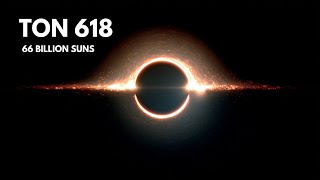
one of the largest black holes ever discovered: 66 billion solar masses. TON 618 is sixteen thousand times more massive than Sagittarius A*. By comparison, Sagittarius A* is tiny.
But "tiny" is a relative term. Four million Suns. 1.
3 trillion Earths. Incomprehensible mass, crushed into infinite density. And Sagittarius A* is 26,000 light-years away.
The closest supermassive black hole to Earth. When we look at Sagittarius A*, we're not seeing it as it is now. We're seeing it as it was 26,000 years ago.
Humans were living through the last Ice Age. Small bands. Firelight.
Stone tools. The first cities were still ten thousand years in the future. Writing didn't exist.
Agriculture hadn't begun. And those photons kept going. through dust, through spiral arms, through the quiet lanes between stars.
until they finally reached our telescopes. And Sagittarius A* is ancient. It likely formed in the early universe.
billions of years ago. When galaxies were young and still colliding and merging. When the first stars were just beginning to illuminate the cosmos.
Sagittarius A* was already there when our solar system formed 4. 6 billion years ago. Already massive.
Already ancient. It was there when life first appeared on Earth. When the dinosaurs ruled and died.
When the first humans looked up at the night sky. It will still be there long after the Sun dies. Long after Earth is gone.
Long after every star we can see has burned out or drifted away into the expanding void. And it's been doing the same thing the entire time. Pulling.
Holding. Anchoring. Right now.
in this present moment. Sagittarius A* is doing something. Pulling gas inward.
Maybe flaring as a cloud drifts too close. Maybe quiet. Stars are orbiting it.
S2 is somewhere in its 16-year path. Other stars are accelerating toward periapsis or drifting away. The event horizon is there.
The ring of light is glowing. Something is happening. But we can't see it.
The light that would show us Sagittarius A* as it is right now. in this exact moment. won't reach Earth for 26,000 years.
Think about that. 26,000 years from now. Modern humans appeared roughly 300,000 years ago.
26,000 years is nearly one-tenth of the entire span of human existence. In 26,000 years, human civilization might be unrecognizable. We might have spread across the galaxy.
Or destroyed ourselves. Or evolved into something we wouldn't recognize. Earth's climate will have shifted.
Continents will have drifted. Species will have gone extinct. New species will have appeared.
The stars in the night sky will have moved to different positions. And only then. 26,000 years from now.
will the light from today's Sagittarius A* finally arrive. Only then will observers. if there are any.
see what Sagittarius A* looked like in the year 2026. We're always watching the past. Never the present.
The black hole we photographed in 2022? That was Sagittarius A* as it existed 26,000 years ago. S2's orbit that we've been tracking since the 1990s?
We're watching events that happened 26,000 years before we saw them. Everything we know about Sagittarius A*. every measurement, every observation, every image.
is ancient history. And there's no way around it. Light has a speed limit.
Information has a speed limit. We are separated from Sagittarius A* not just by distance, but by time itself. A 26,000-year gulf we can never cross.
What is Sagittarius A* like right now? We can't know. Not for 26,000 years.
All we have is the past. Always the past. But the past is enough to tell us what Sagittarius A* does.
Sagittarius A* doesn't hold the entire Milky Way together by itself. The galaxy is bound by all of its mass. stars, gas, and dark matter.
added together. But Sagittarius A* rules the inner heart of it. Near the core, its gravity dominates.
It sets the rhythm of the closest stars. It anchors the very center we measure everything from. And in that sense.
quietly, relentlessly. it is the dark landmark at the center of home. We orbit at 230 kilometers per second.
Fast enough to circle the Earth in about three minutes. But the galactic center is so far away that one complete orbit takes about 230 million years. Think about that.
The last time our solar system was in this position in its orbit, dinosaurs hadn't appeared yet. The next time we come back around to this spot. 230 million years from now.
Earth might be unrecognizable. Or gone. Stars closer to Sagittarius A* orbit faster.
S2 completes an orbit in 16 years. S62. another tracked star.
has been reported to have one of the shortest known orbits: just 9. 9 years, screaming around the black hole at nearly 10% the speed of light at periapsis. Farther out, stars take thousands of years per orbit.
And at the edges of the galaxy. 70,000 or 80,000 light-years from the center. stars crawl through their orbits over hundreds of millions of years.
Some stars have been circling Sagittarius A* for billions of years. They'll keep circling for billions more. Generations of stars, born and dying, all held in orbit by the same invisible anchor.
Sagittarius A* doesn't care. It doesn't hurry. It doesn't rest.
It's patient. It's invisible. Silent.
But absolute. Every star near the core bends to it. Every orbit.
Every trajectory. Every motion. shaped by its gravity.
You can't negotiate with it. You can't escape it. We're bound to it.
The quiet tyrant at the center of everything. Right now, somewhere near the constellation Sagittarius, there's a black hole. You can't see it with your eyes.
You can't point to it in the sky and say "there. " But it's there. And you've been circling it your entire life.
So have your parents. So has every generation before you. So has every star you've ever seen.
All of it, held by something we couldn't even photograph until 2022. Something we still can't see as it is. only as it was, 26,000 years ago.
The dark heart of the Milky Way. Not the most massive black hole in the universe. Not the farthest.
Not the brightest. But ours. The center of home.
Patient. Quiet. Inescapable.
You're orbiting it right now. You were orbiting it when you were born. You'll be orbiting it when you're gone.
Always turning. Never arriving. Always seeing it late.
never seeing it now. The invisible thing at the center of everything. The thing you can't escape.
The thing you've always been bound to. Sagittarius A*. The dark heart of the Milky Way.