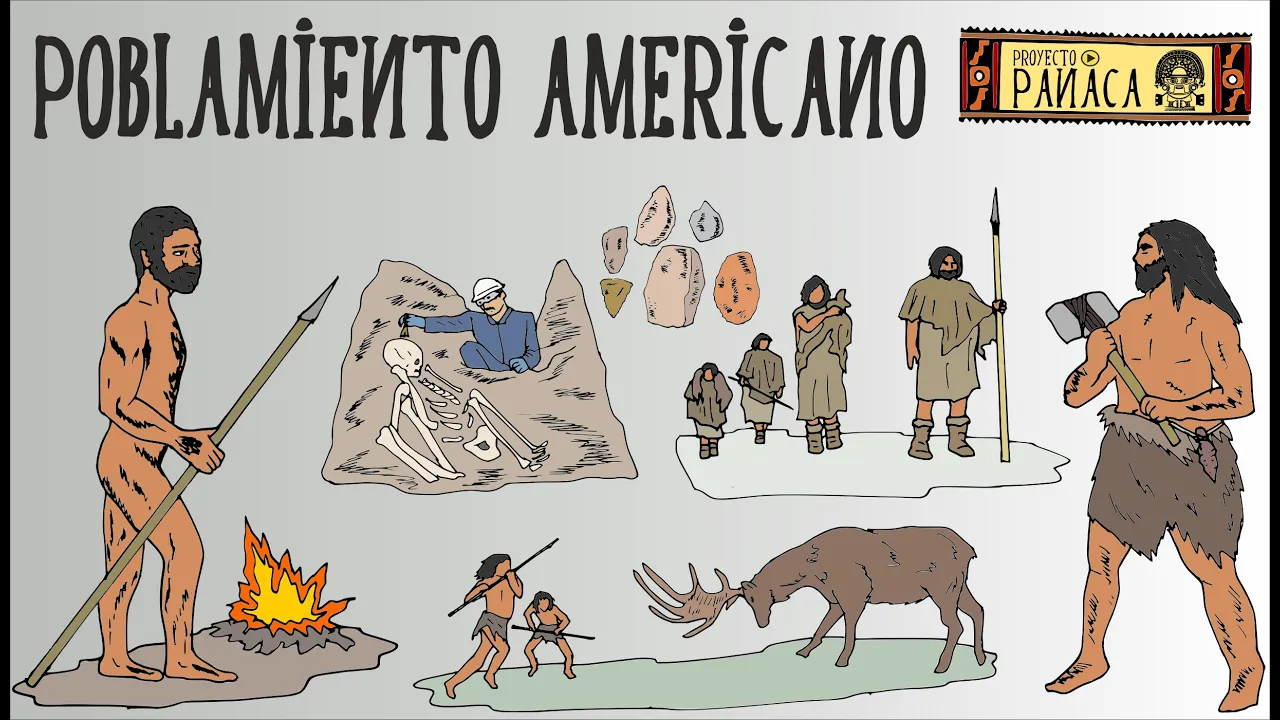
With the appearance of man on the African continent during the Quaternary period, the search for food and better conditions led him to move from one place to another, eventually expanding to new continents, leaving behind indelible traces of his journey. Panaca Project presents AMERICAN PEOPLE: The routes of primitive man The arrival of man to the American continent has been one of the great scientific questions of recent centuries, knowing how the first nomadic men or homo sapiens, were able to physically move to a continent away from others and their way of survival, have generated various theories and hypotheses that seek to explain the origin and route followed by these primitive men. Although there were supporters who defended the autochthonous origin of American man, such as Antonio de León Pinelo in the XVII and Florentino Ameghino in 1869, who hypothesized the appearance of "Homus Pampeanus" in the tertiary era; This theory has been completely dismissed for lack of support.
On the contrary, the theories that gain the most strength and credibility are the immigration theories, the same ones that establish the Asian, Oceanic and Australian origin of the first men who populated America. The Asian theory, which is the most accepted within the scientific community, establishes that during the last ice age called Wisconsin, held in the Pleistocene, a continental bridge was formed between the Chukotka Peninsula, in Asia, and Alaska, in America, ( Bering Strait), through which the first nomadic men would make their way to America, approximately 30 million years ago. At the beginning of the 20th century, the Czech anthropologist Alex Hrdlicka, based on the similarities in physical characteristics between Asian and Native American man, would argue that the first American settlers were Asian hunters.
Among the physical characteristics that he highlighted as proof of his affirmation, there would be straight and dark hair, slanted eyes, wide and protruding cheekbones, the famous "Mongolian stain", among others. Another of the immigration theories is the one that postulates the oceanic origin of the American man, the same one that was raised by the French anthropologist Paul Rivet in 1943, who considered the oceanic route as complementary to the Asian and Australian routes, since he considered the American man as multiracial. Rivet supported his theory by pointing out the anthropological similarities, for example, between the Melanesians and the men of Lagoa-Santa, ancient hunters from Brazil; linguistic similarities , such as those between the Melanesians and the Hoka Indians of North America; and ethnographic and cultural similarities, such as the customs and rituals common between Melanesian and Amazonian communities.
(trophy heads, hammocks, wooden drums, suspension bridges)) For Rivet, the Melanesians and Polynesians would have arrived in America through the center and the south on primitive rafts, bringing elements of their culture and mixing with the inhabitants who would have arrived by alternate routes, thus generating the miscegenation of the American people. On the other hand, Mendes Correa posits the arrival of the American man thanks to a phenomenon called "optimus climaticum" or optimum climate, thanks to which the inhabitants of Australia and Tasmania would have left Auckland on primitive rafts, reaching Cape Horn on Earth . del Fuego, thus populating Patagonia.
He supports his theory in the blood group that the natives of Patagonia share with the Australian aborigines, as well as in the similarity of the skull and customs and uses practiced by both populations. ( hive-shaped huts and rafts with intertwined vegetable fibers) Although these are the most important theories that would explain the arrival of man to the American continent, human and lithic remains have also been found that would help clarify the route made by these first men . .
Among the most important findings we can mention: In North America, in Kenneweick, a human skull with a narrow face, prominent nose, protruding upper jaw and long and narrow forehead was discovered in 1996, which was called "Kenneweick man". ” the same one that is 9 thousand years old, making it one of the oldest skeletons known. Although at first it was believed that it was a Euro-American character, recent studies have determined that it is an American Indian man.
Between 1973 and 1978, a team from the University of Pittsburgh led by James Adovasio discovered in Pennsylvania, near the Atlantic coast of the United States, an archaeological site called Meadowcroft Rockshelter with abundant stone tools such as knives and bifacial points, flakes and scrapers, as well as elements indicating the processing of animals such as deer, reindeer, bird eggs, etc. , as well as plants and seeds; all of which would have an antiquity of 16,000 years BC. Although this dating has been questioned, many archaeologists agree that Meadowcroft was used by Native Americans in the pre-Clovis era.
At the beginning of the 1930s, grooved lithic points 10 to 12 cm long, bifacial and sharp, dating from 11,000 to 10,000 years BC, were found in New Mexico, United States, the same ones that were made by which is known as the Clovis culture, or culture of the plain; considered until the middle of the 20th century as the oldest culture in the American continent; However, the accumulated archaeological evidence would show that man was in America thousands of years before the Clovis . As for the tools found, current studies have determined that they were manufactured only for a short period of 300 years, stopping production 12,750 years ago. years, coinciding with the disappearance of the last megafauna of North America, such as the mammoth and the mastodon.
Another important lithic tradition corresponds to that of Folsom, named after the place where they were found in 1908, small and light fluted spear points, which would have been used for hunting woolly bison. Folsom dates back to about 9,000 BC, which would place it as post-Clovis. In 1977, archaeologist Tom Dillehay, together with a team of scientists from the Universidad Austral de Chile, found hunting objects, architectural elements, wild potatoes, animal bones and even a footprint in Monteverde, in the Chilean Lake District.
human foot. When the dating of these remains was carried out, it was discovered that some of the algae found in said deposit were about 14,800 years old; however, other remains would have been 33,000 years old, but the validity of these findings has been strongly questioned by the scientific community, since some of its representatives claim that these remains are the product of nature. It is worth mentioning that before the discoveries of Monteverde, there was a clear consensus in science regarding the Clovis as the first American settlers.
In 2014, a genetic study was carried out on an adolescent skeleton found together with Clovis tools in Montana, United States, called "Anzick Boy", with an age of 12,600 years, determining that all the native peoples of Central and South America They are genetic descendants of the same population group. The discoveries of Monte Verde and other anthropological sites in America such as Piedra Museo in Argentina, Pedra Furada in Brazil, Topper in California, United States and the same Meadowcroft Rockshelter mentioned above, have completely rethought the prevailing theory of late American settlement, founded on the Clovis Culture, which maintains that man entered the new continent approximately 13,500 years ago, and has given foundation to a new theory of the early peopling of America, which places the date of entry between 15,000 and 50,000 years BC, at the same time that it modifies Theories about the routes of entry and diffusion through the continent.