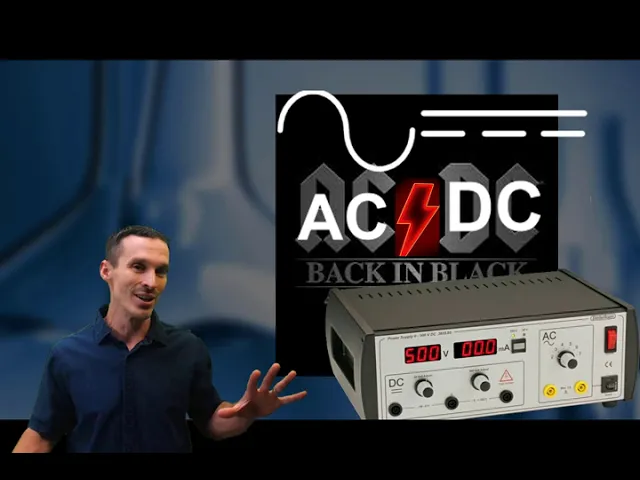
[Music] hey how's it going um we're going to talk quadrupoles today but before we do i got to talk to you about these things over here alternating current and direct current so we're going to talk a lot about how electricity works to understand how the quadrupole works let's start with the easier one so dc only in other words like a battery although it could be a power supply that's producing a direct current all direct current means is that the voltage is constant you turn the battery on and you get a positive voltage you have flip
things over you can get a negative voltage as well so you can decide how high up or how how low you want to go when we're talking about alternating currents things get a little bit more complicated so this is like the electricity that's coming out of the wall socket it has a frequency to it that means that the voltage will look like this it's going up and down and up and down with whatever frequency and it's defined by that equation up top there so we can change the frequency and you see it in the equation
over there so you see that this has twice the frequency of what i showed you before and by the way the frequency that we're dealing with at least for quadrupoles is in the rf region the radio frequency region so the radio frequency is actually a pretty broad region of the spectrum but that's the zone that we're talking about here now we can change the magnitude of that frequency so there's the waves are sort of tighter in this region over here but what we can also do is we can we can offset the entire voltage so
if we apply a dc voltage it takes the entire setup and raises it up in other words it's not evenly positive negative positive it's actually spending more time in the positive region and you could offset it negative and we can also have it where it drops down into the negative region so most of the time this would be applying a negative voltage but every every so often it sort of pops into the positive region just for a split second all right so let's talk quads now um not those uh quadrupole mass analyzers we've seen this
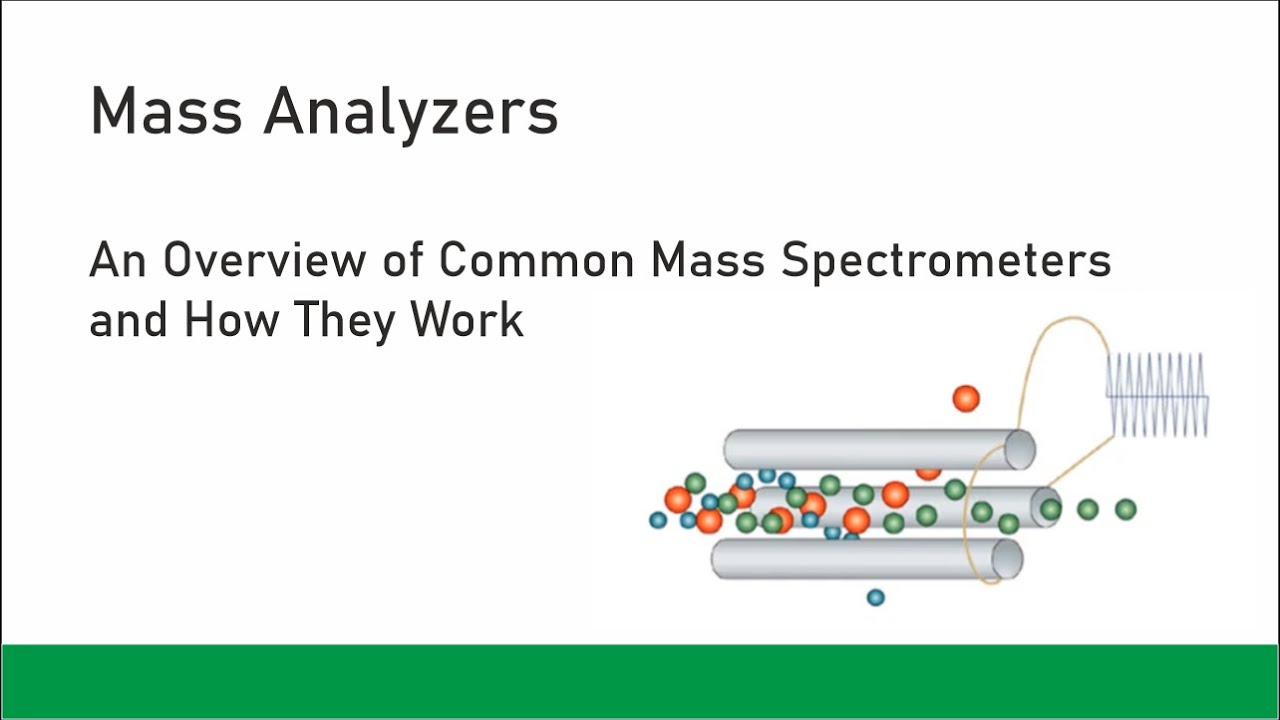
video before so we know the basic configuration they call it a quadrupole because it has four rods there is such a thing as a hexa pole or octa-pole the main feature about these rods is that they have these oscillating charges so the voltage is not just dc it's a combination of dc and ac so the polarity is sort of switching positive negative and the ions are going to move through these quads in this kind of weird dance that they go like that it doesn't even look as the picture is showing up here so i'll show
you in just a second maybe a better description of what it's actually doing so the only way to think about this is if we divide the quadrupole along two planes so we've got the rods on the upper portion and then we get the rods on the side the ones on the two sides we're going to call that the x plane and then we have the y plane as well the voltage is like exactly the same but with the opposite polarity to it so that's not to suggest in the x plane that they're always positive it
just means that they're positive most of the time and in the y plane they're going to be negative most of the time so they're kind of doing the opposite effect one's positive negative and the other one's negative positive but for different periods of time let me explain that a little bit better so to start with the simplest scenario let's say that the rods are positive like all of the time that means that they're applying a force for positive ions that pushes everything exactly to the center they're not going to move because the force is pushing
equal opposite pushing all lines of any size towards the center of course as long as they're positively charged now if the rods are negatively charged well there's going to be a pull it's going to pull the ions away from the center some of them might pull up some of them might pull down but there's going to be this kind of cloud that's forming that bubbles outwards from there that'll only happen until the charge reverses and then it pushes the cloud back down so you see this expansion and then collapsing of the ion clouds all the
while they're moving down through this tunnel so this is a mass spectrometer which means that we have ions of different mass to charge inside this electric field so let's see what happens as we change the charge the polarity of the quadrupoles for different ions well there's still going to be that pull and then the charge will reverse and then it's going to push them back down but what you're noticing here is that the smaller ions are moving out faster the big ions sort of stay slow and stuck into the middle so they're all pulsing up
and down but it's how big they pulse is going to depend on their mass to charge and that's simply because small ions move quickly the big ions have a lot of momentum they're kind of sluggish they stay put for longer okay you're gonna have to kind of just accept this for a minute because i know the explanation i'm about to give whenever you say it you still look back at it and say no this doesn't make sense but like it's the best that we can do at least for now so let's think about the ions
that are in the x plane only so we're just talking about those rods that are on the x plane and the x plane is positive most of the time so now i'm symbolizing it plus plus plus minus plus one plus minus that's actually sort of through time it's like three quarters of the time it's in the positive and then it dips to negative and comes back and forth so these larger ions are going to be forced inwards to the center by the positive and then the negative there's going to be attraction out towards the rods
so as they move through the quadrupole they're going to have this kind of up and down push on it but most of the time the push will be towards the center so the pulsation will kind of look like this it's going to squeeze in and then come out and squeeze in and come out and ultimately stay towards the center because most of the time the ions are being forced inwards so that one makes sense at least i hope it does what about for the small eyes well the opposite scenario will happen because the ions are
so quick to respond to a change in voltage every time that's that voltage switches negative they sort of pulse out a little bit more these ions are destabilized and they won't get through the quad yeah i know i know like it's i know it's confusing but like here's the summary the big ions are stable the small ions are unstable that's in the x plane so if we go into the y plane now we're talking about the opposite polarity so we've got instead of mostly positive it's mostly negative and the exact opposite situation is going to
occur so now when the ions the larger ones are having this net force to pull them outwards they're slow but they're going to kind of gradually pull outwards by that net negative charge and then the opposite happens for the small ions i i i know what you're thinking it's like this no none of this makes sense i agree none of it makes sense i'm not making this stuff up i'm just spreading it on to you there is another explanation which i'll get to uh in a second but let me just explain what we've done here
so we have a mass spectrum the goal of a quadrupole is to basically select ions of a specific mass to charge and it does that by eliminating all of the other ions except the one that it wants the x plane is eliminating one set and it does it like this so the x plane cuts down all the small ions the y plane is designed to take away the bigger ions and you can tune the voltage just right to create like a little bit of a gap between these two planes so right now you're looking at
a unit mass resolution window all the ions that are sort of plus or minus a half or or one gap between the window are stable and make their way through and of course to use this as a mass analyzer all you need to do is change the voltage on these quadrupoles to sweep the spectrum to scan from low mass all the way up to high mass and in doing so each of the ions has a turn at making its way through the quadrupole so yeah none of that really made sense i know it wasn't really
a satisfactory argument it seems a little hand washy it's like ions are moving in and out i don't know but like there is a stricter definition to it when it comes down to deciding if the ions are stable or not we just simply have to calculate the forces so the forces at play relate to the electric field and the electric field is a quadripolar field so we can calculate the force that these ions are experiencing at any point within the quadrupoles so we just take a look at these equations right here and we take our
potential in a hyperbolic field which is dependent on the geometry of the system where we decide exactly what the radius of of the uh quadrupoles are what the distance between them you can define it along the x and y plane and the z plane as well so we take partial derivatives there's just a little bit of calculus you can set the forces equal to zero because we know what's going on here and now we can apply the electric force to an ion which is proportional to the charge of each of the ions knowing of course
newton's law and force equals mass times acceleration we can take these partial derivatives and work their way through everything simple it all works out until we come to these final equations which are a little bit more complicated in fact mathematically i don't know how to solve them in fact most people don't know how to solve these equations fortunately somebody else solved them for us so we don't have to do the math all of that explanation it's the technical explanation but it's like it's it's kind of this type of explanation it's not something that's going to
make much sense let's simplify this as well like literally let's simplify these equations right here so what we're going to do is make two substitutions we're going to call these symbols a and q a is related to the u value the the u is the dc voltage i always remember it because it's a u okay uh so a is related to the dc potential q is related to the ac potential and we take these terms and we substitute it into this equation and we get a simpler equation which can be plotted on a two-dimensional coordinate
axis so i know the symbol doesn't make sense but the plot should when you plot out this equation this is the diagram that comes out from here so it kind of looks like an iceberg we're defining the a and the q value on each of these axes and we're looking at these zones of stability this is actually just a partial portion of the entire region of stability but basically it comes down to this anything inside the iceberg is stable what that means is the ions will go through the quadrupole if it's outside of the iceberg
we're in the unstable region those ions are going to move up and down until they strike the quads and they don't get through so any ion with its given m over z will land somewheres inside of this plot and that depends exactly on how you decide what voltage to set so what is the magnitude of u n of v so we pick that and when we pick that what we do is we fix it just onto that line so that blue line is what we call the mass scan line those are the parameters that we
define when we turn on the instrument now by the way when you operate a mass spec the instrument's doing this for you so you're not having to type these numbers in but this is what it's actually doing it's placing all of the ions on this virtual line so the big ions are basically down in the bottom and the small ions work their way up onto the top and what we need to do is basically increase u and v proportionally so you increase the two of them at the same time and you're pushing the ions from
the unstable region into the stable region what you're doing is you're scanning that mass window over you're taking ions that used to hit the quadrupoles and when they hit the inside of that stable region they no longer do so when it comes down to it the way that a quadrupole works is to control those voltage curves to control the magnitude of the electric field and we do that specifically by relating the dc potential and the ac potential together now the other thing you can do here is you can actually play with the parameters a little
bit so if i wanted to control the resolution the resolution is basically how much of that line sits inside the stable region so i can change the slope of that line i'll do that by increasing u relative to v and the slope goes up so now because it's only crossing just at a tip of that iceberg the resolution is higher the mass window is smaller so i can change that resolution i can go the other way and i can go the extreme on the other way where the curve actually lies flat when we do that
what we've done is we've set the magnitude of u the a term to zero or another way of saying this is that this is rf only we only have the ac potential we only have the v the q term so we call this rf only so an rf only quadrupole is one where basically every single ion that you can think of will still fit simultaneously inside the stable region it's not scanning it's not filtering any of these ions out so since they all go through it's acting exclusively to focus the ions they're all being pushed
to the middle now where have we seen this why would we want to do this well this is exactly what a collision cell is all about with a collision cell you imagine all those collisions the ions are hitting each other they're going to fly out on purpose we need to keep them back towards the middle so a quadrupole is a perfect way to do that it keeps the ions contained as they go through the collision cell they stay put in the center so that's why we're saying that the middle quadrupole of a triple quad is
not really a mass analyzer it's it's not it's not doing the job of a mass analyzer it's acting like a lens or just a a focusing setup not as a mass analyzer