Saturday 21 June 2050, in a ski resort in Switzerland. It's in this dream setting that the Dubreuil family just spent an extraordinary vacation week. The end of their stay is approaching, so, to end it splendidly, they have chosen to give themselves an unforgettable experience. Are you dizzy? They plan to climb up to 4000 meters above sea level today on board the highest cable car in the country. At this moment, The Dubreuils have no suspicions. You'll see it in a few minutes, she'll have a dramatic experience. As unbelievable as it may seem, it is a well-known
scientific phenomenon that will cost them their lives, global warming. For several decades, scientists alert us concerning the alarming state of the planet. The disasters happening on the planet indicate that there is a problem. These frightening images, up until now, we didn't pay much attention to it. We thought these disasters would never reach us. We didn't care, and our humanity didn't care. Today the threat no longer lingers only at the end of the world, It is also hovering here in France. It's no longer on the other side of the planet. We'll no longer just talk about
bears. It's a shift in mentalities. By the end of the century the temperature could rise by 6 to 7 degrees. Which is huge! We'll run out of water. for sure. It's no longer climate change, it's a cataclysm. There will be no more ice floes. Glaciers too are falling. It is really terrible! Therewill be be more recurrent, more violent storms. We realized that we are fragile and vulnerable at the risk of brutal and especially deadly floods. At some point, we'll have to agree to return some land back to the sea. We thought we were spared from
global warming. However, if we do not act now, we may well fall into chaos. It's a matter of survival for humans, and lots of species on Earth. We have the choice to either help or kill each other. Let's meet with the Dubreuils. Remember, on this sunny day in June 2050, they boarded a cable car, and headed to the peaks, for an idyllic hike. There are glaciers out there! It is very beautiful. But not far from there, a strange phenomenon is happening. They are not aware, but the mountain is cracking. While the first few minutes of
the journey went off without a hitch, the family will be alerted by disturbing noises. The Dubreuil's troubles are far from over, far from it. Now, terrible tremors are being felt. It looks like an earthquake right under their feet. The cabin seems completely out of control. The family hold on to their life, but it is already too late. While this disastrous scenario is now fictional, It may be a reality in a few years because the mountains are the first to suffer from rising temperatures. We are witnessing a reaction from the biotope. There are animals. You can
definitely feel it's getting hotter. Animals that are used to snow are affected by its absence. The second modification, which is much more annoying, It's the action on the snow but especially the glaciers. Glaciers are alive because they move and evolve. It's ice. Is it hard? Not at all It's more like marshmallow. These glaciers are experiencing a rise in average temperature. They melt very quickly. Today, if you go to Chamonix, for example, the sea of ice has receded drastically over the last century. What is interesting, This is a simulation carried out by École Polytechnique de Lausanne.
They believe that in 2050, 80 percent... That's huge! Eighty percent of Switzerland's glaciers will disappear. The Swiss are worried. If glaciers are threatened this way today, It's because of what we call permafrost. It is a permanent type of ice found inside the mountains. This permafrost is destabilized by global warming. Look at these images, what's in blue is ice. It acts like cement between the blocks of rocks. Without it, mountains fall apart. The blocks held together by the permafrost are breaking off and you can see huge mountains crumble. We mostly see it in Chamonix. where there
are regularly quite spectacular images of entire mountain sections that are crumbling. This is precisely what could cause Gigantic cracks in mountain resorts, and cause the death of numerous tourists. Look! This time it's not fiction. It was October 19, 2015, precisely in Switzerland. Luckily no one was close enough. In addition to these gigantic landslides, the melting of permafrost has another effect. This one is even more perverse. The permafrost melts and releases gases that were stuck in it for a very long time, especially methane. That's what worries me most. It's going to release billions of methane bubbles.
As you know, methane is 30 times worse for the climate than CO2. In two years, we could have more than one degree of average temperature on Earth. Meanwhile in two centuries, We had 1.2 degrees. It would be an absolute climate disaster, because an average degree means it will be much warmer in continents and much hotter at the poles as well, and then there will be no more ice floes, Even the glaciers would fall off. It's terrible! It can happen in 2028 or 2035. I don't know when. Are we going to grieve for our mountains in
the next few years? Are we still going to ski? scientists are skeptical about this. In 2050, mountains will experience a significant reduction in the snow season. In the years to come, there will be no stations below 1800 meters. It's a great change. These are all the changes currently happening in the mountains. If today our mountain ranges are directly threatened by global warming, they won't be the only victims. For several decades, the temperature is constantly rising on our planet. You will see it, this phenomenon will cause disasters more and more violent, even in our homes. How
did we get here? Why is our planet in such a state today? To understand it, you have to go back two centuries. When mankind, and especially in Europe, our companies industrialized, all of our economies focused on coal and oil. We need it. We are totally dependent on that. To manufacture and transport products, to extract materials, shape them, distribute them, to live, we use energy. There has been an increase in oil consumption After the Second World War. It multiplied the power of organized humans by a factor of 100. We can see that now, we have backhoe
loaders, tractors that make 500 horsepower, airplanes, cars, trucks, vans. There was no such thing at the time of Louis XIV. Only, industrialization will have a totally unexpected effect on our planet. A devastating effect. This is all good. We call it technological benefits. At the same time, you have ailments. W.O.E.S You can't have one without the other. What scientists are pointing out is that since the industrial era, we emit CO2, greenhouse gases. Seven hundred and forty billion tons of it have been discarded. Huge! This unrestrained development of the planet with all these fossil fuels and these
greenhouse gases have, in fact, contributed to increase global warming even more. We forgot one thing in the middle of all this, which is the fact that we lived in a natural environment. We consumed energy, We didn't care, and our humanity didn't care either. It wasn't until the end of the 70s that some scientists began to raise the alarm, to no avail. We started talking about global warming, It didn't have a big impact. That's what's crazy. What stood out to me about thirty years ago, is, the French would laugh at the fact that temperatures could exceed
45 degrees. Perhaps we were not audible and not very much followed. Proof of that is. In 1979, on a television set program, Vulcanologist Haroun Tazieffs sends an alert message on global warming. Industrial pollution releases quantities of chemicals of all kinds, including a huge quantity of carbon dioxide. Claude told us just now that this is more than tens of billions of cubic meters... No, 20 billion tons per year. It's the quantity of CO2 that humans reject as a result of their activities. You will see it, the reaction of other guests, especially that of the famous Commander
Cousteau is astounding. This quantity of carbon dioxide is propagated in the atmosphere, and it risks turning it into a kind of greenhouse. It's bullshit sir. It is true that a lot of CO2 is produced, but there are auto correct features anyway. It's pretty amazing. That is to say that 40 years ago already, Haroun Tazieff predicted or said what is happening today. It was half a century ago. He was right before everyone else. There could be a general greenhouse effect, warming of two or three degrees of the atmospheric temperature, Hence the melting of an enormous quantity
of polar ices both in the south and north, - and mountain ice... - Then there is a risk of warming. An average of two or three degrees is okay. Isn't it? Then, the rise of the waters, and therefore, drownings on all the lower coasts. That is to say New York, Le Havre, Marseille, Nice and London... Haroun Tazieff, you are making people panic. The reaction of presenters to say it's not true, that he is talking nonsense, that the people shouldn't be worried, went on for a very long time Until the 2010s. Why then have we been
hiding our faces for so long? I think the trigger came when we started feeling in the western hemisphere the effects of global warming with some droughts, heat waves, heatwaves. People have seen the change with their own eyes. When you see repeated storms, record floods, all the disasters happening in the planet, you believe there is a problem. The human reaction means that we need to feel and see about our lives the effects of a phenomenon to address it. Finally, we will have to wait until June 2019, for an event that has put all French people to
the test to raise their awareness. It's thursday 25 July 2019 in Paris. The heatwave is about to intensify, this is why vigilance has been intensified. It is 15:20, the temperature is 42.4 degrees in the shade on the streets of the capital. A temperature never reached before, breaking the historical record of 1947. The 2019 heatwave in France was exceptional in its intensity. It's worrisome because 42 degrees in Paris, It's still questionable especially Between the perceived and the real temperature. We're running out of air. I'll go home, close the windows and never go out again. We are
not used to these temperatures. We speak of a heat island especially in big cities. It is linked to the bitumen and the fact that the buildings are closer to each other. How do you live when you experience a heatwave? We look for water points, we go to fountains. She can't drink water anymore. I'm sending you an ambulance. Has the lady lost consciousness or not? There was a summer when the french man understood what climate change was about. Since it's no longer happening on the other side of the planet. Greenland or Canada are no longer going
to be affected, or we won't just talk about bears anymore. We'll talk about the Parisian who is hot, the Gardois who will live with 46 degrees. It's really a shift in mentality. Now, out of asudden, we tell ourselves it's true, we need to do something! It is clear that it is necessary to adapt, because it will speed up. This heatwave that we thought was exceptional could well be part of it Tomorrow, of our daily lives. We'll no doubt experience more and more such severe heatwaves. They could occur every year in France. Especially last longer. There,
we had a peak in temperature. For over four or five days, it was hard then after that, it fell back. If it lasts 15 days, three weeks, or a month... Much longer heatwaves may have dramatic repercussions on our health. The human being must have a constant temperature of 37 degrees. It's homeostasis. When the temperature outisde is very important, We tend to have a temperature that has difficulty regulating itself. If it lasts at night, we won't be able to lower that temperature. As a result, these 37 degrees are increasingly difficult to maintain. Experiencing heatwaves is not
good for your health. If we constantly have them, there will be health effects in France. For sure. The number of deaths can be multiplied by 30 or 40, or exceed 100,000 annually. All of these deaths are caused by heatwaves. You want to get naked, you will get through. Not only will the heatwaves be more recurrent and longer, but they will also be much hotter. If in 100 years, the temperature on Earth has risen by one degree, it could well climb dramatically in the years to come. It's not linear, where we gradually gain a tenth of
a degree every 10 years. No, it's rather speeding up. If we keep acting like we're doing, issuing so many greenhouse gases, by the end of the century, the temperature could rise by 6 to 7 degrees. Which will be huge. If we go to 7 or 8 degrees, it will no longer be climate change, but a cataclysm. That's what people need to realize. We'll see Africa's climate which will go all the way up to the northern latitudes. This is one hell of a big upheaval. Maybe we'll have to start living like the spaniards with more nap
phases. They work less, very early in the morning. Maybe eat later, live later in the evening and postpone our day. These are the real questions to ask, and businesses will have to live on a daily basis, and settle down more often. In the years to come, we'll then be forced to find solutions against heat, in order to protect our health. This is not the only problem we'll have to face in 2050. With these rising temperatures, Will the planet still be able to offer us sufficient resources to survive? Nothing is less certain. On August 21, 2050,
in a small village in the south of France, Claire, a young lawyer aged 28, wakes up. As usual, She hurriedly gets ready for the day that awaits her. An ordinary day. At least that's what Claire thinks. For several days now, France is affected by an extreme heat wave. We've seen it, 46 degrees in Strasbourg, 47 in Lyon and the temperature has gone up to 48 degrees. This sudden rise in temperatures has catastrophic consequences. Tell us what to do Franck. There isjust one thing to do Nathalie, the key word: drink. Even so, it has to be
possible. That's it Nathalie, because the south of France is currently experiencing a situation of exceptional drought. Three departments have been completely deprived of water. It is a record shortage in Gard, Aude and the Alpes-Maritimes. The prefectures of these departments therefore invite you to be vigilant and to stock up on your own water. We guess supermarkets will be stormed. Right Nathalie. The authorities are scared of a hydrological crisis. which may be historic. Thank you Franck for these explanations. Claire is in distress. She needs to drink. The young woman rushes to the first supermarket but when she
gets to the drinks section, there are no bottles left. You can be deprived of food and sleep for several days, but you can't be deprived of hydration and water. because after 48 or 72 hours, maximum four days, the consequences are acute kidney failure, and death. Of course oxygen is vital, if you run out of oxygen for 3 minutes, you die. If you run out of water or hydration for three days, you also die. Maybe there's hope for Claire. A few kilometers away, a water supply is organized. If the military seems to be handling the supplies
well, the situation will however quickly degenerate. For Claire, unfortunately it is too late. You may think that this scenario is still far from us, however, it has already happened. It was last August, seven towns in Corrèze found themselves without running water. Four thousand inhabitants were then supplied by tanker truck. I am filling the tank with water To be able to supply a little further. How many rotations do you do per day? Now I'm onthe sixth. We'll do seven rotations a day. Every summer now, there is lack of water, and recurrent drought. Water is the basic
element for hydrating, washing, hydrate the animals that provide you with milk, or when you are breeding. There was shortage of drinking water this summer in Corrèze, because our groundwater was completely dry. Didier Luhrmann is responsible for the hydraulic network in Alsace. his role is to measure the available water reserves. In the groundwater. His observation is very worrisome. Now we're 3.55 meters above ground level, Which corresponds approximately to 50 centimeters below the average level that you can usually have at the end of June. The problem is that we have drawn on reserves which are groundwater. They
don't recharge in a year or two, but sometimes over several decades. The water must pass slowly while percolating drop by drop. The problem is that the ground layer is fragile. Each time, we will have layers that will have trouble recharging, or even collapse, it is definitely potential water reserves that will be lost. If our groundwater is no longer recharged, How will we have access to water in 2050? Should we be worried about a shortage? Cities are likely to become uninhabitable. Living in Paris in 2050 will be difficult. We are not sure if water will flow
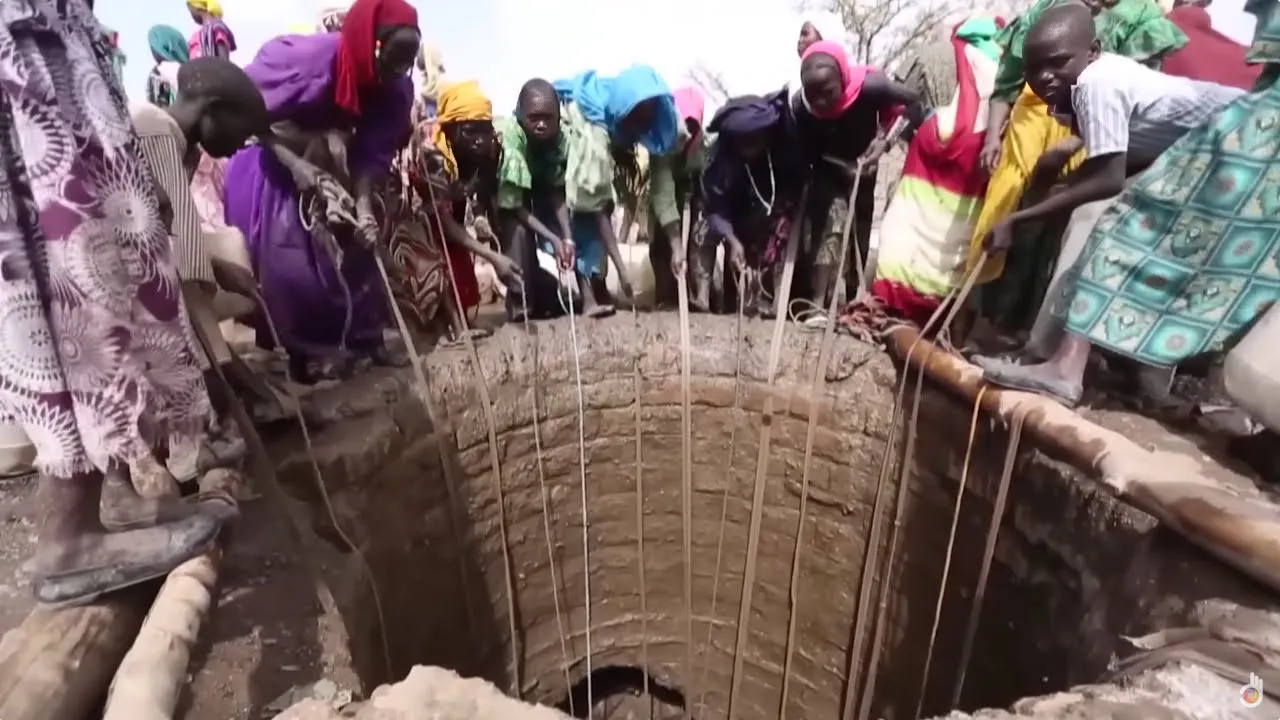
from the taps. At that moment, the problem is the supply of drinking water to the people. We'll definitely run out of water. According to the United Nations, in 2050, 5.7 billion human beings are likely to live in regions experiencing water shortage at least one month a year. The fight for water has already begun in all four corners of the world. We can imagine that countries already suffering from water crises in Africa, in some South American countries, and in Asia, it's likely to get worse. Look! It was last March 8 in Caracas, Venezuela. The shortage of
water drove the inhabitants of the city to get supplies along the Guaire, One of the most polluted rivers in the country. Unbelievable! It is water from the pipes that the people came to draw. Look! We're at the banks of the Guaire, the river where all the wastewater from Caracas is discharged. Whether you are rich or poor, we're forced to come here to get water. It is only here that you can find drinking water. How did we get to this point? Look! Unfortunately, the pressure points on the surface of the globe. We're fighting for water. Look
at what's happening in the Middle East. People are making dams on the Nile to collect water in Sudan. There are already security tensions, be it in the Sahel or in Southeast Asia. The quest for water can even create wars. It's been a call for concern for several decades. The fight for water could get worse because of global warming. Some are already preparing for the worst And think that this water war could reach Europe and even as far away as France. Yves Cochet was Minister of the Environment under Lionel Jospin in 2001. He became what we
call a collapsologue. Convinced that the end of the world is near, he left Paris to settle in a small village in Brittany. He completely changed his life. No more golden desks and suits and ties. He wore his boots and he is living happily in the middle of nature. Brat, are you coming with us? That's the cat too. Most definitely, he is very happy here. He takes care of biodiversity. He fights for life by eating rats. Why did you choose to settle here? It was about 14 years ago now, my daughter and I were already thinking
about the collapse. We told ourselves that we had to find a place that was resilient. That is to say where there are basic amenities being water, food and energy, such as wood. My belief is that the worst will happen. The worst would be that we will have a choice And we should be prepared for it. This choice is simple, help or kill each other. Hey friends, if you want to make apple jam, put them in your pockets. According to the former minister, to survive in 2050, we will have to be united. We don't have a
visionary survivalist from California with the bunker and the Winchester. That's not our thing. It means putting our ecological ideas into practice, to do what I call the social healing biotope. That's to say that we are on good terms with our neighbors, to exchange products and services. That's what we do with people who are three or four kilometers away. It may go from a dietary point of view,. Today the politician is already trained to be able to live without running out of resources. We'll see a swamp fed by the stream, but it is dry at the
moment, because it has not rained for three months. It is a problem in Brittany and elsewhere. There is a bit of water! I didn't think there were so many. It's nothing, it's just a puddle. It's usually full. You can pump it as long as you want, you can even bring a watering can if you want to. To make it drinkable, you have to boil it. Once you've boiled the water, you can drink it. It's wonderful! What a beautiful landscape It's paradise here. Sometimes I go on boat tours with the grandsons. You need to have a
good laugh. Even though he fears the worst, Yves Cochet remains an optimistic man. In the event of a shortage, he has everything planned out. What is it? It's a well with a hand pump on it. There is no electricity. It allows you to have water annually. You can boil water to make it drinkable. We don't lack water. It was one of the resilience criteria. To have water. Because, as you know, without water... Gentlemen and ladies, do you live in Paris? You are in your Haussmann building on the fourth floor, no tap water... Here you need
to have water. Neighbors we're trying to have better relationships with, because we're either helping or killing each other, most are skeptical. They want to know if I am sure that the world will end soon in 2030? They say that mankind has seen others, that we'll get there. Alone against all odds, Yves Cochet does not give up. Maybe the world will end, but he's not out of ideas. If you want, we'll see the dry toilets, that are well known and are part of the ecological hardware legend. We open like that, and we do it like this,
and you have electricity inside your dry toilet, with the sawdust container, and all other little things. To wash your hands leaving the toilet, there is nothing better than rain water. Here is our first container of 1000 liters of water that comes from the roof and falls in here. Then we have it on the tap. We put this one so that people can come and wipe their hands after using the toilet. Yves Cochet bets all on rainwater. Are you guys still here? Note that he knows that in 2050, extreme rainfall will increase by 22 percent. A
very disturbing figure. Did you notice it? With global warming, water evaporates and the earth dries out. So, in the sky, The clouds are swelling with water in big proportions. When the water settles, the damage is huge. The storms that were a hundred years old, that is, those who fell every 100 years, very big storms that submerge the coasts, that break, will come every 10 years, and then they are likely to come every year. They'll be more recurrent, more violent storms. Waterfalls are changing. It pees, it's falling, it's falling, it's falling, it's falling! When you learn
geography, you discover that rivers are torrents that are dry in summer, All of a sudden they swell, because we are on impermeable ground so it trickles down. Now, no region of France will be spared. Floods could cause appalling material and human damage. throughout Hexagon. We realized that we were fragile and vulnerable and we were exposed to floods, and not simple floods, but violent, brutal and, above all, deadly floods. Sometimes, you can see the water rise up to two meters in height. On the national road that connects the cities of Nîmes and Alès, the height of
this road was three meters high. in 2022 I saw refrigerators of a restaurant in the trees perched five meters high. The water rose five meters above the level where it was. It's mind-blowing! There is an increasing acceleration of these phenomena, major flash floods. It is a flood that will have an extremely rapid rise time of the waters. Except that in the process, it destroyed everything on the territory. Unnormal floods that devastate everything without human beings being able to avoid them. That is for a simple reason. If it rains it means tropical rain. Our water flow
methods are not adapted to this, because the surfaces are concrete. That is all. We've strengthnd everywhere, we're still building. If you go 50 years back, when a river overflowed, it overflowed into nearby fields, and the fields absorbed it. Today, there are fewer fields, more buildings, more commercial areas around cities. Cities have impermeable surfaces. When the river crosses the city, this is the case of Nîmes, we channelled it into parking lots in order to save space. What cannot pass in width passes in height. Anyways, the water is here. Today, when there is a flood, there are
also many more impacts on the houses that are built in a housing estate, where the flood once spread quietly. To give you an idea of what floods can cause, we went back to a small village that was completely devastated by the water. Villegailhenc, a small village of 1600 inhabitants, located near Carcassonne. Here, everything changed during the night of October 14 to 15, 2018. In just a few hours, the small town was covered by four meters of water. Michael Proust, The mayor of the village, is still traumatized. On this side, the streets have been closed. Here
is the church, it had two meters of water inside, and the monument to the dead, I can also show you, where the water has risen. It best describes the extent of the disaster. Here is one of the natural flood markers, the monument to the dead, where water was above the helmet of the unknown soldier, this was approximately between 3.50 and 4 meters deep of water. If you draw a straight line, you can see that the water was on the first floor of the houses at the back. The post office, the municipal offices and even the
village church, everything was destroyed in a few hours. Michel Proust accepted to tell us about that horrible night. It all started when heavy rain suddenly fell on Villegailhenc. The speed, the volume of water that fell quickly aggravated the situation. People called me to say they will remove the roof tiles to climb up to the roof just in case. There was a disabled man who called me every half an hour since he was alone in his house. His wife was away, he was in his wheelchair, with water on his knee level. At that moment, Michel Proust
started measuring the magnitude of the tragedy affecting his village. He rushed to the town hall but the flood happens to be much more violent than he imagined. Living on the hills 90 minutes away, I couldn't come. I called assistants who couldn't come. There was too much water, we couldn't get to the village anymore. Help came in. People on the roofs were airlifted, including two who were injured. You can't gain access to the village because the water level has had consequences beyond belief. Water was found at more than four meters in the houses. It was desolate
since the refrigerated window of the butcher was on the street. His window exploded, it was blown off the ground and ended up on the side of the sidewalk. All the doors and windows exploded. In the houses, everything was upside down. Everything was raised, the fridges, the freezers, the gas stoves. Out of the 860 homes in the village, 430 are flooded. Even the city's bridge gave way under the weight of the water. The damage is insane. In the early morning, Michel Proust draws up a provisional assessment of the flood, and the result is tragic. Until you
experience it, you can'timagine what damage water can cause as damage. There are four deaths to mourn in town. It was at the heart of the village, but as is often the case... It's very painful for families, especially for two people out of the four, because in our families, when the grandparents or the parents are elderly, what do we do? On the ground floor we fix a bedroom and a bathroom. Two out of four were in these ground floor layouts. They are dead. The third person passed away due to the flood. Firefighters managed to keep her
alive but she died upon arrival at the hospital. The last was carried away by the floods. He had a studio behind his parents' garden, the flood came and carried him away. He was found at the other end of the village in a tree. For the mayor of the village as well as the inhabitants of Villegailhenc, the trauma is immense. it's always very complicated, Mostly for the elderly than the youths. For those over 70, part of their lives is being lost For some, their houses represented a home to the third generation. All of these people had
their lives in photo albums. It's all gone. This mud is everywhere. We can't get anything back. It's all gone. It's very painful for these people. Villegailhenc is not the only town that was devastated. In the surrounding villages, the situation is also chaotic. Go to the other side of the window, Report to them. That day in the department of Aude, we counted 15 deaths, 99 injured and huge material damage. Over 1,000 people were evacuated from their homes. Today, a year has passed since the deadly flood. Meanwhile, Villegailhence still bears the scars of the drama. The most
shocking is behind this wooden door. Two streets completely ravaged by the flood, which makes Villegailhenc look like a ghost town. All the houses were inhabited on this street except for that house. There were tenants everywhere with the owner right behind. Now, all is gone. This house is half collapsed by the flood. You can still see the pressure cooker, the bowls. The freezer turned upside down. For Michel Proust, the feeling is still intact. It's a mixed feeling. It's painful because there were families who were there, one or two are gone and are not coming back. Families
that were well integrated, and everyone loved. It's sad because I knew these streets. I surveyed them even before leaving for the town hall. It's true that it means somthing. Today, Michel Proust is careful. he fears another flood that is just as violent. There is climate change, so it can happen again. It has never happened but can happen again, that's for sure. Year in year out, the water that falls from the sky, threatens us more than ever. There is no doubt about that. The water that rises and swallows all in its path doesn't come solely from
the rains. Because of global warming, another danger is emerging, very much destructive. Each year in the North Pole, there is an accelerated melting of ice pack. A generalized font all over Greenland, So almost every point in Greenland, even those at an altitude of 2,000 or 3,000 meters have melted. There are big pieces that break off, and form huge icebergs, melt and provide fresh water. That is why we are witnessing a rapid rise in sea level. It's likely to get worse. When it comes to rising sea levels, One of the unknown factors is the behavior Of
Greenland and Antarctica In a context of global warming. The water rises inexorably. You don't realize it with the eyes, but the sea is gaining ground, it is undeniable. In the latest IPCC report, rising water levels according to scientists is believed that in the worst-case scenario, if we continue to emit as many greenhouse gases as we do today, by the end of the century, the oceans could rise by one meter. One meter is huge. If you are told that it increases by 2 or 3 mm annually, you won't see the difference when you go to your
usual beach. One meter will gain approximately 10 meters inland. Now it's becoming sensitive. The problem is that this rise in sea level, will continue no matter what we do. The greater the warming, the higher the sea level will rise. The problem is that water is endangering the destiny of millions of citizens who have spent their whole lives by the ocean. When you think that there are 600 or 800 million people who live near the water, so at a height of 50 centimeters compared to the water level, it will cause a lot of human damage. In
regions like Bangladesh Which are very dense and very close to ocean level, this could cause massive population displacements in areas that are already very tense politically, these population displacements are likely to cause political crises. As is the case in Europe with migratory pressure at our borders. When you see cities like Jakarta where we tak about displacement, there are over 10 million inhabitants now... Relocating people, It seems unthinkable and yet, it's already the case in France. We are in 1967, in Soulac-sur-Mer, in Gironde. A building called Le Signal is erecte 200 meters from the edge of
the ocean. Four floors, 78 apartments and breathtaking views of the coast. A paradisiacal residence, which, with global warming, will however become a real hell. Fifty years later. Unbelievable! The water has gone nearly 190 meters, so much so that residents are worried. I have been a homeowner for about fifteen years. Last year, it was five meters taller than the limit we have there now. It was 200 meters away about 20 years ago. - Are you worried now or not? - Very worried. I was one of the only optimists, but today, I am becoming pessimistic. The residence
Le Signal saw the sea come very close, in a few decades. The sea was getting closer to land by the day and it was so yearly to the point of completely envading the building. Unfortunately, every year, the work is limited to putting in sand. But, putting in sand to prevent water from rising, didn't help. Inexorably, year after year, the water is rising right before the powerless residents. It's getting worrisome for the building that's there. Something has to be done. Because we keep talking but, it's time to do something concrete. This building has been evacuated. Besides,
no one has the right to live there anymore. There is indeed a risk that this building will collapse. Today, the ocean is only nine meters away from the Le Signal residence. The danger is not only looming in Gironde. Here is a short overview of the rise of the waters in France, but also just about everywhere on the globe. You'll see it, the predictions of scientists are frightening. There are already municipalities, like that of Royan, who are thinking of moving. The Camargue, which was also a wetland, could eventually be submerged by seawater. The whole southern part
of Languedoc-Roussillon, where we have made beautiful residences, large artificial beaches, all of it will be submerged. No country bordering the coastline will be spared from rising waters. We talked about Pacific islands that could be Like the islands of Maldives or Fiji, or even Hawaii. It's Tokyo, even New York, one meter of flood from sea level, you won't be able to protect yourself from it, Bombay, Kolkata, we can talk about Lagos, about Bangkok. At some point, we will have to agree to return land to the sea. Nothing can stop the rise of the waters today, not
even the huge cliffs that border the coasts, like here, near Étretat. What happened on July 18, 2013 is proof of that. We are in Saint-Jouin-Bruneval, a few kilometers from the famous cliffs. In a few seconds and before an amateur cameraman, nearly 30,000 tons of rocks crumble on the beach. Erosion due to wind, frost and water has caused the rock to burst. The more the sea rises, it must unfold, the more it nibbles on the land. Inevitably, the cliffs are likely to crumble more strongly. More water, unbearable temperatures, and hundreds of thousands of victims, 2050 would
therefore be terrifying. Especially since there's something we've kept from you. When the ice melts, viruses that were trapped there and who have hibernated for years can wake up. When we talk about issues concerning the virus and global warming, We don't think about viruses coming out of the ice anymore. The soil melts to a certain depth. There are soils that have thawed, and others that have never thawed. There may be diseases that have disappeared. By releasing these ices, organic matter is released. This organic matter contains particular viruses which can be extremely old. Like in the Russian
Far North in 2016. Rising temperatures have awakened a deadly bacterium present in the carcass of a frozen reindeer for 75 years. This virus is called anthrax. I saw four people who were in intensive care. They were between life and death. A child was in a critical condition, but in the night, his condition improved. In a few days, the disease got to humans, and also to animals. Two thousand reindeer will be killed by the anthrax virus, and a child will lose his life. Anthrax is caused by a particular bacterium called anthrax, with cutaneous, pulmonary, and digestive
complications, which can be extremely serious. The return of anthrax is not the only health threat. With global warming, new diseases could appear in our regions, because even mosquitoes will become dangerous. On July 25, 2050, in the south of France, Nina and Nicolas, a young couple are celebrating the arrival of sunny days. An ordinary summer day, but not for much longer. While lovers savor this moment of happiness, a little detail will disturb their quiet time. Mosquitoes seem to have colonized the PACA region. Five days later, in his apartment, The couple is going through hell. From now
on, red patches cover their bodies. Headaches, fever, joint pain. What's happening to them? They don't know they've been stung by Aedes albopictus, tiger mosquitoes that carry a terrible virus. In the emergency room, there is a crisis because the staff is not prepared. Patients all have the same symptoms. They are waiting for a diagnosis. Actually, Everyone suffers from a disease which we were not used to seeing in France, however, chikungunya. Nina and Nicolas have been particularly affected by the virus, their case is serious. Nina is suffering from respiratory failure. When the doctor finally comes to see
her, the news is far from happy. I'm sorry your husband is gone. Nicolas, Nina's partner, did not survive the chikungunya virus. Maybe you think all of this is fiction? Think again. In 30 years, 2.4 billion people are expected to be exposed to the tiger mosquito, and could be infected with chikungunya. Unfortunately, the mosquito that is becoming fashionable In our temperate climates, it's the tiger mosquito. It is a mosquito that came mainly from hot countries and from the south. It's more present in tropical regions, for example in Brazil or in the sub-Saharan regions. Before, it could
not have developed in France, because the temperatures did not allow it to. Progressively, over the last 10 or 15 years, He settled in the south of France. Especially the entire region that bordered the Camargue. The Montpellier area was one of the first to be affected. It can be seen that the entire Mediterranean border has been affected. Gradually, it's the entire south of France. It is very clear that they will end up arriving in the north of France. They are spreading everywhere. Rising temperatures linked to global climate change will only accelerate the arrival and development of
mosquitoes. The consequences of the tiger mosquito invasion will be dramatic. This mosquito will be used as a transmitter for a virus. It is a mosquito that can cause very serious diseases. This is Raymonde. She lives in the Var, in Cannet des Maures. She has been close friends with the tiger mosquito. It was in August 2017. I got shivers down my spine. I told myself that I had contracted the flu. The next day, it had spread all over my body, the knees, the ankles, the fingers. I had intercostal pain, in my shoulder, I was walking bent
over. You will have pneumonia That will complicate the chikungunya disease, or a neurologic meningeal form. In short, it is a serious form of chikungunya. The tiger mosquito can transmit another virus whose consequences are irreversible, the Zika virus. The problem with Zika is that it has complications in mother-to-child transmission. We have seen this in particular in South America, on the overseas departments of the Antilles. Zika, which infects a pregnant woman, is a malformative risk it's very important. We all have these images of children in mind with a very particular facesis, with neurological and growth retardation, what
is linked to Zika virus infection at a point in embryogenesis, during the manufacture and development of the embryo, and later, the fetus. If you are infected at this time, there will be unfortunate complications, that are irreversible, because they are real malformations. Mosquito invasion is not the only visible consequence of the inexorable rise in temperatures. There is a new phenomenon today who is not deceiving, and it confirms to us that there is something wrong with our climate. You are not dreaming, wild boars are now invading our cities. These animals that were hiding in the forests, now
there are swarming our streets. On 30 July 2019, the English newspaper The Guardian published a long survey on the proliferation of wild boars, due to global warming. The British daily explains that with rising temperatures, winters are milder and favor the reproduction of these wild pigs. This is not the only factor behind their development. The drought would also play a big role. These are species that have fewer habitats, who, in addition to the drought, are facing a lot more difficulty to find food. The problem is the search for food. They are closer to homes. We see
it in France, in Poland, in Hong Kong. Wild boars that are naturally afraid of humans become aggressive. They are coming now because there is food. They come and ransack everything in the villages to find food. At the hairdresser's place. It's dangerous, it's 50 kg. In shopping centers, but equally at the beach. Wild boars are terrorizing the population. In some cities, the invasion is such, that municipalities have set up traps to catch them, like here in Montpellier. There's the installation. So far this cage that I put has worked well. Are you satisfied with the samples? We
put corn and bread. As they notice that there is corn around the stones, They'll grow with their snouts. I'm going to show you. They're going to push the rocks, and that will trigger the system. It is urgent to limit the proliferation of wild boars, because, beside being dangerous, they can also carry diseases. In contact with a wild boar, a wound on the hand will be a route of entry because skin is a protective barrier. If you have a wound and your hands are not properly washed, you will have pasteurellosis. It is a bacterium that can
enter the body. For example, you will have leptospirosis. For now, hunters, veterinarians, veterinary assistants, slaughterhouse employees are the most at risk. Globally, these are communicable diseases. So wild boars are invading our cities, especially because, these are the forests that could completely disappear. It is a desolate landscape that is chilling. We are in California. An entire city had to be evacuated. It was just a year ago. What happened here? You'll see, It's still the effects of heat and drought which we're taking about. These impressive images were shot by an American woman, Rebecca Hackett. Oh my God,
please let me get out of here. As the young woman leaves her Malibu home, seeking to flee from the fire, she suddenly found herself trapped in the flames. Rebecca Hackett is one of the 200,000 people who had to leave their homes Because of the fires that hit western Los Angeles on November 9, 2018. California is one of the most heavily affected areas by global warming. There are lots of forests, but then there were major fires again, difficult to control, which started from all sides. Again, the scientists there believed that these fires left earlier in the
season owing to the warming, because very little rain had fallen, so the floors were dry. In a few days, 62,000 hectares and 14,000 homes were destroyed. Hello Karen? - Katy. - I am alive. I did not sleep all night. Honey, the house burned to the ground. It was horrible! I can't even imagine. It came all of a sudden. The whole town of Paradise burned down. Everything got burned. The toll is extremely heavy, 87 dead and about 500 people are missing. This fire was the deadliest in California history. These fires seem far away to you, However,
they are approaching us at high speed. Henceforth, even northern France is burning. Unbelievable! We are in Hauts-de-France, near Beauvais. Hundreds of hectares of corn and wheat fields are burning, it was last July. Firefighters tirelessly tried to put out the fire day and night, to no avail. Fires in Picardy are not usual. Especially in Hauts-de-France, there was this drought, With landscapes worthy of sub-Saharan Africa. It made a big impression. Increased temperatures have increased the risk of fires in regions that were not used to deal with fires. We saw it more in the south of France. It's
still hard to imagine how fires could devastate our country. With global warming, their power has increased by tenfold, and maybe we haven't seen anything yet. I wrote an article, Where IPCC scientists were talking about Fontainebleau. Those who live in the Paris region know it. It is a forest south of Paris. This forest could be faced with more fires by 2050 or 2100, if nothing is done to limit global warming. If we show a map of fire risks by 2050, a large part, especially central and eastern France are becoming regions at risk of forest fires. Gigantic
fires, viruses, floods, storms, And then the water that would run out. All this is not very pleasant, but nevertheless makes the collapsologues happy, they are those who have predicted the end of the world by 2050. Let's meet Yves Cochet in his house in Brittany, where he decided to live secluded like in the 18th century, According to him, the only way to escape the disaster of global warming. is, for example, in order to stop producing greenhouse gases, the former minister will propose a radical solution. No more cars to get around. He focuses everything on a particular
vehicle, the horse-drawn carriage. There is a first horse-drawn carriage here. It's a horse-drawn carriage that's been handed over, but that is sometimes used for fun, and going out with the kids on Sundays. There, you can install one or two horses which allows this carriage to be towed in case we want to go to the village to visit the neighbors. It can make you laugh, but I am convinced that starting in the years 2035, the main mode of human transport, Especially in Brittany and France will be the equestrian mode. It will take a lot of horses
for the wagons, the stagecoaches, the horse-drawn carriages. Between villages, or we will have teams, or we'll ride a horse. If you come here, you'll see the second carriage. This one is a bit lighter than the first one we saw. It has four seats. There are two at the front. There is the driver who is my daughter, and I am the bellboy. You can take two people behind. That's how you hook up the horse's hitch. We are preparing for the future where the main mode of travel, as we say now, cars, trucks, vans, tractors, all of
this will disappear due to lack of oil. If Yves Cochet wants to go far away, He must pace himself. So, with his horses, he looks after them. They love apples. Don't give them too much, because they are gluttons. In addition, It's like when you eat too much of something like chocolate, you're overloaded. There they are. Who is this apple for? Who is the apple for? The sweet apple! It's sweet! He is beautiful! Eat, drink, get around, and all without depending on anyone. Yves Cochet has everything planned, the same goes for energy. Because according to him,
in 2050, there will be no electricity. It is with this wood that we try to produce our energy. We don't buy wood from outside, We have enough of it in the small forest of three hectares behind. Three hectares is enough for 10 or 12 people, It gives us exactly that. It's been almost a winter. You put logs like these in the fireplace. Here, we have hotplates for cooking. We are autonomous and we can warm ourselves if there is ever no electricity, gas heater, oil or coal. They are horrible. Oh my god! The only recourse for
Yves Cochet is the countryside. In 2050, we'll have to flee from cities. At first, nature is very dirty. It's raining, the socks are wet, It smells bad. It's probably the future, because I don't see how in 2038, we'll live healthily in Paris . It begs the question. If Yves Cochet is at this point the visionary of a disintegrating world, Why doesn't he take up the torch To convince French people of the usefulness of his approach? We asked him the question. If I ran for office, I won't show up anymore but I did, I would say,
vote for me, We'll all try not to die together. It's not funny. If I can save a few people through my actions or speeches, that would be nice. I would have had a successful life, if instead of 50% of humanity dying, She dies at 49%. It looks awful, but I tell myself that I would have helped save what could be saved. Yves Cochet is dubious about the future of humanity, but he is not the only one sharing this opinion. That is the least that can be said. Some journalists and renowned scientists agree. There is the
attitude of pessimists they say we're heading on a wall, but it depends on the height of the wall. If it's not too high, we can get over it. That is my position. If I have a building in front of me, We'll crash into it. We need to have hope because the human species is very resilient. It has adapted to a lot of shocks. Future shocks are likely to be much greater than what we have experienced so far. That's why we need to react as quickly as possible. The Earth will keep turning. On the other hand,
will all of humanity survive? It's not that safe. It will depend on his ability to react very quickly In order to raise the bar, reduce greenhouse gas emissions, and change the entire economic and societal model. It represents a lot of change, a lot of turmoil. It's a matter of survival for a lot of human beings and species on Earth. The problem is that it is a global phenomenon. The Americans, the Chinese, the French have different interests, They have different interests than that of endangered inhabitants of a small island, because the sea will rise. The most
complicated thing is to have these 195 countries around a table, And to get them to agree on how to act. For that, everyone has to look in the same direction, the states as well. It concerns all sectors of activity and each of us. Should we be afraid of what awaits us tomorrow? Shake the red cloth like collapsologists do, Is it effective in avoiding the worst? Sometimes fear can be a good drive for action. It can lead to action, and you can tell yourself that it is necessary to change your living comfort. We often say small
streams make big rivers. If you start using your car less, maybe eat less meat, limit air travel... The main point is that we need to move towards greater sobriety, so consume less in general. It doesn't mean we should stop eating, but that means no longer being overconsumed which has also shown that it can make people not necessarily happy. These are gestures that, when placed end-to-end, means there will be fewer greenhouse gases, so less warming. It's not going back to the Stone Age, or lighting, heating yourself with a candle. We can change things gradually without going
back to the 18th century. Scientists are formal, all is not lost, there is still a glimmer of hope. There is still time to do the maximum and reverse the curve. It is our imperative duty. There is still time to act if we want to preserve this planet which is beautiful, and provides us with most of what we need, water, food, air to breathe. If we want to keep living on this beautiful planet, we have to act now. This is the biggest challenge we are yet to face.


![Aftermath To The World's Deadliest Natural Disasters [4K] | Mega Disaster | Spark](https://img.youtube.com/vi/Jm3EPmKFO9o/maxresdefault.jpg)