all right so we're back to the board here so we have discussed what the objective of the experiment in the lab is which is to determine the constitutive equation for the material out of which a specimen the dog bone specimen has been cut the process of testing to determine stress and strain is going to be by using the universal testing machine to apply load measure stress and measure strain well let's talk a little bit about measuring stress and measuring strain so the first question would be what is stress anyway right so at this point I
would invite you to pause and go and think about first of all the stress come up with the definition or look it up I assume you did that so I think we all agree that stress is a measure of the internal forces acting in a piece of material that is loaded with external forces and moments so it's a measure of the internal forces now you will remember that in terms of the definition of stress if we have a piece of material and some loads acting [Music] we consider a point P inside the material an interior
point and at that point we consider the penny shaped using it is infinitesimal area which we call DNA now we consider the normal to this infinitesimal penny shaped area so the normal depends upon the orientation of the penny and then we perform a mental experiment and we say let us measure the force acting on this surface and let's call that force EF it's a vector so that force acting on this infinitesimal teddy shaped area DF DF is called circus traction so it's a mental experiment to see it's easy to say it's not easy to do
you cannot just dive inside the potato find the point that you're talking about make identify a penny shaped infinitesimal surface at that point that is centered on that point and then measure the force at the same time because you can't have your Apple I need it to the moment you perform a cut in order to measure the force then that force is no longer there the force only exists as the body is in one piece so it's easy to define but actually not very easy to determine now let's break down the force into two components
so component in the plane which are you gonna call BS and the component along the normal which are going to hold the end so the surface traction has two components the end is the surface traction component perpendicular to the surface the S is the component of the surface traction in the plane of the pen in the painting plane of the cross section you remember that we define normal stress the normal stress on that surface as being DN the magnitude of P n divided by DA this is a definition of normal stress as opposed to shear
stress which is the magnitude of D s divided by here so for this infinitesimal penny shaped surface located inside the material centered on the point P at which we want to determine stress we can determine normal stress and shear stress all right that's the definition let's practically do it how are gonna do and here's where the problem is you can define it you can't do it you can't use the definition by itself to measure because you can't dive into the potato to the point of interest you can't cut and measure that penny shaped surface and
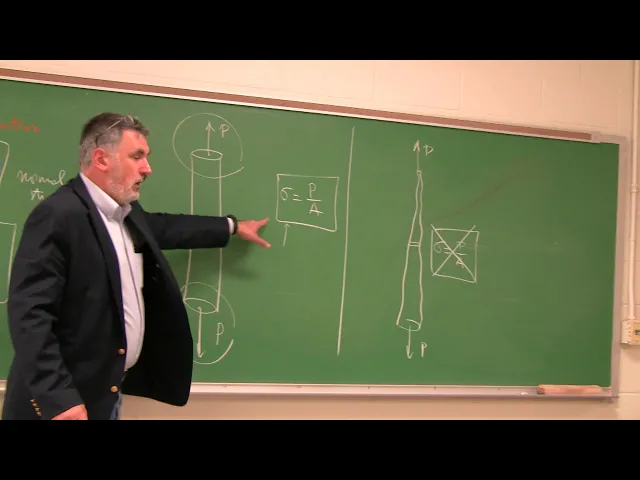
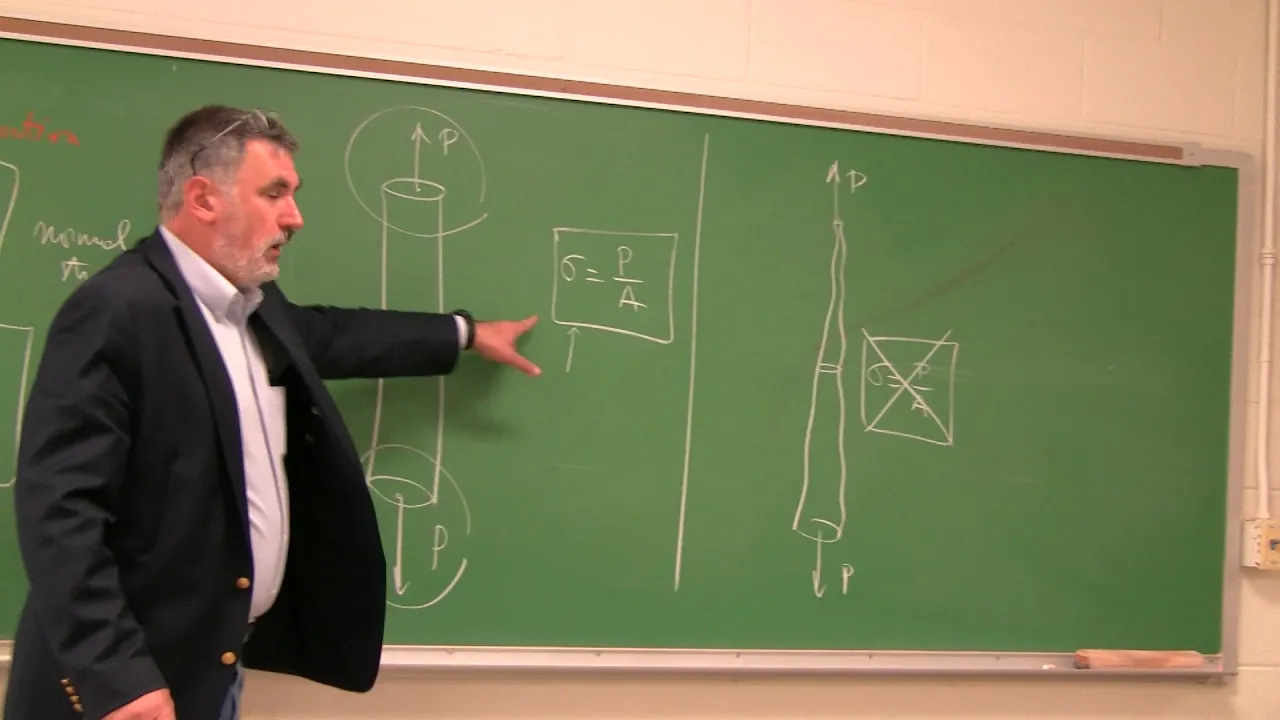
then measure the force acting on it you just can't do that so in fact we cannot measure stress let me emphasize that we cannot measure stress what we're going to do instead is we're going to estimate stress so let's go back to what you learned in 23:12 if you have a bar and you apply equal and opposite forces P enemy at the ends and the cross section of the bar is 80 you said okay Sigma is equal to P over 8 and the story went if you go far enough from the points of application of
concentrated look which are at the ends of the specimen if you go far enough then in that cross section the normal stress is going to be P equal or people P divided by implied in this is the following we're assuming that this concentrated force distributes itself somehow miraculously uniformly or read this area to make this true you can always write it but it may not be true so in order for this to be true this this concentrated force needs to somehow miraculously distribute itself uniformly in there in truth over this area well you remember that
this doesn't generally have if I go to the forest cut the tree cut the trunk and apply 8 in the trunk and the fly a little piece here and the low key here the fact that sequence is equal to B over a is not true for a number of reasons first of all the tree doesn't have uniform cross-section second that cross the the tree trunk is not actually straight so there is no reason for this applied load to this actually distribute itself uniformly over the cross section this is only truly an average sense in an
average sense is true in an average sense in this destroy as well but in the general sense of some structural member to which you applied and loads this is not true in order for this to be true in order for this equation to be true in order for this load concentrated load applied at the ends to distribute itself uniformly over the cross section two conditions need to be satisfied and I trust that you're going to remember from 23:12 what those conditions are the first condition is that the cross section of the bar is uniform and
the second condition and in is that the bar is straight and then there is a third condition that has to do with the application of level so the cross section needs to be uniform along the bar the bar needs to be straight and the force needs to be applied at the particular points on the cross section and not trust that you remember that the answer is the centroid of the cross section so unless a is constant along the bar and the bar is straight and the P is applied at the centroid this is not true
so in order for this equation to be true all these three conditions need to be satisfied if however those three conditions are satisfied then we can write this equation and we don't actually measure stress we actually determine stress from two other measurements the measuring the force and a measurement of area well guess what the measurement of cross sectional area you just took care of it during the experiment number one you have measured the width you have measure the thickness you know the cross-sectional area of your specimen now what's left is a measurement of force and
that's the where the load cell of the testing machine comes in to help the load cell of the testing machine during the test will perform measurements of low axial load applied you will provide before the test the cross sectional area of your specimen and as the consequence the testing machine the software will perform this operation and we'll know we'll think of those we'll consider that Hypno's and make the record of stress so that's how you're going to be measuring stress during the experiment you're gonna be using the load cell to measure P you're going to
be using your measurement of area to note a and the software will determine Sigma and the software will record Sigma during the experiment the stress during the experiment the normal stress now let's check that these three conditions are met yes the unit for the cross section of the specimen in the gauge section is indeed the uniform that the cross section from here to here the gauge area of the cross section of the specimen does not change the president is straight yes we can test that the specimen is not right I hope that one of you
that your specimen of my claim we did too hard so that's the second condition the third condition P is going to be applied at the center it we're going to make sure that when we install that the test specimen in the grips of the testing machine it is going to be located in the middle of the grave such that the the force is effectively going to be applied along the center of the cross section if we for example take this specimen install it with an offset in the testing machine in the grips then this last
condition is not going to be met and that's the consequence this is not going to be correct now that's not going to keep the Machine from computing stress that word