hi welcome to Investments glad to see everybody here so today I'm going to be doing an introduction for those of you who are not able to make it to live to the first class and we going over the introductory materials this PowerPoint is available on canvas so welcome glad to have to see everybody with us so this is really an an introduction to the stock market and Investments so how does this work we're going to go through uh different kinds of Investments and by and large dedicate the entire class session to each one of these
but it's important to think in in whole about the types of Investments that we'll be dealing with we'll talk about common stock common stock every corporation issues common stock of of some sort we have corporate bonds bonds are are may be issued by a company that's not it's not required not every company is going to be issued ising bonds we have government and gsse bonds government being you the treasury bonds and other kinds of Investments that we use to uh fund the deficit for for our country and then the gsse refers to government sponsored Enterprises
there a number of these uh the most notable ones are Freddy Mack and Fanny May which operate in the mortgage market and we'll spend an entire session talking about those so a preferred stock is U something that a corporation can issue but not all do mutual funds are collections of stocks that are professionally managed exchange traded funds are are similar to mutual fund but have some very important uh distinctions we'll go over on in that session but why do these all exist that is what do they have in common what they really have in common
is they're all designed to stuff liquidity to put money into an into something so in the case of of a common stock or corporate bonds again uh common stock issued by by a traditional company a publicly traded company and that common stock is a way for the company to raise money so if you buy a corporate bond or you bu buy a buy a stock or the origin when stock was purchased the point is to put cash into the company they then use that cash to build plants fund operations build inventory whatever they need they're
using that money to really support the business uh you're buying it as investment but it doesn't exist so you can invest in it it exists to provide money into the system same thing with uh with government bonds are there to to put cash into uh our our federal government and keep it going the gsse bonds the particularly Freddy and Fanny are putting liquidity into the mortgage market so you never go into your into your bank on in in March and say Hey listen I've just found a house I want to buy a house and I'd
like you to lend to me and and give me a mortgage they never have to say oh man we're sorry we lent all of our money last month we don't have any cash the reason is is because these these entities Freddy and Fanny exist and they're constantly stuffing money stuffing liquidity back into the the mortgage market so the reason as a class all these things exist is so that we can um uh so that there there's an opportunity for you to uh to to put money into the system and to raise money so really another
way of thinking about this is that investing and financing are two sides of the same transaction so if I am a a company and I need financing I need cash I need money to to put into operations to grow to head staff whatever I need to do uh I can go seek investors issue stock issue more stock issue a corporate bond maybe was a preferred stock and and get cash into it so when I talk about financing investment is the other side of that that coin now I know that many of you are taking this
as a as an accounting elective You' all had accounting so you may be wondering okay well where is it on the balance sheet that I'm going to see these investment instruments and the answer is potentially everywhere it is if you're a company with a treasury function meaning that you have money that you're managing over time you're probably going to have Investments you're not going to stick that money in the vault somewhere you're going to either put it in the bank or you got to get at least some interest right ideally in other kinds of Investments
where you're going to get uh get a return so among your assets at any given moment as a corporation maybe um investment instruments if you have floated bonds that is a liability you owe money to the bond holders and so your investments in some cases depending on your your your financing and which to the buyer an investment in any given moment may be part of your liabilities and certainly if you're a corporation the owner Equity is typically in the form of common stock that who owns your company those who own the stock own your company
so the stock is owner's equity in fact you sometimes see the formula written is assets equal liability plus shareholders Equity so that's the reason in corporate case uh owners Equity really is shareholder Equity so terms to know these are terms that you may have seen they may feel familiar but you may not have used them in the technical sense we'll be using them in this course the first is return return is what you get back for your investment so you're investing you're going to get money back it could be cash it could be growth in
the value of your investment could be any combination thereof but what do you get back in exchange for your investment that's what we mean by return when we take that and express it as a percentage which allows us to compare one investment to another so we look at the percentage of of the return that's called a yield and we'll spend some time talking about that in some detail what you what you're venturing other than your your money is risk so what is the risk that you don't get paid at all you invest in a company
on Tuesday and on Wednesday they go bankrupt and they don't exist the value of your investment goes to zero um the risk is uh essentially what is what are the chances that things don't go well for you as an investor when that and and there's a relationship we're of times look at the relationship between risk and return so if you're taking on more risk logically you would expect to get a higher return when that risk becomes uncommonly High that's when we start talking and using the term speculation so speculation is simply when the risk and
and maybe the return is very high but the risk is also very high so there's a legitimate chance you may lose everything as part of this that's when you're getting into the realm of of speculation so speculation is just a term of AR that means really high risk and ideally if if it's something you're taking on really potentially High returns an investor is the person who's putting their money in and expecting this return in exchange in this case for this class most of the time we're going to to place you the student in the place
of of being the investor when a common stock or preferred stock pays you cash in the case of a that's a dividend in the case of a common stock it may be something the company declares periodically they may have a history of giving consistent and and you know similar size dividends in the case of a of a preferred stock it is uh usually written into the contract so you know what the what the return on the preferred stock in terms of dividend is is going to be capital appreciation is something you buy becomes more valuable
so you buy a stock at 20 is now worth 25 that is that is that is growth that is that is capital appreciation so in looking at the return or the yield on a stock you really have to look at both that is How likely is it to go up or how much has it gone up and what's the dividend because the dividend is essence you may think of it as them paying you to wait for the value of the stock to to go up so it's um it's something very very very valuable uh Bull
and Bear I'm not sure what the history is in terms of why these particular animals were selected but we use buold to describe things that we think are going to go up we're bullish on the market or we're bullish on a particular stock bearish is when we think the Market's going to go down or a particular stock is going to go down you know I'm bearish on XYZ company means I think that their their the value of the stock is not likely to increase it's likely to decrease Now understand that even in the the best
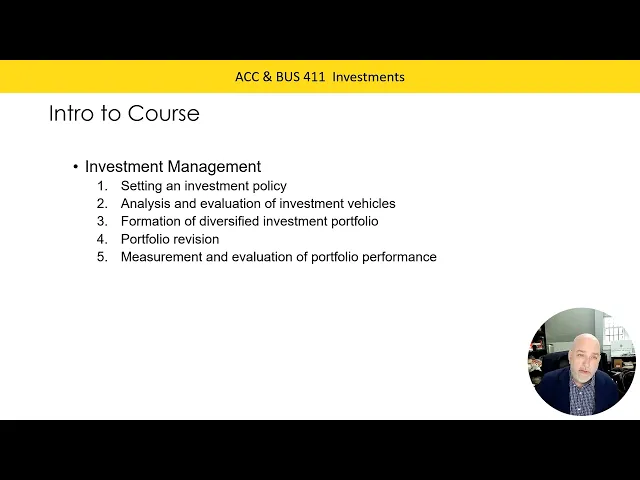
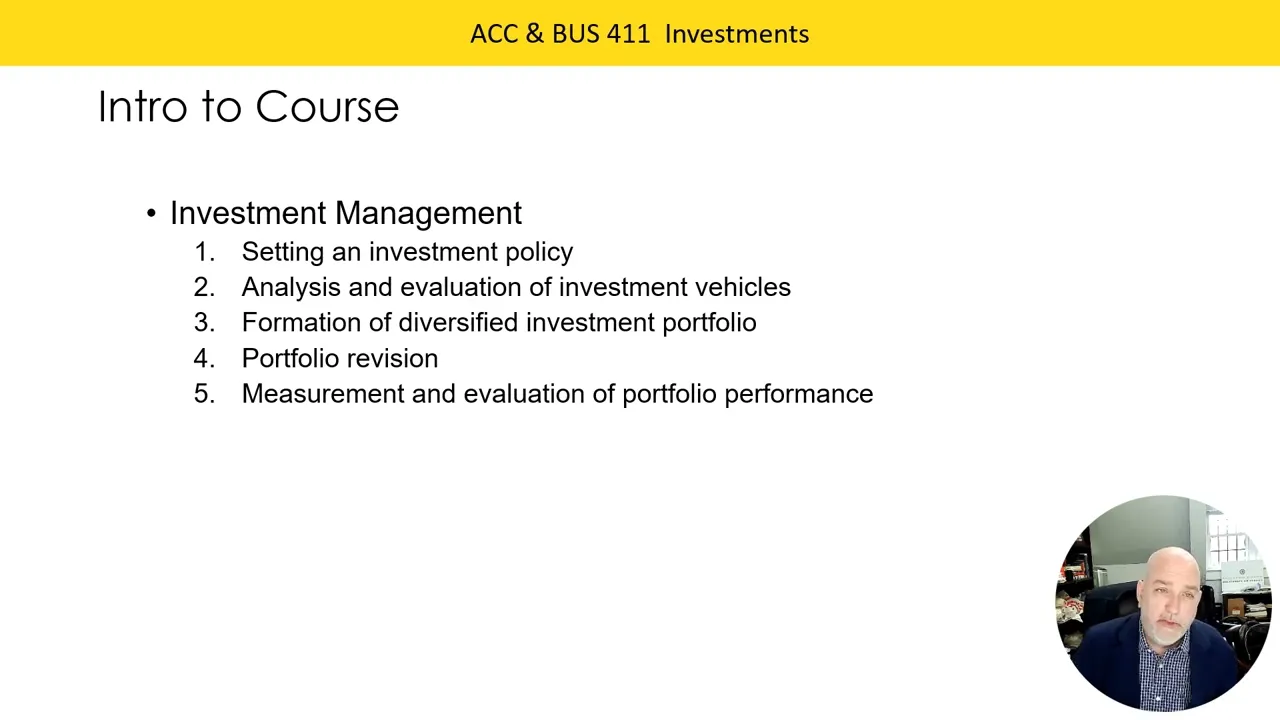
bull markets were things Rising everything seems to be rising there going to be some losers some companies going to go down same thing in a bare Market everything is predominantly dropping becoming less valuable it doesn't mean you can't find some stocks that are going to do very well so um you know bull but bull bull means good bear means bad in terms of up and down one of the you're reading for for this first class uh talks about the investment strategy process think of it as you're going to have some sort of policy is what
is it you want to accomplish if you're talking about the case of of an institution you have money you're going to park for a period of time what's that period what is it that you want to to set you may also have uh philosophical positions that is you don't want to or you think it is is out of the realm of your brand to invest in liquor companies or people who make weapons or medical systems that provide um reproductive care or um in maybe even you know farming if if sensibilities of your of your customers
and your values you know would be against consuming animals so whatever it is if you have those kinds of of policies or if you have personal goals I'm this is money I'm put this money here this money I'm setting aside for a house so I'm going to want it with the next 5 years this is money I'm putting for retirement I won't be touching for for many many years so what is what is your investment policy what's your risk tolerance how much risk are you willing to take on then you analyze and evaluate the investment
vehicles that is what is it that I might invest in you formulate a diversified Investment Portfolio understand that um uh sometimes in in some context an investment Diversified or diversification is seen almost as a universal good understand that it is kind of a controversial position some investment professionals are a very strong belief that U diversification simply kills the return that you're that you're getting and in fact diversification is not a good thing but diversification uh of a diversified portfolio portfolio revision have some sort of understanding of when in the process you're going if you have
a stock that goes up when do you take profit and and sell U measure and evaluate portfolio performance and then make adjustments as needed so brokerage types what are the types of accounts that um you would be using well as an organization you're going to be using a straightup brokerage account you're going to have an account uh with a major brokerage firm and all your you know your money and your securities you're going to go into there as a person you can also have a brokerage account brokerage accounts to a person are fully taxable meaning
at the end of the tax year if you've gotten interest on cash if you've gotten dividend payments from the company you're going to pay taxes on those when you sell a stock and you have a capital appreciation so again you buy a stock for $20 you sell it for 25 you're going to pay taxes on that $5 but that happens only when you sell so it doesn't matter how much a stock is going up if you have a sold it the the the profit the taxable incident only happens once you um uh once you once
you sell the stock the other four accounts underneath there are all tax protected accounts so the first traditional IRA and raw Ira 401k 403b and then the raw 401K 403b these are the major types of accounts as an individual that you may have uh in addition to the brokerage account these are all tax deferred meaning that you're not going to pay taxes on the money until it's withdrawn typically in retirement so traditional IRA traditional IRA this is money that you get put into your IRA and you meet the income requirements this this the ability to
put money in Ira phases out as you as your income increases but if you qualify and you have qualified income you put money in traditional IRA and that then becomes deductible on your taxes so you are essentially not paying tax on the money you put into a traditional IRA and then when you retire many many years from now you will pay taxes at your current tax rate F so the money doesn't get taxed until you take it out Roth IRA also a retirement vehicle but that is after tax money so the money you put into
a Roth IRA would be money that you've already been taxed on so you've already paid your income tax on that so when you withw draw those those principal payments in retirement uh years from now you will not be taxed again on those 401K 403b these are there there's some small differences between them but essentially they're the same thing 401K is the as an account that is offered by a for-profit company 403b a nonprofit so if you work for Ole forp University for example we're a nonprofit so we have 403b accounts this is an account where
you can contribute money and typically your employer also going to contribute money so just note to students one of the biggest mistakes I see students make is getting into their career and not taking the 401K match it's free money essentially your employer is saying I'm going to give you another three four five six 7 10% of your salary for free so not having this account not making your contribution and if there sometimes it's a match so you have to put a th000 in they'll put ,000 in but that's $1,000 free money so you put your
$1,000 in you get a second th000 that's an automatic 100% return just by doing it so it really is uh uh you affirmatively stupid to not participate in your company's 401k or 403b account if if it's offered as as a benefit now this is like the traditional IRA for a 1K 403b is um is is pre-tax dollars so when when you pull the money out in retirement of those accounts you'll be paying the the taxes at your current tax rate at that time Roth 401k 403b of these this is probably the the least common toine
corporations offering U but the Roth 401k 403b is um uses post tax money so you've already paid taxes on that again there may or may not be an employer match if there is your tool is not to take it or make the contributions you need to to get that match and then when you take it out in the future your contributions will not be taxable so You' already pay tax on it so those are the types of accounts now where would you find those accounts that is who's going to hide going to go to to
the shelter and hold that account um these are called custodians so who is the custodian of your account traditionally if you're going to open open a brokerage account it's probably going to be a maj your brokerage firm so your Charles Schwabs Merl lynches e Jones um those those are your types of companies that are going to uh have places where you can go in open a brokerage account you just got to go in give them you know 50 bucks 100 bucks home you open brokerage account fill out the paperwork they will fill it out you
open it just like a bank account but once it's in there you've got some cash in it you can then go out and buy stocks bonds CDs anything really available in the world now you will go and see that there are most of the major banks have investment arms so you can go into a city or regions the truest they may or may not be operating under that bank's name but they will typically have an investment partner where you can open a bank uh open an account now there are also banks that still offer Bank
IRAs these are not very popular because the only thing you can really invest in in Bank IRAs typically is is the bank's own CDs and so to give you more options you're usually better off going either with the um with the brokerage firm or the um uh the the investment arm of of the bank as opposed to the bank itself so there are investment firms you know typically that have their own um um mutual funds so Fidelity T price Vanguard you can open an account directly with the company there and uh and it's treated like
a brokerage account the only difference is and it's a pretty big difference is that unlike with a schab or Maro Lynch you can go in and buy Fidelity funds if your money is at Fidelity it's not like you can go buy other Investments you can only invest your Fidelity money in Fidelity funds and then they're employer custodians so there are other companies that may some may be household name some you've never heard of who will house your 401k 403b or raw 401K 403b here at Ogle thort we use a company called Lincoln Financial and they
uh they're they're the custodian so I have an account with linoln financial as a University employee everybody all the university employees have an account there and that's where our 401K money that we contribute as well as University's match goes into now how safe are these Investments well the major brokerage firms are cpic insured sipc uh security investors Protection Corporation it is often compared to the FBI but it is different in that the cpic really is designed to support and protect custodianship as opposed to Value um cpic Returns the cash and securities but not necessarily the
value you invested them so if you go and put you know $300,000 into a brokerage account their major brokerage firm and that brokerage firm goes bankrupt tomorrow goes out of business generally this doesn't happen so this is not this is not a common app and just say for the sake of argument that that it did you would get your stock back now when you get your stock back it may be worth a fraction of what it was worth before you if you've got your your money in an account that's FDIC insured at your bank and
the bank goes under and there's $250,000 in the account you're going to get $250,000 back if you if if it's cpic you're going to get the the Securities back so Civic protects stocks bonds treasury certificates um CDs mutual funds money market funds and and certain really anything that's qualified under I think it's the 1936 definition of Securities uh is um is covered cic does not protect commodity Futures contracts foreign exchange or certain other derivatives that that are that are not covered those are in account and the company goes under you're just out of luck so
there is a protection limit uh cpic will ensure up to $500,000 in custodial value which includes 250,000 limit on cash but that's within the 500 so it's not 500 plus 250 cash it's 500 to 50 of which at a Max can be cash so if you've got 200,000 sitting in in a Charles swab and th 100,000 in um um uh securities and Charles Schwab goes under which again is not going to happen then it is um it'll be protected by by cpic cic will make you whole now the main way that they are are different
the FDIC and and cpic is FDI FDIC and acts more like an insurance company like your State Farm or all state or Geico Whoever has your car insurance or your renters insurance the they collect premiums from the bank Banks and if a bank there's a run on a bank and a bank is can't be its obligations they will step in and use those uh the the premiums that they received to to cover claims cific actually asks to see everything on a regular basis so if a broker is cific insured that means that they're showing the
Securities to cific and the cash to cific on a regular basis so they're saying okay you tell me for all your beneficial owners that is all the investors um that you've got your x million shares of stocks show me those stocks that you actually have them and they have to demonstrate that they have you say you've got $6,000 of cash on hand well where's the cash show me the cash show me the account show me where that money is so uh cific is is much more uh Hands-On in terms of of making sure that what
you're looking for and what you're being protected against are really there so we talk about markets in general terms and there are market indices and these are different index measures of of markets the most common three you hear all the time S&P 500 Dow Jones and NASDAQ now Russell 2000 is um meant to demonstrate the health of small business so Russell 200000 is the index of the 2000 smallest uh stocks in the Russell 3000 um composite Dow Jones Industrial Average looks at 500 the largest stocks on US Stock Exchange the Dow Jones Industrial Average looks
at the 30 largest companies on us exchanges and NASDAQ which is a National Association of security dealers automated quotation system that's that's you know cute moniker uh NASDAQ is actually a composite of everything on NASDAQ since it's holy electronic they've been able to Simply tell you okay in the aggregate here's how every single stock on NASDAQ uh work so when we talk about NSE or the big board we're talking about the New York Stock Exchange there was another Stock Exchange the American Stock Exchange what people refer to it years ago some years ago merged into
the New York Stock Exchange so really the New York Stock Exchange is the dominant Stock Exchange in the United States the nasda ndaq is tends to focus on newer companies I think the average age of a company on NASDAQ is something like uh you know 15 16 years whereas the average age on the uh New York Stock Exchange is probably 50 60 I mean you have 100 year old plus corporations who are still listed on the New York Stock Exchange uh Chicago Board of of exchange is uh it's a is a is a market that
focuses is on SEC on on Futures present future values I mean future contracts and so puts and calls we'll explain all that in the in just a little bit but the it it deals with exchange traded funds and other things that are uh a little bit different than than some traditional stocks but uh CBOE is is a great market and as you might guess it's based in Chicago so Chicago Board of options Exchange so that concludes our our introduction we will meet on Wednesday live and in person and start uh our each individual session on
each of the Investments mentioned above it we'll start Wednesday with common stock it's great to see everybody thanks for tuning in