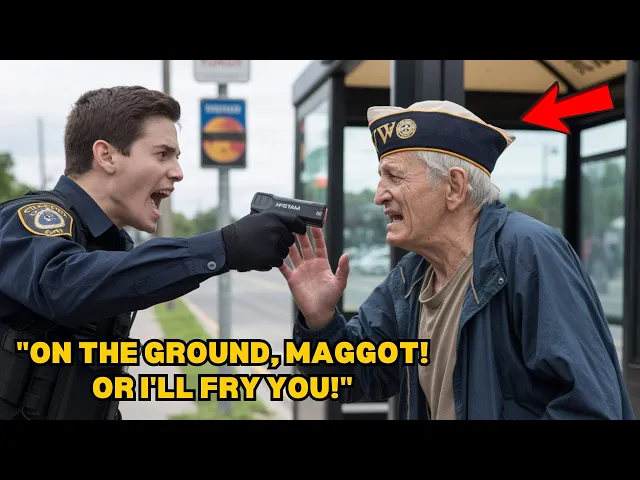
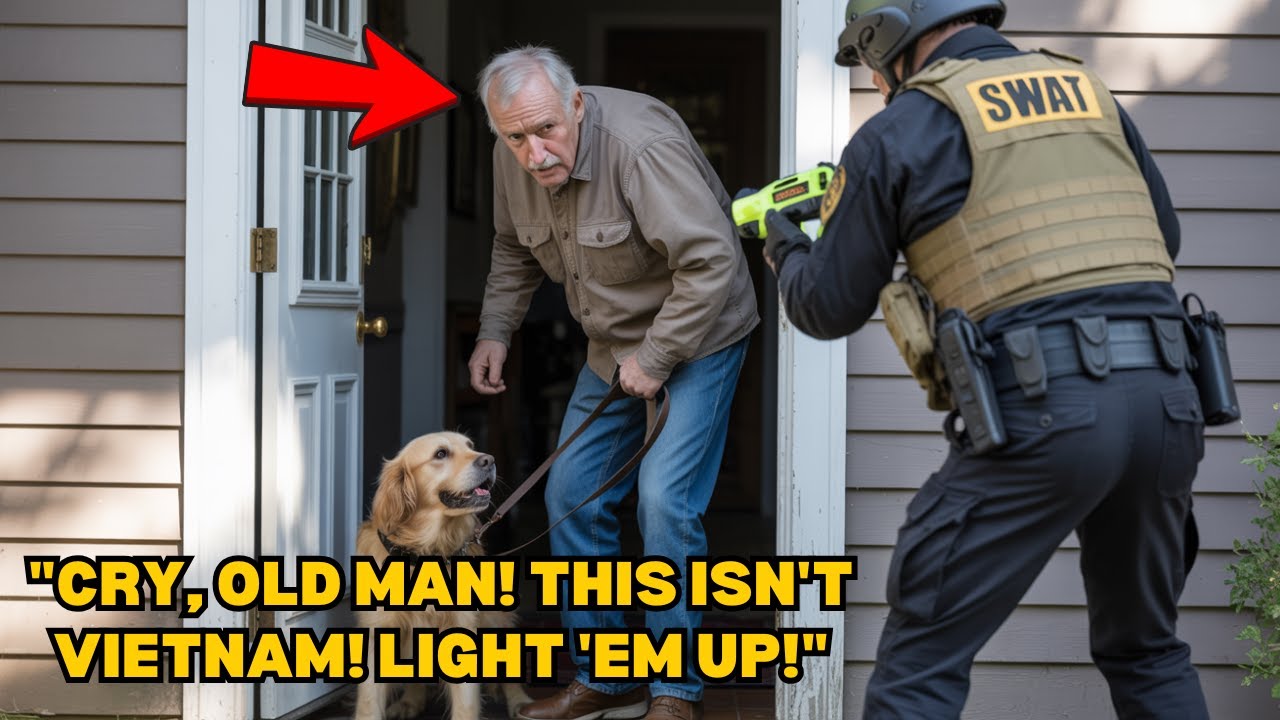
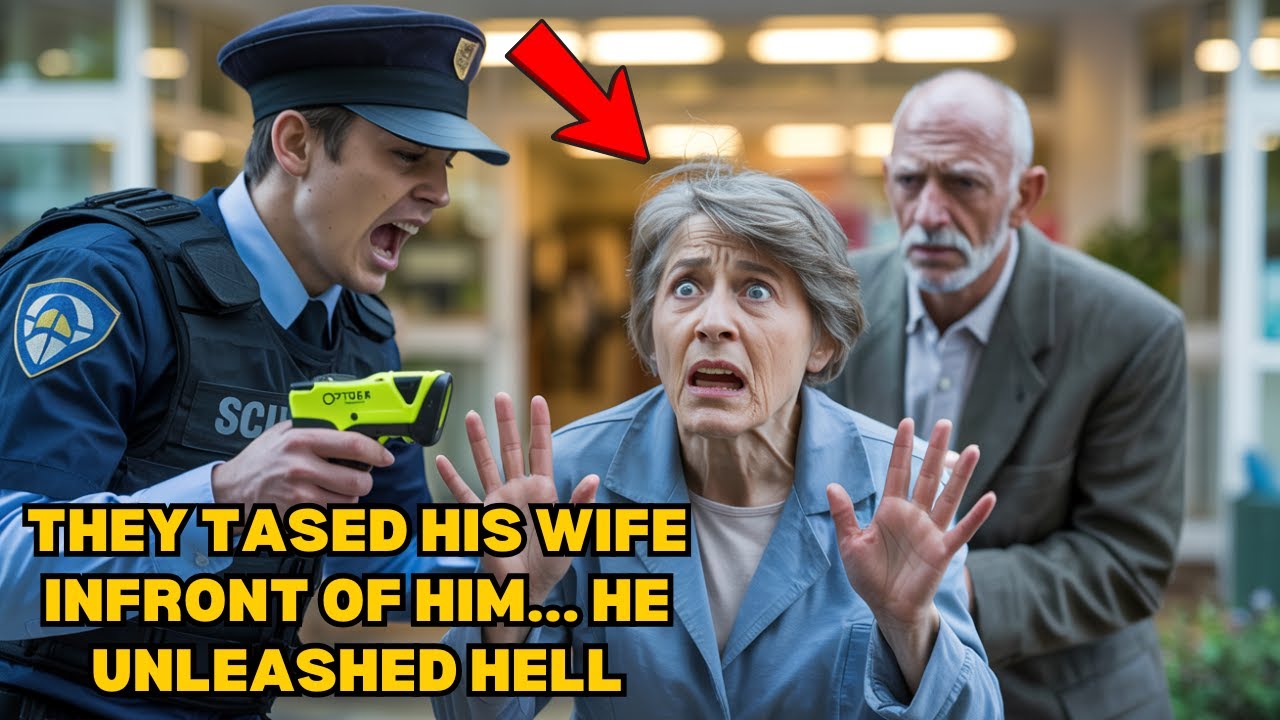
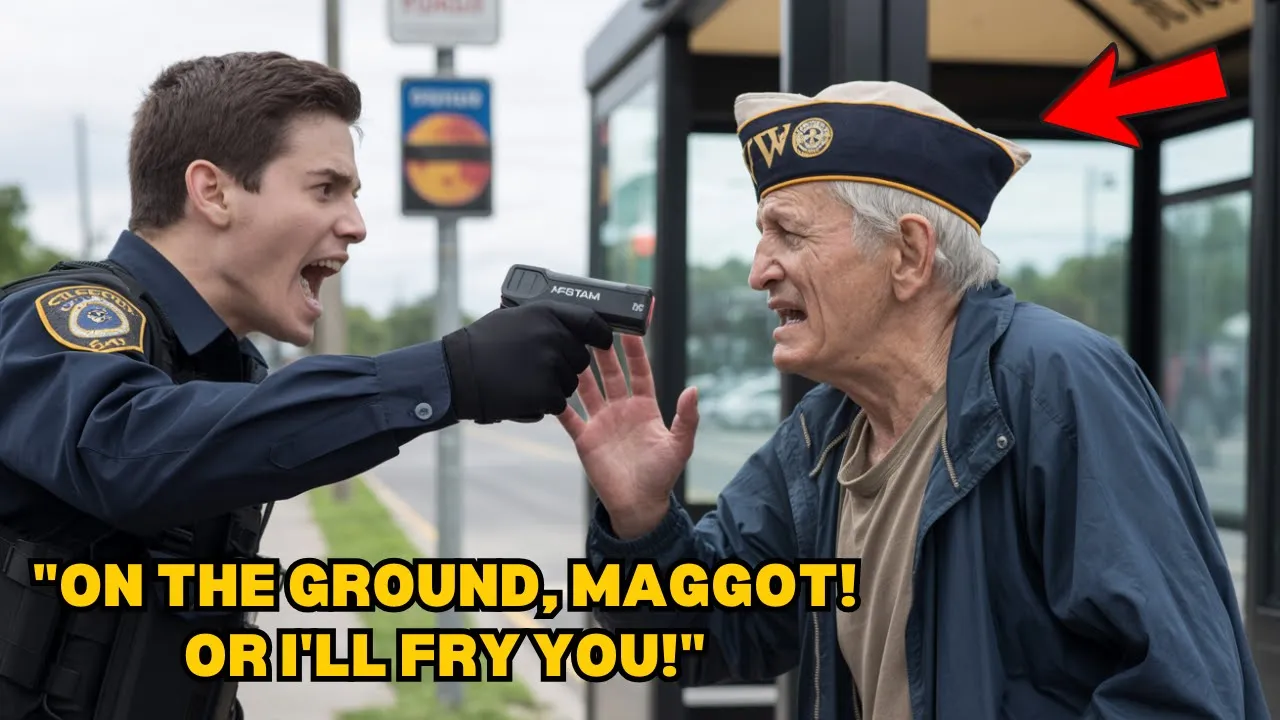
Sir, you've been asked to move along three times. This bus stop is for active commuters, not for loitering. Final warning, the young police officer said, his hand already resting on his holstered taser.
Arthur Arty McMillan, 78, looked up from the worn paperback he was reading, his brow furrowed. Officer, I'm just waiting for the 215 bus to the VA clinic. My appointment is at 3:0.
The officer scoffed. Likely story. You're disrupting public order.
Before Arty could protest further, the officer drew his taser and fired. The barbs hit Arty's chest, sending jolts of agony through his frail frame. 6 minutes later, as Arty lay dazed on the sidewalk, the screech of tires and the sight of heavily armed men in tactical gear disembarking from unmarked black vehicles shattered the afternoon calm.
The Pentagon had responded, "If you believe those who served deserve our utmost protection, not tasers, type, never forget below. " Arthur Ry McMillan was a man of quiet habits and deep unseen scars. His small third-fup apartment was sparssely furnished but impeccably neat.
A testament to the discipline ingrained during his 30 years as a senior chief petty officer in the US Navy, specializing in advanced electronic warfare systems during the Cold War and beyond. His work had been highly classified, often isolating, involving long, silent patrols beneath the waves or in remote listening posts. Now in his retirement, the silence was different.
Tinged with loneliness since his wife passed, and punctuated by the persistent hum of tinidis, a souvenir from too many hours spent amidst powerful radar arrays. He relied on the VA for his medical care, particularly for the worsening arthritis in his knees and the checkups for a heart condition managed with medication. Today, he was heading to his quarterly cardiology appointment.
The Tyber 12 bus stopped right outside the VA clinic and the bus stop was a mere three blocks from his apartment, a manageable walk, even with his protesting knees. He arrived at the bus stop a good 20 minutes early, as was his habit. He settled onto the hard plastic bench, pulled out a well- readad Tom Clansancy novel, and prepared for a quiet wait.
He was not panhandling, not making a disturbance, simply existing in a public space, waiting for public transport, lost in the world of espionage and submarine warfare that in some ways felt more familiar than the bustling city street around him. Officer Miller, no relation to the mall cop, was young, barely two years on the force, and eager to make his mark. He saw the city not as a community to protect, but as a series of potential infractions to correct, approving ground for his authority.
He was on foot patrol in a recently cleaned up downtown district under pressure from his sergeant to maintain a visible presence and address quality of life issues, which often translated to moving along anyone who didn't look like they were actively spending money. He spotted Arty on the bus stop bench. Old guy, worn clothes.
Arty favored comfortable, durable chinos and a faded navy windbreaker, reading a book. To Miller, this didn't look like an active commuter. This looked like a loiterer, a potential vagrant, someone lowering the tone of the revitalized street.
He approached Arty, his posture already confrontational. "Sir, you can't just sit here all day," Miller began, his voice unnecessarily loud. Arty looked up, startled, marking his page.
Excuse me, officer. This bus stop is for people waiting for a bus. Then they get on and go, Miller stated as if explaining a complex theorem.
You've been here a while. You need to move along. I am waiting for a bus officer, Arty replied calmly.
The 215 to the VA clinic. He gestured vaguely up the street. Miller's eyes narrowed.
The VA clinic? That's across town and the 215 isn't due for another 15 minutes. You're loitering.
I'm giving you a warning. He tapped his ticket book meaningfully. Arty sighed.
Officer, I assure you, I am simply waiting for my scheduled transport to a medical appointment. I am not causing any disturbance. That's your interpretation.
Miller snapped. My interpretation is that you're occupying public space without immediate intent to travel, which constitutes loitering under city ordinance 34B. Move along or I'll have to sight you.
He clearly enjoyed the jargon, the assertion of power. Arty knew it was pointless to argue with this kind of mindset. He'd seen it before in different uniforms, in different countries, the inflexible adherence to minor rules while missing the bigger picture of common decency.
All right, officer," he said, preparing to stand, though the thought of standing for 15 minutes with his arthritic knees was unpleasant. He began to slowly gather his book. But Miller, perhaps misinterpreting Arty's slow movement as defiance, or maybe just eager to escalate and demonstrate his authority, stepped closer.
"I said now, old man, you think I'm joking? " His hand drifted towards his utility belt. Arty, startled by the sudden aggression, instinctively put a hand up, palm out, a non-threatening gesture.
There's no need for that, officer. I'm going. That gesture, however slight, seemed to trigger something in Miller.
Resisting? He barked. You're resisting a lawful order.
Before Arty could react before he could even fully comprehend what was happening, Miller drew his taser. Last chance. Move it.
Arty, shocked and confused by the sudden escalation, opened his mouth to protest, to explain again, but it was too late. Miller fired. The barb slammed into Arty's chest through his thin windbreaker.
An explosion of agony seared through him, his muscles spasming uncontrollably. He cried out, collapsing from the bench onto the hard concrete sidewalk, his book skittering away. The world dissolved into a white hot haze of pain and confusion.
Miller stood over him, taser still pointed, adrenaline courarssing through him. "Should have moved when I told you," he grunted, already reaching for his radio to call for backup and report a non-compliant subject taser deployed. Passers by stared, some in horror, some quickly averting their eyes, phones emerging to record.
Arty lay on the ground gasping, the residual electricity still courarssing through his frail body, his heart, the very organ he was on his way to get checked, pounding erratically. The indignity of it, the sheer injustice, was almost as painful as the taser itself. As Arty lay on the sidewalk, dazed and disoriented, the pain slowly receded into a dull, throbbing ache, he fumbled in his pocket.
not for ID, not for a phone to call for help in the traditional sense. His fingers closed around a small discrete panic button no bigger than a coin attached to a thin chain around his neck, usually tucked under his shirt. It wasn't standard military issue.
It was something else. A relic from a very specific, very classified program he'd been part of decades ago. a program that dealt with personnel recovery under extreme or unusual duress involving compromised identities or systemic failure of local authorities.
He'd never once had to use it in all his years of retirement. He'd almost forgotten it was there. With a surge of residual adrenaline and a desperate last ditch instinct, he pressed it.
A tiny, almost invisible LED blinked once, green. He wasn't sure if it even still worked, if the network it connected to still existed. He closed his eyes, the sounds of Officer Miller talking into his radio and the gathering crowd fading into a distant hum.
4 minutes passed. Miller had called for an ambulance, more as a procedural necessity than out of genuine concern, and was busy trying to control the scene, feeling a surge of self-importance. 5 minutes.
An ambulance siren wailed in the distance. 6 minutes. The ambulance was just turning the corner onto Arty Street when something else arrived far faster, far more decisively.
Two unmarked black Ford Expeditions and a black Chevrolet Suburban, lights discreetly flashing in their grills, screeched to a halt, boxing in Officer Miller's patrol car and the approaching ambulance. Doors flew open and six figures emerged. Men and women in dark civilianstyle tactical gear, body armor visible, sidearms holstered but clearly accessible, moving with the swift, coordinated precision of a highly trained special operations unit.
They fanned out instantly creating a secure perimeter around Arty, their movements economical, their expressions utterly impassive, ignoring Miller's shouted, confused questions. One of them, clearly the team leader, knelt beside Arty, checking his vitals with practiced ease. Senior Chief McMillan," the team leader asked, his voice calm and respectful.
"Signal received. Extraction protocol initiated. You're secure.
" Arty still groggy managed a weak nod. Code Night andale. Blue, he mumbled, a phrase from an old forgotten protocol.
The team leader nodded. "Understood, sir. We have you.
" Officer Miller was apoplelectic. Who the hell are you people? This is a police scene.
I deployed my taser on a non-compliant individual. You are interfering with an arrest. The team leader didn't even glance at him.
He spoke quietly into a comm's unit on his wrist. Night andale blue confirmed. Asset located interference.
Requesting immediate sec liaison intervention level one. A moment later, officer Miller's police radio crackled to life. Not with local dispatch, but with a voice that was cold, clipped, and carried the unmistakable weight of federal authority.
Unit 714, this is Overwatch. Stand down immediately. I repeat, stand down.
Do not interfere with the federal recovery team on site. A department of defense liaison is on route to your precinct and your watch commander has been apprised of the situation. You will await instructions from your superiors.
Is that understood, Officer Miller? Miller's jaw dropped. Overwatch, Department of Defense, Federal Recovery Team.
He stammered a yes, sir. Into his radio, his earlier bluster completely gone. He looked at the tactical team surrounding Arty, then at Arty himself, now being gently helped to his feet by two of the operatives with a new dawning sense of horror and confusion.
Who was this old man? The ambulance crew, who had arrived amidst the chaos, were politely but firmly waved off by the tactical team, who had their own advanced medic. Within another minute, a sleek black helicopter devoid of any markings save for a small, almost invisible federal insignia, descended with astonishing speed and precision, landing impossibly in the middle of the four-lane street, its downdraft whipping up debris.
The tactical team escorted Arty swiftly towards it. Just before he boarded, Arty paused, looked back at Officer Miller, who was now being very sternly spoken to by his own arriving sergeant. Arty didn't look angry, just incredibly weary.
Then he was helped into the helicopter, and it lifted off as quickly as it had arrived, vanishing into the city sky. The black vehicles followed suit melting back into traffic, leaving behind a street full of stunned witnesses, a bewildered ambulance crew, a very shaken officer Miller, and a police department suddenly fielding frantic calls from the Pentagon. The fallout was immediate and severe.
Officer Miller was suspended pending a full investigation by internal affairs. An investigation now being very closely monitored by observers from the Department of Justice and the Department of Defense. The city's mayor and police chief issued a public apology not just to Arty McMillan, whose identity was kept carefully shielded from the press, but to all veterans for the isolated but deeply regrettable incident.
The city's policies on use of force, especially against elderly or vulnerable individuals, and its training on interacting with veterans, underwent an immediate and comprehensive review with input from several national veterans organizations and discreetly from DoD advisers. Arty McMillan was taken to a secure military medical facility. His heart thankfully had withstood the taser assault, though he was badly bruised and shaken.
He was treated not as a non-compliant subject, but as a national asset who had been endangered. He learned that the nightingale blue panic button system, a relic of a deep cold war program for recovering critical intelligence personnel under extreme duress, was indeed still active, monitored by a highly classified joint agency task force within the Pentagon. His activation was the first in over 20 years.
After a few days of observation and care, Arty was quietly relocated to a comfortable assisted living facility in a different state, one specializing in care for veterans with complex medical needs, all expenses covered by a grateful and anonymous benefactor, likely the DoD. He got his books, his few momentos, and a new sense of security he hadn't felt in years. He never saw Officer Miller again.
He never had to wait for a bus in the cold to get to a VA clinic. He learned that sometimes even the most forgotten protocols, the most hidden networks of support could roar back to life when a brother in arms was down. And that even the smallest button pressed in desperation could summon a response that reminded the world that some debts of service are never truly discharged.
And some heroes, no matter how quietly they live, are never truly off the grid. Because when you harm one of those who served at the highest, most secret levels, you don't just get local police. You get the full focused and formidable attention of a nation that sometimes still remembers how to protect its own.
Subscribe to this channel if you believe every veteran deserves dignity and that some lines should never ever be crossed.