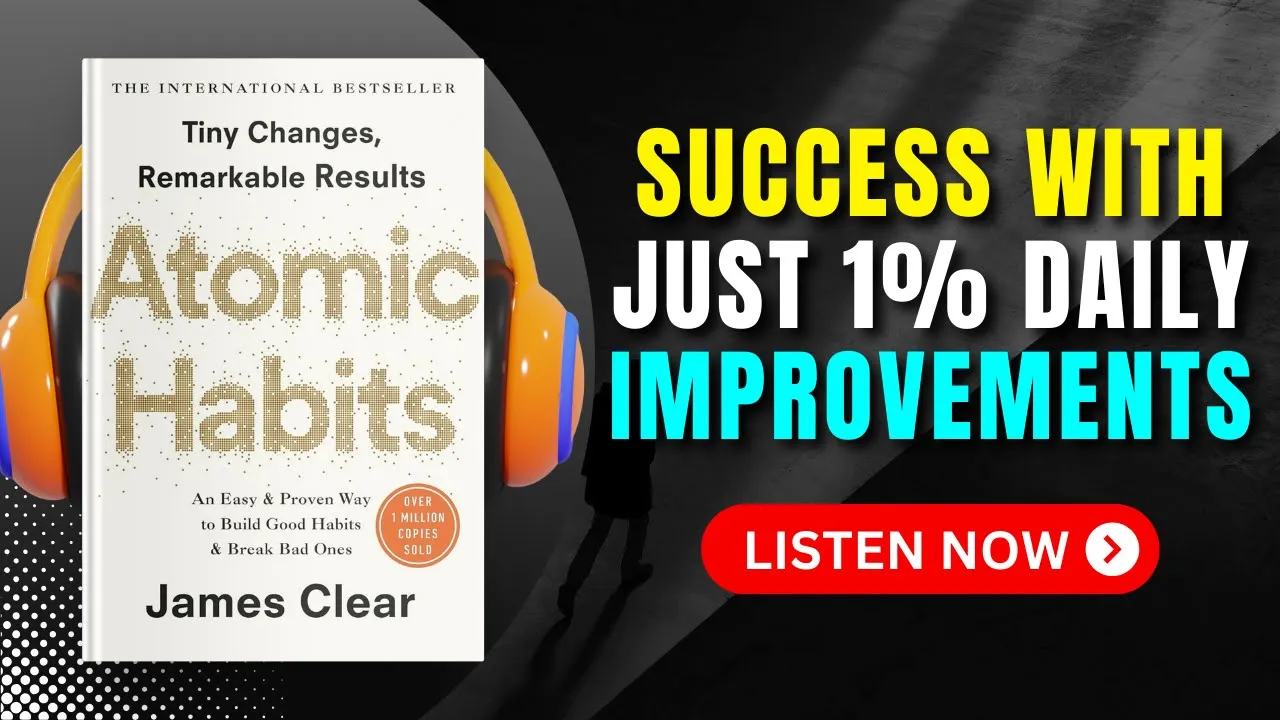
Atomic Habits by James clear this book has revolutionized the way we think about habits and personal growth in atomic habits clear provides practical strategies to form good habits break bad ones and master the tiny behaviors that lead to remarkable results whether you're looking to improve your health your work or your overall life satisfaction the principles in this book can guide you on a transformative Journey imagine if you could improve every aspect of your life by just 1% each day what if tiny seemingly insignificant changes could lead to extraordinary results over time in atomic habits James
Clear reveals the hidden power of small habits and how they can compound into life-changing outcomes this isn't just about willpower or motivation it's about creating a system that makes good habits inevitable and bad habits impossible stay with us until the end and you'll discover practical strategies that can help you achieve your goals no matter how big or small if you've ever struggled to make lasting changes or wondered how successful people build their habits this summary is for you let's dive in and unlock the power of atomic habits together the surprising power of atomic habits in
2003 a pivotal day arrived for British cycling since 1908 British Riders had won only one gold medal in the Olympic Games for10 years no British cyclist had won the Tour to France the performance of British Riders was so dismal that no top bike manufacturers wanted to sell bikes to the team for fear of tarnishing their reputation however when the governing body for professional cycling in Britain hired Dave brailsford something unprecedented happened what set him apart from other coaches was his commitment to his strategy which he called the aggregation of marginal gains this strategy meant looking
for improvements in every small detail brailsford started making small adjustments to his team these changes weren't large but small tweaks such as redesigning the bike seats for more Comfort having Riders wear electrically heated over shorts to maintain the ideal muscle temperature and rubbing alcohol on the tires for better grip these small changes led to improvements and better results in the 2008 Beijing Olympic games the team performed exceptionally well but how did this happen how did an ordinary team of athletes become world champions with just small changes no one could have imagined that these small efforts
could make such a big difference often we don't notice these small improvements even if they are just 1% but if you pay attention they are very effective and their effects are seen not immediately but after several years let's see how this works mathematically if you improve by 1% every day for a year you will end up 37 times better by the end of the year habits are like the compound interest of self-improvement their impact doesn't show up in a day but definitely becomes visible after months of practice however the sad part is that these habits
work at such a slow pace that it often takes a long time to get rid of bad habits if you eat an unhealthy meal today your weight on the scale won't change at all but if you keep repeating this you'll see toxic results as it is said whether you are successful or unsuccessful today doesn't matter as much as your habits which determine if you are moving in the right direction or not how your habits shape your your identity and vice versa why is it so hard to break bad habits while good habits are so difficult
to adopt despite our best intentions once bad habits take hold they don't let go easily we may try our best to change them but often fail and the reasons are one we try to change the wrong things and two our approach is not effective many people start the process of change by focusing on what they want to achieve this leads to outcome based habits but if we start building identity-based habits we focus on what we want to become imagine two people who want to quit smoking when the first person is offered a cigarette he says
no thank you I'm trying to quit smoking this response seems reasonable but it implies that he still identifies as a smoker who is trying to become something else he wants to change his behavior but his beliefs remain the same when the second person is offered a cigarette he responds no thank you I don't smoke notice the subtle difference this simple change in phrasing shifts his identity he no longer identifies as a smoker most people don't think about identity change when they seek Improvement the more proud you feel about a certain aspect of yourself the more
motivated you will be to adopt new habits you just need to decide what you want to become and by making small changes in your habits you can prove it to yourself how to build better habits in four simple steps in 1898 a psychologist named Edward Thorndike conducted an experiment that revealed how habits and rules form our Behavior Thorndike had a keen interest in studying animal behavior so he started with cats he placed each cat inside a puzzle box the Box had a door that the cat could easily open by pressing a lever or pulling a
loop of cord most cats upon being placed in the Box would try to escape by sniffing corners and pawing at the walls eventually they would discover the lever and press it to open the door and and Escape after 2030 trials it became clear that the cats developed a habitual Behavior upon entering the Box they would immediately press the lever to escape with repeated practice the cats made fewer mistakes and focused on the solution Thorndike described the learning process as follows behaviors that produce satisfying results are likely to be repeated while those that produce un favorable
results are less likely to be repeated the process of creating habits can be divided into four simple steps Q craving response and reward one Q the Q triggers our brain to initiate a behavior it acts as a signal for the brain to start a routine this can be anything that provides a hint about the potential reward since the Q is the first sign of the reward it often leads to Cravings two craving Cravings are the motivational forces behind every habit without craving a change we have no reason to act for instance you don't crave smoking
a cigarette you crave the relief it provides Cravings Drive our actions because they are linked to a desire for a specific outcome three response the response is the actual habit you perform which can take the form of a thought or an action whether a response occurs or not depends on how motivated you are and how much effort it requires if a particular action demands too much effort it might not become a habit for reward the reward is the end goal of every habit it satisfies your craving and teaches you which actions are worth remembering in
the future the Q notices the reward reward the craving wants the reward and the response achieves the reward if any of these steps are insufficient a behavior will not become a habit understanding this Loop helps in designing better habits and Breaking Bad Ones the first law make it obvious the man who didn't look right I once heard a story about a woman who had been working as a paramedic for many years years she attended a family gathering and became very concerned when she saw her father-in-law she told him that something about his condition didn't look
right and insisted that he should go to hospital immediately just a few hours later he underwent surgery at the hospital revealing that a major artery was blocked which could have led to a heart attack at any moment thanks to the woman's alertness the old man's life was saved the human brain operates like a prediction machine it observes every small detail and constantly monitors what's happening around you for instance a paramedic can recognize a heart attack patient just by looking at their face because their brain has learned to notice the cues that predict certain results similarly
your brain can start noticing cues that are important to you as you practice and pay attention to them these cues become so common in our habits that we often don't even notice them however before building new habits it's essential to pay attention to your current ones this can be challenging because our habits are often automatic and ingrained over years of repetition the biggest challenge is becoming aware of what you actually do to do this you need to make a list of your daily habits once you have a complete list scan each behavior and ask yourself
whether it's a good bad or neutral habit just score your habits without trying to change anything initially you need to acknowledge what you do don't blame yourself for your faults or praise yourself for your successes the process of behavior change always starts with awareness the best way to start a new habit in 2001 researchers in Great Britain conducted a study with 248 people over two weeks to help them build better exercise habits the first group was a control group that simply had to track how often they exercised the second group called the motivation group was
instructed to track their exercise and read some books on the benefits of exercise additionally researchers told them that working out reduces the risk of coronary heart disease and improves heart health the third group received the same data and motivation as the second group but with an added task they had to create a specific plan for when and where they would exercise to make this even more specific each member of the third group wrote during the next week I will engage in at least 20 minutes of vigor exercise on this day at this time in this
place in the first and second groups only 35 to 38% of participants exercised at least once a week the motivational presentation had little impact on their behavior however in the third group 91% of participants exercised at least once a week the sentence they wrote down is what researchers call implementation intentions a plan made in advance about when and where to act numerous Studies have shown that implementation intentions help people stay connected to their goals many people think they lack motivation but the truth is they are not clear about their goals knowing when and where to
act is not obvious to them however the first law of behavior is to make it obvious being specific and clear about your intentions provides practical cues for your habits and allows you to design a plan for when and where to act the key takeaway is that having a detailed plan significantly increases your chances of sticking to a new habit by explicitly defining the time and place for your actions you turn vague intentions into a concrete plan making it much more more likely that you will follow through motivation is overrated environment often matters more at Massachusetts
General Hospital in Boston a primary care physican named Anne Thorndike had a revolutionary idea she believed she could improve the eating habits of hospital staff and visitors without changing their motivation or making any announcements along Ong with her colleagues she conducted a six-month study to change the choice architecture of the hospital cafeteria the first step was to rearrange the drinks refrigerators near the cash registers were stocked only with soda they replaced the soda with water bottles not only in the refrigerators but also at various food stations throughout the room soda was still available in the
main refrigerator but water was now excess ible everywhere over the next 3 months soda sales dropped by 11.4% while bottled water sales increased by 25.8% similar changes were made to the Food Arrangements and the results were consistent no one noticed the changes yet the impact was significant often people don't choose what to eat because they particularly want it but because of where it is placed imagine you walk into your kitchen and find a plate of cookies you might immediately start eating them not because you're hungry but because they're right there in front of you your
habits can change in the same way depending on where you are and the cues around you environment plays an invisible role in shaping human behavior no matter how different our personalities are some behaviors are automatically formed due to our environmental conditions unfortunately the environments we live and work in often prevent us from taking specific actions because there are no obvious cues to trigger those behaviors if you want to make a habit a main part of your life you need to make the queue a main part of your environment this means that to Foster good habits
you should design your environment in a way that promot otes them for example if you want to drink more water place water bottles around your living space if you want to read more leave books in places where you spend a lot of time by making small adjustments to your environment you can create a setting that naturally encourages positive behaviors reducing the Reliance on motivation alone the secret to self-control in 1971 during the 16th year of the Vietnam War Congressman Robert Steel from Connecticut and Morgan Murphy from Illinois made a shocking discovery that stunned the American
public while visiting the troops they found out that almost 15% of the US soldiers sent to Vietnam were drug addicts followup research revealed that 35% of the service members in Vietnam had tried heroin and 20% were addicted to it this discovery led to the creation of a special action office for drug abuse prevention to help rehabilitate these service members when they returned to the US Lee Robbins a research director proved that if there is a radical change in the environment addictions can quickly disappear the soldiers in Vietnam spent all their time surrounded Ed by cues
that triggered heroin use the drug was easily accessible the stress of the war fellow soldiers who were also users and the anxiety of being far from home and family however when these solders returned to the US they were in an environment devoid of such cues and their habits changed accordingly this Vietnam study challenges many of our cultural beliefs about bad habits our culture teaches us that the solution to all our problems lies in a little bit of discipline however Recent research has proven otherwise when scientists observe people with strong self-control they found that these individuals
were not much different from those who struggled rather disciplined people are better at life because they avoid tempting situations people with the most self-control use it the least if you don't need to exert self-control all the time practicing self-control becomes much easier in other words our self-control does not eliminate our bad habits your energy should be directed toward optimizing your environment which is more powerful make the cues for your good habits obvious and make the cues for your bad habits invisible this means that to Foster good habits you you should design your environment in a
way that promotes them for example if you want to drink more water place water bottles around your living space if you want to read more leave books in places where you spend a lot of time by making small adjustments to your environment you can create a setting that naturally encourages positive behaviors reducing the Reliance on motivation alone the second law make it attractive how to make a habit irresistible in Dublin Ireland an electrical engineering student named Ronan burn loved watching Netflix but also knew he needed to exercise so he came up with an idea he
connected his stationary bike to his laptop and TV then he created a computer program that made Netflix work only if he pedal at a certain speed by using Temptation in this way exercising became more enjoyable for him how did this work it's simple connect the action you need to do with the action you want to do this method is called Temptation bundling and applies a psychological theory known as premx principle this principle essentially states that you are more likely to perform a less desirable activity if it is linked to a more desirable one to make
habits attractive or favorable pair them with something you enjoy for instance if you enjoy listening to audiobooks but need to work out only listen to your favorite Audi book while exercising this makes the less desirable activity working out more appealing because it's paired with something you enjoy listening to an Audi book this technique works because it combines immediate gratification with long-term benefits making the Habit more Irresistible by making the necessary actions attractive you're more likely to stick with them creating a sustainable habit that doesn't feel like a chore the role of family and friends in
shaping your habits we don't choose our first habits we imitate them we follow our family and friends our church our school our local community and Society at large every culture and group has its own set of standards that influence our habits we unknowingly imitate those close to us picking up their habits we copy our parents and try to handle arguments and fights the way they do we even imitate our co-workers it's a well-known rule that if you were close to someone you are likely to copy them a study found that if one of your friends
is is obese your chances of becoming obese increase by 57% and the same applies in Reverse in a way our friends and family act as invisible peer pressure we tend to go in the same direction they do of course peer pressure is only harmful when it leads to negative influences therefore the best thing you can do is join a culture where your good habits are welcomed and encouraged surrounding yourself with people who have the habits you aspire to develop will make it easier for you to adopt those habits your environment including your Social Circles plays
a crucial role in shaping your behavior being part of a supportive Community can reinforce positive habits and make it more likely for you to stick with them how to find and fix the causes of your bad habits you can make make any hard habit Easier by linking it to a positive mindset we often say things like I have to do this or I have to do that but what if we simply changed one word instead of saying I have to get up to go to work say I get to get up to go to work
by simply changing the words you change your entire perspective this way you highlight the benefits of your habit rather than the setbacks and disadvantages the secret to find finding and fixing the causes of your bad habits is to reframe the association you have with them by thinking about them differently you can turn any hard habit into an enjoyable one for example if you dislike exercising instead of thinking I have to exercise think I get to exercise and improve my health this subtle shift in language emphasizes the positive outcomes rather than the effort involved this reframing
can make a significant difference in how you perceive and approach your habits by focusing on the benefits and positive aspects you can transform your mindset and make it easier to stick with good habits this approach helps you to appreciate the advantages of your actions making them more appealing and sustainable in the long run the third law make it easy walk slowly but never backward forming a habit is a process in which a behavior through repetition becomes an automatic reflex habit repetition brings about clear physical changes in the brain for example the cerebellum part of musicians
brains is larger compared to non-musicians each time you repeat an action you activate a specific neural circuit associated with that habit the time it takes to form a habit doesn't doesn't matter as much time has never been the problem what matters is the rate at which you perform a certain Behavior whether you do something twice in 40 days or 200 times it's not about the duration but the frequency to create any habit you need to practice it consistently the key to making habits easier is to focus on small manageable steps the goal is to reduce
the friction assoc associated with starting a new habit for instance if you want to start exercising begin with just a few minutes a day rather than committing to an hourong workout gradually increase the time as the Habit becomes more ingrained by making habits easy and reducing the barriers to starting them you increase the likelihood of sticking with them simplify the process and break down the Habit into smaller steps to make it more achievable remember progress may be slow but as long as you're moving forward and not backward you're on the right track consistent small steps
will eventually lead to significant changes the law of least effort energy is valuable and the brain is designed to conserve it whenever possible it's human nature to follow the law of least effort which states that when people are given two similar Cho choices they will naturally choose the one that requires the least effort every action requires a certain amount of energy and the more energy required the less likely we are to do it in a sense every habit is just an obstacle standing between you and the desired outcome dieting is an obstacle to Being Fit
and meditation is an obstacle to peace of mind you don't love the Habit itself you love the out come it delivers but if we're all so lazy how do some people achieve difficult goals the solution is to create an environment where doing the right things is as easy as possible thereby reducing the friction of obstacles for example meal delivery services reduce the friction of grocery shopping and dating apps reduce the friction of social introductions in the struggle to create better habits explore ways to reduce the friction associated with good habits and increase the friction associated
with bad habits for instance make your workout clothes easy to access and ready to wear or prepare healthy meals in advance to avoid the temptation of junk food by designing your environment to support your goals you make it easier to follow through with good habits and harder to indulge in bad ones this approach helps you conserve energy and stay consistent with your desired behaviors ultimately leading to the achievement of your goals with less effort how to stop procrastinating by using the two-minute rule if you want to start something big even if it feels easy by
taking big steps you should still begin with baby steps we all tend to try to do too much too quickly because we're excited exced about the change however a strategy that can help you is the two-minute rule which states when you start a new habit it should take less than 2 minutes to do you'll notice that almost any habit can be scaled down to a two-minute version for example read before bed every night becomes read one page before bed every night do 30 minutes of yoga becomes take out my yoga mat the point is to
make it easy to start a particular habit whether you meditate for one minute read one page fold one piece of clothing or do anything small just start doing something that feels right is a powerful strategy people often think reading one page of a book daily is insignificant but the point is not how much you read or do it's that you are doing it at all once you start the the first two minutes become a ritual that leads into a larger routine this is an ideal way to become proficient in any difficult skill once a habit
is established there will come a point where you perform the action routinely and perfectly you can mix the two-minute rule with habit shaping techniques to ensure your habit helps you achieve your ultimate goal after establishing a habit take it to intermediate steps and repeat the process until you become an expert only then should you move to the next level eventually you'll find that the Habit you wanted to build has become part of your personality how to make good habits inevitable and bad habits impossible in the summer of 1830 Victor Hugo a French writer was struggling
with an impossible deadline he had promised his publisher a new book 12 months earlier but had made no progress instead he started working on other projects delaying his commitment frustrated Hugo's publisher set a strict six-month deadline telling him he had to complete the book by February 1831 faced with this challenge Hugo devised an unusual strategy he gave all his clothes to his assistant and instructed them to lock them away with no clothes to wear outside he had no choice but to stay home and focus on writing for the entire fall and winter of 1830 Hugo
dedicated himself to writing his book The Hunchback of Notre Dame was published two weeks ahead of the deadline on January 14th 1831 the key to success isn't just making good Happ abits easy it's making bad habits hard to make good habits inevitable and bad habits impossible you need to design your environment to support your goals one remove Temptations Just as Hugo removed his clothes to avoid leaving his home you can remove items that lead to bad habits for example if you want to eat healthier remove junk food from your house two increase friction for bad
habits make it difficult to indulge in bad habits if you want to stop wasting time on social media log out of your accounts or delete the apps from your phone three decrease friction for good habits make it as easy as possible to follow through with good habits if you want to exercise in the morning lay out your workout clothes the night before four create a positive environment surround yourself with cues that support your good habits if you want to read more Place Books around your living space where you can easily access them five make commitments
publicly commit to your goals making it harder to back out this adds a layer of accountability by strategically designing your environment and removing obstacles you can make good habits easier to maintain pain and bad habits harder to fall into this approach ensures that you are naturally guided towards the behaviors that align with your goals the fourth law make it satisfying the cardinal rule of behavior change when an experience is satisfying we are more likely to repeat that behavior which makes perfect sense even small Pleasures send a signal to our brain that says this is good
do it again take chewing gum as an example the earliest chewing gums had no flavor just Bland resins which weren't tasty at all but in 1891 flavors were added making the experience more enjoyable it stands to reason that if an experience isn't enjoyable there's no incentive to repeat it the cardinal rule of behavior change States behaviors that get rewarded get repeated and behaviors that get punished get avoided however this rule is a bit tricky we don't just seek satisfaction we seek immediate satisfaction the outcomes of all habits are different over time and these outcomes are
often surprising for example bad habits often provide immediate pleasure but have long-term negative consequences while good habits can be challenging initially but provide long-term benefits an immediate reward is often preferred over a future reward people tend to spend their time seeking instant gratification rather than waiting for long-term benefits the key Point here is that the end of a behavior should be satisfying if you want to end a bad habit you need to make the change enjoyable because change becomes easier when it's enjoyable to make good habits satisfying you can one track your progress keeping a
journal or a chart to mark your achievements can provide immediate satisfaction and a sense of accomplishment two reward yourself create a reward system for completing a habit for example treat yourself to something small when you complete a workout or finish a task three visual cues use visual reminders of your progress such as a jar where you add a coin each time you complete a habit seeing the jar fill up can be satisfying and motivating four make it fun find ways to make the Habit itself enjoyable if you want to exercise choose activities you enjoy like
dancing or playing a sport by ensuring that good habits are satisfying and pleasurable you increase the likelihood of scking with them remember the goal is to make the process enjoyable so that you naturally want to repeat the behavior thereby reinforcing positive habits and eliminating negative [Music] ones how to stick with good habits every day when Benjamin Franklin was in his 20s he carried a small booklet with him daily to track his 13 personal virtues this list included goals like lose no time meaning don't waste time and always do something useful at the end of each
day he would open his list and record his progress this method is known as habit tracking an easy way to monitor your habits habit tracking is powerful because it employs multiple laws of behavior change one make it obvious habit tracking makes a behavior obvious every time you open your list you see your goals written down reinforcing the behavior two make it attractive habit tracking makes any habit enjoyable because the most effective form of motivation is progress seeing tangible evidence of your advancement can be very satisfying three make it satisfying it's widely known that Crossing an
item off a to-do list feels incredibly satisfying seeing your progress and results is inherently rewarding habit tracking is crucial for staying motivated because it keeps your focus on your goals here are some tips to effectively track your habits one use a journal or app keep a dedicated journal or use a habit tracking app to log your daily habits this can provide a visual representation of your progress two set clear goals Define what success looks like for each habit clear measurable goals help you understand what you need to do each day three track consistently make it
a daily routine to review and update your habit tracker consistency is key to building and maintaining habits four celebrate small wins acknowledge your achievements no matter how small celebrating progress keeps you motivated five review regularly periodically review your habit tracker to assess your progress and make adjustments if necessary reflecting on your journey helps you stay aligned with your goals by incorporating habit tracking into your routine you create a system that makes good habits stick it provides a sense of accountability motivation and satisfaction ensuring that you remain committed to your personal growth and goals how an
accountability partner can change everything just as we tend to repeat enjoyable experiences we avoid repeating painful ones pain is an Effective Teacher if failure is painful we are motivated to fix it however if failure has no immediate effect on us we tend to ignore it the more immediate and costly the mistake the more we learn from it for example the Fe of a bad review forces an employee to work better extreme consequences make people learn quickly this is why having an accountability partner can be incredibly helpful knowing that someone is watching you keeps you motivated
and Powerful if you have to face immediate consequences for your actions you're less likely to delay your work if you procrastinate your boss might see you as lazy and untrustworthy we all care about the opinions of those around us especially those who can help us reach the top an accountability partner ensures that someone is always there to monitor your progress here's how an accountability partner can make a difference one immediate feedback an accountability partner provides immediate feedback on your actions this helps you recognize and correct mistakes quickly two motivation knowing that someone is holding you
accountable keeps you motivated to stick to your goals the desire to avoid disappointing your partner can be a powerful motivator three consistency regular check-ins with your accountability partner ensure that you remain consistent in your efforts this consistency is crucial for building and maintaining good habits four support and encouragement an accountability part partner offers support and encouragement helping you stay positive and focused on your goals five honest evaluation they provide an honest evaluation of your progress helping you see areas where you need Improvement and celebrating your successes to make the most of an accountability partnership one
Choose Wisely select someone you trust and respect and who is committed to helping you achieve your goals two set clear expectations Define what you want to achieve and how your partner can help you stay accountable three regular check-ins schedule regular check-ins to discuss your progress and any challenges you're facing four be honest be open and honest about your progress and struggles transparency is key to making the partnership effective by having an accountability partner you create a system of external checks and support that helps you stay on track and achieve your goals more effectively Advanced tactics
how to go from being merely good to being truly great when you practice a habit long enough it can start to feel routine and boring what once excited you and brought satisfaction now feels like just another part of your day this boredom is one of the greatest challenges you will face we get bored with our habits because they no longer provide the same level of satisfaction and we always expect an outcome the truth is it doesn't matter what you want to get better at if you only do it when it excites you if you only
engage in a habit when it excites you you won't be consistent enough to achieve great results yes there will be days when you want to quit but the key is to stick with it even when it's painful boring or exhausting this is what separates amateurs from professionals the only way to succeed is to do what you do with all your heart and enjoy it the downside of habits is that we often don't notice small mistakes because you do something repeatedly out of habit you might not improve it however you don't need worry too much about
this because some habits don't require constant Improvement for example how you tie your shoes doesn't need frequent upgrades but if you want to master a skill just having a habit is not enough you need hard practice until you acquire certain skills here's what you need to do to go from good to great one Embrace boredom understand that not every moment will be exciting embrace the monotony and keep pushing through this is where true growth happens two continuous Improvement always look for small ways to improve your performance don't lock yourself into Old thinking and acting patterns
life is constantly changing and so should your habits and beliefs three self-awareness maintain a high level of self-awareness regularly EV evaluate your performance and look for areas where you can improve avoid getting complacent four deliberate practice engage in deliberate practice which means practicing with the intent to improve and focusing on the aspects that challenge you the most this is how you develop Mastery over time five feedback and reflection seek feedback and reflect on it on understand what works and what doesn't make adjustments to your approach based on the feedback you receive by incorporating these Advanced
tactics you can push past the initial excitement and routine of your habits and continue to improve this approach will help you achieve not just good but truly great results conclusion Atomic Habits by James Clear offers a comp prehensive guide to understanding and transforming our habits the principles laid out in the book are not just theoretical but practical steps that can be applied in daily life to achieve remarkable results by following the four laws of behavior change make it obvious make it attractive make it easy and make it satisfying you can create an environment conducive to
positive habits while minimizing negative ones one of of the key takeaways is the importance of small incremental changes often we underestimate the power of tiny improvements made consistently over time these 1% improvements compounded daily can lead to significant transformations in our lives by focusing on the process rather than the outcome we can stay motivated and committed to our goals the book also emphasizes the role of our environment and Social Circles in shaping our habits surrounding ourselves with supportive like-minded individuals and designing our spaces to encourage good behaviors can make a substantial difference in our ability
to stick to new habits moreover clear highlights the importance of self-awareness and deliberate practice in achieving Mastery it's not enough to Simply perform a habit we must continuously seek ways to impr improve and adapt to New Challenges this requires a mindset of lifelong learning and resilience in the face of boredom and setbacks Atomic habits provides a blueprint for building a better life through the power of small Habits by understanding the science behind habit formation and implementing the strategies discussed you can create lasting change and unlock your full potential remember success is not a single Monumental
event but a series of small consistent actions taken over time start small stay consistent and watch as your efforts compound into extraordinary results thank you for listening to this audiobook summary of atomic Habits by James Clear we hope you found the insights and strategies helpful and that you're inspired to start making small positive changes in your life remember it's the tiny consistent actions that lead to remarkable Transformations over time by making your good habits obvious attractive easy and satisfying you can create a system that supports continuous Improvement and success if you enjoyed this summary and
found it valuable please consider subscribing to our Channel and sharing it with your friends and family your support helps us bring more content like this to you don't forget to leave a comment below and let us know which habits you're planning to build or change using the principles from Atomic habits stay tuned for more summaries and insights from the best personal development books out there until next time keep striving for Progress not Perfection and watch as your efforts compound into to extraordinary results thank you and take care