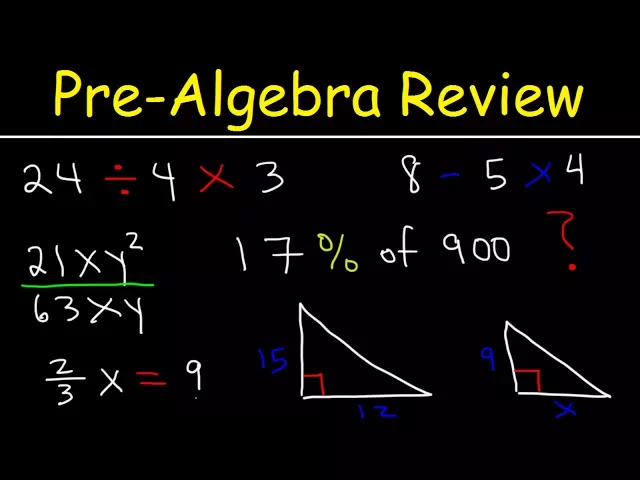
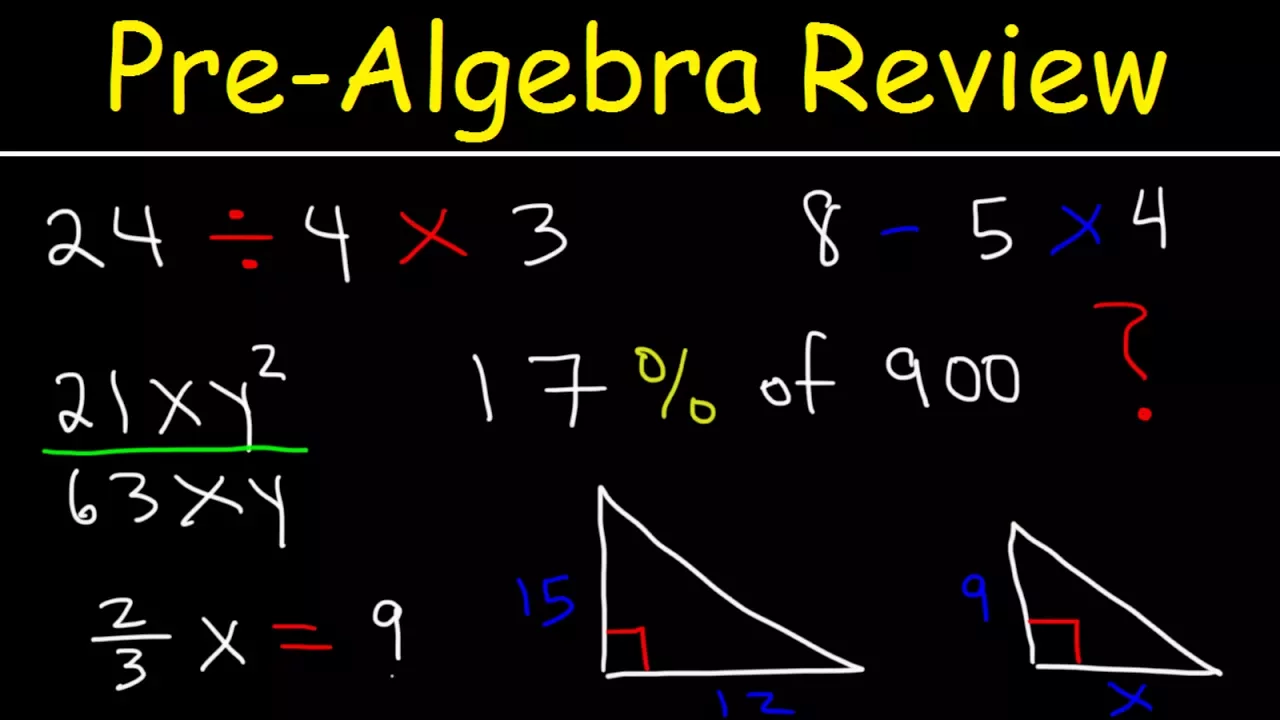
In this video, we're going to focus on pre-alggebra. We're going to cover some common topics that you might see in this course. So, the first thing that you need to be able to do is add and subtract integers.
For example, let's say if we want to add 5 + 3. Now, many of you know that 5 + 3 is 8. But if you ever have difficulty with this type of math, use a number line.
Let's start with five. You could place it anywhere. Whenever you're adding a number to another number, you need to move to the right of the number line anytime you're adding.
And if you need to subtract, travel towards the left. So in this case, we want to add three to five. So we need to travel three units to the right.
1 2 3. This is 6 7 8. So therefore 5 + 3 is 8.
Now let's try some more examples. What is -4 + 5? Let's use the number line to get the answer.
So we're going to start with4 and we're going to add 52 in. So we're going to travel 5 units to the right. 1 2 3 4 5.
This is -3 -21 0 1. So4 + 5 is pos 1. Let's work on another example.
7 - 5. So, we're going to start with seven. And this time, we're subtracting it by five.
So, we need to travel five units to the left. 1 2 3 4 5. So, this is 6 5 4 3 2.
So, 7 - 5 is 2. Now, what about -4 - 2? So, let's start with4 and we're going to subtract it by two.
So, we need to go two units to the left. And actually, that should be 5. 3 is on the right side.
So, this is -6. Therefore, -4 - 2 is equal to -6. Now, what about this one?
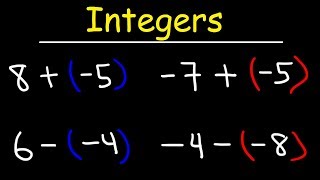
-6 - -3. If you were to see something that looks like that, what would you do? Whenever you have two negative signs right next to each other, it's equivalent to a positive sign.
When you multiply a negative by a negative, it's equal to a positive number. So, we're looking for -6 + 3. So, if we're adding, we need to travel to the right.
1 2 3. This is543 and so -6 + 3 is -3. Now what about 8 + -5?
What's the answer for this one? So if we start at 8 and we're subtracting it by five. By the way, this expression is equal to 8 - 5.
A positive time a negative is a negative sign. So we need to travel five units to the left. This is going to be 7 6 5 4 3.
So 8 - 5 is pos3. Now let's talk about multiplication. What is 8 * 3?
So you could answer this question easily if you have memorized your multiplication tables. But in the event that you don't know, just remember multiplication is simply repeated addition. 8 time 3 means that you're adding 8 three times.
It's also equivalent to adding 3 eight times. But it's easier to add 8 three times. 8 + 8 is 16 and 16 + 8 is 24.
So therefore, 8 * 3 is 24. Let's work on another example. What's 9 * 4?
9 * 4 is equivalent to adding 9 four times. 9 + 9 is 18. So these two 9ines add up to 18.
And the other two 9ines add up to 18 as well. And 18 + 18 is 36. So therefore 9 * 4 is 36.
Now, what is a -5 * 3? A negative * a positive number will give you a negative result. So, we could just focus on adding five three times and then make the entire thing negative.
5 + 5 is 10 and 10 + 5 is 15. So, therefore,5 * 3 is5. Try this one.
What is -6 multiplied by8? When you multiply two negative numbers, you're going to get a positive result. So, this is equivalent to multiplying 6 * 8.
So, I'm going to add 8 six times instead of adding six eight times. Now, adding 2 eights will give me 16. So I have 16 + 16 + 16 and 16 + 16 is 32 and 32 + 16 is 48.
So therefore -6 *8 is equal to this number pos 48. Now let's move on to our next example. Let's focus on division.
What is 54 / 6? Now it's important to understand that division is the opposite of multiplication. 6 multiplied by what number is equal to 54?
So how many times do you have to add 6 to get to 54? It turns out that 6 * 9 is 54. So 54 / 6 is 9.
So division is simply the opposite of multiplication. So here's another example. What is - 455 / pos 9?
A negative number divided by a positive number will give you a negative result. So we know the overall answer is negative. So let's just focus on dividing 45 by 9.
So 9 * what number is equal to 45. It turns out that you have to add 9 five times to get to 45. 9 + 9 is 18.
18 + 9 is 27. 27 + 9 is 36. 36 + 9 is 45.
So therefore, 9 * 5 is - 455. And if we focus on the reverse statement, -45 / 9, that's going to be5. And so that's a quick and simple way to perform simple division.
Here's another example. What's -12 / -2? When you divide two negative numbers, you're going to get a positive result.
So this is equivalent to dividing 12 by two. So 2 * what number is 12? You have to add 2 six times to get to 12.
2 + 2 is 4. If you add another two, that's six. And then 8.
And then 10. And then 12. So therefore, 2 * 6 is equal to 12.
And 12 / 2 has to be six. Now let's say if you have this problem, what is 8 - 5 * 4? So what is the answer?
Now there's two possible ways of attempting to do this problem. And one of the two ways that I'm going to show you is the right answer. The other is not.
So should we subtract first or should we multiply first? If we subtract, 8 - 5 is 3. and 3 * 4 is 12.
We're going to get that result. But now let's say if we multiply first -5 * 4 is -20. So this becomes 8 - 20 and 8 - 20 is -12.
So the results are different. So which one comes first? Subtraction or multiplication?
Perhaps you heard of PEMDAUS. Please excuse my dear aunt Sally. P stands for parenthesis, E exponents, M multiplication, D division, A is addition, S is subtraction.
And so anytime you need to figure out which operation comes first, look at this expression. This is associated with the order of operations and parentheses have the highest priority. Now we're comparing multiplication and subtraction.
So therefore you should always multiply first before you subtract. Multiplication has more priority than subtraction. So that's how you can use pendas to know which operation should come first.
So therefore this is the correct answer. 8 - 5 * 4 is -12. Now you can confirm your answer using a scientific calculator if you have access to it.
Simply type this expression exactly the way you see it and the answer that you should get is -12. Now let's move on to another example. Try this one.
What is 6 + 24 / 4? So feel free to take a minute and work on this example. So according to PEMDAS, division has more priority over addition.
So P E M D A S. So as you look at the letters towards the left, they have more priority over the letters on the right. So D is to the left of A.
So division has more priority than addition. So you should divide first before you add. So what is 24 / 4?
24 / 4 is 6 because 4 * 6 is 24 and 6 + 6 is 12. So that's the final answer in this example. Now let's try another one.
What is 8 - 5 * 7? So should we subtract or should we multiply first in this case? In this case you should subtract.
You need to perform the operation inside the parentheses. So you're comparing parenthesis to multiplication and you need to work inside the parentheses before you multiply. So 8 - 5 is 3 and 3 * 7 is 21.
So that's the answer in this particular example. Now what about this problem? What is 24 / 4 * 3?
Should we perform division first or multiplication? Now according to the word pendas, it appears that multiplication has more priority than division because it's on the left. But it turns out that these two terms multiplication and division they have the same priority and addition and subtraction also have the same priority.
Now when you see a problem like this where you can multiply or divide first you need to travel from left to right that means you should work on the operations on the left and then save the operations on the right for last. So, we're going to do it two ways. Let's divide first.
24 / 4 is 6. 6 * 3 is 18. Now, let's do it the other way.
Let's perform multiplication first. 4 * 3 is 12. And 24 / 12 is 2.
So, as we could see, um, we get different answers here. If you type this in your calculator, hopefully you have a scientific calculator, it will give you 18 as the answer. So whenever you have division and multiplication, simply work from the left side to the right side and that will give you the right answer.
Now what about a problem that looks like this? In this case, what should we do? According to PEMDAUS, parenthesis has more priority than multiplication and division.
So in this case, we need to work inside the parenthesis. 4 * 3 is 12. And so we have 24 / 12, which is 2.
And if you type this in exactly the way you see it in a scientific calculator, you should get two as your answer. And that's how you could confirm all of these problems. Just type it in the calculator and see what you get.
Now let's work on another problem. What is 48 / 8 - 2 * 3? So first we need to work inside the parenthesis.
8 - 2 is 6. So we have 48 / 6 * 3. Now that we have division and multiplication, we need to work starting from the left towards the right.
48 / 6 is 8 and 8 * 3 is 24. And so that's going to be the final answer for this problem. Here's another example.
What is 32 - 24 / 8 / 2? So feel free to pause the video and simplify this expression. 8 / 2 is 4 and 32 - 24 is 8 and 8 / 4 is 2.
So that's going to be the final answer in this example. Try these two problems. What's 7 * 9 - 4?
And what is 3 * 4 + 8 - 2 / 2? So the one above is simple. We need to work inside the parentheses first.
9 - 4 is 5 and 7 * 5 is 35. Now let's work on this example. So first we need to subtract 8 by 2.
8 - 2 is 6. And now we need to work inside the brackets. 6 / 2 that's equal to 3.
So we have 3 4 + 3. Now what's our next step? 4 + 3 is 7 and 3 * 7 is 21.
So that's the final answer for that example. Now sometimes you may need to evaluate algebraic expressions. For example, let's say if we have the expression x y / 2 + 5 and let's say that you're told x is equal to 4 and y is equal to 3.
What is the value of this expression? If you see a question like this, all you need to do is replace x with its value. x is equal to 4 and y, we're going to replace it with three.
So what we now have is 4 * 3 / 2 + 5. 4 * 3 is 12 and 12 / 2 is 6. 6 + 5 is 11.
So that is the value of this expression given x = 4 and y = 3. Let's work on another example. Evaluate the expression.
Let's say the expression is 4x + 3 y - 2 z. And let's say that x is equal to 5, y is 2, and z is equal to 3. So all we need to do is substitute.
We need to replace x with its value of five and we're going to replace y with 2 and z with 3. And then just perform the operation. 4 * 5 is 20.
3 * 2 is 6. 2 * 3 is also 6. 6 - 6 is 0.
And 20 + 0 is simply 20. So therefore, that's the value of this expression. Let's try another example.
What is 5x - 2 * y + z? So let's say x is 3, y is 7, and z is 4. So feel free to pause the video and evaluate this expression.
So let's replace x with three and y with 7 and z is 4. So don't forget to perform order of operations. We need to add 7 + 4.
We could multiply 5 * 3 simultaneously. That's going to be 15. 7 * 4 is 11.
Now we need to multiply before we subtract. 2 * 11 is 22. So what we have is 15 - 22 which will give you -7.
And so that's the end result for this problem. Try this one. X^2 - Y^ 2 / 4 Z + 8.
And let's say that x is equal to 8, y is 6 and let's say z is 4. So x^2 will be replaced with 8^2 and y let's replace it with six. And then let's substitute z with 4.
So this is the expression that we need to simplify. So now what is 8^2? 8^2 is 8 * 8 which is 64.
6^2 or 6 * 6 that's equal to 36. And on the bottom we have 4 * 4 which is 16. Now what is 64 - 36.
If we use a calculator that's equal to 28 and 16 + 8 is 24. Now this fraction is reducible. So, how can we reduce this improper fraction?
28 is 7 * 4. 24 is 6 * 4. 4 / 4 is 1.
So, we can cancel it. So, what we have left over is 7 / 6. And that is the answer.
What would you do if you saw an expression that looks like this? What is 3 * x + 4? So we can't really add x + 4.
x is a variable in which uh we don't know or have a value for. So we can't evaluate the expression but we can simplify it. So how can we do so?
Now there's something called the distributive property. We need to distribute 3 to x and 4. 3 * x is simply 3x and 3 * pos4 it's 12.
So this expression is equal to 3x + 12. Let's try another example. Now what is 4 * 2x - 3?
Go ahead and use the distributive property. 4 * 2x is equal to 8x and 4 * -3 is -12. So this is equal to 8x - 12.
Now sometimes you may have some other algebraic expressions to simplify. Here's another one. What is 5x + 3x?
Go ahead and simplify. All you need to do is add the coefficients. 5 + 3 is 8.
So this is equal to 8x. Now what about this? What's 7 y + 2 y + 8?
So based on the last example, go ahead and simplify this expression. What we need to do is add like terms. 7 y + 2 y and that's equal to 9 y.
Now, we cannot add 9 y and 8 because what is it going to be 17 or 17 y? Because the 8 doesn't have a y. It's not a similar term to 9 y.
So, we cannot add them. Therefore, the final answer is 9 y + 8. Try this one.
3 * x + 5 added to 8x. Now before we could do anything we need to perform or use the distributive property. So we got to distribute 3 to x which we know it's going to be 3x and we have to multiply 3 and 5 which is 15.
Now the only common terms that we have are 3x and 8x. They're similar. They both carry the variable x.
3 + 8 is 11. So 3x + 8 x is 11 x. Therefore, the final answer is 11 x + 15.
Here's another problem that you could try. 9x + 5 - 3x + 8. Go ahead and simplify the algebraic expression.
9x - 3x is equal to 6x and 5 + 8 well that's 13 and so this is the answer 6x + 13. Now let's move on to solving simple linear equations. So here's an example.
x + 4 is= 11. What is the value of x? So x is simply a number which you currently don't know the value of.
So ask yourself what number + 4 is equal to 11. Intuitively you know that 7 + 4 is 11. So therefore x has to be equal to 7.
But what can you do to show that x is equal to 7? You understand that 7 + 4 is 11. But mathematically, how do you show that?
In order to find the value of x, you need to isolate x. You need to get it by itself on one side of the equation. And all other numbers, you must move to the other side of the equation.
So, we need to get rid of this four on the left side. The opposite of addition is subtraction. So, if we subtract both sides by four, we can get rid of the positive four on the left.
4 + -4 is 0 and 11 - 4 is 7. Any number added to zero will be equal to that number. So x + 0 is simply x.
Therefore x is equal to 7. Here's one you should work on. y + 5 is equal to -4.
What is the value of y? Well, just like before, we need to isolate y. We need to get the y variable by itself.
And so to remove the positive five on the left, we need to subtract both sides by five. So pos5 and neg 5 adds up to zero, which is nothing. So what we have left over on the left side is simply y.
On the right side we have -4 +5 or simply4 minus 5 which is equal to9. If you use the number line technique if you start with4 and travel 5 units to the left you should get9. This is5 -6 -789.
Let's say that 12 is equal to x - 8. What is the value of x? So x doesn't have to be on the left side.
It can be on the right side by itself if we want to find the value of it. So we got to move the negative 8. We need to get rid of it on the right side.
So the opposite of subtraction is addition. So let's add 8 to both sides. So this will cancel.
We could bring down the x. And on the left side we have 12 + 8 which is 20. And so that is the value of x.
Now what about this one? 3 y is equal to 18. What is the value of y?
So we need to separate three from y. Currently the 3 is multiplied to y. The opposite of multiplication is division.
So therefore we need to divide both sides by 3. 3 / 3 is 1 and 18 / 3 is 6. 1 y is the same as y.
So therefore y is equal to 6. So if we look at this expression 3 * what number is 18? We know that 3 * 6 is 18.
So therefore y is equivalent to 6. Now what if you saw an example like this? 8 is equal to x / 4.
What should you do to find the value of x? So x is divided by 4 and the opposite of division is multiplication. Therefore, we need to multiply both sides by four.
And that's how we can get rid of the four on the right side. Four divided 4 is one. And so we just have x on the right side.
On the left we have 4 * 8 which is 32. So x is 32. Now what about that one?
2/3 x is equal to 9. How can we find the value of x? If you have a fraction in front of the variable that you want to isolate, multiply both sides by the reciprocal of the fraction.
So that is multiply both sides by 3 over2. 9 is the same as 9 over 1. Now whatever you do to the left side, you must always do to the right side.
3 / 3 is one and two divided two is one. So the twos and threes cancel on the left. On the right we have 9 * 3 which is 27 and 1 * 2 which is 2.
So the answer is 27 / 2. Now we could simplify this fraction if we want to. 27 is 26 + 1 and 26 / 2 is 13.
13 plus a half is 13 and 12 as a mixed number. So as a decimal this is equal to 13. 5.
So that is the value of x in this problem. Try this one. x + 3 / 4 is equal to 10 over 5.
Now what can we do to find the value of x if we have two fractions separated by an equal sign? If you see this, the best thing you could do is cross multiply. 4 * 10 is 40 and 5 * x + 3.
We need to distribute the 5. So 5 * x is 5 x and 5 * 3 is 15. So this is what we now have.
Our next step is to subtract both sides by 15. 40 - 15 is 25. So 25 is equal to 5x.
Next we need to divide both sides by 5. 25 / 5 is five. So x is equal to that number.
Go ahead and try this. In that last example, we solved an equation that looks like this after cross multiplying. So this is a multi-step equation.
Now before separating 8 and x you need to get rid of the five on the left side. So the opposite of addition is subtraction. 21 - 5 is equal to 16.
And now we'll need to divide both sides by 8 to separate x from 8. So 16 / 8 is 2. And that is the value of x in this example.
And we can check it. 8 * 2 + 5. Is that equal to 21?
8 * 2 is 16. 16 + 5 is 21. So x is indeed equal to 2.
Go ahead and try this one. Let's say that we have 3 + x / 4 and let's say that's equal to 5. What is the value of x?
There's many ways in which you could solve it, but if you want to get rid of the fraction, multiply everything by 4. So 4 * 3 is 12. x / 4 * 4.
The fours will cancel, leaving behind x. And then we have 4 * 5, which is 20. And now all we need to do is subtract both sides by 12.
20 - 12 is 8. And so that is the value of x. So if you're solving a linear equation and if you have fractions, it's helpful to multiply every term by the denominator of the fraction just to clear away all fractions.
Now what about this one? Sometimes you may have multiple fractions. What is the value of x in this case?
Multiply by a multiple of 2 3 and 4. 12 is the least common multiple of 2 3 and 4. 12 is divisible by 2, 3, and 4.
So, first let's multiply 12 by x / 3. So, that's going to be 12x / 3, which is 4x. And then, let's multiply 12 by 12.
Half of 12 is 6. Now what is 12 * 5/4s? There's two ways in which you can do this.
You can multiply first and then divide or divide first and then multiply. 12 * 5 is 60. 60 / 4 is 15.
Or you could say 12 / 4 is 3. 3 * 5 is 15. So either case, you're going to get the same value.
Now let's subtract both sides by six. 15 - 6 is 9. So we have 4x is equal to 9.
Let's divide by 4. So now we have an improper fraction. X is 9 / 4.
And that is the answer. If you want to convert it to a mixed number, separate 9 into 8 and 1. 8 + 1 is 9.
8 / 4 is 2. So we have 2 + 1/4, which is the same as 2 and 1/4 as a mixed number. As a decimal, 1/4 is 0.
25. So 94 is equivalent to 2. 25.
Now let's spend a moment talking about exponents. So what is 2 raised to the 3 power? What is that equal to?
Having exponents suggests repeated multiplication. And if you recall, multiplication is repeated addition. So 2 to the third power means that you're multiplying three twos together, which is equal to 8.
4 the 3r means that you're multiplying 4 * 4 * 4. 4 * 4 is 16. 16 * 4 is 64.
So 4 to the 3r is 64. Now what is the value of these three expressions -2^2 -3^2 and -3 inside a parentheses squared. So above we have a negative and we're multiplying two twos.
The two is positive and we have two of them. So 2 * 2 is 4 combined with a negative sign that's4. These two expressions are equivalent.
So this is * 3 *3 which is9. On the bottom we have two -3's multiplied to each other. Since the negative is inside the parentheses, it's affected by the exponent.
-3 *3 is positive 9. Just make sure you know the difference uh between those expressions. Now the next thing we need to talk about is factoring monomials.
For example, let's say if we have the expression 14x, how can we factor this monomial that is writing everything in terms of prime numbers? 14. We can break it down into 7 * 2 and we only have one x variable.
So that's 14x. That's how you can factor it. Now let's say if we want to factor 9 y^ 2 9 is 3 * 3.
y^2 is y * y. So that's how you can factor that monomial. Now what about 8x y^2?
Go ahead and factor it completely. 8 is basically 2 * 2 * 2. We have one x variable and two y variables.
So that's 8x y^2 completely factored. Try these two. 28 a^2 b -12 x cub y and 18 x 4 y 5th.
So go ahead and factor those monomials completely. Let's start with 28. 28 is 7 * 4 and 4.
We can break that down into 2 * 2. So that's 28. A^ 2 is a * A and then we have one B variable.
12 is -4 * 3 and 4 is 2 * 2. X cub is X * X * X and we have a Y variable. Now 18 is 3 * 6 and 6 we could break into 3 * 2.
X to the 4th means that we're multiplying four X variables and Y to the 5th means that we're multiplying five Y variables together. And so that is the answer. So now you know how to factor monomials completely.
Now the next topic of discussion is finding the GCF, the greatest common factor. What is the greatest common factor between 8 and 12? So, we're looking for a number that's less than 8 and 12 and that goes into 8 and 12.
So, this number 8 and 12 are both divisible by this integer. So, what is the highest number that is divisible uh by 8 and 12? So, first let's factor 8 completely.
8 is 2 * 2 * 2. 12 is 2 * 2 * 3. So notice that 8 and 12 have these numbers in common that is 2 * 2.
So basically it's four. That is the greatest common factor between a and 12. 8 is divisible by 4 and 12 is also divisible by 4.
Let's try another example. What is the greatest common factor between 12 and 18? So, feel free to pause the video and try that uh example.
So, let's write out the prime factorization of 12 and 18. 12 is 3 * 4 and 4 is 2 * 2. 18 is 3 * 6 and 6 is 3 * 2.
So 12 and 18 have a three in common and they also have a two in common. 3 * 2 is 6. So that is the GCF between 12 and 18.
The greatest common factor is six. Now what is the greatest common factor between three numbers 27 36 and 45? So go ahead and try that.
27 is 9 * 3 and 9 is 3 * 3. So 27 is 3 to the 3 power. 36 is 3 * 12 and 12 is 3 * 4 and 4 is 2 * 2.
45 is 5 * 9 and 9 is 3 * 3. So all of these numbers have these two in common. that is 3 * 3.
So the GCF between 27, 36 and 45 is 9. Each of those numbers are divisible by 9. Now what about this example?
What is the greatest common factor between 5xy and 10 x^2 y. So let's follow the same process. 5 x y is simply 5 * x * y.
10 x^2 is 5 * 2 * x * x * y. So we have a five in common and we have an x in common and we also have a y in common. So therefore the greatest common factor is 5x y.
Let's try this one. 6 x and 9 x^2. What's the GCF?
So we could factor 6x into 3 * 2 * x. 9 x^2 is 3 * 3 * x * x. So these two terms have 3x in common.
So that's going to be the GCF between 6x and 9x^2. It's 3x. Now let's spend a few moments simplifying fractions.
For example, what is 14 x^2 y / 63 x y? When dividing monomials, what you can do is you can simplify it by factoring. 14 is 7 * 2.
x^2 is x * x. And then we have a y. 63 is 7 * 9 and we still have an x and a y.
Notice what we can cancel at this point. We could cancel a seven and we can cancel an x and a y. So on top, what we have left over is 2 * x.
On the bottom, simply a 9. So the answer is 2x / 9. And that's how you could simplify monomials by factoring.
Let's try another example. What is x^2 / x 5th power? So let's simplify by factoring.
x^2 is x * x. x 5th is basically 5 x variables multiplied to each other. So we could cancel two of them and that leaves behind three x variables on the bottom.
And x * x * x is simply x cub. So the answer is 1 / x cub. Now what about this one?
y 4 / y^2. y 4th is y * y * y * another y. And y^2 is simply y * y.
So we could cancel two of these leaving behind y * y which is y^2. Try this one. 21x y^2 / 28 x^2 y cub.
So feel free to take a moment to simplify that expression. 21 is 7 * 3 and y^2 is y * y. 28 is 7 * 4 * x^2 and y cub is y * y * y.
So first we can cancel a 7 and we can cancel an x variable and we can cancel two y variables. So on top all we have left over is a three and on the bottom we have a four an x and one y variable. So it's going to be 4x y and that's the answer.
So now you know how to simplify uh monomials when they're divided against each other. Now I'm going to show you an online algebra course that you can use uh to help you with other topics. So if you go to udemi.
com and just type in algebra and the course that I created will come up and it's basically this one uh with a black background. So if you go to it, you can see an overview and if you go to course content, you can see a list of topics that are in this course. So I have uh basic arithmetic, addition, subtraction, multiplication, things like that.
If you want to review a fractions, you can look at section three, solving linear equations, you have a multiple choice quiz as well. order of operations, graphing linear equations, linear equalities, absolute value expressions, and there's more. Polomials, multiplying, dividing, things like that.
A whole section on factoring, that's a big thing in algebra. And then you have systems of linear equations, solving by elimination, substitution, even graphing those things. And then you have quadratic equations, rational expressions, radical expressions, and then complex imaginary numbers, exponential functions, logs, how to simplify them, functions in general like inverse functions, composite functions, and then consections, graphing circles, ellipse, parabas, hyperas.
There's two video quizzes on that. and finally arithmetic and geometric sequences. So if you need help in any of these topics, feel free to check out this course when you get a chance.
Now let's talk about multiplying monomials. What is x^2 * x cub? What is that equal to?
When multiplying monomials, you need to add the exponents. 2 + 3 is 5. So it's x 5th.
You could see it this way. X2 is X * X. X cub is X * X * X.
So notice that we're multiplying five X variables together. So it's X 5th. So try these.
X 4th * X 7 and X 8 * X 12th. Go ahead and try those two problems. So this is going to be 4 + 7 which is 11 and x^ 8 * x^ 12 that's going to be x^ 8 + 12 which is x raised to the 20th power.
So when multiplying monomials you should add similar uh variables uh exponents. Here's another example. Let's say if we have x cub y 5th multiplied x^ 6 y 8th.
So first we need to multiply x cub and x 6 and 3 + 6 is 9. So that's going to be x^ the 9th power. And here we have y 5th * y 8th.
So that's going to be y^ the 13th power. So we have to add all the exponents. Now what about this one?
3x^2 * -4x 4th power. Go ahead and try that. So first we got to multiply 3 and -4 which that's going to be -12.
And then we can multiply x^2 by x 4th which is x^ 6 power. So it's -12 * x 6. Here's another one.
2x cub y 4th* 8 x 5th y 7th. Go ahead and multiply those two terms. So let's begin by multiplying 2 * 8.
2 * 8 is 16. Next, x 3r * x 5th. 3 + 5 is 8.
And then y 4th * y 7th. 4 + 7 is 11. And so you should get that answer.
Now let's talk about dividing monomials. What is y to the 7th? / y^2.
When multiplying, you should add the exponents, but when dividing, you need to subtract the exponents. So, this is going to be 7 - 2, which is 5. Now, to explain it, let's use factorization.
y to the 7th means that we have seven y variables multiplied together. y^2 is just y * y. We could cancel two of them, but notice that we have five y variables left over on the top.
So that's why it's simply y 5th over 1, which is y 5th. Now what is 3 to the 7th / 3 power? Go ahead and try that.
So we know that we need to subtract the exponents. 7 - 3 is 4. So this is 3 to the 4th power which is 3 * 3 * 3 * 3 * 3 is 9.
So we have 9 * 9 which is 81. And so that's the answer for this example. Now what is x cub * x 8 / x 5th power?
So to begin, in order to simplify this expression, let's multiply x cub x 8 first. 3 + 8 is 11. Now at this point, we could divide.
11 - 5 is 6. And so that's going to be the final answer. Here's another one that you could try.
y 8 / y^2 * yub. So take a minute and work on that example. So first I would multiply the two on the bottom, which I think is easiest to do first.
2 + 3 is 5. And now it's best to divide. 8 - 5 is 3.
So the answer is y 3. Now try this one. What is x^2 / x 7th?
That's going to be 2 - 7. You take the top number first and subtract it by the one on the bottom. Now, this is equal to x^ 1 / x^ 5.
So, when you have a negative exponent, what you need to do is move the variable to the bottom and the negative exponent will change sign. It's going to become positive. To verify, we could simplify this another way.
X^2 is X * X and X to the 7, you know, is basically seven X variables multiply to each other. Two of which can be cancelled. So, we have five X variables on the bottom.
Thus, is 1 / X^ 5th power. So, what is 3 to the 1 power? So right now the three is on the numerator of the fraction.
If you bring it to the denominator, it's going to have a positive 1 exponent. X to the -2 is equivalent to 1x^2. And 1 /x -4 is x to the pos4.
So when you move a variable or number from the top to the bottom or to the bottom to the top, the exponent changes sign. It can switch from negative to positive. What is -4 raised to the -2 power?
So first we need to bring it down. This is -4 raised to the second power. -4^2 is pos6.
So that's 1 / 16. So now you know what to do if you ever have a negative exponent. Now let's spend a few minutes talking about percentages.
So, what is 15% of 300? How do you find a percentage of a number? Well, let's see if we could do it mentally.
So, first, what is 10% of 300? Do you know? It's very easy to find 10% of a number.
All you need to do is move the decimal one unit to the left. is basically one10enth of that number. So one of 300 is 30.
So if 10% of 300 is 30, what is 5% of 300? Well 5% is half of 10%. So half of 30 is 15.
So now what is 15%. 15% is the sum of 10% and 5%. So therefore 15% is going to be 30 + 15 or 45.
So 45 is 15% of 300. Now if you want to use your calculator, all you need to do is take 300 and multiply by the decimal value of 15%. To convert a percentage into a number, you can divide this number by 100 or simply move the decimal two units to the left.
So 15% is equivalent to 0. 15. And so if you take 300 and multiply by 0.
15, this will give you 45. So that's how you could find the percentage of a number. Let's try another example.
What is 20% of 500? See if you can do it mentally. Now let's find out the value of 10% of 500.
So all I need to do is move the decimal one unit to the left. So 10% of 500 is just 50. Now 20% of 500 has to be what number?
Well 20% is twice the value of 10%. So if we multiply 50 by two, we'll get 100. So 100 is 20% of 50.
To verify, multiply 500 by 20 and you should get 100. Now, here's another one. What is 25% of 400?
So, go ahead and try that one mentally. So, let's find the value of 10%. 10% of 400 is 40.
So another 10% is 40 as well. And 5% that's half of 10. So half of 40 is 20.
So if we add 10, 10, and 5, that will give us the 25% that we need. And 40 + 40 + 20 is 100. So therefore 25% of 400 which is basically a quarter of 400 or 1/4 of it is 100.
Here's another example. What is 23% of 800? So first let's find the value of 10%.
10% of 800 is 80. Another 10% is 80 as well. Now, what is 1% of 800?
To find 1%, you need to move the decimal 2 units to the left. So, that's going to be 8. It's basically 1/10th of 80.
So, if 1% is 8, what's 3%. That has to be 8 * 3. It's 3 times this value.
So, it's 24. So, therefore, 23% is the sum of 10, 10, and 3. So we got to add up 80 + 80 which is 160 + 24.
So that's 184. So that's 23% of 800. It's 184.
Now what is 17% of 900? Go ahead and figure that out. So let's start with 10%.
10% of 900 is 90. 5% is half of 10%. So half of 90 is 45.
And 1% that's 110th of 90. So that's going to be 9. So 2% must be twice the value of 9.
So that's 18. So to get 17%, we got to add 10, five, and two. That's 17%.
So we need to add up 90 + 45 that's 135 + 18, which is 153. So that should be the answer. And to check it, you can type this in your calculator.
Take 900 and multiply by. 17. and you do indeed get 153.
Now before we end this video, there's one more topic that is common in pre-alggebra and that's solving similar triangles. So let's say if these two triangles are similar to each other and let's say this is 15, this is 12 and this is 9 and this is x. If these are similar triangles, what is the value of x?
Now, the best way to solve a similar triangle is to set up a proportion. Let's call this triangle 1, triangle 2, and let's say that 15 is the height of triangle one. 12 is the base.
And here, this is the base and this is the height. So, let's set up a proportion between triangle one and triangle two. So, we need two fractions separated by an equal sign.
On top, I'm going to put the height. On the bottom, the base. So, the height of triangle 1 is 15.
The height of triangle 2 is 9. The base of triangle 1 is 12. And the base of triangle 2 is x.
And then you're just simply solving. You have to be careful when setting up the proportion uh correctly. If you don't do it correctly, then you're going to get the wrong answer.
So that's why it helps to have one side to represent triangle one and the other side to represent triangle two. Now let's cross multiply. So we have 12 * 9 which is equal to 15 * x.
So what is the value of x? Well, let's simplify before we multiply. 12 is 4 * 3 and 9 is 3 * 3.
15 is 5 * 3. So, we could at least cancel a three. Now, let's divide both sides by 5.
So, on the right side, we have x. On the left side, we have 4 * 9, which is 3 * 3 / 5. So it's going to be 36 / 5.
So that's the value of x. Now let's turn this into a mixed number. 36 is 35 + 1 and 35 / 5 is 7.
So as a mixed number, this is 7 and 1/5. 1/5 is2 as a decimal. So it's also equal to 7.
2.