Quick, name the last three books you finished along with one idea you still use. Stumped? Stick around and you'll never blank like that again.
I'm Daniel Pink. I've written seven books and in the process how to go through hundreds of other books, research papers, and manuscripts and retain the information. In this video, I'm going to share seven techniques to help you read better and smarter.
Starting with number one, torture your books. That's right. Don't be gentle with your books.
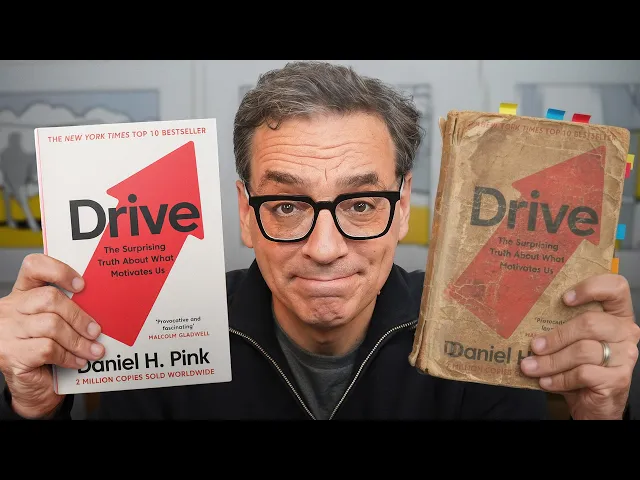
Beat them up. Crack the spine. Write in them.
Underline, dogear the pages. Your books aren't precious objects. They're partners.
Sparring partners. They'll jab you. You'll jab them.
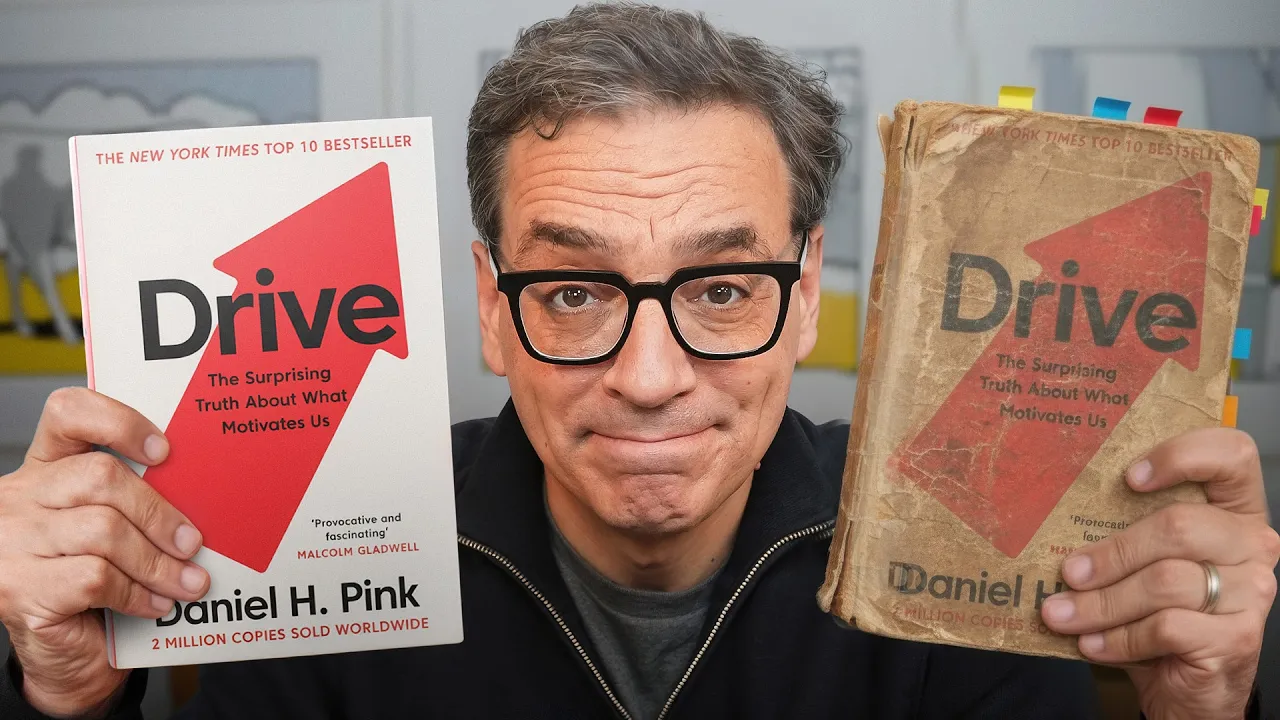
And that will make you better. It'll help you understand and help you remember. When readers come to me with one of my books and it's ragged and dogeared and full of underlines, they often apologize, but I want to hug them.
It means they've engaged with what I've written. So, if you're not banging up your books, you're doing it wrong. And if you want to bang them up even better, use the S and H technique.
What's that? Summarize and harvest tips two and three. Number two, summarize.
Piles of research show that passive learning is not lasting learning. So, with reading, you've got to be active. And the best way to do that, especially for non-fiction books, is to summarize.
Here are two easy, straightforward ways I do that myself. First, with non-fiction books, when you get to the end of a chapter, summarize what you've just read in two or three sentences. That's what I've done right here.
Write it at the very end of the chapter. Right at the end. If it's a library book, do it in a notebook or a notes app.
The purpose of summarizing each chapter is not necessarily so you can look at it later. It's so you can think about it and remember it right now. When you encapsulate a chapter after you've read it, rather than just moving to the next one, your brain has to work a little harder.
That slows you down in the short term, but it pays off in the long haul. Putting things in your own words as deep as your understanding helps you see how the pieces fit together. And when you're done with the book, ask and answer these three questions.
What's the big idea? How does the author know? And what should I do?
At the end of the book, take 10 minutes and put the answers into a Google Doc or Word file. Answering what's the big idea helps you zero in and remember the main point of the book. Asking how does the author know helps reinforce that main point and allows you to talk about the book to others with greater authority.
But the third question is most important. What should I do? What is one action you can take after having read this book?
When I read this book, one takeaway was to use time distancing to reframe stressful situations. To ask myself, will this even matter in 8 weeks or 8 months or 8 years? When I read this one, one big takeaway was to never ever be a chill host.
So, when you jot down two quick sentences after each chapter, the next chapter hits harder and sticks longer. And when you ask those three big questions, you'll see that 1 + 1 + 1 equals 4 because they all reinforce and enlarge each other. Knowing the big idea helps you take action.
Taking action deepens your understanding of the big idea. Understanding the source gives you the confidence to do both. Number three, harvest.
It's crucial to come up with a system to collect and access the ideas and words and facts that matter most when you need them most. Here are some ways to do that. You know those summaries you've been writing?
Keep them all in one place, a Drpbox folder on your hard drive, whatever. As they accumulate, they'll become a supplemental brain, your own private database. Do the same for your underlines.
Download your Kindle highlights or dictate your top print underlines into that same document. Now, this is a lot of material. I get it.
In the past, I found accessing the good stuff a bit cumbersome. But now, you've got a wickedly powerful partner, AI. Feed your book underlines and summaries to your favorite AI system, Claude, ChatgPT, Notebook, LLM.
Then, when you're working on something where you need help, use a prompt as your harvesting tool. For example, tell the large language model, "I'm pitching my business idea to a possible source of funding. " Then, describe the idea and ask, "What are three quotations from books I've read that I could put into a presentation?
" What I've done for a few projects are prompts like these. I'm writing a column on living celebrations, people who arrange and attend their own funerals. Please read my book summaries and underlines and find any ideas, quotations, or statistics that might be relevant.
And voila, I surfaced some material from a book on religion I'd read four years ago that I ended up using in the article. So, you've tortured your books like a tyrant. You've summarized them like a superstar, and you've harvested them like a heavyweight.
That leads us to number four, reread. Back when I was in college, a professor told our class that he was assigning us Mark Twain's The Adventures of Huckleberry Finn, and all 30 of us in the class groaned. He paused, took in the groans, then said, "I know you've read this book, but you haven't read this book.
" What he meant is that when you pick up a book you've already read, the book is the same, but you're different. Now, let's be honest, most books aren't worth rereading. But if you are, because when you do, you'll learn more about the book, but more crucial, you'll learn more about yourself.
For example, if you read Man's Search for Meaning when you're 18, that's one experience. If you read it 20 years later when you're 38 and you've endured more of life slings and arrows or have become a parent or a spouse, it's a completely different experience. You see the book a new because you're no longer the same person.
Another example, a few years ago, I reread Joseph Heler's Catch22, which I'd read and loved decades before. This time around, not so much. It wasn't nearly as funny as I remembered, and the way it portrayed women was really offputting.
What happened in the time since I first read the book? The world changed and so did I. Find an important book the you of the past has already read.
Give it to the you of today and I guarantee you'll learn a ton. All right, we're more than halfway done. Next up, number five, become a T-shaped reader.
Think of the letter T. It's wide and it's deep. That's how you should read.
Burrow into lots of books on things you're deeply interested in. If you're an engineer, read all you can in that area. Henry Petroski, Faklav Smith, Deb Chakra.
but also read outside your field. Biology, psychology, politics, history, art history, fiction, even poetry, which it's a form of engineering itself. For me, being a T-shaped reader has led me to new ideas, new understanding, and even a few new projects.
For instance, I've always read lots and lots in psychology and economics because that's what I write about myself. But I also read way outside these fields. I don't have some master strategic plan.
I do it cuz I enjoy it. But reading outside your field can lead you to unexpected places. For example, I read a lot of biographies of artists like Andy Warhol or Mark Rothkco.
Why? I just find them interesting. Then that's enough.
But over time, I've realized that in some small way, these biographies have helped me become a more adventurous creator. Another example, I've always loved comics and graphic novels, so I read those too. Then I thought to myself, why are there no business books in this format?
So, I ended up writing one. Depth without breath can make you isolated. Breath without depth can make you a diloton.
The key is to combine depth and breadth because good reading begins with T. Number six, become a quitter. It's okay to start a book and not finish it because in nine cases out of 10, that's not your fault.
It's the author's fault. And I say that as a writer. If someone can't finish one of my books because they're bored or they're unconvinced or they're confused, that's on me.
It's my job to hold the reader's attention. It's not the reader's job to stand by an author. So, don't fall for the sunk cost fallacy.
Just cuz you've read 50 pages doesn't mean you have to read another 250 pages. And if you're looking for a way to decide when to quit a book, here's a formula I learned from I'm not sure exactly who. Here's what you do.
Take the number 100, then subtract your age. That's how many pages you should read before you decide to quit. So, if you're 26, read 74 pages.
If the book doesn't work for you by page 74, put it aside. If you're older, you've got less time to waste. So, if you're 53, read 47 pages and then decide whether to move on.
I've changed my mind on this topic, folks. In the past, if I started a book, I'd always finish it. Always.
It's human nature to be a completionist. Quitting a book seemed wrong. A meltdown of morality.
But I eventually understood that this philosophy was nonsense. So, let me officially give you permission to quit a book you don't want to finish. Finally, what might be the most important tip, the final one, number seven, don't stress.
Reading should be a pleasure, not a burden. A source of enlightenment and wonder, not a fountain of anxiety and pressure. There's so much out there to read, you can't read it all, you can't even read a fraction of it.
There will be lots and lots of stuff you miss, and that's okay. I've never read Moby Dick or War in Peace. Maybe I'll get around to those, maybe I won't.
Celebrate what you have read instead of lamenting what you haven't. And don't worry about reading fast. Speed reading is pretty much a hoax.
It doesn't work. So, read at your own pace. I happen to be a slow reader, but I also happen to know that slow and steady wins the race.
The key is to remember that reading is one of life's great privileges. Do it with intention. Do it with rigor.
And most of all, do it with joy. And if you're looking for particular titles that are worth your time, check out this video.