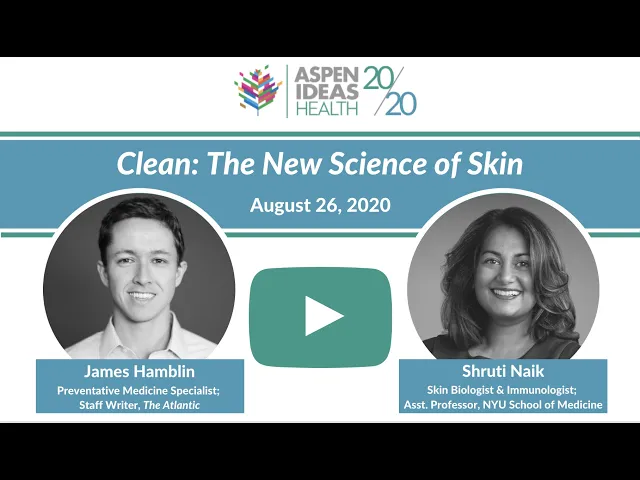
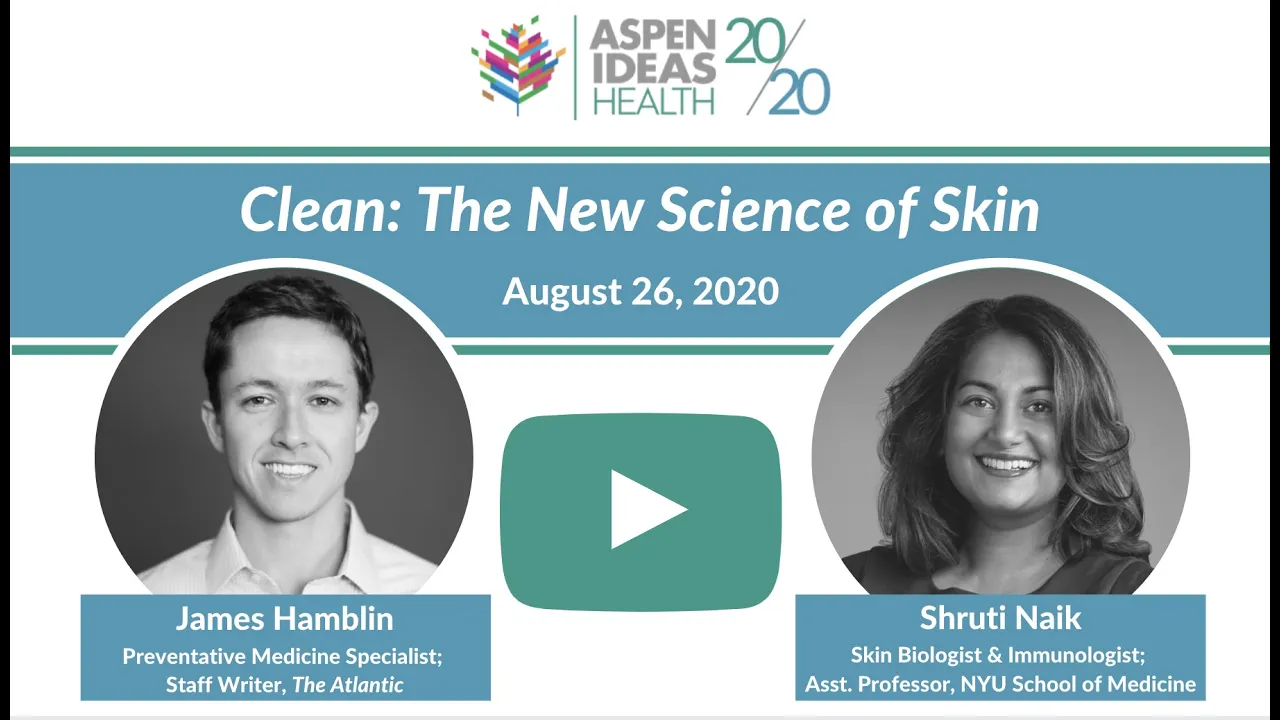
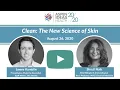
[Music] good afternoon and welcome my name is deb cunningham and i'm the director of strategic partnerships for the aspen ideas health program here at the aspen institute on behalf of all my colleagues thank you for joining us as many of you know the pandemic prevented us from gathering together live in aspen this summer but we've pressed on virtually hosting an ongoing series of informative inspiring conversations between leading health experts advocates scientists innovators artists and many others today we're thrilled to host dr james hamblin author of the new book clean the new science of skin and
dr shruti nike skin biologist immunologist and assistant professor at nyu school of medicine they will discuss the fascinating history of hygiene the role of soap in preventing the spread of disease and the evolution of the skin care industry with daily reminders to wash our hands during the pandemic we think it's a perfect time to order a copy of james's book take those clean hands turn the pages and ask ourselves how much cleanliness is actually good for us so to help us begin to understand that question let me properly introduce our speakers dr james hamblin is
a staff writer at the atlantic a lecturer at the yale school of public health and a specialist in preventive medicine in his writing for the atlantic and his podcast social distance he covers health science and of course this year the coronavirus he's the author of if our bodies could talk and hosts a video series of the same name james is based in brooklyn new york and a relevant fun fact he only uses soap on his hands dr shruti nike is a world-renowned skin biologist and immunologist and is currently an assistant professor at new york university
school of medicine she's discovered that normal bacteria living on our skin actually actually educate the immune system and help protect us against harmful pathogens recently named a pew scholar dr nike's research has been published in top scientific journals including science nature and cell and she's been recognized with the regeneron award for creative innovation and the l'oreal for women in science award amen among many others james and trudy and all of our zoomers one last thank you for being with us today and with that over to you shrewdy thank you so much thank you for the
kind of production and i must say i'm so excited to speak with dr james hamlin i loved his book as a scientist and also as a consumer of the many many products that he spoke about in his book so thank you so much for being here and having this conversation uh with me dr hamlin i am looking forward to it i usually moderate events at aspen this is my first time on the other end of things so and i have a lot of questions for you so i'll probably end up throwing a lot back to
you because you're the expert but thank you for having me well if i'm in the opposite position because i'm usually answering questions so we get to play a little role reversal yeah and maybe we can start by uh discussing this idea of hygiene deb touched upon it especially now in sort of this unusual pandemic moment where we're talking about hand washing and cleanliness uh maybe you could talk about the history of hygiene and and sort of how it's evolved and what are the maybe intended and unintended consequences of this word hygiene yeah um there's so
much uh so much to it and one of the distinctions i make in the book is the difference between um sort of cleanliness behaviors which tend to be social signaling and personal preference and aesthetic practices which are extremely important for all sorts of psychological and social reasons but are different from hygiene behaviors which tend to be public health related evidence-driven disease prevention behaviors so these include things like clean water and sanitation uh washing your hands making sure that you're not you know emitting viral particles into a enclosed space that you're not bleeding uh etc these
are things that we're definitely doing to prevent disease and those are actually pretty straightforward and when it comes to you know our daily rituals it's kind of uh you brush your teeth and that will help you prevent prevent you from getting infections in your oral cavity and you wash your hands and that will prevent you from seeding an infection into your own respiratory tract and outside of that most of the cleanliness behaviors are kind of they go along together they they might signal you know that if you've combed your hair and you smell nice that
you probably uh aren't carrying uh germs on your hands that's the history of how they became conflated but they actually don't have anything to do with health we can we we see products in in pharmacies and so we think they have this sort of health halo but but they're really um you know preferences and preferences that are very new to the human species it's a long history i don't think you want me to do all of all of it but really just in the last hundred years that we've thought at all about you know having
the sort of access to running water and ability to mass produce and afford soap such that it could be a daily use product um on our entire body and and it really quickly came from being like maybe we should do that too you are gross and disgusting if you don't do that every single day yeah so so what i'm so i get i get the sense that we're conflating disease avoidance with quote unquote health um and so maybe you could talk a little about what is health and what is skin health because you know even
as a skin biologist it's unclear to me what we call a healthy state so what is what is sort of the idea behind that word yeah right and a lot of what it's difficult you know we say skin conditions and uh disorders but there's things like acne and eczema that are so common it's hard to consider it you know a disease maybe there's a disorder into the processes behind these um the flares that we get and they cause mostly psychological distress but they're not shortening lifespans um you know so it's difficult to say skin we
tend to put a really extraordinary amounts of value on uh on the appearance of it and um not so much on you know it's it's actual functionality or long-term use we want it to not you know we want to take care of it and we want it to um be maintained kind of from the inside out whereas we live in a culture that is used to treating it from the outside with topical uh you know topical maintenance and quick fixes when we do see a particular issue um but health is kind of what you define
it you know if in in if you really want to take elaborate care of your skin and you really want to do you know invest a lot of time and money in these rituals that we do uh you know i think that can be great it can be a really empowering uh positive part of a person's life where they really feel better and look better and socialize and meet people over those uh their shared practices but if you you can be perfectly healthy in a medical way and that you're not contagious you're not putting yourself
at risk of any disease and also do radically less which is kind of where i fall um and i don't mean to say that one way is is better or worse but i'm just curious what your take on or perhaps maybe as a consumer how i can educate myself better about what products actually work in promoting skin health right because i hear all the time like scientifically proven clinical data and and those things have very different meanings in the scientific realm where they signal rigor and you know control groups and statistical significance and in the
sort of public arena so so how can a consumer know oh i'm buying this thing that claims i'm going to rejuvenate my stem cells right yeah which you study stem cells in the skin uh you know wait are are any of these products actually able to rejuvenate don't read stem cells rejuvenate by definition that's what they are yes that is the definition of stem cells and i to need i have yet to see a product um that rejuvenates stem cells yeah yeah it's like hitting the sun yeah like scientifically proven by sort of peer review
standards right yeah standards you know products in in this space uh and also in sort of the diet and wellness space generally tend to have a really interesting relationship with scientific language as in an interesting saying this is recommended by doctors this is proven in studies um so not rejecting the traditional system but absolutely rejecting like rigor within that system not wanting to say here's all the details of the study it was a massive randomized controlled trial uh it was done at these institutions um it's just so it's it's a weird middle ground and it's
really hard you know to actually if you did want to find where those claims are coming from to track down where they were uh and oftentimes there there's nothing to it or there's some study of you know four people who work for the company said that they felt better after taking it and um you know study is such a broad term so um that's what like that's why people need kind of docents through this space to help like because it's a massive menagerie of things and different products affect different people in different ways as you
know that like there's so much variability in our skin due to our differences in our immune system and our microbes and our lifestyles and our genes that we're bringing to this table that the product some people swear by these products say they completely change their their skin and other people's like is total waste of money or made me break out and how could you think that and you know it's possible that both are right so uh yeah you find so many people who are just in the space of trial and error and those are the
people who i kind of talked to in the book and you either end up just forming your own belief system or actually starting your own skin care line in some cases so it sounds like how you take care of your skin is very very personal and and you know really an individual decision uh but what role does the sort of food and drug administration have in this because when you look at their mission and when you look about when you look at their mission about regulating drugs it says you know regulate the safety and efficacy
of drugs but then if you look at cosmetics it's the safety of cosmetics so so there's a clear disparity there in how they're protecting consumers yeah um it's such an interesting space because um skin care is really writing a line between the old school cosmetics which would be basically makeup like really it's meant to decorate your skin it is not changing the function or structure of your skin and and medicines which would be clearly trying to change the structure and function of your skin um and now skin care comes along and it wants to be
sold over the counter and but also make claims about actually changing the way your skin is functioning and working and making you look different um so they're it's in some ways it's wonderful because the barriers to entry are really low you don't need a a million dollars in vc funding to start your own company i mean i started one anyone can start one you don't have to know anything you can make stuff and if it works for you some simple product that has worked you make it in your kitchen you decide you just want to
throw it online and start it sell it on etsy or amazon and add an advertising instagram you know you can do it and people have and i spoke to people who have and now do that as a living um and it's usually pretty safe but it does make it hard that consumers don't know uh you know when a product says it has vitamin c in it how much does it have uh does it have a meaningful amount does it have it in a form that's getting into your skin um and there's not regulation on you
know whether your product actually has contains what it what it says it does and whether the claims you're making are you know uh justified so um it's there's a lot of good and bad to it and thinking about uh you know how do you really arm yourself with the right information about what is working versus sort of rituals as human beings and and you know rituals that we like to partake in um because they feel nice they spark joy exactly it's really easy to become super mechanistic about it and reductive and um but i think
about it it's almost like religion or like like food where people have beliefs and people put value on things that cannot be reduced to their elemental parts and if someone loves eating mcdonald's cheeseburgers and you come in there no amount of facts about heart disease or diabetes or whatever um is going to kind of change their mind unless they kind of want to engage on it and um it kind of you know it's kind of the same thing with with the skin care uh approaches but i i mean i'm curious you as an expert what
do you look for when you're choosing you know as it's so hard for non-experts even to navigate this space um you know i'm a little embarrassed to say i kind of um compartmentalize my scientific world with my personal care rituals um and so there so i realized that most skincare even though it says clinically proven is the standards of rigor and experimentation and empirical evidence are are sort of not the same in those two worlds and so i kind of agree with your this what you just said which is a lot of it is very
personal and about satisfaction and joy and ritual and your quality of life uh that you attribute with these sort of rituals so uh so okay i don't mean to put you on the spot i'm just always that was my thing throughout the book i every expert i was like no what do you do how do you make up your mind because everyone it's so personal to everyone and they're it's so common that people know you know they know the science and they know that something may not actually be supported by evidence or whatever but do
it uh yeah there's all these other reasons that we that we love these things so i almost wish that they were not marketed on the backs of studies that they would just get rid of like these claims about being clinically proven just the same as a gourmet meal does not try to say we are scientifically better than the mcdonald's hamburger it's like just the people who want to spend their money on that and really enjoy it a hundred times more and are able to pay that you know do it but don't try to tell me
that it's objectively better or worse i'm getting yeah exactly um no no i totally agree with you in that a lot of it is really just about personal enjoyment and and that's fine um i don't think that it you know i think my only concerns come up where it's a safety issue or it's a snake oil issue right where people are treating medical conditions um with things that are cosmetically um inclined so we're quickly running out of time but i really want to ask you about one of my favorite topics which you cover sort of
a lot in the book which is the microbiota um it's really an emerging area in basically every facet of biology and so maybe you could talk a little bit about the skin microbiota and the the work that's emerging there yeah um i mean and that was really a big part of what stimulated me to want to write this book is uh right around the time that i was kind of radically cutting back on soap use and showering generally there was this flood of papers by uh colleagues of yours and who who were sequencing the skin
microbiome and finding out that we have trillions of microbes all over us all the time uh that we're never clean we are never with without microbes all we're ever doing when we do our daily regimens is kind of shifting those populations around or perturbing the oils the the sort of soil on which the microbes grow um which just shattered my understanding of why i thought i needed to do uh you know wash my forearms with body wash every day in a shower um so that is kind of what led me on this journey and it
turns out the science is still very early on and exciting things are happening in labs like yours finding out how these microbes that are all over us are interacting with the immune system and the stem cells that are in our skin and shaping uh the appearance of our skin the functioning of our skin and the immune system generally throughout the body your immune responses to things like foods and to airborne uh particles that it's all just one one big thing and there's this essentially a layer of skin that we that i was not taught about
in medical school because we and it is kind of like dermis epidermis uh skin biome and it's this lovely interface to the outside world it's not quite us and not quite them and uh it yeah it totally changed my kind of conception of myself and why i was doing the things i was doing and it's a really exciting space for future science and products that will help us to better understand it and know exactly what to do about it awesome so i think we're uh going to open it up to audience questions and um folks
please feel free to type your questions in the chat and we have a few questions already so hand sanitizers are being used in abundance to prevent the spread of frontovirus what impact do they have on our skin's microbiome and i love this example because if you suggest to someone you know people know hand sanitizers are good they're effective they'll kind of disintegrate the viral particles and whatever other microbes are on your hands it's a clear cut the forest approach maybe it's not the ideal but it's definitely better than not using it um and yet when
you suggest like hey why don't you put hand sanitizer on your on your hair uh or on your whole body you know why don't you shower under a hand sanitizer breath every day people find that ridiculous uh because you think well why why would i want to do that or why would i need to what would that be accomplishing um because it hasn't been marketed to us that way whereas shampoos and body washes and soap generally has been and it is kind of this concerted effort to say you know people are using some soap how
do we get them to use more uh how do we get them to put it all over their bodies every day um and it's just i think we have a really healthy relationship with hand sanitizer where like it has this distinct purpose we use it in these situations that we use normal amounts where it's appropriate and we don't think more is better um and we could stand to think about soap more like that as well so so in relation to the skin microbiome another question is about how sunscreen which is summer which uh impacts the
skin microbiome are there long-term effects short-term effects do we know no this is not the sort of thing i think when there's a small group of people who are studying the skin biome and they're mostly focused on you know uh serious diseases skin cancers um i mean acne eczema psoriasis things that maybe people don't consider serious who have mild cases but they're very serious too many people or just have long term psychological impact um in even in mild cases so the uh that's what's being studied right now uh things like where we get into what
cosmetic products are doing to the biome i would love to see them be studied because you're gonna see this huge flood of like probiotic sunscreens probiotic moisturizer probiotic wrinkle cream i mean you already sort of are uh i and i i kind of ventured into that world a little bit in the book but um it's going to be really confusing because if you already don't know what sunscreen is doing right now to the biome imagine how much harder it's going to be when you have one that has some bacterial lysates and are some you know
parts of a dead bacteria in it and you're not sure if this is better than another sunscreen or worse um and we're not sure what those bacteria particles are going to do to the immune system of the skin i mean very probably nothing probably they're just gonna not stick around um but it would be much better if that whole process was approached more scientifically and medically i think and that's where you get into the need for like really systemic reform to accommodate these products before they hit us so um sort of in relation to the
probiotics and the prebiotics that you're talking about we often use the words organic natural clean skin care are these products better um do they sort of indicate that this is a safer product or more effective than sort of traditional cosmetics no um i mean the history of the word clean is extremely fraught and it is loaded with just like fetishizing purity and uh racism and xenophobia and all kinds of ideas that we hopefully are moving beyond um now when it's used in the skin care space it's sort of this meta thing of we want not
just ourselves to be clean whatever you you mean by that but the product itself is supposed to be clean and so then it's just again this vague idea of purity often minimalist often just not using um long words in in the title but so once you start saying you know then there are great skincare lines that do this like we only use three ingredients or we you know it's extremely mild you know it becomes the products that we are paying more for are getting closer to doing nothing they are getting close we want milder things
we want uh fewer ingredients and if anything that's what those terms kind of symbolize to people and it's telling me that like this industry is growing and it's on the back of a desire for like moving away from soap and detergents and um moving toward products that just sort of maybe have a mild effect and smell nice and have nice packaging and the experience of using them is nice um but that's that would have been foreign to um you know a generation ago that was a whole we are in new territory in terms of what
it's actually doing to our skin and our biome yeah so speaking of things that are good for your skin and your bio are there ways of improving or feeding your microbiotic are there probiotics that would be recommended to inoculate your skin with or there was a question about adding oil to help your microbiota grow because sebum as we know has served as food for your microbiota um so are there any of those treatment regimens or cosmetic regimens that are out there that could be used um so what's being studied in terms of the biome is
trying to you know when people have um flares of eczema trying to specifically in that scenario try to repopulate or shift the biome toward or away from whatever um proportion was was causing that flare that immune response and to help that help quality immune response in terms of preventive uh you know optimizing of the biome i think it's gonna be very similar to what you see with the gut microbiome which is that everyone wants to know how to do it and a lot of products are gonna promise it but um we don't know exactly we
we know diversity is good um we know to the the point about oils yeah that's like that's like the soil for this microbial garden this ecosystem that you have to my mind as until we know more and i i don't want to apply bacteria to myself i don't want to add oils to my skin but i did seem very reasonable to cut back on aggressively trying to remove the oils from my own skin every day and just you know cutting back on that uh it's worked for me and once i started sharing my story it
turns out a lot of people have pretty super minimalist approaches have done away with shampoos or deodorants and maybe they don't talk about it a lot but you probably know someone who who has done the same and it's very possible if you for people who are interested in trying it out does that all sound right you're the expert you know you keep saying you're the expert we're here to talk about your book and you know i think you do a really great job of incorporating all of this scientific information um and presenting it in such
an accessible way thank you um it was a lot to learn there's there's a tremendous history in the marketing and uh the culture and uh the religious aspects of our ideas of cleanliness and why our beliefs today are what they are and that's um you know i'm an expert in none of those areas but i tried to put it all together i i mean i think you did it really beautifully so maybe i could um end with the last question from somebody who suffers from eczema because you sort of talked about we've talked about the
cosmetic aspects of skin um and you're someone who is experiencing this sort of uh terrible disease the skin condition um the person wants to know is it possible to treat our skin from the inside um and how does the skin maybe manifest uh or represent what's going on in your body yeah and that's kind of a central theme in the book it's not always going to be but very often um you know when you're able to uh de-stress to sleep to eat well to exercise um all the things we kind of know we're supposed to
be doing all the time or that are good for health people see improvements in their skin and it's not to say that these things don't exist outside of that but we have a system that is generally teaches us so something that you have a a blemish you have a flare of something um the impulse is to go apply a product go buy something immediately get a prescription do something and i think in once you get into this minimalist mode that i'm in and a lot of people are in you you become more attuned to how
when you have a sleepless night or you're really stressed out um your skin works differently it looks different um you smell different we didn't even talk about smell but um and i think those are useful indicators to like ideally if you have the ability to say like i need to like take care of myself a little better um and slow down a little bit i like that being more in tune with your body um and what your body needs um and the skin is a sort of signaling organ to let you know through volatile production
um so again thank you so much dr hamblin it was such a fun conversation and also i really once again enjoyed reading your book very much um the clean the new science of skin which you can all get um at penguin random house as well as amazon and i'm sure many independent booksellers um so thanks a lot again and have a good day thank you so much thank you to everyone for coming thanks everyone [Music]