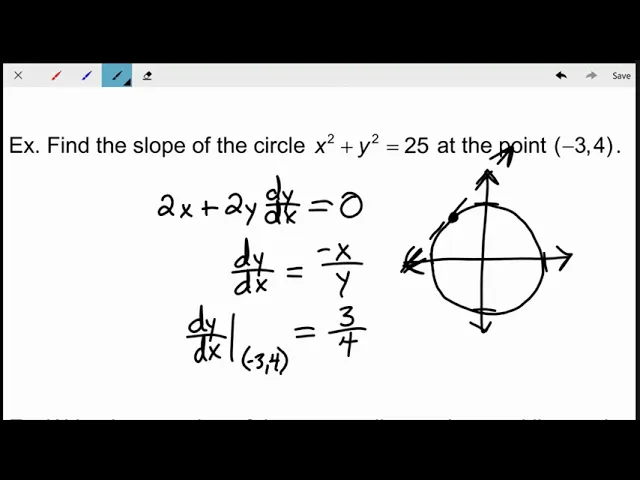
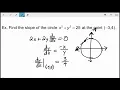
okay this is ap calculus a b and in this video i am going to talk about implicit differentiation um when it comes to implicit differentiation this is a secondary method we can use to take the derivative of an equation and we use this method when we have equations where we don't have a simple function like we've been dealing with up to this point where we have for instance a y in terms of x so when we do when we typically do an implicit differentiation we have an equation where it's not possible to get the function in terms of a single variable okay so i put an example in here to give you a side by side representation of what these two methods are the method we've been using up to this point which is sometimes referred to as explicit differentiation and the method we're going to use now which is called implicit differentiation so what we're trying to do is we're trying to take the derivative of this equation y cubed is equal to x to the seventh and really we're trying to take the derivative and get dydx okay so the most obvious way of doing this problem is doing what we've done up to this point which is solve for y in terms of x take the cube root on each side and get y is equal to x to the seven thirds power and then just do the power rule okay pretty straightforward pretty simple now that's possible on this question on a lot of the questions we're going to see today you're not going to be able to isolate why and so let me show you the second method and show you that it gives you the same results even though we're going about it in a little bit different way so the other way we could do this problem implicitly is we just take the derivative of the equation in the form that it's in so we have y cubed is equal to x to the seventh now when i go through this process you have to remember we're using the chain rule so on the left side of this i did my power rule and got 3y squared that's the derivative of the outside times the derivative of the inside would be dydx okay so then on the right side if i go through and do the chain rule i do the power rule i get 7x to the sixth well the derivative of the inside is dx dx which is just one so we typically don't write dx dx because it's not necessary but really anytime we take a derivative we're using the chain rule but the inside derivative is typically a 1 like you see here when it's dx dx okay so at this point really what i need to do is i need to isolate my dydx term because that's what i'm trying to solve for so i usually just write it out as dydx but you can see on this problem since this is typed up it's easy to see why prime is not y to the first power so i went ahead and typed it as y prime okay so now at this point i'm trying to isolate y prime and i just have to divide by 3y squared and i get this derivative now look at the two results that we got on the first one we got d y d x is equal to seven thirds x to the four thirds and this time we got d y d x is seven thirds times x to the sixth over y squared so we got two different results or at least what appears to be two different results but the reality here is i can modify this second result because remember we said up here y is equal to x to the seven thirds power so i'm going to plug that in and i'm going to simplify this out so in my denominator when i square that x to the seven thirds i'm going to get x to the 14 thirds so essentially i have x to the 18 thirds in the numerator x to the 14 thirds in the denominator and that's going to give me the same 7x to the four thirds power okay so like i said um the reality on this problem is i would never have used implicit differentiation because it was extra work but i wanted you to see that it does it's actually a valid method it gives me the same result to use implicit differentiation most of the problems we see today are going to see problems where you don't have that choice you're going to have to use implicit differentiation okay so here's an example of that we have y d x or we're trying to find d y d x and we have x cubed plus y cubed plus nine x y is equal to zero okay so if you look at that and think about the algebra there there's no way to get y isolated so i'm just going to start taking the derivative of the equation in the form that it's in derivative of x cubed is three x squared derivative of y cubed would be three y squared remember with your chain rule times d y d x now i'm gonna have to deal with the product rule here with this 9xy the derivative of x is just 1 so i would have 9y plus 9x times the derivative of y while the derivative of y with respect to x is dydx and then the derivative of 0 is just 0. okay so that's really my calculus step on this problem the rest of what i'm going to do here is just a little bit of algebra to get dydx isolated if you notice here everything's divisible by divisible by 3. so i'm going to divide out that 3 would give me x squared plus y squared dydx plus 3y plus 3x dydx and that would still be equal to zero okay so now we've got two dydx terms so i'm gonna group them together and i'm gonna factor out dydx so really i have y squared plus 3 x d y d x terms and then i'm going to move the x squared and the 3y over to the right side of the equation by subtracting so that would give me negative x squared minus 3y over here and my last step here is just to divide that expression so that i have d y d x isolated so in the end i'm going to get d y d x is equal to negative x squared minus 3 y over y squared plus 3x okay and that would be my derivative now a lot of times with these uh derivatives that we get implicitly we're going to need the x and the y coordinate to evaluate the derivative so there's not really a way around it in this case remember on that first one i got a derivative that was in terms of x and y but i was able to do a substitution this time we can't do that so if i need dydx at any point along my curve i would have to know the x and the y coordinate all right so what we're going to do here is just a few practice problems i'm going to show you one more of these and then i'm going to have you try one and then we're going to talk about one other thing before we do a little bit of practice so it says find the slope of the circle x squared plus y squared equals 25 at the point negative 3 4.
so before we jump into this try to think about what shape that should be or i guess really what that graph should look like is because we know it's a circle so you should realize that's a circle with a center at 0 0 and a radius of 5. and i'm thinking about the point negative 3 4 so that would put me in quadrant two on my graph so i'm just going to sketch out this graph so we have in our mind what we're actually trying to do here so here's my graph i'm going to say 5 is about right here on all of these axes and i'm going to get a circle and we're somewhere over here negative 3 4. okay so i'm thinking about what would the slope of that tangent line be clearly it needs to be positive so i've got kind of a feel for what i should be expecting to see now when i look at x squared plus y squared equals 25 i do have the ability to isolate y here however if i isolate y i'm going to get y is equal to plus or minus the square root of 25 minus x squared and yes i could take the derivative of both branches of that and get the derivative in terms of x but it's a little bit messy and i'm going to have two branches to my derivative so depending on what point i'm dealing with i'm going to have to deal with a different derivative rule so i would prefer to just have a single derivative rule so i'm just going to take the derivative of this equation in the form that it's in derivative of x squared is 2x derivative of y squared is 2y times dydx again because of the chain rule and the one thing people tend to forget is the right side of the equation the derivative of 25 is zero and now i'm just going to isolate d y d x so d y d x here would be negative x over y once i simplify it down and they asked us for d y d x at the point negative 3 4.
well when i plug negative 3 4 into that i'm going to get a slope value of 3 4. okay so my derivative is 3 4 when i'm at that point negative 3 4 or negative 3 4. and you can see that in my graph that meets up with what my expectations were in terms of what that graph looks like and where i am on that graph all right let's take a look at another problem here it says write the equation of the tangent line and the normal line to the curve and we have x squared plus xy minus y squared is equal to one at the point two three so i want you to pause the video i want you to try this question and when you come back i'll show you the solution okay and here's what you should have ended up with on that one again there was no way to isolate y for this equation so i just took the derivative in the form that it was in 2x plus y plus x dydx those two terms were just the product rule terms so these terms here i got by using the product rule for xy and then i have minus 2y dydx is equal to zero and now i've got two dydx terms so i'm just going to factor out dydx move all the terms that don't have a dydx attached to them move those to the right side and then just divide to isolate dydx so i get this derivative expression and then they asked us for the equation of the tangent line and the normal line so i'm going to need to find the slope at the point 2 3 just plug 2 in for x and 3 in for y we get a slope of 7 4 and then i've got my equation of my tangent line and remember the normal line to get that slope you're just going to do the negative reciprocal of the tangent sub so negative 4 7 okay so fairly simple and that's a lot of what you do in your assignment today will be that type of a question just to get you comfortable with the process of taking derivatives implicitly all right so let's take a look at this next question so the next question it says show that these curves x equals y squared and 2x squared plus y squared equals three are orthogonal now the terminology orthogonal is something that you're not going to see very often in this class but it is something that you're going to see from time to time in future math classes and when we talk about curves being orthogonal what that means is when those curves intersect their tangent slopes are perpendicular so what i'm going to do is i'm going to try to do a little bit of investigation here and see if these are actually orthogonal so i need to be looking at two things first of all do these curves actually intersect and if they do what are the slopes for each curve at those points of intersection so the first thing i'm going to do i'm not going to show all the algebra here but you could find the intersection points and to find the intersection points we've essentially got a system of equation there and our intersection points um all i could all i'd really need to do as a substitution here i could plug in um x for y squared in the second equation and solve that out and i would find that there are intersection points at the point one one and the point one negative one okay so those are my intersection points so these curves do actually intersect so potentially they could be orthogonal now i need to check the slopes okay so now what i'm going to look at is or i'm going to look at the derivatives for each curve okay so we have x equals y squared i definitely could isolate y but just like on that problem a couple of minutes ago i really don't want to be dealing with a plus or minus the square root of x so i'm just going to take the derivative in the form that it's in 1 is equal to 2 y d y d x and i get a slope here or a derivative of 1 over 2y okay so 1 over 2y there and then for the second equation 2x squared plus y squared is equal to 3.
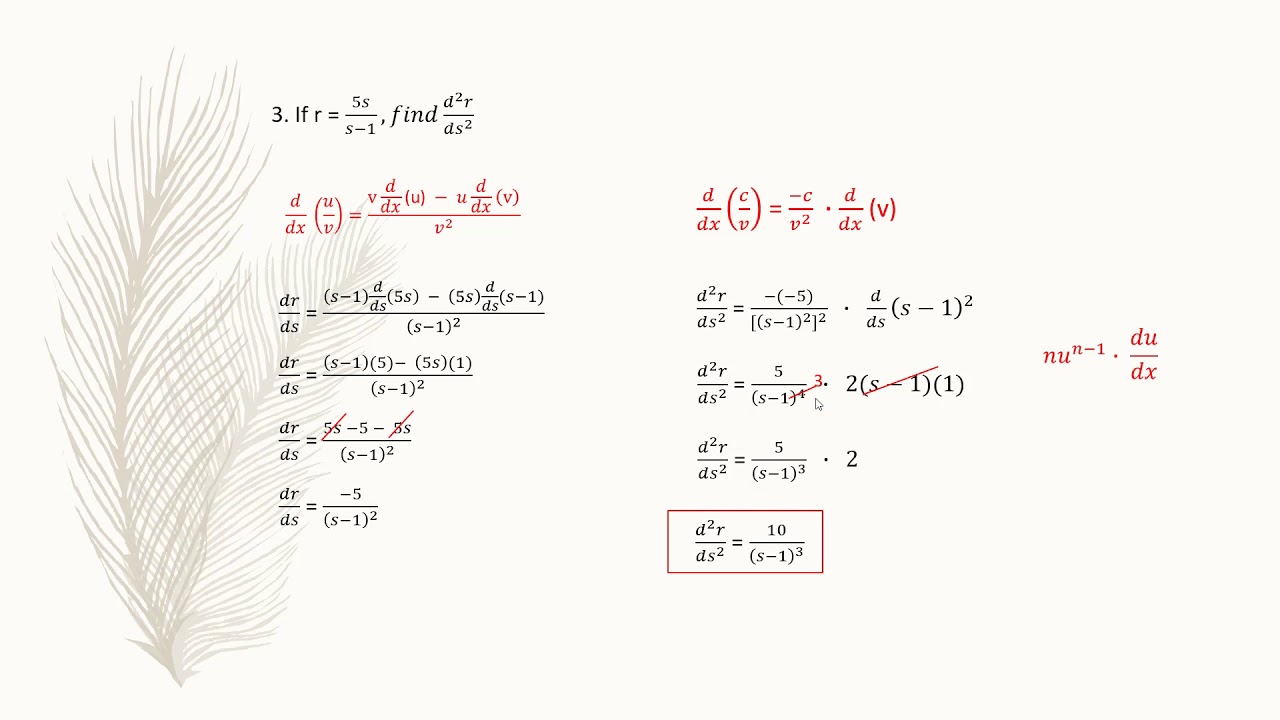
when i take the derivative there i'm going to get 4x plus 2y times dydx is equal to 0 and now when you solve for dydx that's going to give you negative 2x over y okay so just to be able to distinguish between these two curves i'm going to call this y1 and i'm going to call this second one y2 and now i know when i plug in to my slopes i know what i'm referencing okay so in order for these curves to be orthogonal we have to have perpendicular slopes at our points of intersection so the next thing i'm going to do is i'm going to test my intersection points so i'm going to put that down here okay so to test my points i'm just going to use the two intersection points we had one at 1 1. if i were to find that first derivative at the point 1 1 it would be equal to one half and if i find the derivative for that second curve at the point one one we get negative two so those are perpendicular slopes so that meets up with what i'm hoping to see if i'm trying to show that these are orthogonal curves okay so now for the second point the second point was 1 negative 1 and i'm going to go through the same process if i found the slope of that first curve at that point i would have a slope of negative one half and then the second curve when i find the derivative at the point one negative one i'm going to get a value of two okay so notice that we got perpendicular slopes at both points of intersection so i can say therefore the curves are orthogonal okay so understanding um the whole idea of orthogonal curves is not really the main point of what we're trying to do here what we're trying to do is just show you one way that we can use the idea of implicit differentiation so you might see a problem on your assignment or on your quiz or on your test that deals with orthogonal curves just keep in mind if you do see a problem like that what we're trying to do is we're trying to find points of intersection and then we're trying to test the slopes that those points of intersection to make sure that we have slopes that are perpendicular to each other all right so the next problem here asks you to find the second derivative this is a little tricky but you know how to find second derivative so you're going to find the first derivative and then i want you to try to find the second derivative now keep in mind when you get the second derivative you might get an expression that involves the first derivative within your second derivative when you get to that point you need to do some substitution and try to get it simplified down so i'm going to let you try this first and then i'm going to show you my solution so pause the video take a minute work through that problem and then i'll show you the solution okay so here's what you should have ended up with on that one now the first derivative x squared over y you can see i have that circle that's pretty simple we've done several problems like that at this point but when i start to get involved with taking the second derivative now this becomes a little messier because i'm going to have to use my quotient rule so i took the derivative of the numerator i got 2x times the denominator minus the numerator times the derivative of the denominator now notice there's a dydx term within my second derivative expression and then i'm divided by y squared so i don't want to have to find d y d x first before i find the second derivative so what i'd really like to be able to do is jump straight to the second derivative if i know what the coordinate is on my curve so we're going to take what we found for dydx and substitute it into that second derivative expression and then do some algebra to simplify it down and i dealt with a complex fraction here you can see i went through some algebraic steps and i simplified it down into this form 2xy squared minus x to the fourth over y cubed so in the end i was able to get a second derivative that doesn't require me to find the corresponding first derivative value okay so when you find second derivatives they tend to be a little bit messy algebraically because we're always going to have that substitution that comes into play so just realize that if you're ever asked for a second derivative you've got to substitute back in for a dydx expression that might show up within the second derivative all right so there's a couple more problems left here that i want you to try and these are all calculator questions so we have this equation x squared minus 2xy plus 4y squared equals 64. so on part a they ask you to find an expression for the slope on part b they ask for equations of tangent line and then on part c they ask for the second derivative at a point so i'd like for you to pause the video take a few minutes and work through that problem keep in mind on part b you have a calculator available to you so you've got to think about that in terms of how are you going to find the corresponding y values when x is 2 use your calculator to figure that out and then for part really parts a and c you probably don't need the calculator but you can at least implement it on on part b when you're finding that y coordinate so take a couple of minutes pause the video and when you come back i'll show you the solution for this one okay so here's what i have first of all for the first derivative on part a very straightforward just take the derivative of the equation in the form that it's in solve for d y d x okay same process every time in terms of implicit differentiation part b finding the equation of the tangent line this is a little messier because we had to find the y value and you can see that what i did here was i took the original equation and i know x has to be two so right here what i have circled is the original equation with two plugged in for x and now what that leaves me is an equation in terms of y and then i just use the calculator to find these values negative 3.
405 and 4. 405 you could have gone through and used quadratic formula and gotten the exact values but since we have a calculator i just wanted you to approximate those whenever you're approximating decimals with your calculator make sure you use a minimum of three decimal places that'll become really important for us when we start doing a lot of problem solving applications okay so in the end you can see my equation of my two lines there so i had to get the slope at each one of those points and then get the equation of each of those tangent lines now the last problem you may have done this um in a way that's a little bit harder than necessary so when you find the second derivative yes we go through sort of the same process we have to do the quotient rule we have dydx terms in here and it's kind of a messy second derivative but keep in mind they didn't ask us to find the general expression for the second derivative at the point zero four they only asked us to find the actual derivative value at zero four so i don't need to know what the general expression is so what i did to get my solution here is i took the first step of my my second derivative i took this expression which is a big mess but now i just substituted in the values that i know i know that the slope at that point is 1 4 using my dydx and then i know that x is 0 and y is 4. so i plugged in 1 4 here and 1 4 here and then everywhere there's an x i plugged in 0 everywhere there's a y i plugged in 4 and then you can just do it all on the calculator so again save yourself the effort when it's not necessary to actually do all the algebra to get things simplified out and you can just plug the numbers in go ahead and plug the numbers in early if it's if it's okay to do that so in this case it was and you can see i got my second derivative there as negative 3 over 64.