it's real pleasure for me to be here and I was thinking about how to begin my remarks because I'm a bit of an oddity here I found my way to two Thomism as much as I can say I'm a Thomas I suppose I can say that via phenomenology and and personalism and in some ways it was because I was looking for for better ways at least to my way of thinking to ground certain notions that are fundamental to the phenomenological project and at the time of my graduate studies certainly now Pope Saint John Paul the
second was my my inspiration and I thought if he can combine phenomenology and tome ISM then I can too maybe not as well as him but I can at least strive to do so so and and yet as as I studied tome is amore and particularly tome ism as it bears on questions of personal ISM I found it to be less and less of an odd combination and what's striking about the two readings that I asked you to prepare for today is that it's not so much a question of canto ms 'm accomodate personalism it's
not so much a question of whether or not there's there's some room for personalism within tome ism but both dr. Mara tan and father Norris Clark think that personalism is tome ism right they they both take note of this striking statement that Aquinas makes in the Summa theologia a question one archetype started part one question twenty-nine article three where he says that the person is that which is most perfect in all of nature the person is that which is most perfect in all of nature again that's prema pars question 29 article 3 now what does
Aquinas mean by the person right that's certainly a question that father Norris Clarke for instance takes up and perhaps doesn't push as far as some of my colleagues here would like to have seen him push on that front but nevertheless there is this question of this reality of personalism somehow being at the heart of the two mystic metaphysical project so with with that as a cornerstone of my remarks I I want to talk about three main areas first I want to look at at the the effort the combined effort of Mara tan and Clark and
try to gauge what it is that they think they're doing these are the personalism and tome ISM second I want to bring to light a particular feature of their combined project that has to do with what Clark sometimes refers to as the dynamism of being and then third I want to reflect particularly on merit Ann's reflections on the person and the common good and to explore the tension that he identifies and see whether or not his solution is in fact a worthwhile one so first both of these philosophers that were reflecting upon today see themselves
as recovering something and Aquinas like merit an is is in fact almost unaware of the fact that there should be some question of whether or not personalism is compatible with tomé ism he's as he sees it bringing to light fundamental features of two mystic thought and reflecting particularly on what it means to be in a day I Clark on the other hand sees himself as making explicit certain implicit themes that one finds in Aquinas and also stretching together in a way that can combine the two disparate of reflection the analysis of being particularly being as
it's captured in in this notion of essay ok the act of being active being and person and what Aquinas means by that and he sees himself as as completing a project that Aquinas did not quite realize right and whether or not merit an is is reading too much into Aquinas or Clark too little I'll leave for your own reflections both Clark and merit an see themselves as correcting certain excesses and the contemporary discussions of what it is to be a person all right so Clark on page 65 and I'm going to refer to the page
numbers within this entire packet rather than the page numbers on the individual pages of the the collections well he sees himself as providing an overlooked development and reflection upon the connection between person and being in so far as Descartes on the one hand and then Locke and Hume on the other think of substance as isolated right so that the the thinking thing is an isolated substance of one sort that's entirely different than the extended thing that which is extended flexible and mutable and within the the cogito as as at least Clark is coming at it
there's a kind of solipsistic a pible right well and then with respect to lock the notion of substance is deployed simply as that which lays below that which stands below any kind of other quality all right so it's it's just a thing at the bottom but there's nothing dynamic about it okay and for Hume the the notion of substance entails some sort of identifiable feature that can be shirred as an idea or it's or it's nothing this is again the way that clark comes at hume that way of thinking of you might need some refinement
but in each of these instances the notion of substance seems without value for those who want to make sense of notions of relationality of depth of participation between a created being and the create or all of that seems lost to the notion of substance and you have an emphasis and a lot of personalist reflection christian and otherwise on relation right well and it seems as though you just have a bundle of relations and if not just relations that aren't connected to some kind of dynamic notion of substance then you just have certain features of the
person say subjectivity about which we heard quite a bit today that seemed to be elevated in some reflections to the level of the account of what the thing is what is a person well is a person subjectivity or is subjectivity subjectivity a feature of the person right for clarke for aquinas it's a feature of a person in fact i would identify it as a necessary accident of a person calling it an accident doesn't mean that it's unimportant at all right there are all kinds of accidents that are vitally important to who you are as an
individual and what you are but but is it in fact what a person is well it seems not to go to that depth and there are other necessary accidents or just call them features of the person which are needed to be explored but what are they resting on what what's the account of what a person is clark sees himself as as going some way to supplying that so ii does does merit an effect when i i've read this work a number of times but rereading the introduction was rather striking if you look at page 244
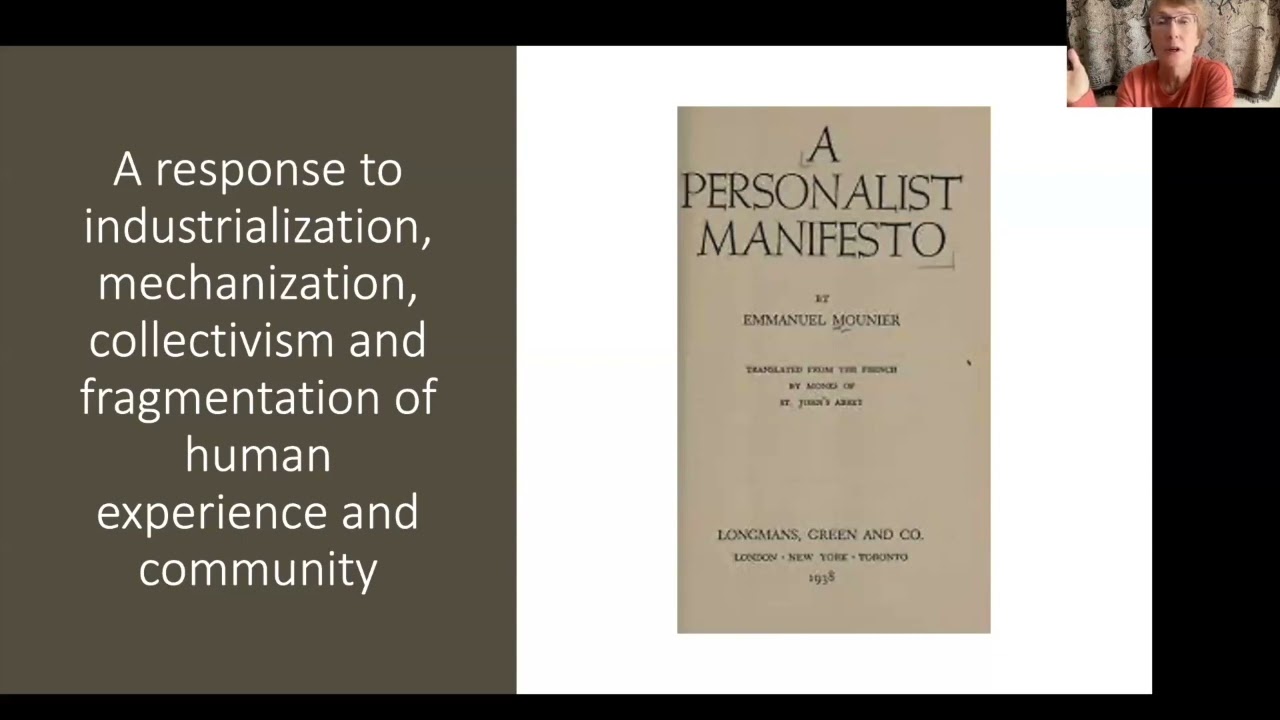
of the a person in the common good so 244 in your packet this is the first page of that work merit an writes among the truths of which contemporary thought stands in particular need and from which it could draw a substantial profit is the doctrine of the distinction between individuality and personality the essential importance of this distinction is revealed in the principles of st. Thomas unfortunately a right understanding of it is difficult to achieve and requires an exercise of metaphysical insight to which the contemporary mind is hardly accustomed right Bob and he says something also
about the the contemporary mind where where those who reflect upon not just the notion of a person but other other features of significance in contemporary debates it's not necessarily a feature of being untrained and metaphysical reflection that's at work but sometimes the will right not wanting to be as clear as one needs to be so this is a rather polemical way for merit an to begin and indeed he has some reason for his parlament seeing as he does this this fundamental problem in contemporary society of individuality on the one hand and totalitarianism on the other
right he's writing shortly right around the time of the second world war and he is reflecting upon the way in which these these two features of individuality and totalitarianism czar to totalitarianism are two sides of the same coin they they they lead to each other right and they're the chief dangers of the contemporary human person he wants to revive a notion of person as not falling into individuality does not contribute to totalitarianism a person that's connected to society and a notion of the common good which is distinct from the right so he's writing with a
certain fervor and with a certain frustration at the the the abandonment of some of the philosophical resources necessary to provide depth to his account of the person as he as he sees it again okay so this is this is how I would characterize both Clark and and Meriton in their endeavors what they're what they're after if they're seeking to correct they're seeking to ground and there they're a little tired of being on the defensive they've gone on the offensive personalism is an expression of Tommen ISM itself right because as Aquinas says the person is that
which is most perfect in all of nature so what is what is the major feature of personalism that they explore I'll focus first on on some features of Clark and then we'll go back to merit in the the notion that Clark emphasizes time and again is this idea of essay connected to a Gary essay being the infantile form of our infinitive form of aladdhin to be if I had a board behind me I'd write some of this out so just wash my watch my hands and words will spring forth from them as I wave them
and you can just rearrange the words and you're in your own mind so when when Clark is thinking of B and generally the word he uses as in sometimes Aquinas uses Ali quit something an individual B every being is an individual being every being as as a created being has at the very least a tinge of potentiality as Aquinas puts it and day into it a sensi of chapter four even Angels have that that hinge of potentiality potentiality in this way of thinking signifies a kind of receptivity right potentiality is linked to the notion of
a sense your essence so every being is a combination of the act of being the SA not active being but act of being and essence Ascencio and as Clark puts together the the grand to mystic metaphysical scheme he sees both a vertical as well as a horizontal a set of horizontal lines of participation like God as Aquinas refers to him in on being an essence tant at essentia is if se sa subsistence what does that mean right so God God is active existence subsisting itself and I'm not going to unpack that for you right now
but try to get the the big the big picture here right so every being is insofar as it's participating in this being itself and every being is distinct from every other type of being in so far as it has the distinctive essence that it has right so every being is insofar as it has si that's its mode of participation in God the first being and every being is distinct from every other type of being in so far as it has the particular essence that it has right and so you're all familiar with the notion of
the scale of being those beings that are so to speak farther from the first being are those beings that have a lot of potentiality with respect to this way of thinking of potentiality connect is the essence okay those beings that are closer to God are beings that have less potentiality in this way of thinking of potentiality as potentiality compared to other beings there's a way of looking at potentiality from the inside right where we say well human being has a lot more potential than a worm certainly well well that's that's true seen from from the
inside right capable of doing more than worms I should hope and the yet when we look at the type of being that it has that's where this notion of potentiality comes in so what's the point of reminding you of this this grand scheme of how everything is connected well for Clark he means to bring to light the way in which every being is insofar as it acts that active action is not just a way of being but being is action and because every being insofar it is as it is is esic and in fact I
think it's quite clear if you read Aquinas with care that although Aquinas talks about matter as a principle of individuation matter does not make an individual being an individual being Aquinas says in a number of places what makes an individual being what it is what makes it one which is to be is si si is the principle that makes each being be the individual that it is so to to be is to be active and that points to the the fundamental way in which every being is communicating itself okay being is not this static notion
of substance that that you find in Hume or that you find in Locke being is self communicative and insofar as being a self communicative it's sharing itself it's it's opening up these points of relationality to every other type of B so rather than looking at the the whole of reality as so many atomic beings disconnected from one another that may or may not enter into relations with each other every being is by virtue of the fact that it is already related to every other B and then when we look at particular modes of relating one
being to another then we're reflecting upon these features that are really important and significant but they're they're secondary to this first mode of being so just being the first mode of act I know not all of you may be familiar with this idea of first actuality and second actuality so trying trying to say enough without saying too much so that we're all along the the same mental page but well when when this goes back to Aristotle's de anima one finds it in a number of places in Aquinas certainly in questions Rob 75 through 84 of
the Prima parse if you think of question 76 of the Prima parse article one Aquinas says that that we act by that whereby we are in act and we act by that whereby we are in act we are in act by our our soul the act of the body and then our modes of acting are expressions of this type of being that's become through the soul animating the body so our second acts then are all the things that we do because we're the kind of beings that we are and this goes as well for any
other type of being every being is this combination of essence and act of existence so on the one hand then we have relationality as an expression of the very being of each being and on the other hand we have a kind of receptivity that's a feature primarily or first off by our being the beings we are we we receive our B via our participation in God well second secondarily then all we are receptive to each other in ways that go far beyond what we tend to think of as our typical actions but friendship itself implies
both relationality and receptivity I'll focus just may be on love in general right as an expression of a person love is not merely wishing well or willing well or feeling well or passionately or whatever towards another love is not just about giving to another your effective 'ti for your your act of the will love implies union like longing for the other longing to be with the other you have both the the the relationality that the pointing out of good will good feeling and so forth in love but there's also the the gathering in and those
are both perfected in love and it's only persons indeed who can love perfectly but I would argue that you've you find both these these notions in however distant the echo in every be right that is to say that the kind of outpouring as well as receptivity insofar as it is it's grounded in its very be but the perfection of both relativity or or relationality and receptivity is to be found only in the person okay so let me now turn to a few of the specific points in in Meriton to try to appreciate the depth of
what he is providing for us and I mentioned already the way in which he sees individuality and totalitarianism as opposed to each other I want to look at page 247 if you will and emphasize what in this drama if we want to think of this philosophical work as a kind of dramatic narrative I think it is emphasize one side of the dramatic tension and that's the the infinite value of the person in the first full paragraph Meriton writes elsewhere the angelic doctor writes that the good of grace of one person is worth more than the
good of the whole universe of nature for precisely because it alone is capable of the supreme good because it alone is the image of God the intellectual creature alone is capable of grapes and the next paragraph he writes in the second place concerning the possession itself of the ultimate end say Thomas teaches that in the beatific vision each blessed soul knowing God as he is and as it itself is known by him grasps the divine essence and becomes God intentionally in the most immediate act conceivable right so the the individual human person is of infinite
value ultimately because not merely is every human person in a day but to be an imago date means being able to be God intentionally right so deification divinization is the ultimate expression of the infinite value of the human person and maraton who is a philosopher not a theologian sees fit to reflect upon this notion of the imago Dei in a specifically Christian context here but I would say still from within a proper philosophical mode of reflection so I say that because the just pointing out to the earlier and professor bluetick Leone's remarks he was he
was driving a pretty sharp line I know you hear Rocco I don't see you pretty sharp line between the mode of philosophical reflection and a few logical mode of reflection and one of the the necessary features of appreciating merit an is being able to dance back and forth across that line he doesn't he doesn't draw that line with the kind of strictness that other philosophers do so I would certainly characterize this as a philosophical reflection but he he doesn't make any bones about the fact that that he's reflecting upon life in in in God part
of the reason why he does that it's the way he looks at Aristotle for instance and I'll leave those reflections for for Wednesday where the notion of deification is is held out in there Assad's own texts not in a specific the Christian way though okay so we have on the one hand this this infinite value of the person this is a bedrock principle and merit Ann's remarks and yet we don't yet have a definition of what a person is so let's look at page 254 for that he says here in the the large paragraph in
the middle about eight lines up metaphysically considered personality is as the two mystic school rightly asserts subsistence the ultimate achievement by which the creative influx seals within itself a nature face to face with the whole order of existence so that the existence which it receives is its own existence and its own perfection personality is the subsistence of the spiritual soul communicated to the human composite because in our substance it is an imprint or seal which enables it to possess its existence to perfect and give it so freely personality testifies to the generosity of expansiveness in
being which an incarnate spirit derives from its spiritual nature in which constitutes within the secret depths of our ontological structure a source of dynamic unity or unification from within so this notion of subsistence how many of you are familiar with two mystic metaphysics the notion of subsistence do I have a majority-minority here okay just a few so the the idea that that the the soul Aquinas argues subsists signifies that it has an activity that is distinct from the activity of actualizing a physical organ which the soul does as well right so most of our cogitate
'iv cognitive powers are powers that that imply the physical organs right our realm of effectivity is in fact a matter of our body being organized in a particular way to feel and to receive in fact many of our judgments every every emotion is a kind of judgment right well it's not a judgment in the stoic sense of a a mere eruption of the mind but it's it's a it's a kind of judgment about something as fearful or good to eat or attractive right well non-human animals have these kinds of judgments non-human animals however don't judge
their judgments I'm Rob to judge one's judgments to put it in McIntyre in turns terms requires a kind of activity that persons from any kind of physical act right it points to the subsistence of the intellectual soul Rob and then on the basis of this notion of subsistence Aquinas moves to a consideration of the immortality of the intellectual soul but first and foremost subsistence points to the the souls the intellectual Souls ability to to act in a way that entirely presents from any kind of material considerations in order to do things like judge judgment or
think in general or to perform any act of the will so on the one hand then we have this notion of personality that is connected Meriton argues to the idea of subsistence on the other hand we have the idea of individuality and he identifies that as connected to many of our distorted senses of the self right when we when we say that that we tend to be selfish notions of egotism in general Meriton argues are an expression of this idea of individuality which he connects to our materiality okay so individuality is connected in human beings
to materiality but not in every case is individual 'ti connected to materiality right angels are individuals so one should not read or hear in merit an his reflections on individuality as castigation x' of the notion of individuality or materiality in general he's not Latinas he doesn't think that all matter is evil and to be flown away from our mode of existence happens to be a material one and it's a good thing right that's the way we're made and an Angels mode of existence is not a material one and yet it too is an individual it
too is personal so one runs the risk of what dr. Crosby referred to as as the risk of an angel ISM with respect to thinking about the person if you overplay what maraton calls personality one runs the risk of what might be called and certainly as by Walker Percy and his novel love on the Bruins beastial ISM if one identifies with the individuality of our be but our being is both individual and personal we're neither beasts nor angels the way Meriton puts this point is on 255 he says in that second full paragraph however evident
it may seem in order to avoid misunderstandings and nonsense we must emphasize that they are not two separate things individuality personality there is not in me one reality called my individual and another called my person one and the same reality is in a certain sense in an individual and in another sense a person our whole being is an individual by reason of that which in us derives from matter and a person by reason of that in us which derive from spirit but we're neither one nor the other and that's that's one of the hardest things
I find I've been teaching for more than just a few years now one of the hardest things for for my students to wrap their minds around right because so much of what we think of about ourselves seems to take place in a spiritual realm right well and our body does seem discardable or insignificant somehow not really who we are and what does it mean not to say simply that I have a body but that I in my body I I think a Thomas is committed to that proposition I in my body it sounds shocking I
could make it even more shocking using a an idea that that the great Thomas and Catholic convert gm's comb uses in one of her essays and what she reflects upon a number of principles that she thinks ought to be abandoned by by Christian philosophers one of which is the notion of the self she argues there there is no self not in the way that we think of the self as an inner person who I really am we are the totality so that's that's an scull and I would argue that that fits what merit and is
is arguing here as well okay otherwise Meriton thinks you run the risk of a kind of dualism Anscombe certainly thinks that that that was the major threat of her own day so indeed I acknowledge it sounds shocking if I try to tell if I do if you try to say that to somebody who's not philosophically trained if I if I say to my my one of my children you know you you're not a self they'll be really confused right it sounds as though I'm I'm yeah well I do hope I could say it after they
read some Descartes and Hugh and Aquinas but you know you don't you don't so much have a self but anyways I'm losing my point let me get back on track so we have then this this notion of the infinite value of the person I've emphasized what merit an at least means by personality now let's think about the the other side of this tension right we we are beings who both because of our materiality and because of our spirituality are not meant to be alone we we are fundamentally communal right well if we wanted to theologizing
air attend does in some places we could reflect upon the community of the Trinity if we want to to analyze it we can reflect upon the community of needs that we can meet through living in concert with each other but we're neither God nor beasts right our mode of community is properly that of human society human society is a whole Meriton says made up of holes every person is a hole a kind of totality unto him or herself and a community is a hole made of holes not parts that compose a hole but holes that
make a hole it's when one thinks about the individuality of each human being that one falls through the mode of thinking of part the hole right but in thinking about the human person as a whole the personality of each be one can see how indeed were were a hole and a hole that surpasses the totality of human society right so how am I on time as I don't have a watch I'm doing okay a lot so one more minute yes I should have followed professor aside for its good example the let's look at page 264
here we come to the the the climax of this drama and then I'll look at the day new mall in a moment 264 so write it smack-dab in the middle of this page he says the person as person insists on serving the community and the common good freely it insists on this while tending toward its own fullness while transcending itself and the community in its movement toward the transcendent whole the person as an individual is necessarily bound by constraint if need be to serve the community and the common good since it is excelled by them
as the part by the whole so in one sense the whole is greater than any of its parts that human community human society the good that is held in common truly is greater than any individual and each individual human being is bound by obligation to serve the common in another sense each individual surpasses any kind of transitory human society each human person is to be served by the common good to transcend it because each human person is ultimately destined for deification right so the way in which merit an wrestles with this tension is by way
of the distinction between individuality and personality that combine to compose each be as one whole with respect to our individuality we serve the common good with respect to our personality we surpass it and are meant for communion with a divine other