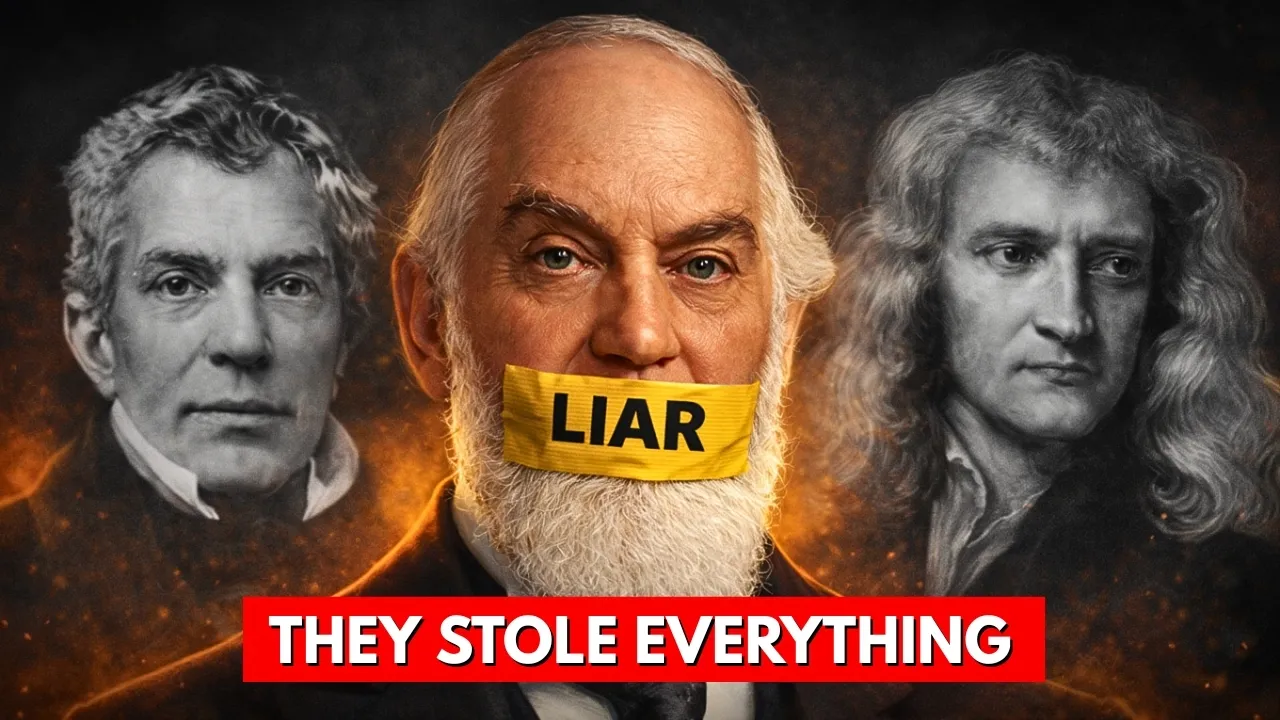
In 1879, a 27-year-old clothing store owner from Alagany, Pennsylvania, published the first issue of a small religious magazine. It had a print run of about 6,000 copies. The title was Zion's Watchtower and Herald of Christ's Presence.
Today, the descendant of that magazine, now called simply The Watchtower, is printed in over 360 languages and distributes tens of millions of copies per issue. It is by some measures the most widely distributed periodical in human history. The organization behind it, Jehovah's Witnesses, claims over 8 and a half million active members in 240 lands.
They operate one of the most sophisticated media production facilities in the world. They knock on more doors than any other religious group on earth. And they teach their members that this entire movement traces back to a single clean origin.
a young man named Charles Tae Russell who guided by God's Holy Spirit rediscovered the truth of the Bible that had been lost since the first century. That is the official story. It is simple.
It is inspiring and it is in almost every important detail wrong. What if the doctrines that define Jehovah's Witnesses, the invisible return of Christ, the chronology that points to 1914, the division of human history into divine dispensations, the entire prophetic framework? What if none of it was original?
What if every single one of those ideas existed in some cases for centuries before Russell was even born? And what if the people who actually created those ideas have been systematically erased from the record? That is not speculation.
It is documented history. And the documentation comes not from enemies of the faith, but from Russell's own publications, from court records bearing his own signature, and from the work of scholars like James Penton, a former witness, a professor of history, and the author of what remains the most thorough independent examination of the movement ever written. If this kind of investigation matters to you, take one second to hit like and subscribe.
It cost you nothing and it makes sure this kind of content keeps reaching the people who need it. Because today we are going to trace the real origins of Jehovah's Witnesses, not the version they tell you, the version they have spent over a century trying to hide. Part one, the British connection, a religion that isn't American.
The first thing you need to understand is that Jehovah's Witnesses are not theologically speaking an American religion. Yes, the organization was incorporated in Pennsylvania. Yes, its headquarters have always been in the United States.
But the actual ideas, the theological DNA that holds the entire structure together, came from across the Atlantic. They are British. And the trail begins with a name that will surprise you.
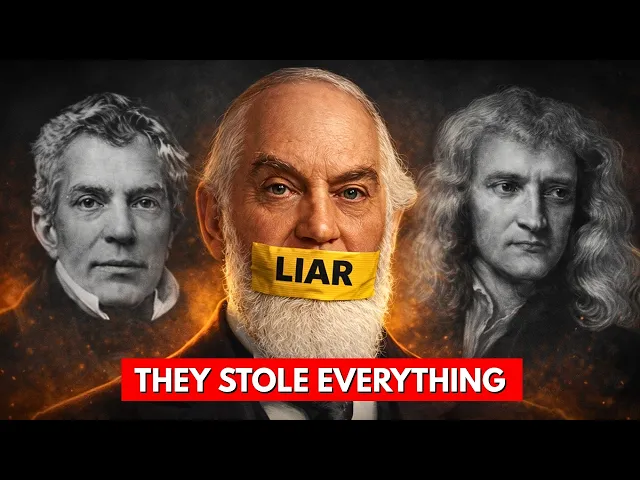
Isaac Newton, the physicist who decoded prophecy. When most people hear the name Isaac Newton, they think of gravity, calculus, optics. What they do not know is that Newton wrote more about theology than he ever wrote about physics.
After his death in 1727, his estate contained over 4 million words of unpublished theological manuscripts, 4 million. By comparison, his Principia Mathematica, the work that revolutionized science, contained roughly 200,000. Newton was consumed by the books of Daniel and Revelation.
He treated biblical prophecy the way he treated the natural world, as a system governed by mathematical laws that could be cracked with enough precision. He developed a method for calculating prophetic time periods by converting symbolic days into literal years. He cross-referenced ancient chronologies.
He analyzed the Hebrew calendar against astronomical records. He was in the most literal sense the first person to attempt a scientific calculation of the end of the world. One calculation in particular matters for our story.
Newton analyzed the prophecy of the seven times in the book of Daniel, the passage that describes a period of divine punishment measured in prophetic time units. He proposed that these seven times represented 2520 years of real history. That specific number 2520 would travel through two centuries of British theology, cross the Atlantic, and eventually become the mathematical backbone of the most important date in Jehovah's Witness esquetology, 1914.
Russell did not invent that calculation. He inherited it. And the chain of inheritance runs directly through Newton's unpublished papers.
John Nelson Darby, the architect of the framework. If Newton provided the math, the man who built the theological architecture was an Irishborn clergyman named John Nelson Darby. And his story is worth pausing on because without Darby, Russell's entire system collapses.
Darby was an Anglican priest who became disillusioned with the institutional church in the 1820s. He left the ministry, joined a small group of dissident in Dublin known as the Plymouth Brethren, and spent the next several decades developing a radically new way of reading the Bible. He called it dispensationalism.
The core idea was deceptively simple. God does not deal with humanity in one continuous way. Instead, he has divided history into distinct periods, dispensations, each with its own covenant, its own test, and its own form of judgment.
When one dispensation fails, God closes it and opens the next. Here is why this matters for our story. If you have ever opened a Watchtower publication and seen a chart dividing history into the patriarchal age, the Jewish age, the gospel age, and the millennial age, you are looking at Darby system.
If you have ever heard a witness explain that we are living in a special final period of God's timetable, different from all previous eras, that is Darby. The very structure of Russell's studies in the scriptures, the charts, the timelines, the division of human history into harvests and epochs is dispensationalism with a different coat of paint. Russell modified some conclusions.
He rejected the rapture, for instance. But the blueprint, the architectural logic that holds the entire prophetic system together is not Russell's. It belongs to a man who was preaching it decades before Russell was old enough to read.
And it was not as though Russell would have had to go looking for these ideas. Darby toured the United States at least five times between 1862 and 1877, preaching in major cities, establishing networks of followers, and distributing literature. His system spread through the exact kind of independent Bible study circles that a young, spiritually restless Russell was moving through in Pittsburgh during the 1870s.
By the time Russell began publishing, dispensationalism was not a niche theory. It was in the water, the rainbow, and the invisible presence. There is one more British source that needs to be traced because it leads to one of the most distinctive doctrines Jehovah's Witnesses hold today.
Ask any witness when Jesus Christ returned and they will tell you 1914. Then they will clarify not visibly. Christ returned invisibly.
His presence the Greek word perusia began in 1914 but it is not something human eyes can detect. This is not a minor teaching. It is the doctrinal foundation for virtually everything the organization claims about the last days, the authority of the governing body, and the urgency of their preaching work.
Witnesses are taught that this understanding of the Peruia was restored by Russell through careful Bible study. But the historical record says otherwise. In mid-9th century Britain, there existed a theological journal called the Rainbow.
It was devoted entirely to prophetic study and its contributors, ministers, scholars, and theologians spent years debating the precise nature of Christ's return. Among the positions they explored in exhaustive detail was the concept of an invisible perusia. The argument that the Greek word should be translated as presence rather than coming and that this presence could be spiritual, imperceptible, already underway was published and debated in the Rainbow long before Russell ever encountered the idea.
So the invisible presence is not Russell's discovery. The 2,20year calculation is not Russell's discovery. The dispensational framework is not Russell's discovery.
Every foundational element of his theology was developed by British thinkers whose work he accessed, absorbed and repackaged without ever fully acknowledging the debt. Part two, the mentor in the shadows, Nelson Barber, the man who calculated 1914. We now move to American soil and to the single most consequential relationship in the early history of this movement.
Because the man who actually put the pieces together, who took the 2520-year calculation, anchored it to a specific starting date and arrived at the year 1914 was not Charles Russell. It was a man named Nelson Homer Barber. Barber was a product of the Millerite movement, the wave of American Adventism that erupted in the 1840s around the preacher William Miller, who had calculated that Christ would return in 1844.
When that prediction failed, an event historians call the great disappointment, the movement shattered into fragments. Some gave up entirely. Others, like Ellen White, formed new denominations, and others, like Barber, went back to the calculations and tried again.
By the mid 1870s, Barber was editing a prophetic journal called Herald of the Morning, published out of Rochester, New York. He had developed a chronological system that took the 2520-year prophetic period, started the clock at the fall of Jerusalem, which he dated to 606 B. CE.
and counted forward to arrive at 1914 CE as the year when the times of the Gentiles would expire. He had also adopted the invisible presence interpretation of the Perushia, arguing that Christ had already returned invisibly in 1874 and that 1914 would mark the end of the gentile nation's domination. This is the entire chronological skeleton of what Jehovah's Witnesses believe today.
And Barber published it years before Russell entered the picture. A partnership built on money and prophecy. Russell encountered Barber's work around 1876 when he came across a copy of the Herald of the Morning.
He was a young man with a family fortune from the clothing business, a deep spiritual restlessness, and a growing conviction that mainstream Christianity had it all wrong. Barber's chronology electrified him. Here was a system that seemed to make mathematical sense of Bible prophecy, and it had a date, a specific, testable, soon approaching date.
Russell did not just endorse Barber's work. He financed it. He traveled to Rochester to meet Barbara in person, and the two formed a partnership.
Russell provided the money. Barber provided the theology. Together, in 1877, they co-authored a book called Three Worlds and the Harvest of This World.
Russell paid for the printing. The book laid out the prophetic timeline, the invisible presence doctrine, and the 1914 calculation in full detail. James Penton in his study of the movement makes this point with precision.
At this stage, Russell's role was primarily that of a financeier and a promoter, not a theologian. The intellectual heavy lifting had already been done. Russell's genius was organizational and financial.
He saw the potential of these ideas to build a movement and he had the resources to make it happen. The doctrine that split them apart. The partnership lasted roughly 3 years.
The issue that destroyed it was not a minor disagreement. It was a fundamental question about who Jesus Christ was and what his death meant. Russell held firmly to the doctrine of the ransom.
The belief that Christ's sacrificial death paid the price for Adam's sin and opened the way for humanity's redemption. For Russell, this was non-negotiable. It was the heart of the gospel.
Barber began to drift. He moved toward a position that minimized the atoning value of Christ's death, treating it more as an example of faithfulness than as a substitutionary sacrifice. For Russell, this was theological betrayal of the highest order.
In 1879, Russell withdrew his funding from the Herald of the Morning and launched his own publication, Zion's Watchtower and Herald of Christ's Presence. Notice the subtitle. It is Barber's Doctrine.
Christ's invisible presence embedded in the very name of the new magazine. From this point forward, Russell would present the 1914 chronology, the invisible return and the dispensational framework as the fruit of his own Bible study. Barber continued publishing for years, but without Russell's financial support, his influence shrank.
He died in 1905, largely forgotten. Today, his name appears nowhere in the official literature of Jehovah's Witnesses. The organization that owes its most sacred date to his calculations has written him out of the story entirely, and they have done so deliberately because acknowledging Barber means acknowledging that 1914 was never a divine revelation.
It was borrowed math. Part three, the Jesuit connection. The irony the organization cannot explain.
If there is one group that Jehovah's Witnesses have vilified more consistently and more aggressively than any other, it is the Jesuits. Open any Watchtower publication from the 20th century that discusses the society of Jesus, and you will find them described as agents of Satan, infiltrators of true religion, architects of papal deception. The 1930s publications under Rutherford are particularly vicious in their anti-Jesuit rhetoric.
The Jesuits are in the Watchtower worldview the ultimate enemies of truth which makes the next part of this story almost unbearable in its irony. One of the direct theological influences on the prophetic tradition that shaped Russell's thinking was a Jesuit priest named Manuel Lacunza E Diaz. A Jesuit in exile Lacunza was born in Santiago, Chile in 1731 and entered the Jesuit order as a young man.
In 1767, King Charles III of Spain expelled the Jesuits from all Spanish territories, a sweeping political act that displaced thousands of priests overnight. Lacunza was forced into exile, he settled in Imola, a small town in northern Italy, and it was there, cut off from his homeland and his order that he spent roughly 20 years writing a theological work that would outlive him by centuries. The book was called Laenida de Messias in Gloria Mahestad, the coming of the Messiah in glory and majesty.
It argued for a literal physical future return of Christ to establish a thousand-year kingdom on earth. It proposed that the prophecies of Revelation described real events yet to come, not symbolic allegorories of the past. And it insisted that the restoration of the Jewish people to their homeland was a necessary precondition for the end times.
Every one of these ideas would later appear in the theological tradition that produced Russell. But here is the detail that elevates this from interesting to extraordinary. Lacunza did not publish the book under his own name.
He used a pseudonym Juan Hosafat Ben Ezra. The name was carefully chosen to sound like a converted Jew, a rabbi who had accepted Christianity. Why?
Because Lacunza understood perfectly well that a Jesuit priest arguing for a literal millennium and a future Jewish restoration would be censored immediately by the Catholic hierarchy. He was right. When the book's true authorship was eventually uncovered, the Vatican placed it on the index of forbidden books in 1824.
But by then, the work had already escaped the Vatican's control. A Scottish Presbyterian minister named Edward Irving translated Lacanza's book into English in 1827 and it entered the bloodstream of the British prophecy movement. Irving himself became a major figure in that movement and his translation of Laca was read by the same circles that included Darby and the contributors to the rainbow.
The ideas traveled from a Jesuit exile in Italy through a Scottish translator into the British prophetic tradition across the Atlantic through Barber and directly into Russell's theology. The pipeline is documented and it runs straight through the Society of Jesus. Russell the Zionist Lacunza's influence also helps explain one of the most suppressed chapters of early witness history, Charles Russell's passionate Zionism.
Today, Jehovah's Witnesses teach that God's covenant with the Jewish nation ended in 33 CE. That spiritual Israel, meaning the 144,000 anointed witnesses, has replaced ethnic Israel in God's purposes. There is no special role for Jewish people in the current Watchtower theology.
Russell taught the exact opposite. Russell believed that the Jewish people remained God's chosen nation. He wrote explicitly that Jews should not be converted to Christianity, that God had a separate and distinct plan for them, and that their return to Palestine was one of the clearest signs that the end of the age was approaching.
This was not a marginal opinion in Russell's thought. It was central. He devoted entire chapters of his studies in the scriptures to it.
He gave public lectures on the topic to Jewish audiences. He attended Zionist conferences. And here is a fact that would stun most modern witnesses.
At early Bible student conventions, the song Hatikva was sung. This is the anthem that would later become the national anthem of the state of Israel. Russell's followers were singing a Zionist hymn at their religious gatherings.
All of this was quietly dismantled after Russell's death. Under his successor, Rutherford, the Zionist doctrine was reversed entirely. The pro-Jewish teachings were withdrawn from circulation.
The theological framework was rewritten to exclude any special role for ethnic Israel. An entire pillar of the founders's belief system was demolished and replaced and the membership was expected to accept the change as new light from God as though the previous teaching had never existed. Part four, the human side of Charles Russell, Maria Russell and the faithful slave.
One of the most powerful concepts in the entire Jehovah's Witness belief system is the identity of the faithful and discrete slave. Today, this title from the Gospel of Matthew is applied exclusively to the governing body, the small group of men who direct the organization from Warwick, New York. Their authority rests on the claim that Jesus Christ personally appointed them as the sole channel for distributing spiritual food to humanity.
It is functionally the doctrinal basis for every instruction, every policy and every rule that the organization imposes on its members. The first person to apply that title to Charles Russell was not Russell himself. It was his wife, Maria Francis Ackley.
Maria was not an ornamental spouse. She was a c-orker. Historical records indicate that she wrote articles for the Watchtower, participated in editorial decisions, and helped develop the public presentation of Russell's ideas.
The movement's early years were in many ways a collaborative project. And it was Maria who first made the interpretive argument that the faithful and wise servant of Matthew 24:45 was not a class of people, but a specific individual, her husband. Russell initially resisted this identification, but he eventually accepted it, and for the rest of his life, many of his followers regarded him as the personally appointed servant described by Jesus.
This is documented in Watchtower publications from the period. It is not disputed even by the organization's own historians, though they prefer not to dwell on it. The significance here is twofold.
First, a woman in an organization that would later systematically exclude women from all positions of authority played a decisive role in establishing one of the most consequential doctrines in the movement's history. Second, the faithful slave concept was not the result of deep exugesus or divine revelation. It was a personal application proposed by a wife about her husband which then took on a life of its own.
The divorce the collaboration between Charles and Maria did not end well. In 1906, Maria Russell filed for legal separation in the Court of Common Please of Alageney County, Pennsylvania. The case number is recorded.
The transcripts are a matter of public record and the testimony they contain was devastating. Maria accused Charles of what the court termed his course of conduct toward her, a pattern of doineering behavior, of dismissing her contributions, and of systematically marginalizing her within the organization she had helped to build. There were also allegations involving a young woman named Rose Ball, who had lived in the Russell household.
The court records describe accusations of inappropriate familiarity, though the precise nature of the conduct was disputed. Russell denied the charges categorically. The court ruled in Maria's favor.
She was granted the separation on the grounds of what 19th century law called mental cruelty. Russell was ordered to pay alimony. He fought the ruling.
He published his version of events in the Watchtower. He framed the case as religious persecution, an attack on God's servant by enemies of the truth. What matters here is not the private details of a failing marriage.
What matters is the pattern. When confronted with damaging facts, Russell's instinct was to control the narrative, to reframe criticism as persecution, and to use his own media platform to discredit the accuser. This is not hindsight bias.
It is documented in his own words, in his own publications from 1906. And it is a pattern that the organization would repeat, refine, and institutionalize over the next century. The Bible in stone.
And then there is the matter of the pyramid. This is not a footnote. It is not a minor curiosity.
For decades, it was presented as one of the strongest pieces of evidence for the validity of Russell's prophetic timeline. Charles Russell taught that the Great Pyramid of Giza was designed by God, not inspired by God in some vague spiritual sense, designed. He called it the Bible in stone and argued that its internal measurements when converted from inches to years using a specific interpretive key confirmed the dates he had calculated for Christ's invisible return and the end of the gentile times.
Volume three of studies in the scriptures titled Thy Kingdom Come contains an entire chapter devoted to the pyramid. It includes detailed diagrams, measurements of the Grand Gallery and the descending passage, and calculations that purport to confirm 1874, 1914, and other prophetic dates through the physical dimensions of the monument. Russell was so convinced of the pyramid's divine origin that he even had a large pyramid-shaped monument erected at his grave site in Rosemont, United Cemetery in Pittsburgh.
It is still there today. You can visit it. The Watchtower organization now considers pyramidology to be oultism.
They have published articles explicitly condemning the practice. But they have never published a thorough reckoning with the fact that their founder, the man they describe as the restorer of true Christianity, treated an Egyptian monument as divine confirmation of his prophetic system. The pyramid was not incidental to Russell's theology.
It was evidential. He offered it as proof. And for decades, his followers accepted it as such.
What does this tell us? It tells us that the standard of evidence within this movement has always been flexible. Evidence is not evaluated on its merits.
It is evaluated on whether it supports the current teaching. When it does, it is celebrated. When it stops being useful, it is discarded and the members are expected to move on as though it were never there.
Part five, the end of democracy. What the Bible students actually looked like. Before we can understand what happened after Russell's death, we need to understand what the movement looked like while he was alive.
Because the Bible students of 1910 and the Jehovah's Witnesses of today are structurally almost unrelated organizations. Under Russell, the congregations operated with a significant degree of independence. Local groups called Ecclesius elected their own elders through democratic vote.
Russell encouraged personal Bible study. He stated repeatedly that his writing should not be treated as infallible. He did not claim to be a pope or a prophet.
He described himself as a fellow student of scripture. There were no mandatory field service reports. There were no judicial committees.
There was no formal dysfellowshipping process with enforced shunning. Members could disagree with Russell on secondary matters without being expelled. The atmosphere was closer to a loose network of independent study groups than to the rigidly controlled global organization that exists today.
Russell died on October 31st, 1916 during a train journey through Texas. He was 64. And with his death, the movement entered a period of transformation so radical that many of its original members would not survive it.
Joseph Rutherford, the judge who built a kingdom. The man who seized control of the Watchtower Bible and Tracked Society after Russell's death was Joseph Franklin Rutherford, a lawyer from Booneville, Missouri, who styled himself Judge Rutherford based on a brief appointment as a substitute judge in the Missouri court system. Rutherford's takeover was swift and calculated.
Russell's will had specified that editorial control of the Watchtower should remain with a committee. Rutherford had other plans. Within months, he moved to consolidate all decision-making authority in the office of the president, his office.
Four of the seven members of the Watchtower's board of directors opposed him. Rutherford argued that their appointments had been legally defective. He removed them and replaced them with his own loyalists.
The purge was not subtle. The four ousted directors published a pamphlet protesting what they called a power grab. They accused Rutherford of violating Russell's wishes and of centralizing authority in a way that contradicted everything the founder had stood for.
They were right. But Rutherford controlled the printing presses, the mailing lists, the legal entity, and the finances. The protest failed.
Thousands of Bible students left the organization during this period. They formed their own independent groups, some of which still exist today under names like the Pastoral Bible Institute, the Layman's Home Missionary Movement, and the Dawn Bible Students Association. These groups consider themselves the true heirs of Russell's original vision.
But Rutherford kept the infrastructure, and infrastructure in religion as in politics is what determines who writes the history. Remaking the movement. What Rutherford built in the 1920s and 1930s was something entirely new.
He abolished the congregational election of elders. Leaders were now appointed from headquarters. Door-to-door preaching became mandatory with hours reported and tracked.
Literature distribution was systematized and monitored. The entire movement was restructured along corporate lines with Brooklyn headquarters functioning as an executive command center. In 1931, Rutherford gave the movement a new name, Jehovah's Witnesses.
This was not merely a rebranding. It was a deliberate severance from the Bible student past. The new name signaled a new identity, a new structure, and a new kind of loyalty, not to a set of ideas that could be debated, but to an organization that demanded obedience.
Rutherford also introduced many of the social prohibitions that define the witness experience today. He banned the celebration of Christmas, birthdays, and national holidays, declaring them pagan. He discouraged higher education as a waste of time in the last days.
He elevated organizational loyalty above personal conscience. He created the doctrinal framework within which dysfellowshipping and enforced shunning would later be formally codified. And he demolished Russell Zionism.
Under Rutherford, the teaching that Jews remained God's chosen people was reversed completely. The new position held that God had rejected ethnic Israel in the first century and that all prophetic promises now applied exclusively to the anointed class of Jehovah's Witnesses. The hadikva was no longer sung.
The pro-Jewish publications were withdrawn. An entire theological pillar was removed and the foundation was poured over as though it had never been there. What emerged from Rutherford's two decades of leadership was not a reformed version of Russell's Bible students.
It was a different organism entirely. An organism built not for inquiry but for control, not for study but for compliance. And that organism centralized, hierarchical, demanding total loyalty is the one that exists today.
Let me be clear about what I am not saying. I am not saying that every person who has found meaning, community or purpose within Jehovah's Witnesses is foolish. People have every right to believe what they choose.
What I am saying is that when an organization claims to be the sole channel of divine truth on earth, when it demands that its members sacrifice careers, education, family relationships, and even their lives on the basis of doctrines it claims were revealed by God, then the historical origin of those doctrines is not an irrelevant academic question. It is a matter of basic honesty. And what we have seen today is that there is nothing in the theological foundation of this movement that was original.
Not a single loadbearing doctrine. Every piece was borrowed, adapted, and repackaged. And then the sources were erased.
The people who actually developed these ideas were written out of the story. And the membership was taught that God himself was the author. That is not new light.
That is plagiarism with a divine stamp on it. And the pattern has not stopped. Every generation of witness leadership has done the same thing Russell did with Barber's math.
The same thing Rutherford did with Russell Zionism. Take what is useful. Discard what is not.
Rewrite the record. Punish anyone who remembers. This is not ancient history.
This is the operating system of an organization that controls the daily behavior, the medical decisions, the family relationships, and the futures of millions of people alive right now. And those people deserve to know what the operating system is built on. If any part of this was new to you, I want to hear about it.
Leave a comment and tell me which connection surprised you the most. Was it Newton, the Jesuit, the pyramid, the Zionism? Every comment helps this reach someone who needs to hear it.
And if there is someone in your life, a friend, a family member, a co-orker who is involved with this organization or considering a Bible study, consider sharing this with them. not to attack what they believe, but to give them something the organization never will. The right to make an informed decision based on the full history, not a curated fragment of it.
Thank you for staying until the end.