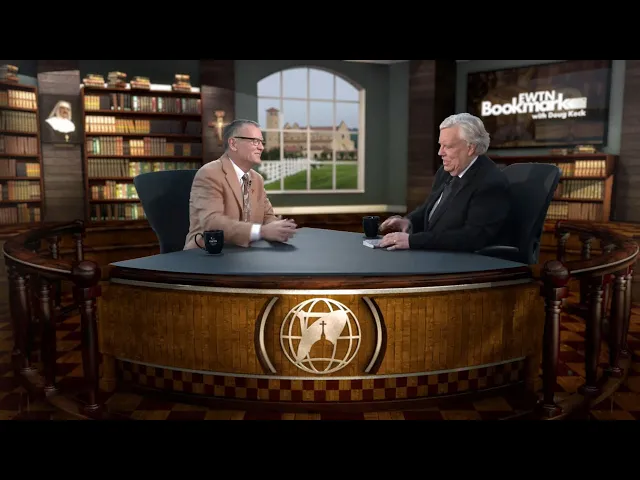
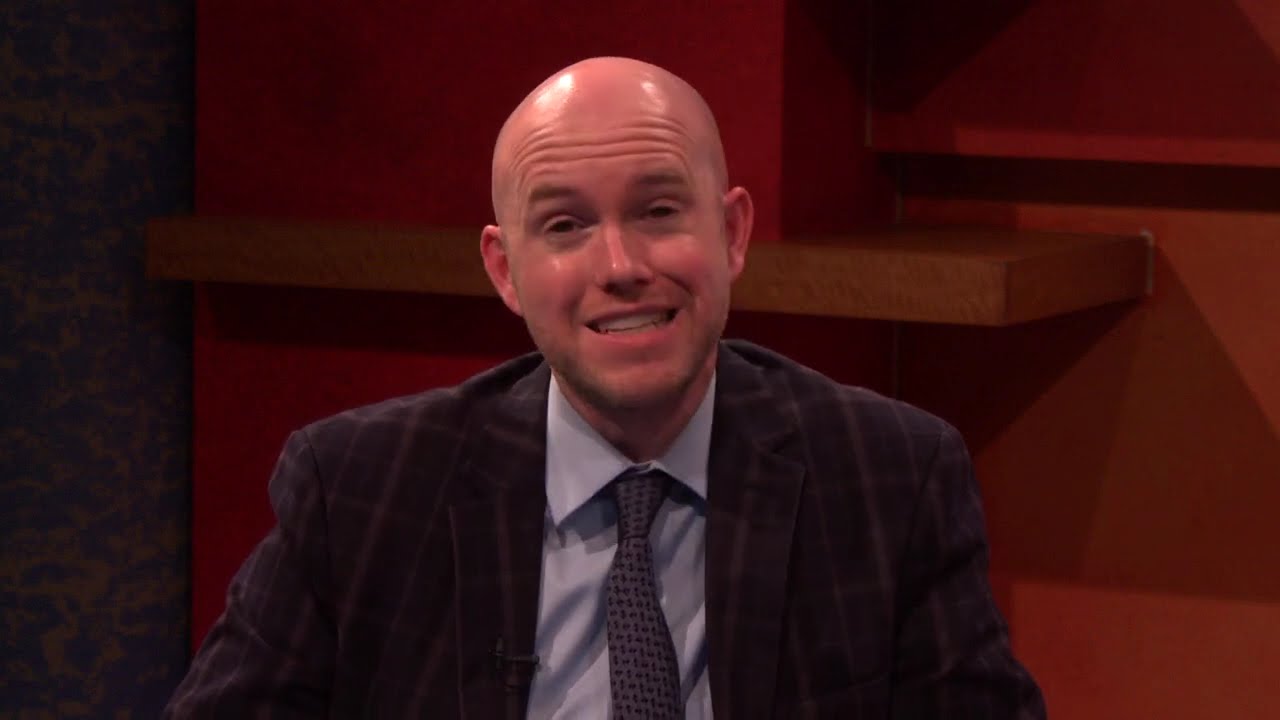
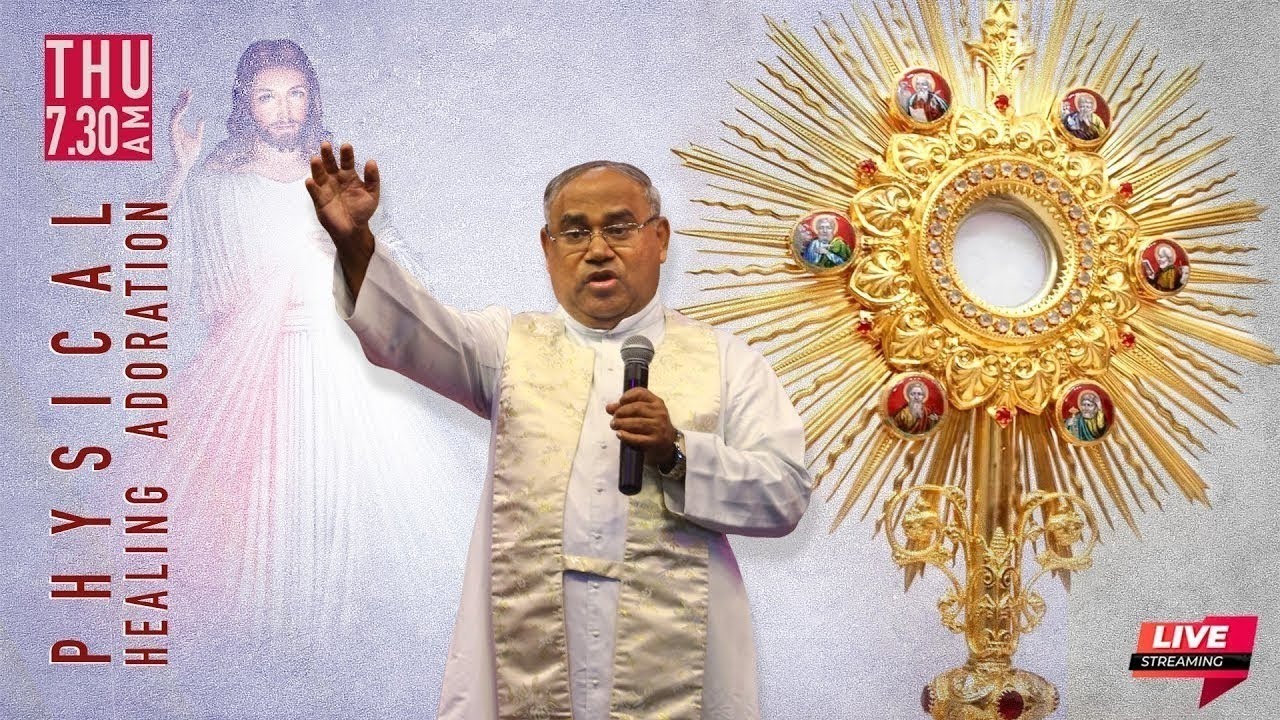
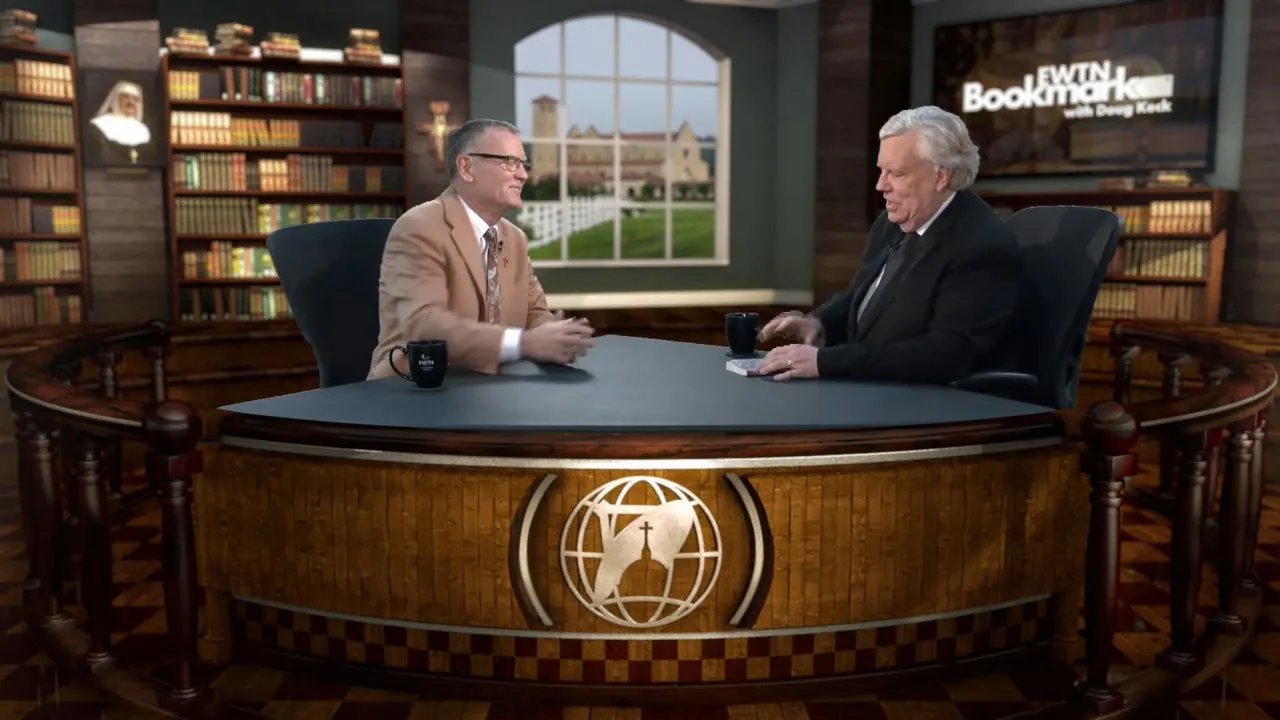
[♪] And welcome once again to EWTN's 'Bookmark'. I'm Doug Keck, your host. Our guest author, Deacon Dennis Lambert, his book, 'For Real?
Christ's Presence in the Eucharist, ' published by Liguori Publications, naturally available through our EWTN Religious Catalogue, EWTNRC. com, all things Catholic. Welcome to EWTN's 'Bookmark'.
Deacon Dennis Lambert: Thank you, Doug. Thanks for having me. Doug: I got to see you back during the family celebration last summer.
And then people remember, back before Christmas you were on with Father Mitch talking about this book, and I appreciate you stopping by. We love books that have to do with the Real Presence of the Eucharist because Mother Angelica and her focus on Eucharistic devotion. We know why it was important to her and the Church.
Why is it important to you? Deacon Lambert: Why is it important to me? Well, the answer should be, why is it important for any Catholic?
Or why should it be? The Catechism spells it out. It is the source and summit of our faith.
This is essentially who we are as Catholics, what we are as far as that goes. Without it, I cannot see the meaning of being Catholic. It is Christ Himself, the ultimate gift of grace to us.
Doug: Right. Now, you're a Thomistic scholar, aren't you? Isn't that what you did before?
No, that's not. So, how did you who worked in pharmaceuticals, I believe; how did you decide as a deacon at this point to take on this project? Deacon Lambert: Well, I can give two reasons for that.
First of all, because there is such a giant need for it, and second of all, the second reason is actually it's personal. The first reason, as far as the need, I think most of us are aware that there are so many Catholics who do not believe in the Real Presence of Christ in the Eucharist. Pew did a very significant survey in 2019, and two findings from that, that strike me, and the first everyone knows about, and it doesn't strike me as much as the second one; the first is that 2/3 of anyone who call themselves Catholics do not believe in the Real Presence of the Eucharist.
But that, when you say anyone who calls themselves Catholic, that could be someone baptized Catholic, never entered a church. So, I'm not so hammered by that statistic. The one that does get me, Doug, is the one that shows that, of people who attend Mass regularly, 1/3 of those people do not believe in the Real Presence of Christ in the Eucharist.
Doug: What do they think it is? Deacon Lambert: Well, largely a symbol, or it's a metaphor, it is the breaking of the bread, it is a community meal, as far as that goes. I'm not surprised by this because that was once me.
I understand that. Doug: Right. You say, "Once identified as a non-believer in the Real Presence, however that changed when I began my own objective research into the topic.
" In fact, you tell a story about your kids and a banner that your wife put together and that you titled a certain way. Deacon Lambert: Yeah. Doug: And why that had meaning to you.
Deacon Lambert: I'll have to give a little back story before we get to that banner, but that is the second part of where I was going in terms of the reason for this book is also personal. Again, as I said, I was once a nonbeliever. I'm a cradle Catholic, don't get me wrong.
My story is basically, I was, thankfully, born into a family of good parents, good Catholic parents. Went to church every Sunday, they were very involved in the church. We had a Catholic grade school attached to our parish as well.
Whenever my parents had a get-together, a party, if you will, there were priests and nuns there. So I was very tied in to it. And I went to that Catholic grade school.
When my kids grew up, they ended up going to that Catholic grade school, just a very good upbringing. And then went to Catholic high school, Carmel High School in Mundelein, Illinois. Two significant things happened for me there.
First was I met my wife. It's actually a Catholic high school where the girls were on one side and boys were on the other. The only time we ever saw each other was for lunch, and well, someone set us up on a blind date.
The second thing was, I had a great priest for teaching me religion in junior and senior year, Father Tom, a Carmelite. And he just really had this way of teaching Scripture and faith; he brought an intellectual component to it, but also an inward component. So, I was there a junior in high school; maybe I was the only guy then who's like, "Wow, I'm really liking this.
" So, significant things happened with regards to my pathway of faith. Doug: You had the typical thing where you go to college and find yourself questioning your faith. Deacon Lambert: Exactly.
So, college comes around, and I don't know how it happens, but suddenly I have all these questions about my faith. I developed a little treatise, here's Dennis' little treatise about the Church, and Doug, I made a crucial mistake. What I did at that point, instead of taking my questions to the Church to somebody knowledgeable, I went to the right.
I was invited to play on this softball team with some friends at a nondenominational Christian church, and back then there was a lot; these were great people, nice people, best intentions, but there was really an anti-Catholic sentiment back then, and they were just overjoyed to have. . .
Doug: Do you think there's less of that these days. . .
Deacon Lambert: Oh yeah. Doug: . .
. with many Evangelicals because of the meeting over the pro-life issue in a lot of ways? Deacon Lambert: I don't know what the reason is, but I'm just talking about like the early '80s.
So, I went and found the home there; I was there for two years, and they answered all my questions just like this. They were on it. "Here, it's right here in the Bible.
" Doug: Well, proof texting is. . .
Deacon Lambert: Exactly. So, initially this was, "Wow," this was it. After a while I'm like, some of these things are not settling so well.
And thankfully I was like what you'd call from the parable of the sower, I was the seed that fell on rocky soil. I sprung up real quickly, this is great, but after a while. .
. So I finally did what I should have done from the beginning. I went back to the Church.
I made an appointment at my parish to meet the new associate pastor to sit down. . .
Doug: And surprise, surprise. Deacon Lambert: Surprise, surprise. I go in there and this is the literal truth.
I go in there and it's Father Tom. Now, I have no idea how he got from being a Carmelite assigned to a high school to being a. .
. but bottom line, the well of our faith is deep. I returned to the Church.
In fact, I remembered the day I actually physically went back into the church. I'm walking down the middle aisle, my parents are front and center. I slip into the pew behind my dad and I tap him on the shoulder and, "Dad, I'm back.
" He turns to me and says, "I was just praying for you to return. " I was back, Doug, but not really. Those two years in the nondenominational world really dinged me.
Doug: Especially with the Blessed Mother, right? Deacon Lambert: Blessed Mother and the Eucharist. I carried with me forward, again, just that the Eucharist is a symbol, which brings me up to the banner we were talking about.
My kids ended up going to that same Catholic high school, they're making their first Holy Communion, each of them, my son was first, and we were asked to create a banner. You put it at the end of the pew for your family, but the instructions were, "Design it, and then sit down and talk to your child about what it means. " So, my wife was the artist, she did it, but I directed her, "This is what to put on it.
" On the banner it says, "I remember. " And there's nothing wrong with it, but what I did, Doug, I sat down with my children and explained to them, "When you receive communion, you remember all the good things God did for you, that He died on the cross. " Nothing wrong with that, but as we know, I left out something very significant.
Doug: Well, what about your wife? What was her take on that when you did that? Deacon Lambert: Unfortunately, it goes to show the significant role the man plays in the family dynamic.
She followed me. So my regrets are, I withheld from my own children the truth that they're receiving the Body, Blood, Soul and Divinity of our Lord, and in the process too, taking my wife down that path as well. Doug: Now, you talk about, throughout the book, you have this concept or an analogy of a relay race.
And that's how you go about, in fact, kind of teaching about the Real Presence and supporting it scripturally, etc. How did you come up with the idea of a relay race? Deacon Lambert: I have no idea how I came up with the idea.
It just kind of made sense. I wanted to; I came to the point to, first of all, I came to the point obviously where I had a reconciliation obviously about this is our Lord, our God. It came to me thinking about this term I remember hearing about being a cafeteria Catholic.
Go through the line and want this. I thought to myself, that's me. I don't want that to be me.
So I set out on an intellectual course to really research the Real Presence of Christ in the Eucharist. So, I got to the point where I'm on my knees, my Lord, my God, a believer. So fast forward now to wanting to write this book.
I felt compelled, again, based on the need that's out there. As Catholics, we are called to evangelize. Pope Paul VI said, "The Church exists to evangelize.
" St John Paul the Great then says, "Our mission fields have focused. We need to be focused in our neighborhoods and in our pews. " And again, with 1/3 of those Catholics potentially in those pews not believing, we've got to do something.
I'm not that only one, but yeah. Doug: So, when you deal with that and you talk about evangelization and things like that, do you ever have somebody say, "Why do you need to evangelize? What's the reason?
" I mean, it might be a nice thing to do to have found something and it's nice in your life, but is it really that important? Deacon Lambert: It is very important, and not only important but it's on us. We're baptized Catholics, we're baptized Christians.
Part of that is sharing in the mission of the Church, so how can we not? When we're talking about the source and summit of our faith, how can we not share that or want to teach that, knowing that, again, some of our brothers and sisters in our very pews, start there, and then we can go out as far as to others who don't believe, as far as that goes. How can we not?
Doug: Right. Now, you talk about the idea of being a Thomas or childlike in your approach. So, were you a Thomas in your approach to things?
Deacon Lambert: Yeah, so, this is just a Deacon Dennis thought here in terms of how people come and about with faith and what they believe. I believe God creates us one of two ways, either childlike or Thomas-like. Bu Thomas-like, I mean like the apostle Thomas, "Unless I put my fingers in your wounds, I've got it.
" I think the apostles. . .
Doug: You were a Chicago skeptic. Deacon Lambert: Exactly. "Show me.
" The Thomas person is the one who has to intellectualize everything. The childlike I aspire to be. Some people might think, "Well, you got to be so smart.
" And this is you downplaying. No. Who did Jesus say we need to become like?
A child. These are the people that, they don't need necessarily the books. They look at the Eucharist and "That's our Lord.
" How I want to be that person, but some of us God made this way. Actually we have to combine faith and reason, Thomas Merton says about the role of faith and reason, "Faith takes over where reason can say no more. " So, yes, I'm a Thomas.
I wish I was more just like didn't need. . .
Doug: Well, it's interesting you mention Thomas Merton, and yet you've got this Baltimore Catechism quote about "A sacrament is an outward sign instituted by Christ to give grace," which we all memorized when I was a kid. So, it's a little pre-Vatican II. Are you sure you're not being overly fundamentalist in your approach to the Eucharist?
Deacon Lambert: I don't believe so. Short answer. To me that's such a quick, easy definition of why not; I mean, again, we can get into instituted by Christ to give grace and add these other things to it, outward sign of an inward reality.
Doug: Right. You also have a really nice quote here from the USCCB, and basically it comes down to the idea of an analogy of a hug. Explain that.
Deacon Lambert: Well, again, that was kind of going more like Tomas-like versus the childlike. I'd have to actually see it to read it. Doug: Well, it says here, "We recognize that the sacraments have an invisible and visible reality, a reality open to all human senses, but grasp in God's given depth with the eyes of faith.
When parents hug their children, for example, the visible reality we see is the hug. The invisible reality is that the hug conveys love. We cannot see the love the hug expresses, though sometimes we can see its nurturing effect in the child.
" Deacon Lambert: Yes. Doug: That's a really nice image. Deacon Lambert: That's the sacraments, when we talk about an inward and outward reality, what really we're talking about; when I saw that I was like, that's it.
Doug: So, what do you say to somebody as you put out here, "Grace is free and undeserved," but yet it requires a response. So, if we don't do anything to get it, then how come we have to do something to get it? Deacon Lambert: Let me take a step back on that, Doug, if I can, as far as grace.
Grace to me, first of all, it's ultimately what we receive in the Eucharist. Some people might say, "Okay, we receive grace, but so what? What is grace?
What does this benefit? " And I actually remember when I was a newly ordained deacon, my pastor gave me an assignment to do a PowerPoint presentation on the sacraments. So I'm working on that and I no, sooner or later, I'm going to have to get to that question about grace.
What is grace? And I remember getting there and then being like a deer in the headlights. What exactly is grace?
How do you describe it? And I thought, well, I could probably tap dance my way around it, but I felt like I don't have a good answer. Being a newly ordained deacon, I thought I had to have an answer; if someone came up to me, I better have.
. . So, I actually started researching, what is a good definition?
A really true one that I came across in Catechism 1996 . . .
I'm going to paraphrase it, it says, "Grace is God's favor, the undeserved help that He gives us to hear and respond to His call to become His adopted sons, partakers of the divine nature and eternal life. " When I heard that I was like, aha, grace all of a sudden made so much sense and so relatable to the Eucharist. The first part, we don't deserve it, God wants to give it to us.
Hey, thank you, Jesus. It was that second part, though, that really resonated. It's us responding to His call.
God is always calling out to us. I kind of envision that like a radio signal since day one. "Dennis, come this way.
Trust me, it'll work out. Don't go that way. " Doug: Kind of the Hound of Heaven approach.
Deacon Lambert: Exactly, but the world's always seeking to block that signal. Doug: We live in a noisy world these days. Deacon Lambert: But when we receive God's grace, it gives us that ability, that second part of the definition, to hear His call, we hear that signal, and then the most important thing is to do something about it.
So, when we receive God's grace, we receive that ability, it strengthens our ability to follow Him, to hear and respond. It's essential. This is why the Eucharist is so, so critical, why it is the source and summit.
Doug: You had that experience with the evangelicals for a period of time, and you make the point, "Ironically, a pivotal cornerstone of the Protestant faith is the literal interpretation of Scripture, a discussion for another place and another time. The key takeaway is that the Catholic position takes quite literally the words Christ spoke, 'This is My Body, '" but they're taking it literal and they're not getting that same meaning out of it. Deacon Lambert: No.
It's remarkable when you think about it because they are so literal in their translations, but here they seem to ignore. When He says "Is," the Greek . .
. is means is, there's just no doubt about it. And then you just open up so much in terms of John 6 and everything else.
There's just so much in Scripture that points that the Eucharist is truly the Body and Blood of our Lord. Doug: You use the relay race imagery to accomplish multiple goals in this book, a couple of goals, "What we'll discover is the baton, " and we'll talk about the relay race, has never dropped. The message of the Real Presence of the Eucharist begins with Jesus Himself, is passed on unbroken, unchanged through recorded history from Christ to today.
" So that point of saying that there's this continuity in the Church. There wasn't this falling away or something after the early Church Fathers or actually closing a canon or something like that. Deacon Lambert: I think earlier on you mentioned about the relay race and we never got to it, but now that we're here again, to me, I use the image of a relay race to really convey the point that this is truly Christ, and how to follow the path of just kind of learning about this.
A relay race has four legs, right? And I'm using that, and then it's one continuous race, not four separate races, and the key is the baton should never drop. So, in this analogy I use in the book, and this is how I walk people through the story of the Eucharist is, it starts with Jesus.
He's leg one. They say, save your best runner for last; in this case we start with Jesus. What did Jesus actually say and teach?
He hands the baton off to the apostles. What did they teach? Is it congruent to what He taught?
The answer is yes, spoiler alert. They hand the baton on to the early Church Fathers, and I love the early Church Fathers because we have so much in writing. Scripture is so illuminative, but there is just so much more writing in the early Church Fathers, and every single one of them writes about the Real Presence of Christ in the Eucharist.
Leg four is the Church today. When you look at it all in totality, the story started with Christ and has never changed. And I did have the experience in the evangelical world that the belief was, this is what they told me, is that, "No, the Eucharist, that was some made up theology.
It was like the Church looking for some way to explain the Eucharist. " No. It was what Jesus taught from day one.
Doug: "The priests wanted something to do to make them important. " Deacon Lambert: I guess. Yeah.
Doug: That's really what it is. It's interesting too, because when you talk about in the book; you go through the first one, two, three, and you said the toughest part was really the fourth part, because it's so clear in the early Church up to the Fathers, but then from the Fathers on, it's a little more difficult to show how the Church's teaching continued. Deacon Lambert: Well, actually, I don't know so much that it was difficult.
Actually, I kind of short cut that because we actually as Catholics today know exactly what the Church teaches. So I simply in that part; it's actually the shorter part; bigger part, what did Jesus, and the other parts; here I'm like, we know what we teach. Well, we should know, not everyone does.
But I simply almost conclude that fourth section with just a couple quotes from the Catechism, which again, when you read it, echoes right back to what the apostles taught, what the early Church Fathers taught. Doug: So, in section one, you kind of talk of the prefigurement, you talk about Melchizedek, a name that showed up when we were kids out of the blue, we didn't know where he showed up from, but that idea of, that prefigurement, that laying out the future of Christ's teaching. But you also refer to it, then, as you get into the second section, that whole idea of overzealous sports promoter and the actual event he or she is hyping to attract tickets.
Where did you come up with that? Deacon Lambert: Well, again, I was trying to segue somehow to emphasize how everything leading up to this point from the Old Testament, there's this great buildup, and now it's payoff time. so they're hyping it, everyone's on it, saying this is the greatest thing, but now we have to show that it is, and that leads right into leg one of the relay, what Jesus taught in John 6.
Doug: You say, "The key to understanding that Jesus was speaking literally versus metaphorically lies when and in what context these two words He uses are used, " and you have the two words here; well, a couple of different words, but one's "phago, " is that what it is, P-H-A-G-O? Deacon Lambert: . .
. Doug: Okay. And why is that important to understand how they're used differently?
Deacon Lambert: Well, this was actually one of the things that helped turn me into a believer, and I had the Thomas-like person as far as that goes, but as you go through John 6, obviously Jesus is talking about that He is the Bread of Life and you need to eat His flesh and drink His blood or you won't have life, all this kind of stuff. So, a lot of times, again, our Protestant brothers and sisters will talk about, "That's all symbolic. " Wait a minute, we have a problem here, not a problem, we have a solution.
First of all, phago is the typical Greek word for "eat. " Every day, eat. Trogon is actually a word, it's derived from this bird who burrows into trees to nest and stuff like that.
The way that's translated is to gnaw or to chew. So, Jesus 14 times during John 6, the word "eat" is used. Jesus switches, though, from saying phago in general terms to eat, to any time He starts talking about eating His flesh, He uses the word "trogon.
" Now, He didn't literally; it was translated into the Greek. So, whatever word He used in Aramaic shifted the focus from just eat to chew, to gnaw. And these are always occurring when He's talking about eating His flesh.
So, place yourself in the crowd that day listening to this, "eat, eat. " And then He says, "Unless you chew on My Body, " etc. So that's kind of one of the proofs that Jesus meant what He said.
Doug: meant what He said, and obviously we know the famous scene with, "Will you too leave Me? " If it was just a symbol, why would anybody leave Him? In leg two, you talk about, "Without question, the most critical component of the meaning of the Eucharist lies within what Jesus taught, Himself.
" And you say, "As noted, there are more than 100 references made to the Eucharist in the New Testament from the followers of Jesus. While many are theological tied and not direct statements like, 'This is My Body,' the number of Eucharistic connections coming from Jesus's followers after His death and Resurrection are remarkable. " Deacon Lambert: Yes.
Now, largely, when they say there's a hundred-plus references to the Eucharist, not all of them are actual, like we could say trogon, phago; some of them are kind of more largely interpretative as far as that, more theological. But there are direct things happening that are in writing from the apostles, that clearly show Jesus meant what He said, and one of them I'm very fond of is Paul's writing, I mean the king of all apostles writes in 1 Corinthians, which was written just 20 years after Jesus' Resurrection. So this is baby time, infancy in the early Church, and he gives the Last Supper, "This is My Body, this is My Blood," right after that, he follows it up with the need for you to receive the Body and Blood worthily, you need to discern the Body and Blood, and that you need to examine yourself before it.
Why would anyone need to do this if it was just a common meal of a community or something like that? This is just 20; that's why I'm saying that baton goes, it doesn't drop. 20 years later, he is teaching the same thing that Jesus taught.
Doug: Right, and you deal also in this, you talk about the Didache, the writings of the 12, and then later, you kind of focus on the fathers of the Church and as we talked about a little bit, that whole idea of reinforcing, and clearly this is what they believed at that point in time. it wasn't something that somebody had to develop or that they were unware of. Deacon Lambert: Exactly.
It started with Jesus and there's just no dropping of the ball or anything. The early Church believed exactly that, and that's why it's kind of a mystery, Doug, how we have to wait till the 1500s for somebody to cry foul. "We had it all wrong up to that point.
" Doug: That's why you say here at the end of this section, leg four, is, "Much harder is traversing down the long hallway of history to look for connections to the present, " which was kind of what I was alluding to earlier. "My hope is that your belief in the Eucharist has been sparked and/or deepened. " Is that how yours was?
Deacon Lambert: Yes, absolutely, I mean in terms of learning all this stuff, and again, I still wish I was more that childlike where I didn't need all this kind of intellectual stuff. But that's the way God built me. Doug: So, how did we end up having so many lane violations, to use your metaphor about the relay race, in dealing with the Real Presence of the Eucharist as we're sitting here in 2023, a time period basically having to reintroduce people to something that the Church has believed and taught for 2,000 years?
Deacon Lambert: Well, that's the ultimate question. We can speculate. My belief is, and I think it's recognized and talked about often on shows like this, that there was a period of time of poor Catechism in the Church.
I went through it. Doug: Me too. Deacon Lambert: I call it the Wild, Wild West of Catholicism.
When I actually think back and where the liturgy was, and where I was, and everything else, and then it really took me going through formation for the diaconate to actually see, "Oh my gosh. What was going on there? " But again, there was a time period where you didn't talk about even these most basic things.
The Body, Blood, Soul and Divinity of Christ was something I didn't hear until I was a man. I never heard that in the Catholic grade school I was in. Doug: Right, transubstantiation was out.
. . .
or some other version was out. Deacon Lambert: Right, and folks were sold on community and all those aspects, that we almost fell into a Protestant way of thinking about these things. The real essence and presence of our Lord just was never really emphasized.
Doug: Not that those are bad things. . .
Deacon Lambert: No, not at all. Doug: . .
. but all heresies are the over-emphasizing of one truth to the diminution of another truth. Deacon Lambert: Exactly.
Doug: That's where you run into problems. Exactly. So, when you decided to put pen to paper here, so to speak, how long did it take you and when do you write and how do you write?
Deacon Lambert: Well, this was last summer, I think it took me about three or four months to put this book out, as far as that goes. I had no idea at the time that the Eucharist Revival was around the corner. I think that's the Holy Spirit.
Maybe that's why I'm here today as far as that goes. So, it was a blessing to be able to write. It's something I needed to do, again, just going back to the need, my personal need, how I learned this, and again, just knowing that there are so many Catholics out there in need of this truth.
And that's how the book ends. It gives a very simple and easy way for people like us, or anybody in the pew, to consolidate this information and using that relay race really helps to kind of put it all in your mind in how to pass that on. Doug: Right, and it's a small book, it's highly readable and something the average Catholic can tackle without being afraid of that.
So, thank you very much, Deacon. We appreciate Deacon Dennis Lambert and his book, 'For Real? Christ's Presence in the Eucharist,' you bet.
And it's available through the EWTN Religious Catalogue, EWTNRC. com, all things Catholic. Thank you so much for stopping by 'Bookmark'.
We shall see you next time. Bye.