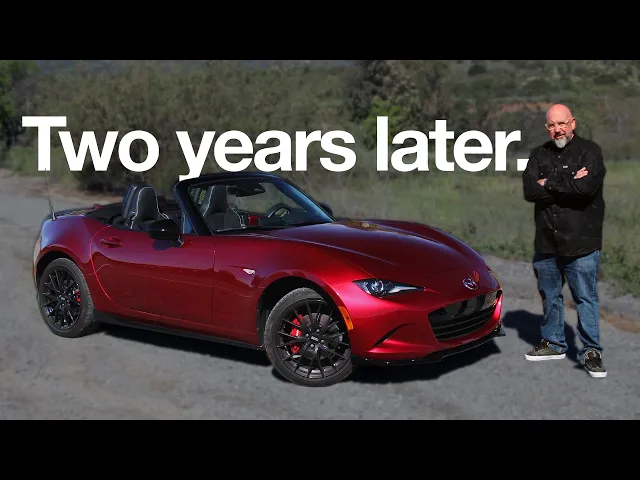
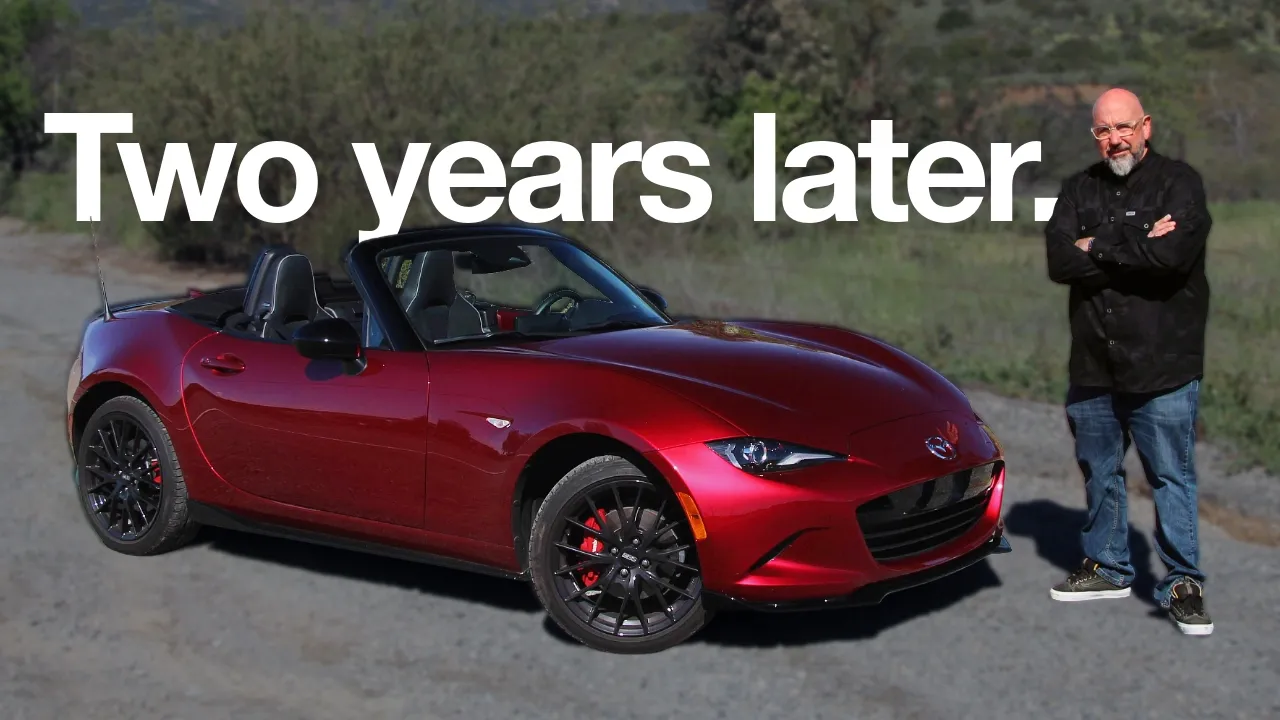
People keep saying Mazda ruined the Miata's steering, but that word gets thrown around by people who test cars in parking lots. So I brought this car here where steering feel isn't a preference, it's a necessary placement tool. I'm your host Brian Makse and on this channel you get reviews for drivers from drivers.
And on roads like this, the steering has questions that the drivetrain has to answer. The internet files a complaint either way, We're here for the transcript. 181 horsepower may sound like a typo, but on a road like this, power isn't the limiting factor.
It's judgment, and this car doesn't dilute your inputs to protect your ego. But here's the thing, every single one of those horses shows up where you ask for it, when you ask for it. There's no turbo lag.
No torque management, no electronic middleman getting in between your throttle inputs and the power getting to those rear tires. And on a road like this, that's worth more than an extra 200 horsepower you couldn't use. Mazda's 2-liter doesn't make any exciting noises, doesn't burble, doesn't crackle, doesn't do anything that would sound good in a marketing video.
What it does do is rev, and above 5,000 RPM it acts like an engine that remembers remembers what carburetors used to be. And we know Mazda's engineers carefully calibrated the sound of this engine, but I think they understand that character isn't defined by volume, it's defined by willingness. It's not loud, it's not dramatic, it's just committed.
Like your coworker who doesn't talk too much but gets everything done. Now the engine does make you work for speed, And that might sound like a complaint until you remember that working for something is the entire point of a sports car with a manual transmission. Throttle response is so linear that it actually exposes bad technique, and if your corner exits feel jerky, it's you, not this car.
Peak torque happens at 4,000 RPM, which sounds unimpressive, especially in an era with everything being turbocharged and maximum torque available from 1,500 RPM. But here's the thing, on a road like this, 4,000 RPM is where you actually live. Mazda did the math.
The effectiveness of the ND3's asymmetric limited-slip diff is the headline that nobody can feel in a parking lot. And if you're reviewing diffs in a parking lot, you're basically reviewing a chef by smelling the menu. Stronger lock on decel, lighter under lock on acceleration.
Mazda's essentially tuned this diff to match trail braking technique, and it works. Lift off the throttle mid-corner and it just tightens your line. When you get back on the power, it plants the rear firmly and you track out of the corner perfectly without pushing wide.
And for me, this diff rewards proper technique instead of rewarding sloppy ones. And the clutch It's basically perfect. It's light enough to deal with traffic situations and firm enough to give you enough feedback.
Mazda threaded the needle perfectly here. Subscribers get notified when new episodes drop on this channel, non-subscribers hope the algorithm will show it to them eventually. And if you want to see when new episodes drop on this channel, well, that's what the subscribe button does.
Now this, my friends, is the audit that matters. Dave Coleman and his team said they fixed the ND1 and ND2 steering friction problem. It's that internal resistance in the system that prevented the steering from coming back to center naturally.
After countless miles on these ridge roads, well, the verdict is clear. This steering rack is alive. It returns to center naturally and communicates slip angles before they become problems and you have to correct them.
And yes, this steering self-centers with some enthusiasm, so much so that you have to remember to hold the line through a corner. The friction is gone, but the information stayed. So it's not ruined, it's clarified.
The rack stopped fighting itself and started telling the truth sooner. When it comes to brakes, let's be clear about one thing. These Brembos on this Club, well, they're not about stopping power.
Any competent brake setup can decelerate the 2,300 or so pounds of this MX-5. Even the standard MX-5 brake setup does a great job. This, my friends, is about granularity.
These Brembos, this pedal gives me millimeter-level precision when it comes to modulation, and that's really important when we are riding a crest of a mountain range at elevation. Bite is strong, it's not grabby, progression is linear, and even after some hard runs, there's zero fade from these front brakes. And the brakes match the chassis philosophy— precise tools, not safety nets.
The Bilstein damper that are part of this package just refine this chassis even further. Turn-in is immediate and the chassis is never nervous. The body rolls enough to load the outside tires progressively, but not so much that you lose track of where the chassis is.
Mid-corner bumps just get absorbed instead of redirecting the car. And this balance took Mazda 3 generations to perfect. It's confidence that doesn't cost you any control.
And let's be honest, with this short wheelbase, the reality is you're not buying an MX-5 to be a boulevard cruiser. But here's what the Bilsteins get right. Those high-frequency impacts like expansion joints just get filtered.
This Mazda moves over them, absorbs them all without transmitting them to your spine. Only the big stuff, the genuine road information, makes it through. And sure, the ride's firm, but it's never punishing, and that's because Mazda understands that compliance and communication aren't opposites.
And this car is about balance. You can induce understeer or oversteer at your discretion. It's progressive, not binary, and you can explore this car's limits in 1-degree increments instead of wondering whether you got your line right.
If you want to support the channel beyond just watching, well, the merch store is open, and your support there means more time for us to produce fantastic episodes like this and less time worrying about manufacturer blacklists. And of course, don't forget, you can get your Save the Manuals merch Sure, this cockpit is tight, but it's tight in the right way cockpits should be tight. Everything is where it should be.
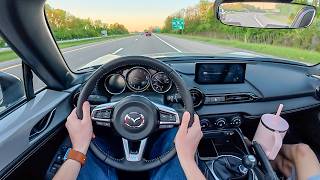
There's no haptics, no swipes. You know, it's almost like Mazda actually wanted you to drive the MX-5. Steering wheel adjusts for height and reach, and these Recaros, well, they're fantastic.
They definitely hold you in place. Bolstering's fantastic, and they're placed nice and low in the chassis. I just have a wonderful interface to this MX-5.
Pedal placement is absolutely perfect, and it's 100% perfect for heel and toe. Not only are the pedals placed properly, but throttle response makes heel and toe a breeze. Visibility is excellent, and I have a rule rule when it comes to driving convertibles, which is if it's not pouring rain, the roof is down.
And right now we have 360 degrees of visibility. You can tell Mazda's designers actually drive this car. It is a driver's car after all.
And who doesn't want rotary dials for their climate controls? It's absolutely perfect here, so easy to adjust. And sure, in this era of modern automobiles, it seems strange to celebrate that there are no capacitive touch surfaces, no gesture controls, only honest, straightforward interfaces.
When it comes to cargo, you know the deal. There's a glove box here, there's a couple of cup holders you can stick in various places inside this cabin, and right now the trunk has absorbed my camera bag and my backpack and a few other things. And that's really all you need to take with you when you're driving an MX-5.
The like button YouTube to share this episode with more people like you who are interested in an episode like this. And if this video gave you more information than a brochure or a press release, well, that's the entire ask. That's my take after a few days on these beautiful roads, but here's what owners are saying after months or years behind the wheel.
Standard disclaimer: forums are like dinos— useful, emotional, and filled with people who will type "objectively" and then immediately describe a feeling. Still, there's real signal in the noise. First, among owners, there seems to be a lot of evidence that these aren't perfectly aligned when they leave the factory.
They say the eccentric bolts are out of place, leaving random camber and skewed rear toe settings. The community standard fix is a precision alignment targeting maximum caster and proper camber specs. Owners consistently report that it transforms steering feel, tire wear, and corner confidence.
If you're going to buy one of these, consider getting your alignment checked before you form any opinions about the chassis. Second, owners treat the stock suspension as a starting point, not as a finished product. The phrase that keeps appearing is that the setup is for 7/10 driving.
But remember, body roll is deliberate. Mazda tuned it softly for accessibility. Most enthusiast owners plan suspension modifications before they take delivery.
As a racer, I disagree. You may want to consider mastering driving first, because it's much easier and much more effective to fix the nut behind the wheel. Third, the asymmetric limited-slip diff divides the owner community.
Owners who came from ND2s describe the rear as more planted on corner entry. The diff actively fights rotation when you lift. For track drivers and newer owners, that's confidence.
For the touge crowd who loved the ND2's willingness to swing the tail on throttle lift, it's been called a sterilization of the car's personality. Again, as a racer, I disagree. A racer's job is to adapt and use the tools that they've been given to their maximum effectiveness.
Fourth, owners seem to think that this paint is much like tissue paper. They say PPF isn't optional if you drive behind any vehicle with tires. This Soul Crystal Red paint is gorgeous, but it collects rock chips like it's trying to build a scrapbook.
Bottom line from owners: despite these minor complaints, the hardware is sorted. The question is whether you're willing to use it. If you own one of these or have some quality seat time behind the wheel of one of these, let me know in the comments what I got right and what I got wrong, because owner experiences are much more insightful than anything I can learn in a week-long press loan.
And I always read those comments. Turns out the ruined steering take doesn't survive real roads. This ND3's rack communicates better and returns to center with intent.
If you miss what the ND2 did, you're not wrong, but the ND3 is objectively easier easier to place at speed. That's the job. They fixed the friction problem that Dave Coleman's team identified without adding artificial weight to simulate what they removed.
The steering is faster, lighter, and more honest than the ND2. The asymmetric diff isn't intervention, it's careful calibration. It's been nearly 2 years since this ND3 was launched, and this drive confirms that it's not over-engineered, it's correctly engineered.
If you measure a car by 0-60 times, you're shopping for a story to tell other people. If you measure a car by its placement at speed, you're shopping for truth. This ND3 is truth with receipts.
And sure, this MX-5 Club isn't fast, it's precise. And when it comes to driving, precise is what separates entertainment from engagement. This is a car for people who understand and driving skill is something you develop, not something you buy with option packages.
That's the Mazda MX-5 Miata ND3 Club. Subscribe if you enjoyed this, don't if you don't. Comments are open if you disagree, and the merch store is here if you want to support more of these.
See you on the next one.