In the States, we had two reactions. One was, "Oh, that would never happen here. " And on the other hand, how long have we got?
>> So, the commander >> Yes. >> He seems to be one of the founders of the New Republic. >> Yes.
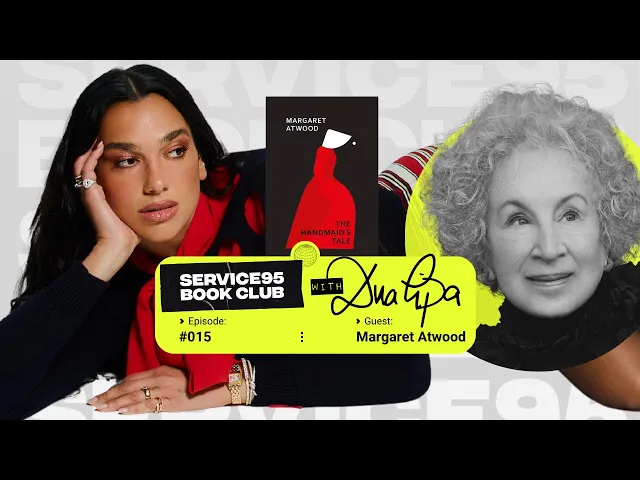
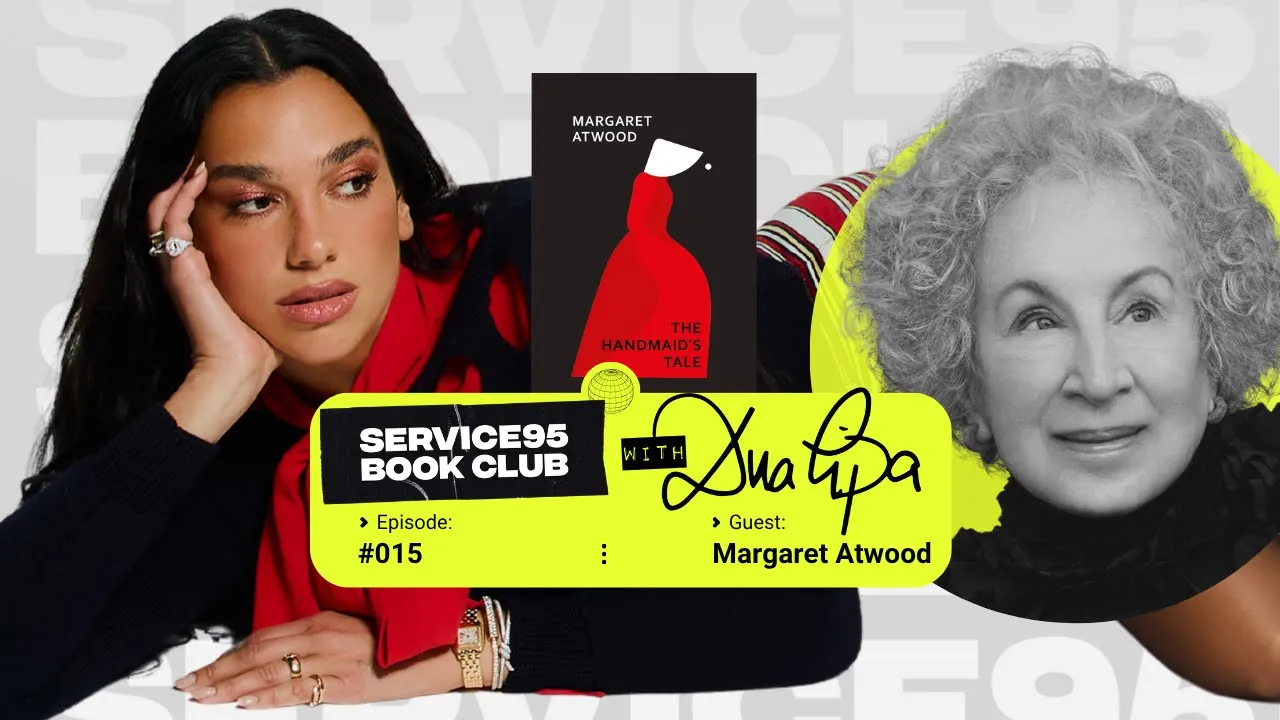
[music] >> And Offred, she describes him as like a museum guard or a Midwestern [music] bank president. >> I've been saying since the 1970s, >> before you were born. [laughter] Welcome to the Service 95 book club with me, Dual Lia.
Honestly, reading has been an anchor through every phase of my life. [music] And this book club is a way of sharing that joy. Every month, I'll spotlight a book I've loved and sit down with the author for an open and honest conversation about the themes, the characters, and the world they've created.
And because I've had the pleasure of speaking with so many brilliant writers already, I'll be opening the archive and [music] bringing back one gem each month. So, pour a glass, grab your book, and let's get into it. Today, in a real pinch me moment, I'm joined by none other than Margaret Atwood.
We're talking about her game-changing novel, The Handmaid's Tale. First published 40 years ago, almost to the day. [music] I think it's fair to say that this novel gains more significance with each passing year.
The story of Offred in the Republic of Gilead is a [music] thriller, a classic work of feminist fiction, and perhaps most importantly, a warning against authoritarian rule for every new generation of readers. My chat with [music] Margaret coming up. >> Hey, Margaret.
>> Hello. How are you? >> I'm very well, thank you.
I um I I I can't even begin to to tell you what an honor it is to to speak to you today. I've been so nervous and and excited. >> Well, that's lovely.
>> I uh I feel like I've had to keep keep pinching myself um today that it's actually it's actually happening. We're here to talk about The Handmaid's Tale, which is one of the most iconic books of the 20th century. And this was really such a such a formative book for me.
I first read it in secondary school. It was part of the curriculum and it was actually the first book I read when I had just moved back from Kosovo. >> Mhm.
>> And at the time I felt that it was so dystopian. It was described to me as dystopian. I imagined it as dystopian.
And I couldn't imagine at 15 years old that there was any danger of that becoming a a reality. whereas now rereading it at at 30 years old in today's climate, it's um it's quite it's quite terrifying. Um I guess this most recent time that I that I reread The Handmaid's Tale, I read it alongside your incredible memoir, The Book of Lives, which is which is out this month.
And I really really recommend doing this because it was so fascinating to know um where you were when you were writing it. you know, what was happening in the world, how your writing career evolved, and also about your pretty incredible childhood. Um, there was just so many so many surprises for me, and I hope we can touch on some of them today.
>> Absolutely. >> Should we get started? >> Plunge in.
>> You published um The Handmaid's Tale in 1985, and you said that some books haunt the reader and others haunt the writer, and The Handmaid's Tale has done both. Um, tell me more about that. >> Well, when I wrote it, it was 1985.
The Cold War was still on. The Berlin Wall was still up, and I was working on the Handmaid's Tale in West Berlin. And during that stay I also visited um East Germany, Czechoslovakia that which was then and and Poland which were all part of the East block at that time.
So that was very interesting for me to note how worried people were about talking to a person such as myself. So in Germany they wouldn't do it at all in East Germany. Uh they would talk to children but not to grown-ups.
Children were safe, you could say. So Czechoslovakia was a little bit more open, but you had to go into a park because people were quite rightly afraid that their rooms were bugged, their cars were bugged. And in today's world with even more refined surveillance tools, you would have to be even more careful than that >> with everything.
Of course, >> Poland was pretty loose even at that time. And I thought to myself, if things start to crumble, they're going to crumble in Poland first, which they did. So at that time, we're talking the mid80s.
Ronald Reagan had been elected in 1980 and a push back against 70s feminism had begun and the New Deal put in there by uh Roosevelt in the 30s had become had started to come unraveled. But people in Europe didn't want to think that the United States could ever go in the direction of its 17th century theocratic um roots >> because why? Because the Cold War was still on.
United States was the leader of the free world. It was the beacon of hope. It stood for all of those democratic virtues that we heard so much about at that time.
and they couldn't imagine that such a place would ever go um in the direction of a totalitarian authoritarian state. U the people who could imagine it were in North America. The Canadians asked nervously when the book came out, could it happen here?
>> And I said, less likely. You know, we're a two language country. It's harder to get us to all line up in one direction.
And anyway, I needed a place in my novel for for people to escape to. But in the States, we had two reactions. One was, "Oh, that would never happen here.
" >> You know, world's leading democracy. No, no, no, no, no, no. >> And on the other hand, how long have we got?
>> Right. >> So, some people saw that happening. other people deny that it could ever happen.
>> Yeah, it's really interesting that and I I want to touch a little bit more on that because um I found the the three origin stories in Book of Lives about the Handmaid's Tale very fascinating. But just to just to kind of take you back, I'm not sure how many people there are remaining on Earth that haven't read The Handmaid's Tale or at least seen the TV series, but for those that haven't seen it, let's just set the scene a little bit. And there's been a revolt in the US.
>> There's been a power grab takeover. >> Totally. There's like the borders are a bit unclear.
Democracy has been replaced with the totalitarian religious dictatorship which is known as Gilead. In Book of Lives, you pose three origin stories for The Handmaid's Tale. And I absolutely love this chapter.
So, I thought let's just let's go through them one by one. And I guess you touched on this one a little bit. The first one starts with the political situation in the US in the early 1980s.
What was specifically happening with women's rights at that time? >> Specifically, that was the beginning of the rise of the so-called religious right as a political force. It started to manifest itself then.
Um and what they were saying specifically about women was that they belonged in the home and uh their proper role was just that and only that and they should confine themselves to the three the three Ks. You've heard these before children cooking in church. Uh in English it's three C's.
In German it's three Ks. So yeah like that. So that was their idea.
And and my question to myself was, if you're going to make all these women go back into the home now that they're out running around having jobs and credit cards and things like that, how are you going to do that? And the if you wanted to do it on a mass scale, not just in the rather sheltered tradife area of life, if you're going to do it on a mass scale with with women who actually have needed to work, uh you'll have to just deprive them of any other alternative. So I rather sinisterly canceled all their credit cards.
It's amazing to kind of see how things um you know something that happened in the 80s then even me you know when I was 15 I couldn't imagine something like that happening and now you're kind of like okay we're so indebted to everything being digital and everything being on a card and >> what would happen if it just got turned off >> what would happen if it Yeah. What would happen if it >> you wouldn't have any money and if you then didn't have a job and you didn't have a credit card >> Yeah. What happens then?
What happens then? Well, back into the home you go, like it or not. >> Gosh.
Um, and then origin story 2, you know, there is uh the the genre question. >> Yes. So, because I was born in 1939 and was a teen in the 1950s, I read a lot of science fiction.
It was one of the golden ages. So let's say it starts with HG Wells in the late 19th century and then blossoms in the 1930s in pulp magazines. That's where Ray Bradbury got his start and ex and unfolds even further in the 1950s.
And meanwhile, we've had 1984 by George Orwell, which of course I read at an impressionable age really just after it came out. Very shocking to me. >> Yeah.
>> So, it made a big impression on me and I'd always wanted to write something in that genre, but did not feel I had the the chops to do it. So, now I was going to do it. And there's a character in in 1984 called Julia.
She's the love interest. And there comes a pivotal moment in the plot when when Winston Smith is being tortured by the regime. And they're going to have rats eaten out his eyes.
And that's when he breaks and he says, "Do it to Julia, not me. " Which became an expression in our household, "Do it to Julia. " >> U.
So I thought what would it be like to write a story like that from the point of view of Julia? >> What would she have said about all of this? >> Yeah, that's it's really incredible.
I I actually read um George Orwell's 1984 maybe two years ago for the first time and that really did leave such a such a wild impression on me too. Um and and finally origin story three the the Puritans. >> Yes.
the 17th century >> of English Puritanism, which you're sitting right there in the country where all this began. So, we have a big conflict in the 17th century between the parliamentarians and the monarchists. >> And you know how that turned out.
So off comes the head of Charles I and in comes Oliver Cromwell and sets up a theocratic state. [laughter] Uh yes, which increasingly as time went on became to be ruled basically by him. Uh be but before that happened and before a couple of groups of Puritans knew that this was going to happen, they decided to decamp and go to the new world.
uh and set up God's God's kingdom on earth, a city upon a hill, a light to all nations," unquote. And if you think you've heard that before, it was in Ronald Reagan's inauguration speech. >> Speech, right?
[laughter] >> He knew what he was doing, but a lot of other people didn't know what he was doing. >> Right. Yes.
>> One thing that I was absolutely um gobsmacked when I read in Book of Lives an Half-Hanged Man. >> Yes. Well, >> please tell us about her and how she relates to the handmmaid.
>> All right. A little bit further on in the 17th century and back towards the end of it, we have the well-known um Salem witchcraft episode, >> which I have studied in some detail. And and that was when the Puritans [snorts] were worried because their thing wasn't working out.
And when that happens and people get angry and afraid, there has to be some somebody to blame. So the United States is doing that to immigrants and various other people. Uh and the 17th century did it to witches or supposed witches.
>> So if things were work weren't working out and they'd expelled all these people with different religious beliefs. So it couldn't be that. It had to be the enemy within.
The enemy within. So it must be the devil working his wicked way within the community itself. And since the rules of evidence were bonkers, these people did have trials.
The rules of evidence were uh spectral evidence, which is if you're asleep in your bed and with witnesses, they've seen you asleep in your bed, but somebody else sees you four miles away messing with their cow, it means you can u project your spectre to go out and do evil things while you're asleep. Spectral evidence. There's no way of disproving it.
You can't say no, I wasn't >> wasn't there. Yeah. Yeah.
>> Yeah. The other one which there is no way of disproving >> your word against someone else's. >> Exactly.
[laughter] uh uh the rule of touching which is if there was a an accused witch having her trial in the courtroom and um one of the accusers who were teenage girls came and touched that person and then had a hysterical fit. It proved that the person being touched was a witch. So once you were accused under those rules, there was pretty much no way you're getting off and u you would get hanged unless you accused other witches.
So you can see what kind of effect that would have. [laughter] Yeah. Her her her and him.
>> Yeah. Just to not just to not get >> Exactly. Right.
yourself. >> You got it. >> Um so that was the situation.
Now halfhanged Mary whose name was Mary Webster and Webster was the last name of my grandmother before she got married. She got taken to Bustin. She got off.
She went back to her hometown and the town's people strung her up. Anyway, this is before the drop was invented. So her neck was not broken.
So she was hanging from a rope all night. >> Gosh. They came to cut down the body and she was still alive in the morning.
And I guess they thought, well, if she if we didn't think she was a witch before that, we're convinced of it now, but we're just going to leave her alone, which they did. So, she was known as half-hanged Mary because she was hanged, but it didn't have the desired effect. Uh on Mondays grandmother would say that she was an ancestor and on Wednesdays she would backtrack because wasn't very respectable was it?
>> So let us say there's definitely a family connection but whether I have any witchy genes from Mary is open to question. >> Yeah. [laughter] Um well, you know, maybe later on we can talk about your your love of astrology.
Maybe that kind of kind of goes into >> goes into that a little bit. [music] >> I'd love I'd love to talk to to you about how you created the word of Gilead. You know, let's start with with the regime itself.
It effectively adopts um a class system. You could even call it a cast system. And within each class, women are firmly at the bottom of it.
And the aim is for this exclusively white heterosexual society. All transgressors have been exiled elsewhere or executed. There are commanders who are the ruling class along with their wives with a capital W.
Yes, >> there has been some kind of environmental catastrophe and one of the impacts is um that the fertility rate has dropped dramatically. >> Have you looked at those statistics lately? >> Yeah, I don't want to look at them really.
Um [laughter] uh the handmaids are fertile women separated from their families and assigned to a commander for the purpose of reproducing. The story is told by Offred the Handmaid of the title. What form did she initially take in your imagination and how did you land on her name?
>> Uh the form she took was pretty much the one you see. >> Um that's who she was and that's what happened and the rationale for this uh arrangement is is simply history. I I put nothing into this book that hadn't been done by some someone sometime somewhere.
So in hierarchical societies the rule is that men at the top get more women. Sometimes those were called herums. Um and sometimes it was you know more Mormon polygamy in which the top guys got the most desirable wives and the bottom guys basically got expelled.
>> Yeah. >> Because there weren't enough to go around. Um yeah, so I I have a lot of reference for for this kind of hierarchical arrangement.
And notice that the handmmaids you you don't get impressed into handmade at least at first unless you've gotten divorced which according to strict church law would be considered adultery as it was for quite a few years >> in Western Europe uh divorce was not possible. So, so that leaves us with um women with prior uh lives who suddenly find themselves without any money or job uh and then end up as as handmaids with their children taken away from them. And children being taken away is a very old and widespread theme.
You just saw it again in Ukraine. All of these children being essentially kidnapped. Um Hitler did it too.
He he kidnapped blonde Polish children, put them with German families hoping they hoping they would grow into blonde German children. >> But this has just happened a lot. And it happened a lot with uh unwed mothers in the particularly 40s and 50s and early 60s where you were just sent to an unwed mother's home and your child was snatched away from you as soon as it was born and it was put out for adoption in some cases sold.
So that's the the hierarchy. At the bottom are the econo wives. This is a very slogan saturated society has kept the American habit of inventing slogans for things.
>> So the economy wives have to do all the functions. In the top households you have servants called Marthas and you have handmmaids and you have wives. But the econom the econom wives have to do all those things.
>> And what about landing on the name for of Fred? the patronmic um system for names in Europe, different countries in Europe, uh there's different different signifiers, but they usually mean belonging to or son of so Anderson, Johnson, etc. Uh, and then you have u French de German fawn vo >> uh Dutch I think it's fan and various things meaning so and so is the child of such and such.
Uh so I just wrote the word of which is the equivalent of the de or the von and um then I wrote a number of men's names [laughter] and offred was the one that appealed to me the most for my heroine although we have other handmmaids called things like off Glenn and >> you know go down the line of men's names and add an ove in front of >> and add an >> that would give you a handmmaid. So, I liked of Fred because it has a couple of other words concealed in it, including red, >> which is the name, the color of the outfit. And you learn to be a handmmaid at something called the red center.
And by the way, this is very biblical, so-called biblical society. So, they do not recognize male infertility. >> If you're not having a baby, it's your fault.
>> Yeah. Not the men's, not the men's at all. >> Well, I give you Charescu, Nikolai Charescu of Romania, who when he was in control of that eastb block country mandated that married women had to have four children.
And they had to have pregnancy tests every month. And if they had not gotten pregnant, it was up to them to say why, you know, not not the guy. >> Yeah.
to have a reason for it. >> I don't know what you would say. Well, I don't know.
It just, you know, >> didn't work this time. >> I also thought it was uh, you know, so interesting because even the names that they given like Offred or Off Glenn, you know, those will will change when she's assigned to a different commander. >> Yes.
>> You know, and and a different handmade will become Offred as >> as we see with the character off Glenn. And these women don't even own their names, you know. They're they're only defined in their in their relationship to the man that owns them.
That's right. Literally like sex slaves, although that term is never used, >> you know. It's um it was it was really interesting.
And then, you know, the choice of that you said it's the handmaids don't really have a choice. It's either become a handmmaid or go to the colonies. And if that's the alternative to go and and shovel toxic waste and die there, but then choose to become a handmmaid and that, you know, also causes them to be looked down by the Marthas for making this choice.
It's all a very complex system overall that again just >> either pits women against each other or constantly puts them at the bottom of the food chain essentially, you know. >> Yes. The origin story of of the Gilead regime is, you know, sketchy, but but there are, you know, there are just signs of how it was able to take root.
You know, there's this passage in the Handmaid's Tale that's always really stayed with me. And it's not one of the most quoted scenes at all. It's actually more much more subtle than that.
And it's after Offred and and all women they've lost their jobs and you know they've lost access to their bank accounts and which you know I guess is a sign of things to come and her husband Luke is trying to comfort her and and it goes like this and it goes it's only a job he said trying to soothe me. I guess you get all my money I said and I'm not even dead. I was trying to make a joke but it came out macab.
Hush he said he was kneeling on the floor. You know I'll always take care of you. I thought he's already starting to patronize me.
Then I thought, you're already starting to get paranoid. And a bit later, she says, "He doesn't mind this. " I thought, "He doesn't mind this at all.
Maybe he even likes it. We're not each other's anymore. Instead, I am his.
" And I just I always think about that that passage in particular. I find it really such a chilling warning that as soon as the power balance kind of shifts in human relationships, the whole fabric of society starts to unravel. Right.
>> Well, or change. Yeah. >> So, I've been saying since the 1970s before you were born.
[laughter] >> Um, yes. I've been saying uh you cannot change the position of women without affecting the position of men >> and vice versa. >> Yeah.
I I also think you know I you know in the book it it gets worse you know much much worse. You know, the ruling class in in Gilead is obsessed with controlling women's bodies, you know, and as you've said, wives, aunts, handmaids, marths, and economives, all with different levels of comfort, but all equally restricted and controlled, but the extreme boredom of the handmaid's life really quite struck me. And I couldn't help contra contrasting this to your life, you know, as you describe it in Book of Lives, the idyllic childhood in the woods, your unorthodox and independent parents, your academic career, your writing, as well as all your world travels with your partner Graeme.
You know, it it couldn't have been more of a contrast. And of course, all this was a possibility. Um, and it was available to Offred before the revolution.
Um, is this the ultimate form of torture for life to be constrained to this degree? And was there a particular example from history or even present day? >> Yeah.
>> That that was in your mind when you conceived this dayto-day life of a handmmaid. >> I don't think it's the ultimate form of torture. I think there's much worse tortures.
Uh, but what was my my model, one of my models? um the life of a gentile Victorian woman because I was once a Victorianist. There's a Victorian home that still exists in Hamilton, Ontario, just unchanged since the 19th century and it's completely embroidered.
The U women who lived in it embroidered everything. It's all in petty point. So, foot stools, you know, sofa cushions, tablecloths, uh, mantel pieces.
It's just covered with embroidery because that's what they did. >> They embroidered. >> I'm fascinated by the aunts.
>> Yes. >> They are these these enforcers of of women in this new kind of class system which gives them a perception of power. And I think something that you do really brilliantly in the in the novel is give us a glimpse of their old lives and remind us that these people they're people we would recognize.
You know, for example, Offred tells us, "Aunt Helena is fat. She once headed a Weight Watchers [laughter] franchise operation in Iowa. She's good at testifying.
" You know, I I I wonder to what extent is it, you know, a novel about complicity. You know, every reader has sympathy for the handmmaid, but no one wants to believe that she might have become an aunt. >> As every colonialist knows, the best way to enforce your rule is to enlist an army from amongst those um that you wish to control.
Why? Because they speak the language. They know the territory.
and um and they would be much more effective than you. So if you want to control this bunch of women, you're going to have women enforcers partly because it's very sexually segregated. And although there are guardians around the re-education center, they're not inside it.
>> One thing every really good dictatorship does, it it breaks apart families, >> right? >> Yes. In several ways.
number one by getting people to inform on one another and number two by um brainwashing the kids. >> Well, actually I want to I want to talk about I want to talk about that and about you know leaders and leaders in dictatorships because you know I want to talk about the commanders. They are the ruling class that you know the top tier of of society.
But before we get to them, it's really interesting that there is no sole leader mentioned in the book. You know, not once. >> 17th century Puritan New England, they didn't have a leader.
>> They had um >> the sanctified who got together and decided what was going to happen and and that depended quite a lot on how good your preaching was was a skill and what your theology was. So there was a lot of that. Um, Sparta, it wasn't a leader, it was a ruling class.
Uh, the Roman Republic, it wasn't a leader. It was senators. Uh, and various other, you know, levels of authority, but they didn't have a king.
They had thrown the king out expressly. And there was a lot of opposition um to the advent of the empire with an emperor. You will remember the assassination of Julius Caesar and that's what you're seeing enacted in the United States right now.
Is it going to be supreme leader or is it going to be a republic with senators in a house of representatives? >> Yeah, I was going to ask if there was an earlier draft of the charismatic leader, but I don't think there is. I think given given the fact that it was >> no this is a 17th century model and the 17th century Puritan model did not include supreme leader because supreme leader was god >> so the commander >> yes >> he seems to be one of the founders of the new republic.
>> Yes. >> Um and off it's really interesting because she she describes him as like looking like a museum guard or a midwestern bank president. [laughter] And each month Offred has to have sex with him in the presence of his wife >> sex with her.
I don't think there's much reciprocal feeling. >> No reciprocal feeling. Totally.
And these are very uncomfortable scenes in the book. And yet it feels like Offred doesn't hate him. She even says, you know, this is not recreation, not even for the commander.
This is serious business. The commander too is doing his duty. And then there is the unexpected twist.
You know, the the commander ask asks Offred to go alone in his study, which is strictly forbidden. >> Absolutely. >> Um and she's kind of wondering what kind of perversion is she going to encounter in private, you know, what's his kink and his kink turns out to be Scrabble.
[laughter] Tell tell us about this genius decision to have them, you know, play play Scrabble together. >> [laughter] >> Okay. So, it's forbidden for women to read.
So, what more kinky than to be uh having a tetat with a woman based around words. >> Watch her doing this very forbidden thing. How kinky.
>> Yeah. >> How about that? >> Really quite push.
It's It's um >> She can't play Scrabble with his wife because she's not allowed to read either. Oh, she'd probably turn him in. So, she's feeling quite >> bitter >> bitter about the whole thing.
>> Yeah. Well, she helped him set this whole thing up and it's the usual thing. Well, I didn't think they meant me.
>> Yeah. I thought I thought it was it was very very interesting and poignant, you know, of what of what was happening and the fact that women aren't allowed to read and that was a thing that was pushing the boundary. It's like what is the naughtiest thing?
naughtiest thing is just reading and it kind of judging from all the book banning that's going on, it's now considered >> newly naughty. >> Exactly. No, absolutely.
I was I was going to say the same thing. It's it's really it's really interesting. You know, it's it's an incredible legacy that I feel like you've also left with this book and the way that it mirrors so many different um you know, parts of history and women's history throughout the years.
>> Yes. Well, there there of course have been parts of history in which certain kinds of people were not allowed to read. >> It was illegal.
>> And slavery in America is one of those periods. >> It was verboten um to teach enslaved people to read because then they might find out what was really in the Bible. Uh oh.
>> I'd love to know what what do you hope is the ultimate legacy? like what you hope the ultimate legacy will be from this book. >> We don't know how history is going to turn.
So if you had asked me that question in in 1985, I would have said, well, of course, the best thing to hope for is that it will cease to be relevant because none of this will be happening. And let me take you back to um the first season of Handmaid's Tale, the television show which which we were shooting in the autumn of 2016. We had already shot quite a bit of it.
I had done my cameo and um it was November and we all woke up uh the morning after the election and said we are in a different show. It was frightening and therefore people were very um energized and fixated on it. So you can't know about your legacy because you don't know how the context is going to change.
And uh we do find a statue of aunt Lydia in the future in the testaments um in a dissed chicken coupe. So you don't know whether you're going to be in Adysius chicken coop >> or whether you're going to be in Trfalgar Square, you know, looking very noble. >> It's definitely going to be I think something that people will constantly go back to.
I think it's a it's a book that has many lives, you know, in in itself. Um before before we finish, I hope you'll I hope you'll indulge me a little bit. You are the child of biologists and I absolutely loved the childhood chapters in Book of Lives where you paint this really vivid picture of living in the woods and and being immersed in your parents scientific world.
So, um it was quite a surprise to me to learn that you also like to dabble a little bit in astrology and palm reading. And maybe that's a little bit with your witchy ancestors, but this really speaks to my own heart. Um, so please tell me, did you really do your boyfriend's horoscopes to check if they were a good match?
>> Well, yes and no. I did [laughter] them, but not necessarily to see if they were a good match, just out of idle curiosity. U, I also did my fellow poets in the 1970s, but that's when we were doing there there wasn't any I hate to break this to you, there wasn't any internet.
Um, so I was using a ruler and a protractor. I was drawing the horoscopes. >> Amazing.
>> Yeah. So why why did this interest me? Because it was the world view of the Renaissance and the early modern era.
You know, Queen Elizabeth I had her astrologer and you know people just had astrologers and um they they believed these things and they also believed that palistry uh was connected with it. M >> so we have of Jupiter, Saturn, Apollo and Mercury of Venus, Mars and the moon from parts of the hand and that's the system um that's connected to astrology. So it's it's a point of interest for me to to know these things because that's how people were thinking >> you know at the time they >> they were um they were living in a world which had not yet said um the earth is going around the sun and we're part of a huge large universe.
They were still living in a geocentric universe and the important planets were the ones that they could see. >> I loved it. I love it.
I love it so much. Margaret, thank you so much for joining me today. You know, I I once tried counting everything that you'd published between poetry, fiction, non-fiction, children books, and I got to about 70 and I lost count.
So, you're definitely a legend in your own lifetime, and it's been such an honor to talk to you. >> Well, it's been an honor for me, and congratulations on your success, and >> thank you. >> Good luck for your future career.
>> Thank you. Thank you so much. And there's there's so much for readers to dive into.
You've given us a reading a reading list, a playlist. You've also very kindly answered our readers questions. So, thank you so much for being so generous.
There's also an essay by me um about what I have I've learned from reading The Handmaid's Tale. And all of this can be found on service95. com and our socials at service95 book club.
Um anyone who signs up for the free service 95 book club newsletter will get all of this exclusive content in a monthly roundup. You also have your socials and Substack, so there is plenty out there for anyone who needs an extra fix. Um, and finally, I can't recommend Book of Lives enough for all of us die hard fans.
It's the book that we've been waiting for. Take my word for it. It's fabulous.
Margaret, thank you once again. >> And thank you. You can come and live at my house.
>> Oh, I would love to. >> No, you [laughter] wouldn't. >> Thank you so much for your time.
It means a lot. I'm such a fan. And so, this was a this is a dream come true.
Thanks for listening. Along with my new monthly [music] reads, I'll also be sharing a conversation from the archive, some of my favorite chats with the world's best [music] writers over the past couple of years. Trust me, you won't want to miss them.
Make sure you're following the Service 95 Book Club podcast so you never miss an episode. And if you love this one, why not leave us a review? Thanks so much for listening and see you next time.